How does Hydrogen burning duration in a massive star compare to the Sun's?
Answer
Lasting only a few million years, unlike billions of years for the Sun
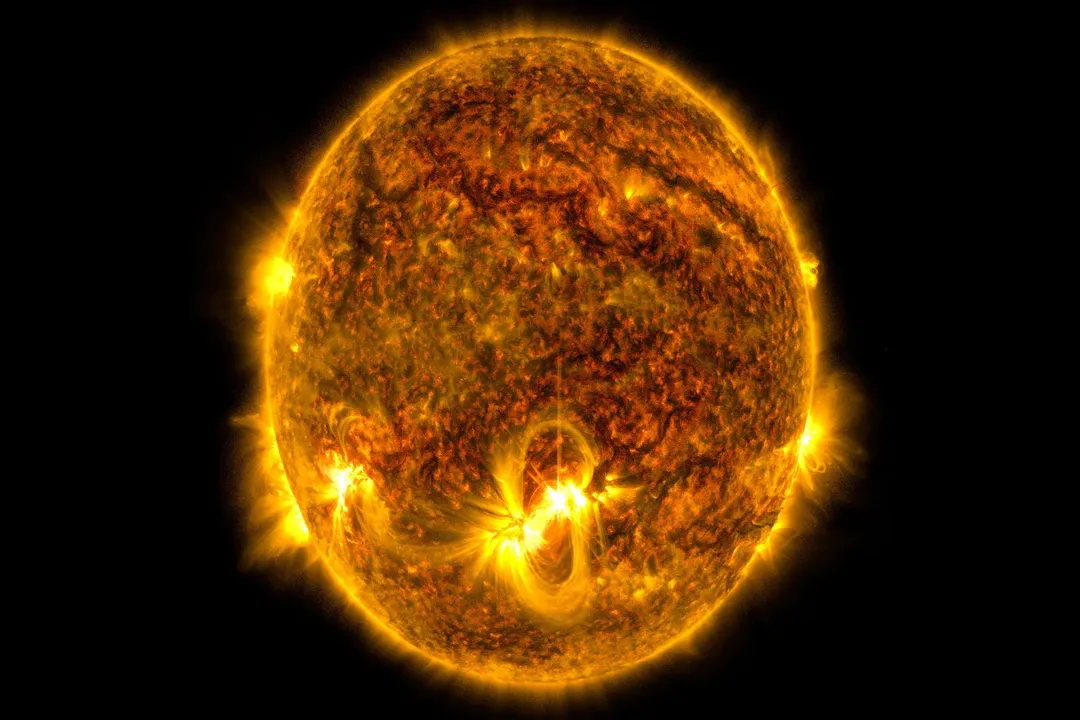
The rate at which a star consumes its hydrogen fuel is directly related to its mass and the resultant gravitational pressure in its core. While a star like our Sun spends billions of years on hydrogen burning to maintain stability, massive stars experience vastly greater gravitational forces, leading to much higher core temperatures and reaction rates. Consequently, the hydrogen depletion phase in a massive star is extremely brief by stellar standards, often lasting only a few million years. This rapid fuel consumption drives the star through its subsequent evolutionary stages much faster, with later fusion stages measured in years, months, or even days.
Related Questions
What is the approximate primordial percentage of Hydrogen in interstellar clouds?What process fuels the majority of a stable star's life by counteracting gravity?Which specific fusion process creates Carbon from Helium nuclei in massive stars?In massive stars, what elements primarily result from the fusion of Carbon nuclei?Why does fusion halt when the core becomes dominated by Iron ($ ext{Fe}$)?What extreme event is necessary to create elements heavier than Iron, such as gold and uranium?What is the mechanism known as rapid neutron capture occurring during stellar death?When core hydrogen is depleted, what ignites in a shell surrounding the inert helium core?How does Hydrogen burning duration in a massive star compare to the Sun's?Which elements are specifically mentioned as being contributed by the s-process in AGB stars?What is the fate of elements synthesized in giant stars after the star dies?