What determines if a star becomes a giant or super giant?
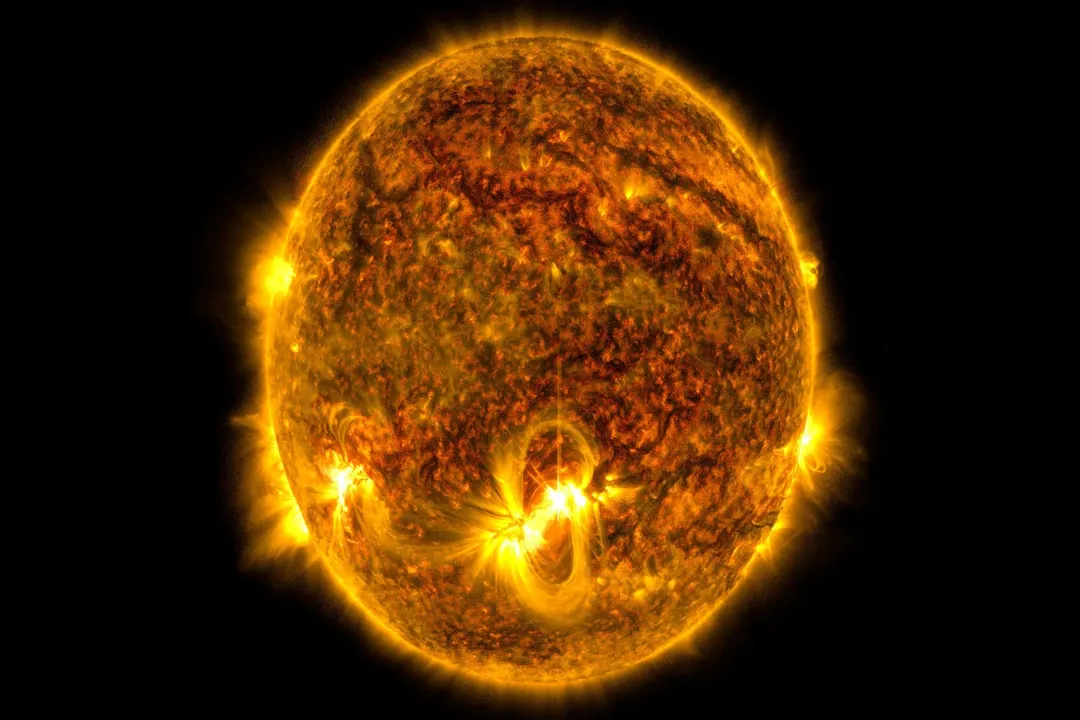
The future size of any star, whether it swells into a respectable giant or explodes into a true cosmic behemoth known as a supergiant, is almost entirely predetermined by one factor: its initial mass. Stars spend the vast majority of their active lives on the main sequence, quietly fusing hydrogen into helium in their cores, much like our own Sun is doing right now. This long period of stability, however, is finite. Once the core hydrogen supply runs low, the internal equilibrium that balances gravity against outward thermal pressure breaks down, forcing the star onto a new, dramatically different evolutionary path.
# Stellar Death Trigger
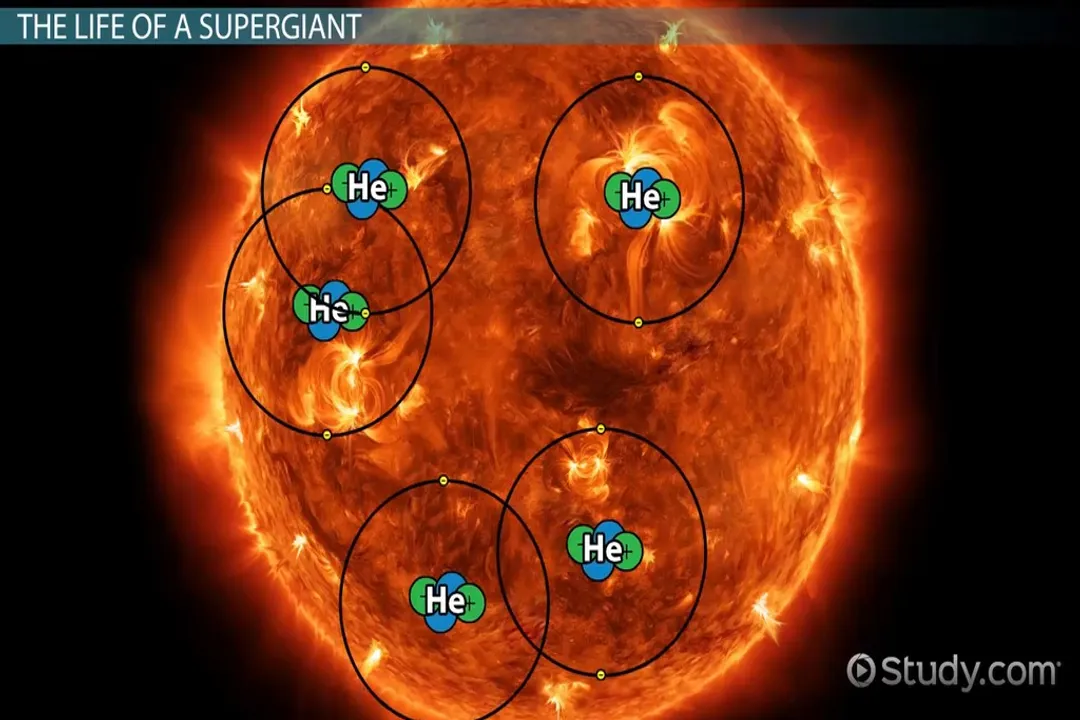
The transition from a stable main-sequence star to an expanded giant phase begins when the hydrogen fuel in the stellar core is exhausted. When fusion stops in the center, gravity takes over, causing the inert helium core to contract and heat up significantly. This compression raises the temperature enough to ignite hydrogen fusion in a shell surrounding the now-contracting core. This shell burning is actually more energetic than the core burning it replaced. The massive surge in outward energy generation pushes the star's outer layers far away from the core, causing them to inflate to immense proportions. This dramatic expansion causes the star's surface temperature to drop, shifting its color towards the red end of the spectrum, thus creating a red giant.
# Mass Difference Key
The fundamental division between becoming a standard giant and a supergiant hinges on the star's initial mass relative to the Sun’s mass, denoted as . Low-to-intermediate mass stars—those up to about eight times the mass of the Sun—will proceed to become red giants. These stars will undergo further evolutionary steps, such as core helium fusion, before eventually shedding their outer layers to become a white dwarf.
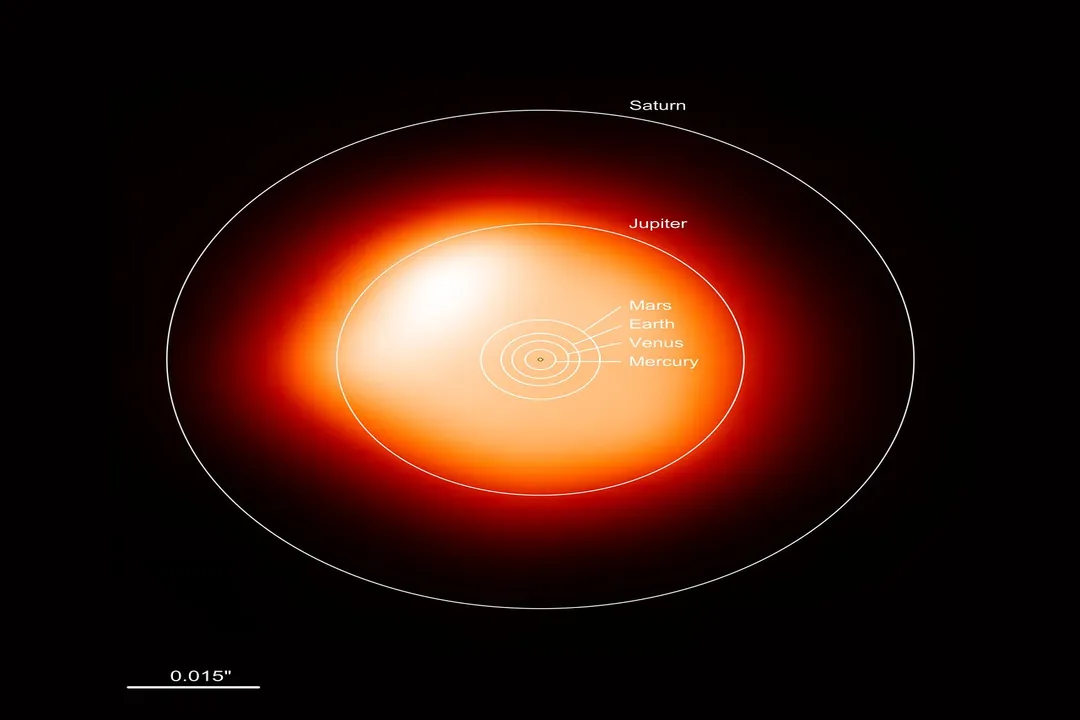
Conversely, stars born with significantly higher masses—typically greater than —are destined for the supergiant phase. These stellar giants are truly enormous, representing the largest stars in terms of volume. While a typical red giant might swell to hundreds of times the Sun’s diameter, a red supergiant can expand to diameters that would engulf orbits further than Mars or even Jupiter. The sheer amount of fuel available to these high-mass stars allows them to sustain core fusion of heavier and heavier elements long after the lower-mass stars have exhausted their options.
For example, when we observe stars like Antares, which is a red supergiant, we are looking at a star that was born with perhaps twenty times the Sun's mass. Its current massive size is a direct result of its initial, much greater fuel reservoir that allowed it to proceed through more complex fusion stages than a Sun-like star.
# Supergiant Physics
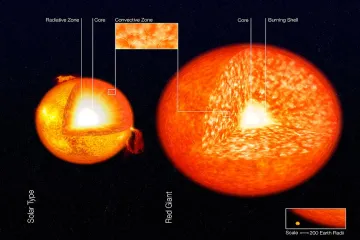
The physics driving a supergiant is a scaled-up, more violent version of the giant phase, but it continues further up the periodic table. After exhausting core hydrogen, a high-mass star also develops a hydrogen-burning shell, causing expansion. However, because its core is so much more massive, it can achieve the temperatures and pressures necessary to ignite helium fusion into carbon and oxygen. This process continues in successive shells, building up an "onion-skin" structure where the star fuses progressively heavier elements (like carbon, neon, oxygen, and silicon) in concentric layers around an inert core. This sustained, layered fusion generates far more power than a standard giant star, leading to far greater luminosity and expansion.
The term supergiant itself describes a star that is both extremely massive and extremely luminous. A key differentiator in their life cycle, which we can infer from general stellar models, is that the entire supergiant phase is dramatically shorter than the giant phase of a lower-mass star. Because they burn their fuel at an exponentially higher rate due to the intense gravitational pressure, their existence as a supergiant can last only a few million years, contrasting sharply with the hundreds of millions of years a Sun-like star might spend as a giant.
# Color Variations Observed
While we often associate the expanded phase with red giants and red supergiants due to their cool surface temperatures, not all are red. The color of a giant or supergiant depends primarily on its current surface temperature, which is itself strongly linked to its original mass and its current evolutionary stage.
Red giants and red supergiants are cool, with surface temperatures typically below $5,000$ Kelvin. The massive expansion cools the outer envelope even though the star is intrinsically far more luminous than it was on the main sequence.
However, the most massive stars can also appear as blue supergiants. These stars are often still relatively young, having recently left the main sequence, or they are in a brief phase where they are extremely hot and luminous despite their expansion. Rigel in the constellation Orion is a famous example of a blue supergiant, signifying intense heat generated by an immense mass fusing fuel rapidly. The surface temperature of a blue supergiant can exceed $10,000$ Kelvin, resulting in their distinctly blue-white appearance.
Consider this simple way to contextualize the scale difference: If the Sun were to become a red giant, its edge might reach near the orbit of Venus. If it were to become a supergiant, it would swallow Mercury and Venus easily. However, if a star like Betelgeuse (a red supergiant) took the Sun's place, its outer edge could extend past the orbit of Jupiter. This massive difference in atmospheric volume—the difference between a giant and a supergiant—is all about the star's ability to continue fusing heavier elements in its core and shells.
# Evolutionary Divergence Paths
The paths diverge sharply after the initial expansion. For a star like the Sun, after the red giant phase, it contracts again and initiates helium fusion in its core. This leads to a temporary return to a hotter, smaller state before it eventually sheds its outer layers.
For the high-mass stars destined to be supergiants, the process is far more dramatic and repetitive. They will cycle through core fusion of heavier elements repeatedly—carbon burning, neon burning, oxygen burning, and finally silicon burning—until an iron core forms. Iron cannot release energy through fusion, marking the end of the line for sustained energy generation.
If we were to map these outcomes, the result is a clear bifurcation point determined early in the star's life:
| Initial Mass Range () | Expected Post-Main Sequence Type | Key Fusion Limit | Final Visible State (Before Collapse) |
|---|---|---|---|
| $< 0.5$ | Subgiant/Red Giant | Helium Fusion | White Dwarf/Planetary Nebula |
| $0.5 - 8$ | Red Giant | Helium/Carbon Fusion | Planetary Nebula/White Dwarf |
| $> 8$ | Supergiant (Blue/Red) | Silicon Burning | Red Supergiant / Core Collapse |
This table underscores that the supergiant status is reserved for stars massive enough to skip or accelerate through the intermediate steps that a lower-mass giant undertakes.
# Observational Confirmation
Astronomers don't just theorize about these stages; they confirm them by observing stars across the galaxy in various stages of life. The classifications of giant and supergiant are based on real measurements of their luminosity and temperature, which place them clearly above the main sequence on the Hertzsprung-Russell (H-R) diagram. For instance, recognizing that a star like Antares is a red supergiant involves measuring its immense apparent brightness and using its known distance to calculate its true, enormous luminosity—often tens of thousands of times that of the Sun. We identify them because their spectral signatures show the presence of these specific, expanded, cooler atmospheres, or in the case of blue supergiants, their extreme hotness and luminosity. We study these objects to build models of stellar evolution, essentially looking at a snapshot of stars that are living (or dying) much faster than our Sun ever will.
The ability to classify a star as a giant versus a supergiant relies heavily on the precise measurement of its absolute magnitude—how bright it actually is. A star that is simply larger than the Sun but not vastly more powerful will sit on the giant branch. A star that is both vast in volume and thousands of times more luminous belongs in the supergiant class. This difference in intrinsic energy output, tied directly back to the initial mass and its capacity for heavy element fusion, is the operational definition separating the two classes in observational astronomy.
# Life Expectancy Contrast
One fascinating aspect that stems from this mass difference is the corresponding change in the star’s lifespan across these stages. For a star like the Sun, its main sequence life is billions of years long, and its subsequent giant phase might last for hundreds of millions of years as it works through the relatively slower process of helium fusion. The star has time to cool down significantly and inflate dramatically.
For the high-mass star destined to become a supergiant, the entire lifespan—from birth to core collapse—can be incredibly short, perhaps only tens of millions of years. The supergiant phase itself is a fleeting spectacle. Because the core burning of heavy elements releases energy so rapidly, the star may transition from a hot, relatively compact blue supergiant to a huge, cooler red supergiant and then proceed toward core collapse in a relatively short cosmic blink of an eye. This rapid consumption of fuel, necessitated by the powerful gravity of their initial mass, is why we don't see as many stable, long-lived blue supergiants as we do red giants, which are the remnants of far more common, lower-mass stars. Essentially, the more massive the star, the faster it burns through all its evolutionary possibilities, turning a multi-billion-year process into one that might be over in a fraction of that time.
#Videos
How Do Stars Become Red Giants Or Supergiants? - Physics Frontier
Related Questions
#Citations
Giant star - Wikipedia
Star Basics - NASA Science
What determines the size of a star? Why do some stars become red ...
How Do Stars Become Red Giants Or Supergiants? - Physics Frontier
How do we know red supergiants like Antares and Betelgeuse aren't ...
Why do stars become red giants? - Astronomy Stack Exchange
Supergiant Stars | Definition, Characteristics & Names - Lesson
Undergrad Expansion of a star to become a red giant - Physics Forums
Stage 5: Subgiant, Red Giant, Supergiant - Lives and Deaths of Stars