What determines the final stage of a stars lifetime?
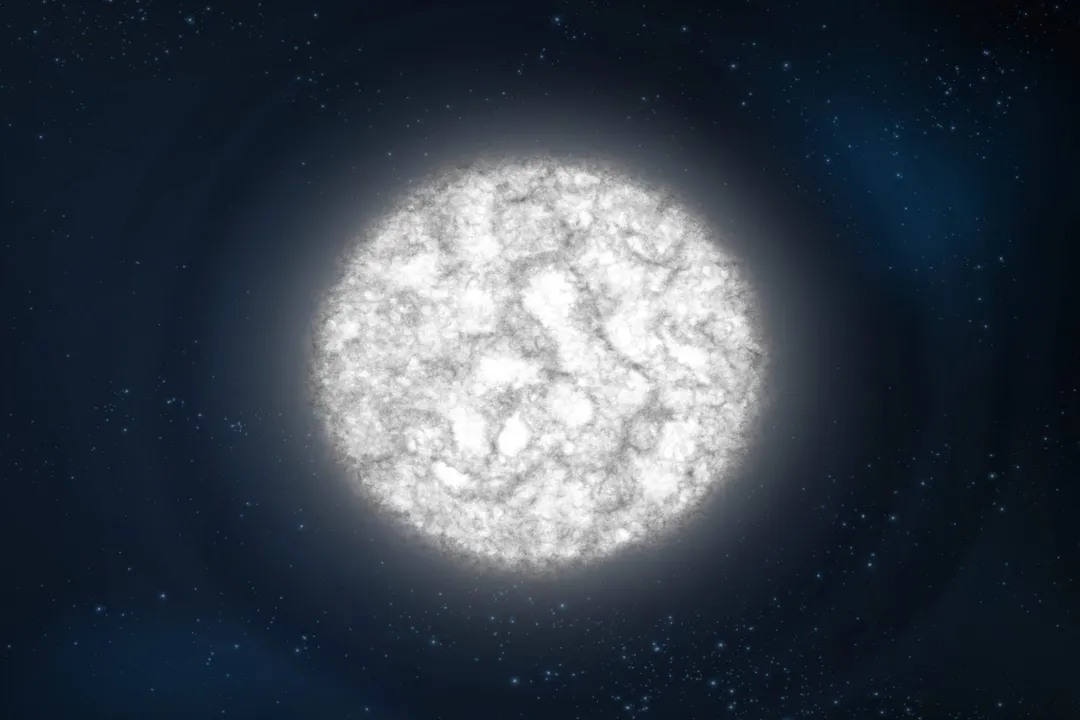
The final curtain call for a star, whether a gentle fade or a spectacular explosion, is predetermined long before its central fuel supply runs dry. While gravity and nuclear physics dictate the choreography, the one crucial script element that sets the entire stage for a star’s demise is its initial mass. [1][2][6] This single property, set at the moment of its birth, dictates how quickly it burns its fuel, what elements it can create, and what cosmic artifact it will leave behind, ranging from a faint ember to the most powerful explosions in the universe. [1][8]
# Stellar Genesis
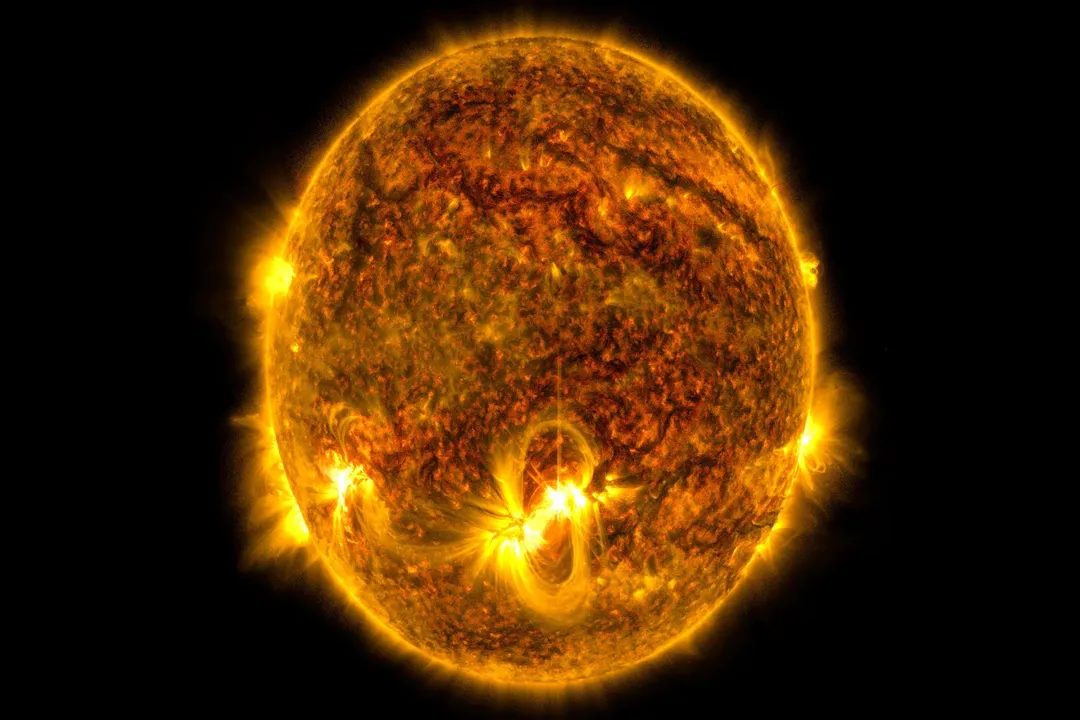
Every star begins its life within a vast, cold cloud of gas and dust known as a nebula. [1][3] Gravity acts as the sculptor, causing denser regions within this cloud to contract. [1] As the material collapses inward, the pressure and temperature at the core rise dramatically. [3] When the core becomes hot and dense enough—reaching millions of degrees Celsius—nuclear fusion ignites. [1] This ignition marks the star’s entry onto the Main Sequence. [2] During this lengthy phase, the star achieves hydrostatic equilibrium; the immense inward force of gravity is perfectly balanced by the outward thermal pressure generated by fusing hydrogen into helium in the core. [1][6]
The duration of this main sequence life is inversely proportional to the star’s mass. A star like our Sun, which is considered a relatively low-mass star, will spend about 10 billion years on the main sequence, calmly converting hydrogen. [8] Contrast this with a massive star, perhaps 20 times the mass of the Sun. Because it has vastly more gravitational pressure, its core temperature and density are much higher, forcing it to burn its fuel at a furious rate. [6] Such a heavy star might only last a few million years before exhausting its core hydrogen supply. [8] It's a profound difference in energy management: the low-mass star is a slow, steady candle, while the high-mass star is a high-powered magnesium flare, brilliant but fleeting. [6]
# Mass Dictates Fate
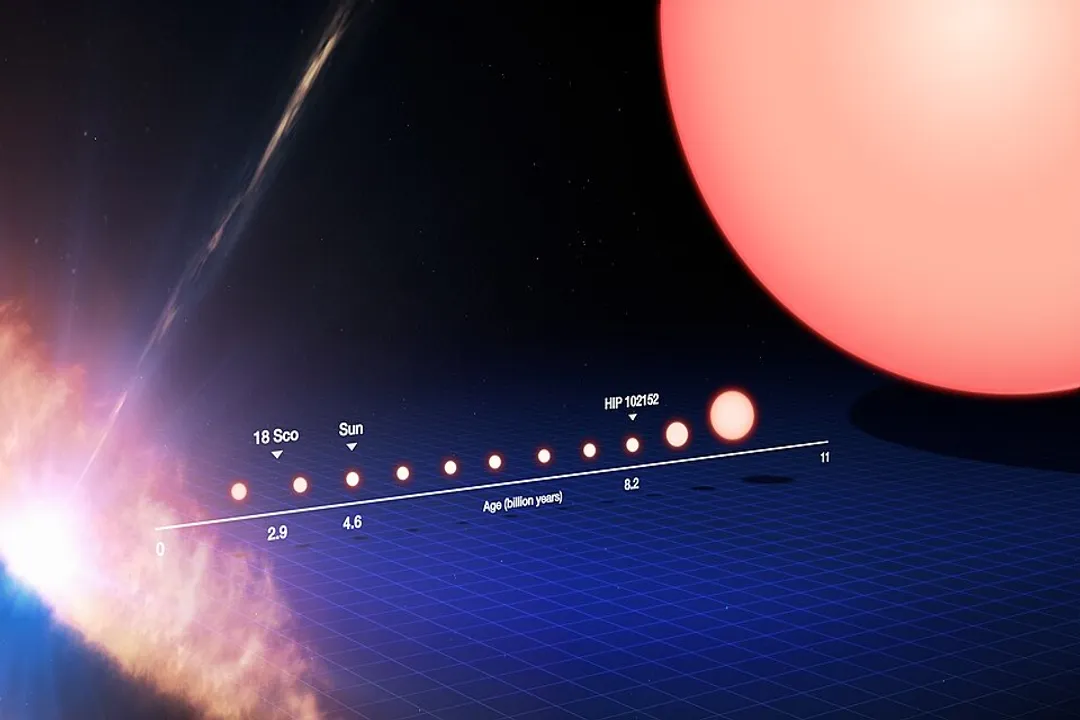
Once the hydrogen fuel in the core is depleted, the balance that defined the star’s existence is broken. Without the outward pressure from fusion, gravity begins to win, causing the core to contract and heat up again. [1] The star leaves the main sequence, and its subsequent path is entirely determined by how much mass remains, specifically the mass of the core that continues to contract. [2] Astronomers often use boundaries based on solar masses () to categorize these tracks. [1]
Stars are generally divided into three evolutionary tracks based on this initial criterion:
- Low-Mass Stars (less than about 8 ). [1]
- High-Mass Stars (greater than 8 ). [1]
- Very High-Mass Stars (stars so massive their end result is almost certainly a black hole). [2]
The precise point at which a star transitions from burning hydrogen to burning heavier elements, and whether it can successfully burn those heavier elements, is a direct, relentless consequence of its initial mass. [4] This mass threshold is the ultimate selection criteria for stellar destiny.
# Low Mass End
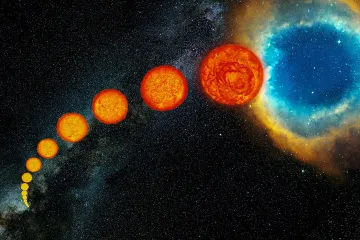
For stars like the Sun, the evolutionary path is relatively serene, culminating in the expulsion of outer layers. [1] Once the core hydrogen runs out, the core contracts, causing the outer layers of hydrogen surrounding it to heat up enough to begin fusion in a shell. [8] This shell fusion generates tremendous outward pressure, causing the star to swell dramatically and cool down, transforming it into a Red Giant. [1][8] For our Sun, this will happen in about five billion years, expanding perhaps past the orbit of Venus. [8]
As the core continues to shrink, it eventually gets hot enough to begin fusing helium into carbon and oxygen. [1] This phase stabilizes the star for a time, but eventually, the helium fuel is also exhausted. [8] For these lower-mass stars, the core never achieves the extreme temperatures and pressures needed to fuse carbon. [1] The star cannot support itself against its own gravity any longer. The outer layers drift away gently, illuminated by the hot, exposed core, creating a breathtaking spectacle known as a Planetary Nebula. [1] The remaining core shrinks down to the size of Earth, becoming incredibly dense—a White Dwarf. [2][8] This remnant is supported not by thermal pressure, but by something called electron degeneracy pressure, a quantum mechanical effect that resists further compression. [2] A white dwarf slowly cools over trillions of years, eventually becoming a cold, dark Black Dwarf. [1][8]
It is interesting to consider that the mass of the remnant white dwarf itself has an upper limit, known as the Chandrasekhar Limit, which is approximately $1.4$ times the mass of the Sun. [2] If the star that formed the white dwarf was initially slightly more massive, the resulting white dwarf remnant might exceed this limit, leading to a final, explosive demise rather than a quiet fade. [2] This shows how even the remnant mass—a direct consequence of the initial mass—imposes a secondary destiny constraint.
# Massive Star Death
When a star possesses an initial mass exceeding about eight times that of our Sun, its internal physics escalates into violent extremes. [1] These stars follow a far more dramatic script. After exhausting their core hydrogen, they swell into Red Supergiants. [1] Their immense gravitational weight allows their cores to achieve the necessary temperatures to fuse progressively heavier elements in nested shells: helium into carbon, carbon into neon, and so on, all the way up to iron (). [2][4]
Iron presents a cosmic dead end for stellar fusion. Fusing iron does not release energy; it consumes it. [4] Once the core is composed of iron, the star loses its energy source instantaneously, and the battle against gravity is lost catastrophically. [2] In less than a second, the iron core collapses under the weight of the overlying layers. [2] As it collapses, it heats up to billions of degrees, forcing protons and electrons to merge into neutrons. [2] The collapse halts only when the density reaches that of an atomic nucleus, triggering a powerful outward rebound shockwave. [2]
This rebound results in a Type II Supernova explosion, an event so luminous it can temporarily outshine an entire galaxy. [2][8] This explosion is the mechanism by which elements heavier than iron, such as gold and uranium, are forged and scattered throughout the cosmos. [2]
# Stellar Corpses
The final remnant left behind after a supernova depends entirely on the mass of the core after the explosion has blown away the outer layers. [2]
If the remnant core mass is between about and roughly , the intense pressure forces the core into a Neutron Star. [2] This object is mind-bogglingly dense; a teaspoon of neutron star material would weigh billions of tons. [2] It is composed almost entirely of closely packed neutrons, supported by neutron degeneracy pressure. [2]
Should the initial star be exceedingly massive, perhaps starting above , the post-supernova core remaining will have a mass greater than about . [2] In this case, not even neutron degeneracy pressure can withstand the gravitational crush. [2] The core collapses indefinitely, shrinking to an infinitesimal point of infinite density called a singularity, creating a Black Hole. [2] These objects possess gravity so strong that nothing, not even light, can escape their grasp once it crosses the boundary known as the event horizon. [2][9]
Thus, the life cycle of a star is a grand demonstration of physics scales. A star's mass is the master variable: it controls the lifespan on the main sequence, [6] the elements it cooks inside its core, [4] the mechanism of its death (gentle shedding or violent collapse), [1] and the nature of its final form (a white dwarf, a neutron star, or a black hole). [2][8] The entire cosmic narrative of stellar evolution hinges on that initial condition set at its birth in the dark interstellar medium. [3]
#Videos
What Factors Determine A Star's Final Lifecycle? - Physics Frontier
Related Questions
#Citations
Stellar Evolution - | The Schools' Observatory
Stellar evolution - Wikipedia
How Stars Form: A Star's Life Cycle in Six Stages - KiwiCo
Stellar Structure and Evolution | Center for Astrophysics | Harvard ...
What Factors Determine A Star's Final Lifecycle? - Physics Frontier
Stellar Lifetimes - HyperPhysics
Stellar Evolution - aavso
Life Cycle of Stars - BYJU'S
Star Basics - NASA Science