What is the final stage of a supermassive star?
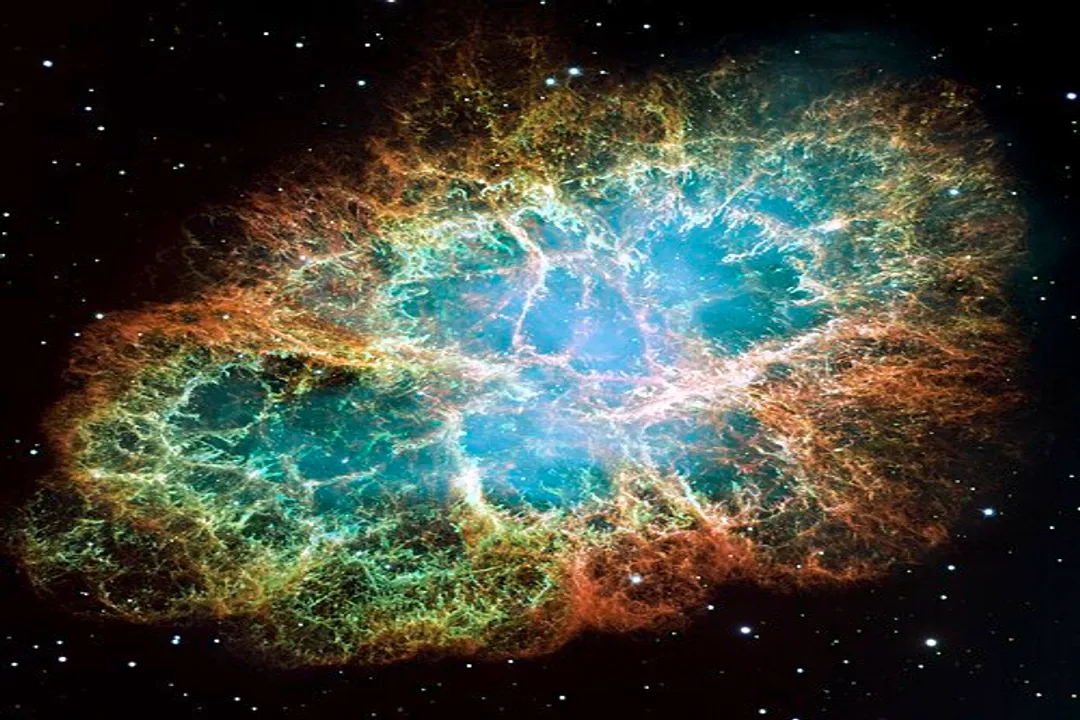
The culmination of a supermassive star’s life is one of the most dramatic and energetic events in the entire cosmos. These behemoths, often starting their lives weighing more than eight times the mass of our own Sun, lead dynamic, short lives defined by rapid nuclear burning and an abrupt, catastrophic end. [10][4] Unlike smaller stars that might quietly fade away, the final stage for these giants involves an explosive metamorphosis that reshapes the interstellar medium around them.
# Fuel Burn
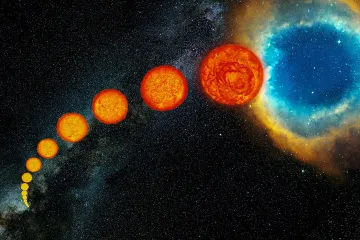
A star’s existence is a continuous balancing act between the inward crush of its own gravity and the outward pressure generated by nuclear fusion in its core. [1] For massive stars, this process is much more aggressive than for solar-mass stars. They fuse hydrogen into helium relatively quickly, but because of their sheer mass and internal temperatures, they are capable of fusing heavier and heavier elements once hydrogen is exhausted. [1]
The reaction chain escalates through successive layers, creating an onion-like structure internally. Helium fuses to carbon, carbon to neon, and so on, building up elements like oxygen and silicon. [2] This layered fusion continues until the core creates iron. [1] This is where the stellar engine grinds to a halt.
Iron, the element sitting at the center of this process, is fundamentally different. Fusing elements lighter than iron releases energy; fusing iron, however, consumes energy. [1] Once the massive star’s core is composed primarily of inert iron, it has lost its source of outward thermal pressure. [4] The star has reached its energetic limit, and the death process begins instantly.
# Collapse Starts
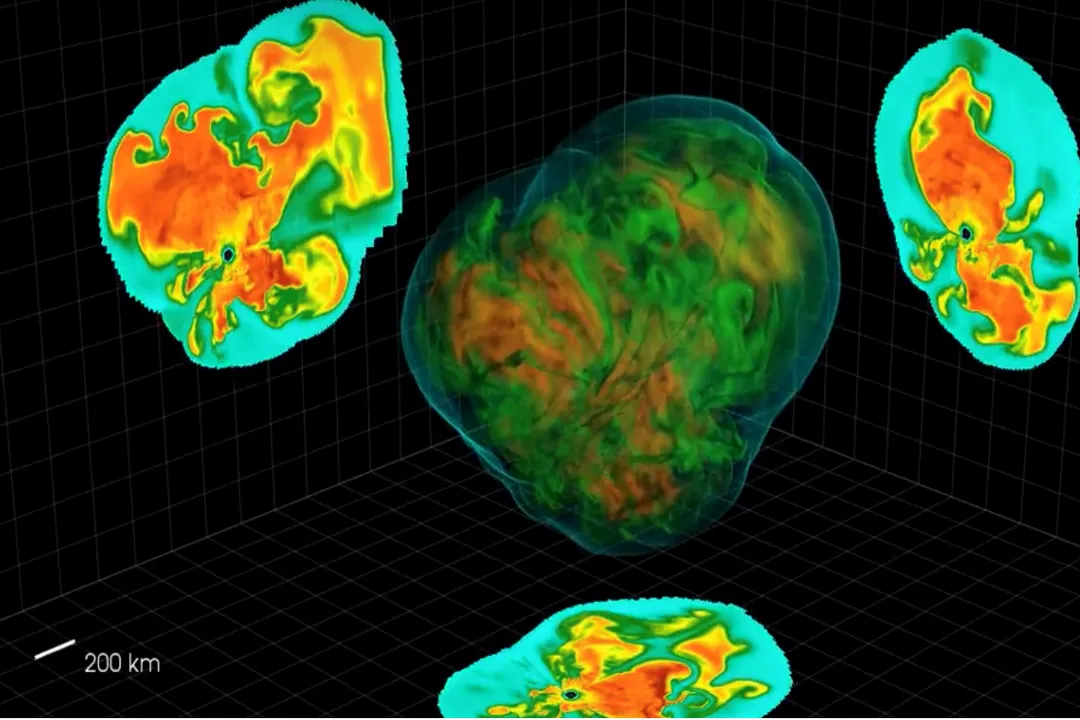
When the iron core can no longer support itself against the immense weight of the star's outer layers, gravity wins decisively. [4] In a matter of seconds, the core collapses inward at speeds reaching a quarter of the speed of light. [3] This implosion compresses matter to incredible densities.
The fate of the collapsing material is determined by the core’s mass. As the core shrinks past nuclear densities, it becomes stiff, resisting further compression momentarily. The infalling outer layers smash into this newly formed, incredibly rigid core. [3]
It is fascinating to consider the scale of this pressure differential. While our Sun will take about ten billion years to exhaust its hydrogen fuel, a star twenty times the mass of the Sun might complete its entire active life cycle in just ten million years. [10] That means the collapse phase, lasting mere moments, is the climax of a life that burned thousands of times faster than our local star.
# Supernova Event
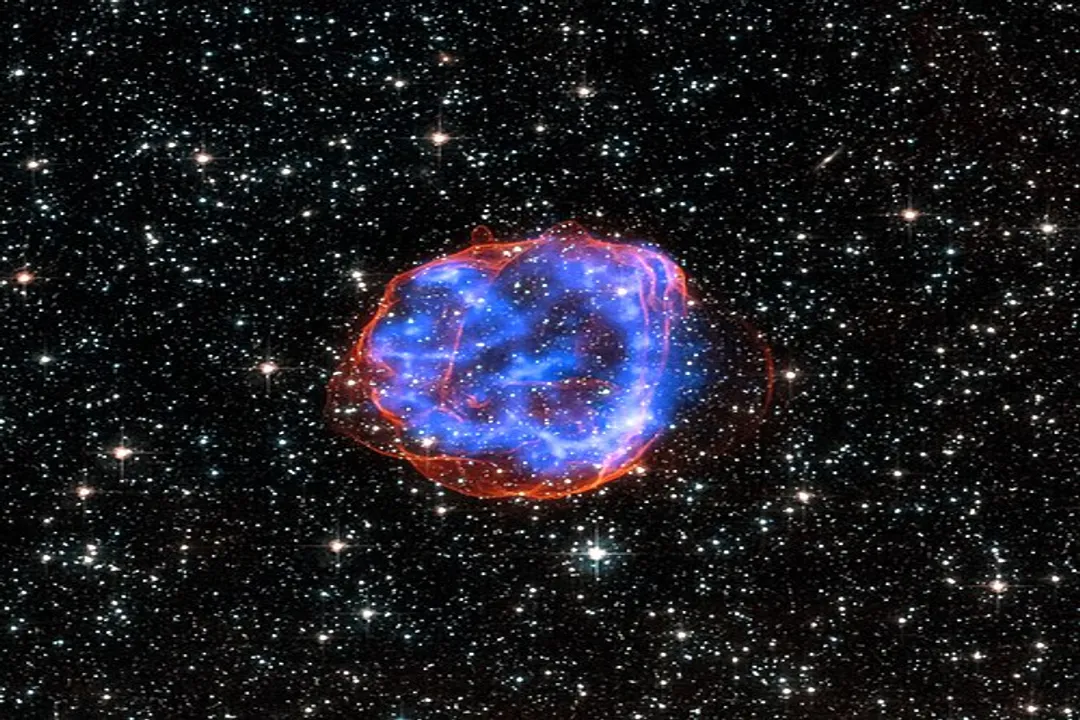
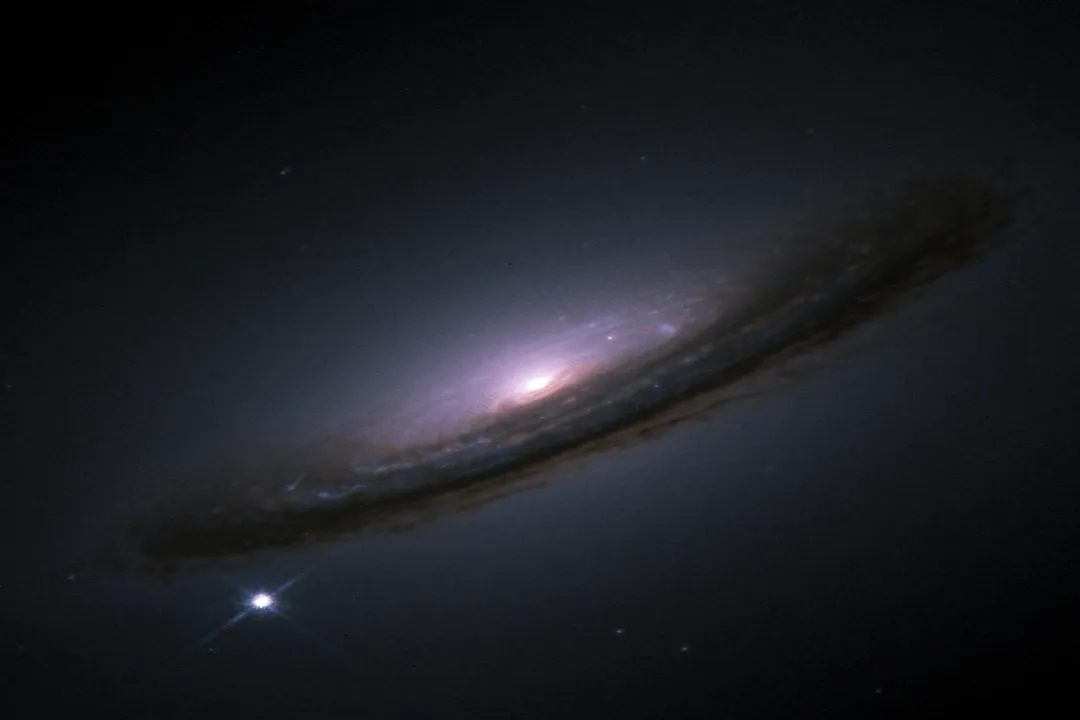
When the infalling stellar material violently impacts the hyper-dense core, a powerful pressure wave—the supernova shockwave—is generated and propagates outward. [3][7] This explosion is so immense that the brightness of the dying star can briefly outshine an entire galaxy. [7] It is during this explosion that elements heavier than iron are created in a process called rapid neutron capture, or the r-process, which are then blasted out into space. [5][6]
The energy released in a core-collapse supernova is staggering. In the few seconds of the explosion, the star releases as much energy as the Sun is expected to produce over its entire ten-billion-year main sequence lifetime. [7] This sudden dispersal of material enriches the galaxy with the heavy elements necessary for the formation of rocky planets and, eventually, life. [5]
# Core Remnants
What remains after the brilliant flash subsides depends entirely on how much mass is left in the collapsed core, often referred to as the remnant mass. [4]
# Neutron Stars
If the mass of the collapsed core is less than about three times the mass of our Sun (a threshold related to the Tolman-Oppenheimer-Volkoff limit), the inward collapse is halted by neutron degeneracy pressure. [6] This creates an object called a neutron star. [4][6] Neutron stars are incredibly small, perhaps only about 12 miles in diameter, yet they pack more mass than the Sun into that tiny volume. [6] Matter is packed so tightly that protons and electrons are forced together to form neutrons. [6]
# Black Holes
If the core remnant is more massive than this critical limit—roughly three solar masses—no known force, not even neutron degeneracy pressure, can resist gravity. [4][6] The collapse continues unimpeded, crushing the matter down to an infinitely dense point known as a singularity, forming a black hole. [4] A black hole is an object where the gravitational pull is so extreme that nothing, not even light, can escape its boundary, or event horizon. [4]
The transition between these two outcomes is exceptionally sharp. A difference in core mass of just a fraction of a solar mass dictates whether the remnant is a stable, albeit bizarre, star composed of neutrons, or a region of spacetime that has fundamentally broken away from observable reality.
# Mass Exceptions
While the supernova followed by a neutron star or black hole is the standard path for the most massive stars, there are variations depending on the initial mass of the star before it began collapsing, particularly for those stars exceeding about 25 times the Sun’s mass. [9]
# Hypernovae
In some cases, the explosion is far more energetic than a standard supernova; this is termed a hypernova. [9] Hypernovae are associated with the collapse of very massive stars and often generate intense beams of gamma rays, known as long-duration gamma-ray bursts (GRBs). [9] The resulting remnant from such an extreme event is almost certainly a black hole. [9]
# Direct Collapse
There is also a scenario where the star is so massive, or its progenitor system is configured in such a way, that it may skip the visible supernova phase entirely. [9] Instead of rebounding the shockwave spectacularly, the entire stellar envelope falls directly onto the core, collapsing it immediately into a black hole without a massive explosion. [9] This "direct collapse" leaves behind a different observational signature than a standard supernova, though both result in the formation of a black hole. The physics governing whether the core explodes or simply falls in is still an active area of study, influenced by rotation, composition, and magnetic fields. [9]
Understanding these final stages provides a direct window into the formation of the universe's most extreme objects and the creation of the elements that constitute everything we see around us. The remnants, whether a rapidly spinning neutron star or a silent, inescapable black hole, represent the dense, compressed ashes of stellar fusion, providing anchor points for gravitational dynamics in galaxies across the cosmos. [6]
Related Questions
#Citations
Stellar Evolution - | The Schools' Observatory
The Life Cycles of Stars - Imagine the Universe! - NASA
Supernova - Wikipedia
What is the end stage of a massive star? | CK-12 Foundation
DOE Explains...Supernovae - Department of Energy
The Final Stages of Massive Star Evolution and Their Supernovae
Supernova - ESA/Hubble
Life Cycle of a Giant Star - How a Supernova Works | HowStuffWorks
How Do The Most Massive Stars Die: Supernova, Hypernova, Or ...
Massive Star | Definition & Life Cycle - Lesson - Study.com