How do stars turn into dwarf stars?
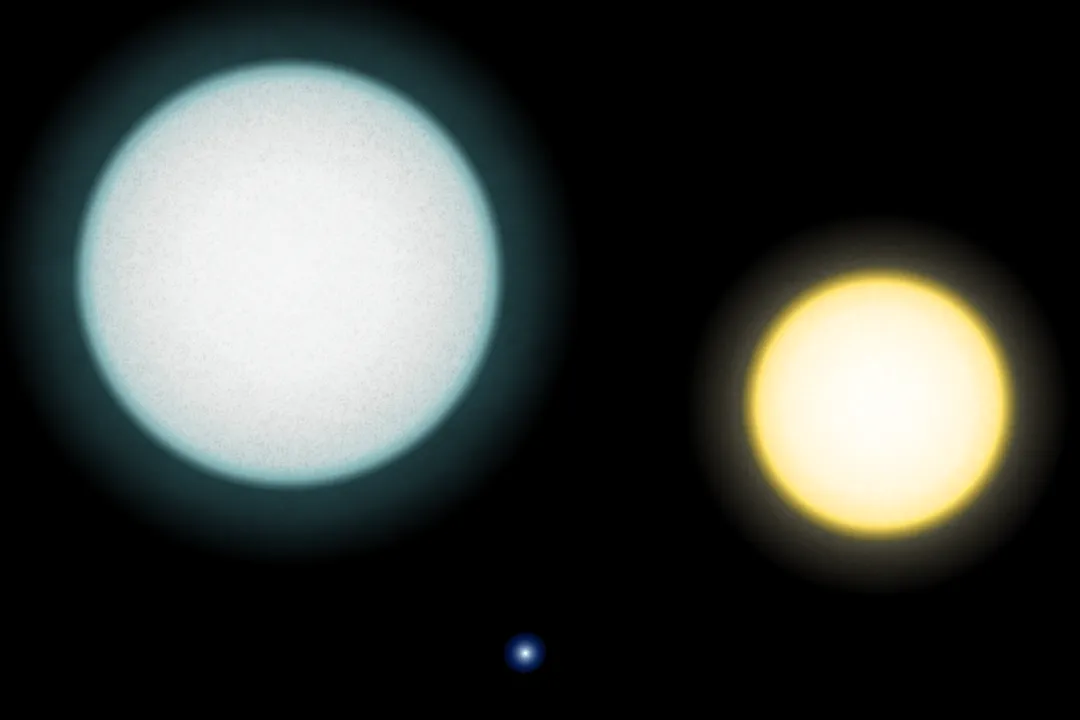
The stellar remnant known as a white dwarf represents the final evolutionary stage for stars like our Sun—a surprisingly common fate in the cosmos. [8][9] These stellar corpses are not truly stars in the conventional sense, as they no longer generate energy through sustained nuclear fusion. Instead, they are the incredibly dense, exposed cores left behind after a star has lived out its life and shed its outer envelopes into space. [1][3][8] Understanding how a luminous main-sequence star transforms into one of these compact stellar ashes requires tracing a multi-billion-year process dictated entirely by the star's initial mass.
# Fuel Depletion
Every star, from its birth, is engaged in a constant balancing act: the outward pressure generated by thermonuclear fusion in its core must counteract the relentless inward crush of its own gravity. [2] For the vast majority of a star's existence, this means fusing hydrogen atoms into helium atoms in its core, which defines its time on the main sequence. [1] Our own Sun is currently in this phase. [9]
This stable period ends abruptly when the hydrogen supply in the core is depleted. [1][7] Since fusion requires sufficient temperature and pressure, and the core is now mostly inert helium, the outward thermal pressure drops significantly. [2] Without this pressure to resist gravity, the core begins to contract and heat up dramatically. [1] This contraction increases the temperature in the shell of hydrogen surrounding the inert helium core, eventually igniting hydrogen fusion there—a process known as shell burning. [1][2]
# Giant Expansion
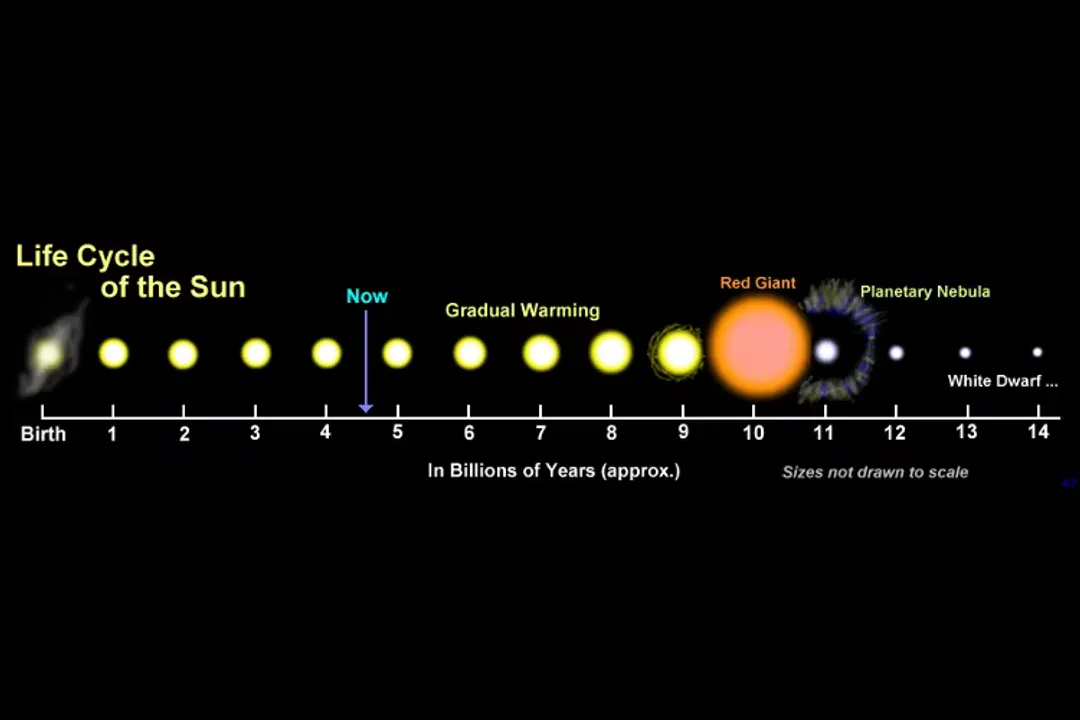
The onset of shell burning dramatically alters the star's structure. The energy released by this new, more intense fusion process pushes the star’s outer layers outward, causing them to expand to enormous proportions while cooling down significantly. [1] This expansion transforms the star into a Red Giant. [2] For a star like the Sun, this expansion will eventually swallow Mercury, Venus, and likely Earth. [9]
As the outer layers inflate, the inert helium core continues to contract under gravity, causing its temperature to climb ever higher. This relentless heating sets the stage for the next crucial step in the star's demise: the ignition of helium fusion. [1]
# Core Ignition
Once the helium core reaches a critical temperature—around $100$ million Kelvin—helium nuclei can begin fusing into heavier elements, primarily carbon and oxygen. [1][2] For lower-mass stars, such as those less than about $2.2$ times the mass of the Sun, this ignition happens suddenly and violently in what is termed the helium flash. [2] In more massive stars (up to about $8$ or $10$ solar masses), the ignition might be smoother, but the result is the same: the star begins fusing carbon and oxygen in its core, temporarily stabilizing its structure again. [1]
This phase is relatively short-lived compared to the hydrogen-burning era. The star has essentially traded its primary fuel source for a heavier one, but the new fuel burns much faster. [7]
# Outer Layer Ejection
When the core eventually exhausts its helium fuel, it becomes primarily a dense ball of carbon and oxygen. [1] For stars in the low-to-intermediate mass range (up to about $8$ solar masses), the core never achieves the immense temperatures and pressures needed to fuse carbon into anything heavier. [1][2] Without the ability to initiate a new fusion cycle, the core contracts again. The star’s outer layers, which are now only loosely bound, are gently expelled into space by strong stellar winds. [3]
This expelled material, rich in elements synthesized during the star's life, forms a beautiful, glowing shell around the exposed core, known as a planetary nebula. [1][3] Ironically, these nebulae have nothing to do with planets; the name arises from their often-round, planet-like appearance through early telescopes. [6] The Sun, for example, is expected to form a planetary nebula that will be visible to us. [9]
# Degenerate Remnant
What remains at the center of this expanding shell is the stellar core—the nascent white dwarf. [8] This object is defined by its extreme properties. A white dwarf typically packs a mass comparable to the Sun into a volume roughly the size of the Earth. [1][4][9] This compression results in staggering density; a teaspoon of white dwarf material would weigh several tons. [4]
The force holding this immense mass up against gravity is not the outward pressure from heat, which is fading, but a quantum mechanical phenomenon called electron degeneracy pressure. [1][4] In this state, electrons are packed so closely that the Pauli exclusion principle prevents them from occupying the same quantum state. This creates an outward pressure independent of temperature, effectively providing a structural support that allows the remnant to persist long after fusion has ceased. [1] The object is hot when first formed, glowing from residual thermal energy, but it has no internal furnace, meaning it will cool down inexorably over trillions of years, eventually becoming a cold, dark black dwarf. [1][3]
The physics governing these stellar cores is fascinating because the star's diameter is inversely related to its mass once it reaches the degenerate state. Consider this: a white dwarf with $1.2$ times the mass of the Sun might have a radius of (Earth's radius), whereas a lower-mass white dwarf, perhaps only , will be slightly larger, possessing a radius closer to . [1] This counterintuitive relationship—more mass means smaller size—is a direct consequence of how electron degeneracy pressure functions under extreme gravitational stress.
# Mass Limit Danger
The stability of a white dwarf rests precariously on its mass remaining below a critical threshold known as the Chandrasekhar limit. [1] This limit is calculated to be approximately $1.4$ times the mass of the Sun (). [1][4] As long as the remnant stays under this boundary, electron degeneracy pressure is sufficient to maintain hydrostatic equilibrium indefinitely. [4]
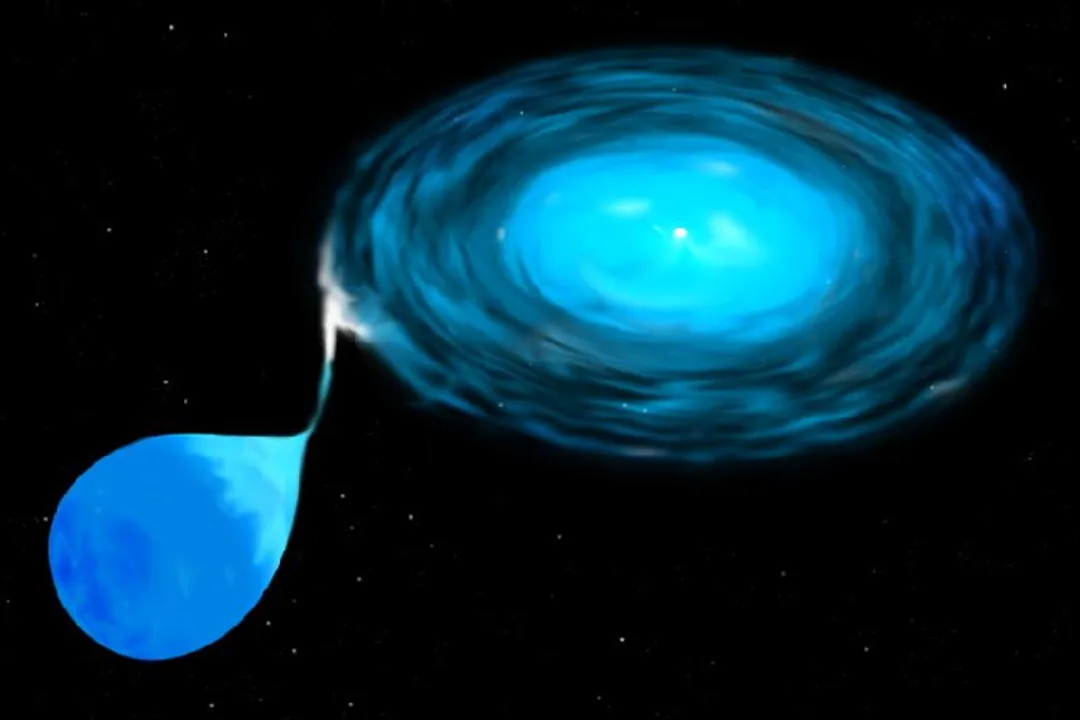
However, if a white dwarf resides in a binary star system and begins siphoning material from its companion star, it can accumulate mass over eons. [4] If the accretion pushes the white dwarf over that boundary, the electron degeneracy pressure fails to counteract gravity, and the core rapidly collapses. [1][4] This catastrophic failure results in a thermonuclear runaway reaction involving the accumulated carbon and oxygen, causing a tremendous explosion known as a Type Ia supernova. [1][4] This event completely obliterates the white dwarf, enriching the interstellar medium with heavy elements forged during the star's life and the explosion itself.
It is important to note that stars born significantly more massive than about $8$ to $10$ solar masses bypass this entire sequence. They become hot enough in their later stages to fuse carbon, then neon, oxygen, and silicon, leading to a core collapse supernova that often leaves behind a neutron star or a black hole, rather than a white dwarf. [1] Thus, the white dwarf pathway is reserved for the stellar majority, the low- and intermediate-mass stars whose internal chemistry simply cannot generate the energy required to fuse elements beyond carbon and oxygen. The entire life cycle, from gas cloud to planetary nebula, is a demonstration of gravity setting the terms for nuclear possibility. [2]
#Videos
How Do White Dwarfs Form From Stars? - Physics Frontier - YouTube
Related Questions
#Citations
White dwarf - Wikipedia
How do stars become white dwarfs? : r/askastronomy - Reddit
White Dwarf - ESA/Hubble
White Dwarfs - Imagine the Universe! - NASA
How Do White Dwarfs Form From Stars? - Physics Frontier - YouTube
What is a white dwarf star and how does it form? - Facebook
How to become a white dwarf star - Quora
What are white dwarf stars? How do they form? - EarthSky
The Sun and white dwarfs - Science Learning Hub