How does a star become a dwarf star?
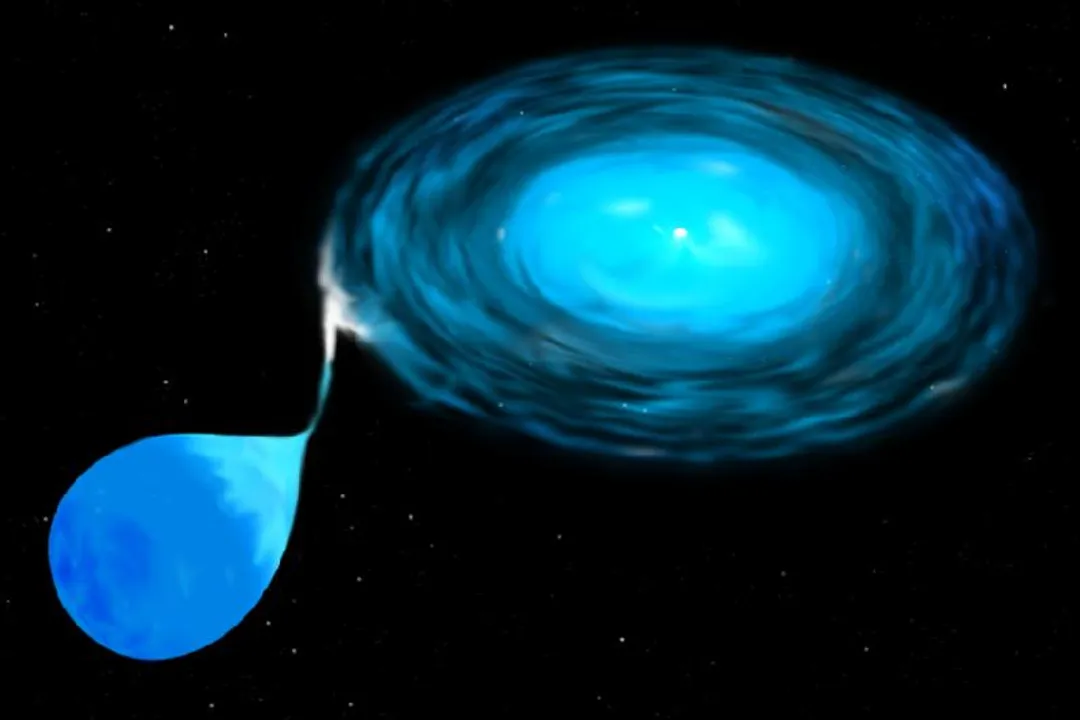
Stars have a diverse range of endpoints dictated almost entirely by their initial mass, but the transformation into a specific kind of stellar remnant—the dwarf star—marks the final, inevitable chapter for a vast number of them, particularly those similar to our own Sun. [1][5] This conversion is not instantaneous; it is a dramatic, multi-stage shedding of identity that unfolds over cosmic time scales. [8] When astronomers discuss a star "becoming a dwarf star," they are usually referring to the creation of a white dwarf, which is the extremely dense core left behind after a Sun-like star dies. [2][5]
# Stellar Fuel
A star spends the vast majority of its existence in a stable state known as the main sequence. [8] During this long period, the star maintains hydrostatic equilibrium, meaning the outward pressure generated by nuclear fusion in its core—converting hydrogen into helium—perfectly balances the inward crush of its own gravity. [1][8] The star's initial mass is the single most important factor determining how long it lives and what its final fate will be. [1] A star only begins its transition toward becoming a dwarf when this primary hydrogen fuel source in the core is exhausted. [8]
# Stellar Swell
Once the core runs out of hydrogen, fusion ceases in the center, and gravity begins to win the long battle against outward pressure, causing the inert helium core to contract and heat up dramatically. [1][8] This increased core temperature ignites a shell of hydrogen surrounding the core, initiating fusion in this new region. [1] The resulting energy output pushes the star's outer layers outward in a massive expansion, transforming the star into a Red Giant. [1][8] This expansion is immense; for a star like the Sun, its diameter will swell so much that it is predicted to engulf the orbits of Mercury and Venus, and possibly even Earth. [8]
# Outer Shell Loss
As the star evolves into a bloated Red Giant, it becomes hydrodynamically unstable. [9] For stars with initial masses up to about eight times that of the Sun, the outer layers cannot be held onto by the weakened gravitational pull. [9][5] These outer layers are gently expelled into space over a relatively short astronomical period. [9] This expelled material forms a beautiful, expanding shell of glowing gas known as a Planetary Nebula. [2][5] Despite the name, this phenomenon has absolutely nothing to do with actual planets; the term is a relic from early telescopic observations where the smooth, round appearance resembled those celestial bodies. [8]
It's fascinating to consider the timescale here. A Sun-like star might spend about ten billion years on the main sequence, yet the entire transition—Red Giant phase, nebula expulsion, and settling into the white dwarf state—can happen relatively quickly, perhaps only a few hundred million years total for the dramatic changes. [8] This rapid final phase makes white dwarfs the most common stellar remnants we observe today in the Milky Way. [3]
# Degenerate Core
What remains after the planetary nebula has drifted away and dispersed is the star’s extremely hot, small, and dense remnant core. [2][5] This leftover object is the white dwarf. [2][5] To visualize this density, consider that the remnant core retains roughly the mass of the original star, yet it shrinks down to about the size of Earth. [2][9] This compression results in matter that is extraordinarily compact; if you could somehow scoop up a single teaspoon of white dwarf material, it would weigh several tons. [3]
A white dwarf no longer generates energy through fusion; it is essentially a stellar ember that shines solely from the residual heat it possesses from its previous life. [5][2]
# Pressure Support
The incredible force of gravity trying to crush the white dwarf further is counteracted not by thermal pressure from fusion, but by a quantum mechanical effect called electron degeneracy pressure. [2][3] Gravity compresses the material so intensely that the electrons are squeezed together to the maximum possible extent allowed by physics. [2] This resistance is governed by the Pauli exclusion principle, which dictates that no two electrons can occupy the same quantum state, creating a powerful outward pressure that halts gravitational collapse. [2][3] This pressure provides the entire structural integrity for the remnant star. [2]
# Mass Limits
This state of electron degeneracy pressure, while powerful, has a definitive ceiling on how much mass it can support. [3] If the remnant core's mass surpasses approximately $1.4$ times the mass of our Sun—a value known as the Chandrasekhar Limit—the electron degeneracy pressure becomes insufficient to resist gravity. [3][9] In such an event, the core collapses catastrophically, leading to a Type Ia supernova, which destroys the star and leaves behind either a neutron star or, if the initial mass was high enough, a black hole, bypassing the stable white dwarf endpoint entirely. [3][9] This critical mass boundary dictates the destiny of stellar cores. [3]
While the primary focus here is the white dwarf endpoint for Sun-like stars, it is worth drawing a sharp contrast with the other dwarfs. A Red Dwarf star, which is much less massive than the Sun (often less than half its mass), achieves stability through continuous, slow hydrogen fusion over truly immense timescales, sometimes predicted to be trillions of years. [1] Because they never become massive enough to exhaust their fuel rapidly and puff off outer layers, Red Dwarfs are not expected to transition into white dwarfs in the manner described; they are predicted to simply fade away over timescales longer than the current age of the universe. [1] This highlights that "dwarf star" is a broad category encompassing objects at vastly different stages and mass regimes. [1]

# Fading Future
Once established, the white dwarf begins its slow decline. With no internal furnace to keep it warm, it simply radiates its stored thermal energy into the cold vacuum of space. [2][5] It will gradually cool down, causing its surface temperature to drop, making it appear dimmer and redder over unimaginably long spans of time. [5] Eventually, after eons pass, the remnant will cool to the point where it no longer emits significant visible light, theoretically becoming a cold, dark chunk of matter known as a Black Dwarf. [5] Since the universe is not yet old enough for this cooling process to complete for even the oldest white dwarfs, no true black dwarfs are believed to exist yet. [5]
Related Questions
#Citations
Dwarf star - Wikipedia
White Dwarf - ESA/Hubble
White Dwarf Stars - Imagine the Universe! - NASA
How do stars become white dwarfs? : r/askastronomy - Reddit
What are white dwarf stars? How do they form? - EarthSky
What is a white dwarf star and how does it form? - Facebook
Frequently Asked Questions Regarding Galactic Halo Dark Matter
How to become a white dwarf star - Quora
A White Dwarf Living on the Edge - www.caltech.edu