What determines if a star becomes a giant or a supergiant?
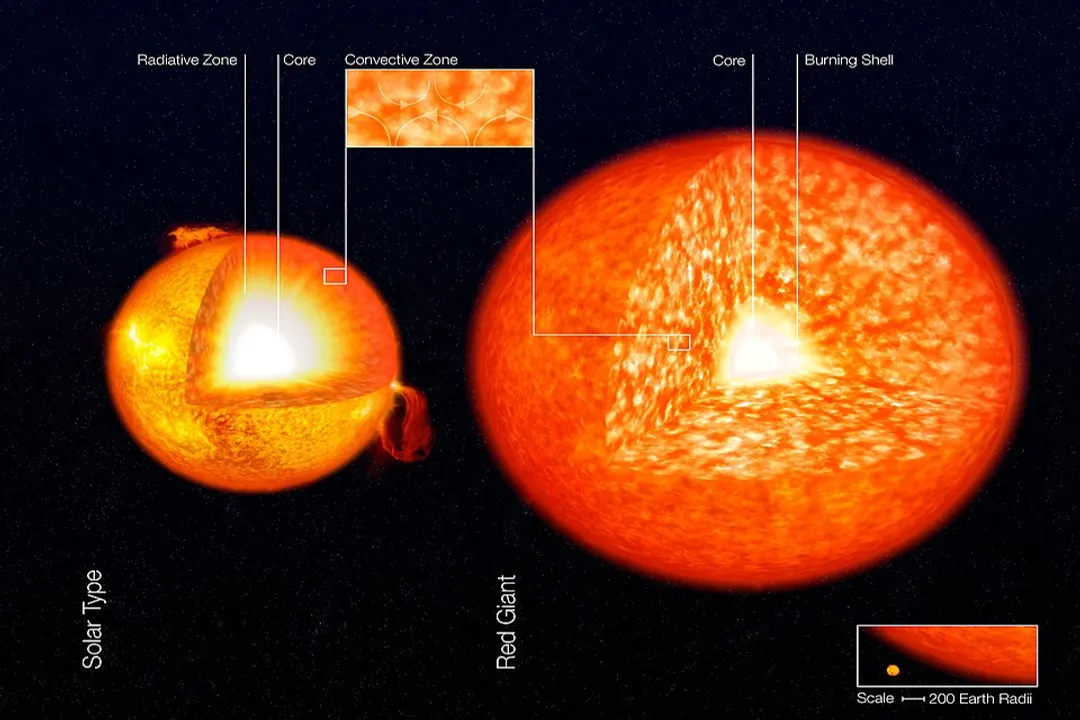
The fundamental fate of a star, whether it will swell into a mere giant or erupt into the cosmic behemoth known as a supergiant, is sealed almost the moment it ignites its core—and even before that, by the sheer amount of matter it manages to collect in its birth cloud. The determining factor, the ultimate cosmic lottery win or loss, is simply the star's initial mass. A star spends the vast majority of its existence, often billions of years, locked in a stable period called the main sequence, peacefully converting the hydrogen fuel in its core into helium through nuclear fusion. During this time, the star maintains a delicate balance, known as hydrostatic equilibrium, where the crushing inward force of its own gravity is perfectly offset by the outward thermal pressure generated by core fusion.
# Fuel Consumption Rate
While it might seem logical that a star with more fuel (greater mass) would live longer, the opposite is true because of how intensely massive stars consume that fuel. The mass of the overlying layers dictates the pressure and, consequently, the temperature required in the core to maintain equilibrium. For the most massive stars, the core temperature must climb much higher than in solar-mass stars. Because the rate of nuclear fusion is extremely sensitive to temperature—for the proton-proton cycle, the rate scales roughly with temperature to the fourth power—more massive stars burn their hydrogen stores prodigiously faster. Stars over $16$ times the Sun’s mass might only last a few million years on the main sequence, whereas a star around $0.4$ solar masses can maintain hydrogen fusion for hundreds of billions of years, far exceeding the current age of the universe. This incredible disparity in main-sequence lifespan sets the stage for vastly different post-adolescent phases.
# The Core Contraction
The transition away from stability occurs when the hydrogen supply in the star's core is exhausted, leaving behind an inert core primarily composed of helium "ash". Without the energy source of core fusion to counteract gravity, this helium core begins to contract and heat up dramatically. Crucially, this contraction heats the surrounding layers of the star—layers that still contain plenty of hydrogen—until they reach the ignition temperature for fusion. This initiates shell hydrogen fusion around the contracting core.
This new energy source, pouring out from a shell rather than the shrinking center, is often far more potent than the previous core fusion. For a Sun-like star, the resultant energy surge can cause the star’s luminosity to increase by a factor of a thousand to ten thousand. This overwhelming outward pressure forces the star's enormous outer layers to expand rapidly while the core continues to shrink and heat—a bizarre, dual personality of contraction within expansion. As the surface area balloons outward, the temperature at the surface drops, shifting the star's color toward the red end of the spectrum, thus creating a Red Giant.
# Defining the Threshold
The initial mass dictates which evolutionary track the star will follow after this initial giant expansion. Stars below a certain mass limit—around $8$ to $12$ solar masses ()—will evolve into Giants after their main-sequence tenure. Stars significantly more massive than this, generally those $10$ times the Sun's mass or greater, are destined for the Supergiant classification. It is worth noting that classification can be complex; sometimes, very high-mass, hot main-sequence stars are already so luminous and have such powerful stellar winds that their atmospheres expand, giving them giant-like spectral features even while still fusing core hydrogen. However, the term Giant or Supergiant usually refers to the post-main-sequence state.
For the Sun-sized star, the mass is sufficient to contract the core enough to initiate helium fusion via the triple-alpha process (fusing helium into carbon and oxygen) once it reaches about . However, this mass limits how far the fusion ladder can be climbed. Stars in the low-to-intermediate mass range () will eventually exhaust their core helium, contract again, and begin fusing helium in a shell around an inert carbon-oxygen core, pushing them onto the Asymptotic Giant Branch (AGB), a phase even more luminous than the initial red giant phase. Because they lack the gravitational pressure to raise the core temperature high enough to fuse carbon, their nuclear activity eventually ceases, leading to the ejection of outer layers as a planetary nebula and leaving behind a white dwarf.
If a star is born with a mass substantially higher than this, say greater than , its fate diverges entirely into the supergiant realm. The tremendous gravitational compression in these objects means that when core hydrogen runs out, core helium ignition is initiated more smoothly, without the degeneracy and sudden flash seen in less massive cores.
# The Supergiant Process
The path of a massive star leads to a succession of nuclear burning stages within the core, each fueling the next contraction and subsequent heating. After helium, the core temperature rises enough to fuse carbon into neon and oxygen, and then further stages produce elements like silicon, all occurring in distinct shells surrounding the inert core material. Each subsequent stage requires higher temperatures, burns more quickly, and releases less energy per reaction than the last.
This cascading process continues until the core is filled with iron. Iron represents the final stop on the energy-releasing fusion pathway; fusing iron requires an input of energy rather than releasing it. Once this iron core forms, the star loses its last source of outward thermal pressure in less than a second. Gravity wins the long battle decisively, crushing the core past the point where electron degeneracy pressure can stop it, leading to a catastrophic collapse and a subsequent supernova explosion.
This difference in post-main-sequence chemistry is the crucial physical distinction: a star becomes a giant if its mass limits its core burning to helium (producing a carbon-oxygen remnant), whereas it becomes a supergiant if its mass allows for the layered fusion cascade all the way up to iron, culminating in a supernova.
# Visualizing Size Differences
The difference in mass translates directly into astounding differences in physical size and luminosity. A typical Red Giant, like the future Sun, might expand to a radius that reaches or exceeds the orbit of Mars. However, a Red Supergiant, such as the famous Betelgeuse, swells far beyond this, with a radius large enough to engulf the orbit of Jupiter if placed in our solar system.
Consider this comparison, derived from stellar modeling data:
| Property | Sun () | Red Giant (e.g., evolution) | Red Supergiant (e.g., Betelgeuse, ) |
|---|---|---|---|
| Lifetime (Main Sequence) | billion years | N/A (Post-MS phase) | million years |
| Radius (Solar Radii) | $1$ | km (est. ) | |
| Core Temperature (K) | $15,000,000$ | Varies, hotter than MS | $160,000,000$ |
| Surface Temperature (K) | $5,800$ | Cooler (Red) | $3,600$ (Very Red) |
| Luminosity (Solar Units) | $1$ | to |
It is fascinating to reflect on the energy scaling involved in the Giant phase for Sun-like stars. The star's entire main-sequence existence is an extended adolescence, taking billions of years. Yet, the transition to the Red Giant phase, driven by hydrogen shell burning around the helium core, releases such a torrent of energy that the star's output explodes by factors of thousands in a relatively short cosmic blink, radically altering its geometry. This immense, sudden increase in energy dispersal relative to the initial fuel source is what makes the expansion so dramatic, even for stars that will never become supernovae.
# Color and Structure Classes
The classification of these expanded stars depends on both their size (luminosity class) and their surface temperature (spectral class).
# Temperature Influences
While the term "Red Giant" is most common, not all giants are red. The hottest giants, classified as spectral types , are known as Blue Giants. Stars that start very massive leave the main sequence and pass through a brief phase as a blue giant or blue supergiant before expanding and cooling into the red supergiant phase, though for the most massive stars, this blue giant stage is extremely short. Stars of intermediate temperature, spectral class or , are termed Yellow Giants. These yellow giants are less common because the higher-mass stars that form them spend less time in that specific state before turning red.
# Luminosity Classes
The Yerkes spectral classification differentiates between the two size outcomes:
- Giants (Luminosity Class III) are stars substantially larger and more luminous than main-sequence stars (Class V).
- Supergiants (and Hypergiants) are reserved for stars still more luminous than ordinary giants. Bright giants (Class II) exist as an intermediate bridge between the two groups.
The critical differentiator for the type of death—giant resulting in a white dwarf versus supergiant resulting in a supernova—is precisely related to the star's ability to overcome degeneracy pressure after helium depletion to reignite fusion of the next heaviest element. For Sun-like stars, the core mass after helium burning falls below the Chandrasekhar limit (), meaning electron degeneracy pressure can support the core against further collapse, precluding a supernova. A star must possess a core massive enough to force neutrons and protons to combine (via electron capture) or fuse elements all the way to iron to avoid this fate. If the residual core mass after the explosion is between $1.4$ and about , it will form a neutron star; if greater than about , it collapses into a black hole.
Thus, the star's initial mass functions as a master switch, controlling the core temperatures achievable, which in turn determines the final stages of fusion chemistry—a low-mass core stops at carbon/oxygen, becoming a giant, while a high-mass core proceeds to iron, becoming a supergiant that dies spectacularly.
#Videos
How Do Stars Become Red Giants Or Supergiants? - Physics Frontier
Related Questions
#Citations
Giant star - Wikipedia
How Do Stars Become Red Giants Or Supergiants? - Physics Frontier
The Life Cycles of Stars: How Supernovae Are Formed
Why do stars become red giants? - Astronomy Stack Exchange
Evolution from the Main Sequence to Red Giants | Astronomy
Stars
G. C. Sloan: Main Sequence Stars, Giants, and Supergiants