What causes a star to become a red supergiant?
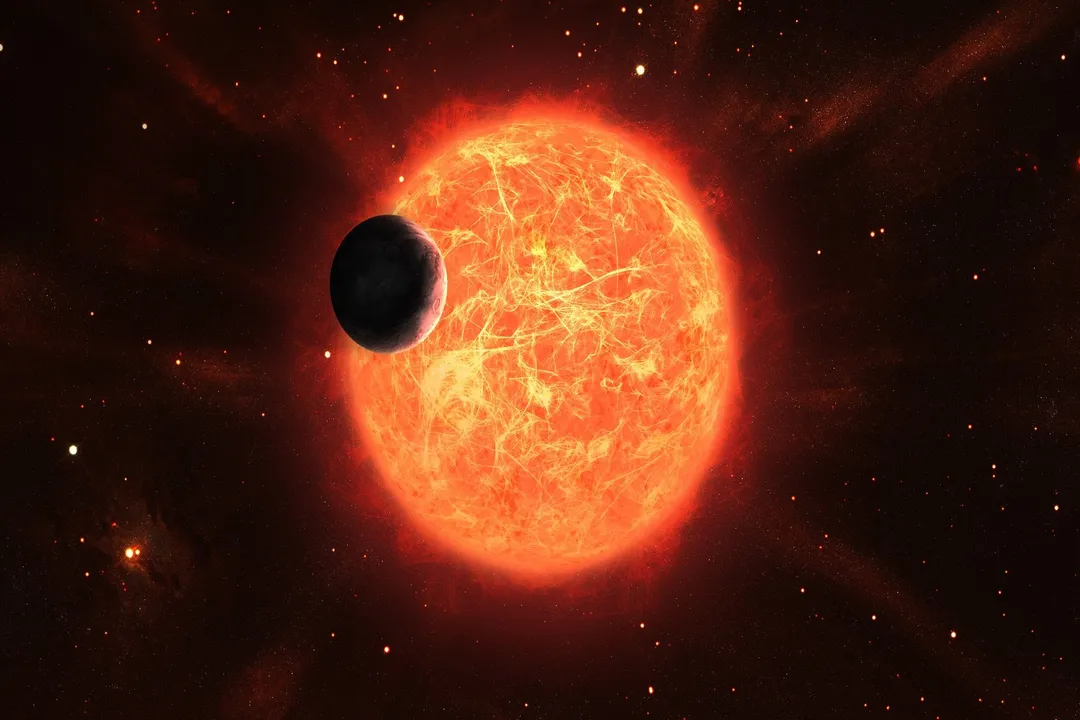
The transition of a massive star into a red supergiant marks one of the most dramatic late-life stages an astronomical object can undergo. These stellar behemoths are defined by their immense physical size, often swelling to radii hundreds of times that of our Sun, making them some of the largest stars observable in terms of pure volume. [1][6] However, simply being large isn't enough; a star must begin its life with significant mass to earn this late-stage designation. [9] Stars that start their lives with masses greater than about eight to ten times the mass of the Sun are the candidates destined for this massive transformation. [1][6][9]
# Core Fuel Exhaustion
The fundamental trigger that pushes any star off the main sequence and into an expanded state is the exhaustion of its primary nuclear fuel—hydrogen—in the core. [7][9] During the long, stable phase of its life, a star maintains equilibrium by balancing the inward crush of its own gravity with the outward pressure generated by nuclear fusion, which converts hydrogen into helium in the core. [2][7]
When the hydrogen supply within the stellar core is depleted, fusion stops there, and the core begins to contract under gravity. [2] This contraction is a critical moment because the process releases gravitational energy, which heats the core tremendously. [2][7] This rising temperature eventually becomes high enough to ignite hydrogen fusion in a shell surrounding the now inert, shrinking helium core. [2]
# Shell Burning Expansion
The switch from core fusion to shell fusion fundamentally alters the star's structure and appearance. [2][7] The energy output from this new, hotter shell burning is significantly greater than the previous core fusion rate. [2] This surge in energy generates an intense outward pressure that forces the star's outer layers—the vast envelope of gas—to expand dramatically. [2][4] As these outer layers move far away from the central, contracting core, they cool down significantly. [3] It is this cooling that shifts the star’s surface temperature down, causing it to glow with a characteristic reddish hue, hence the name red supergiant. [1][3]
The key difference between a star becoming a regular red giant, like our Sun eventually will, and a red supergiant lies in the initial mass. [2][9] A solar-mass star will swell up, but the scale of expansion is comparatively modest. For the more massive progenitor stars, the expansion is catastrophic in scale, creating volumes that could engulf multiple planetary orbits within our own solar system. [6]
To better illustrate this initial mass requirement, consider the general progression based on the progenitor star's starting weight relative to the Sun ():
| Stellar Classification | Initial Mass Range () | Late-Stage Evolution |
|---|---|---|
| Sun-like Stars | to $8$ | Red Giant |
| Massive Stars | $> 8$ to $10$ | Red Supergiant |
| Very Massive Stars | $> 25$ to $40+$ | Directly to Blue Supergiant/Supergiant |
This table highlights that the evolutionary path strongly depends on how much material the star had to begin with. [9]
# Core Reactions Evolve
The existence of a red supergiant is transient compared to the long main sequence lifetime, often lasting only a few million years. [1] As the star expands, the helium core continues to contract and heat up until it reaches the temperature necessary to begin fusing helium into carbon and oxygen. [2][7] Once helium fusion ignites in the core, the star generally shrinks slightly and heats up, moving off the "red" part of the diagram for a time, sometimes becoming a blue supergiant, though this phase is usually brief. [1][4]
However, for the most massive progenitors, this helium-burning phase does not represent the end of internal restructuring. Because these stars are so massive, the core pressure and temperature can become high enough to initiate fusion of heavier elements—carbon, neon, oxygen, and silicon—in successive, nested shells surrounding the inert core. [4] Each subsequent fuel source burns hotter and faster than the last, leading to an increasingly complex, onion-like structure within the star. [4] This layered burning process is what sustains the star’s massive energy output and keeps its outer envelope inflated as a red supergiant for as long as possible. [1]
A helpful analogy for understanding this process involves a furnace. When the primary wood (hydrogen) runs out, you don't stop heating the house; instead, you might start burning finer kindling (shell hydrogen) intensely, which temporarily boosts the heat before you move on to a much smaller, denser coal source (helium), and so on. [2] In the supergiant case, the sheer mass means the "coal" is rich enough to sustain a massive, albeit temporary, energy output from successively heavier elements until iron is formed in the center.
# Size and Temperature
The term "red supergiant" describes a specific location on the Hertzsprung-Russell (H-R) diagram, characterized by extremely high luminosity and relatively cool surface temperatures, typically in the range of 3,500 K to 4,500 K. [1] This cool surface temperature is what imparts the deep red or orange color. [3] Despite this low surface temperature, their immense surface area means they radiate an enormous amount of total energy, classifying them as highly luminous giants. [1]
It is fascinating to compare the sheer volume difference. Consider Betelgeuse, one of the most famous red supergiants. If placed at the center of our Solar System, its radius would likely extend past the orbit of Jupiter, possibly even Mars, depending on its exact evolutionary pulse. [6] This scale contrasts sharply with stars that simply evolve into red giants, which might swell to envelop Mercury and Venus, but generally not as far out as the orbit of Mars. [2]
# The Inevitable End
The process of building up heavier elements in the core is a finite one. Once the core is composed entirely of iron—an element that cannot release energy through fusion but instead consumes energy when fused—the star loses its primary energy source instantly. [4] The battle between gravity and outward pressure is over. Gravity wins decisively, and the iron core collapses in milliseconds. [4]
This rapid implosion triggers a spectacular rebound known as a Type II supernova explosion. [6] What remains depends on the initial mass of the progenitor star that became the red supergiant. Stars that were massive but not excessively so might leave behind a dense neutron star. [1] If the star was among the most massive—perhaps exceeding 20 to 25 solar masses initially—the collapse leads to a singularity, forming a black hole. [1] The spectacular death of a red supergiant thus determines whether the final remnant is a city-sized sphere of neutrons or an object whose gravity is so intense that nothing, not even light, can escape. [6]
Related Questions
#Citations
Red supergiant - Wikipedia
Why do stars become red giants? - Astronomy Stack Exchange
Red giant stars: Facts, definition & the future of the sun - Space
Astrophysics of Red Supergiants - AAS Nova
Stellar Evolution - | The Schools' Observatory
Red Supergiant Star - Universe Today
Evolution from the Main Sequence to Red Giants | Astronomy
Question about the life cycle of stars - red giants, black holes, etc.
Red Supergiant Definition, Temperature & Life Cycle - Lesson