What causes the surface cooling responsible for imparting the 'red' color to a red supergiant?
Answer
The outward expansion forces the outer layers far from the central core, causing them to cool down.
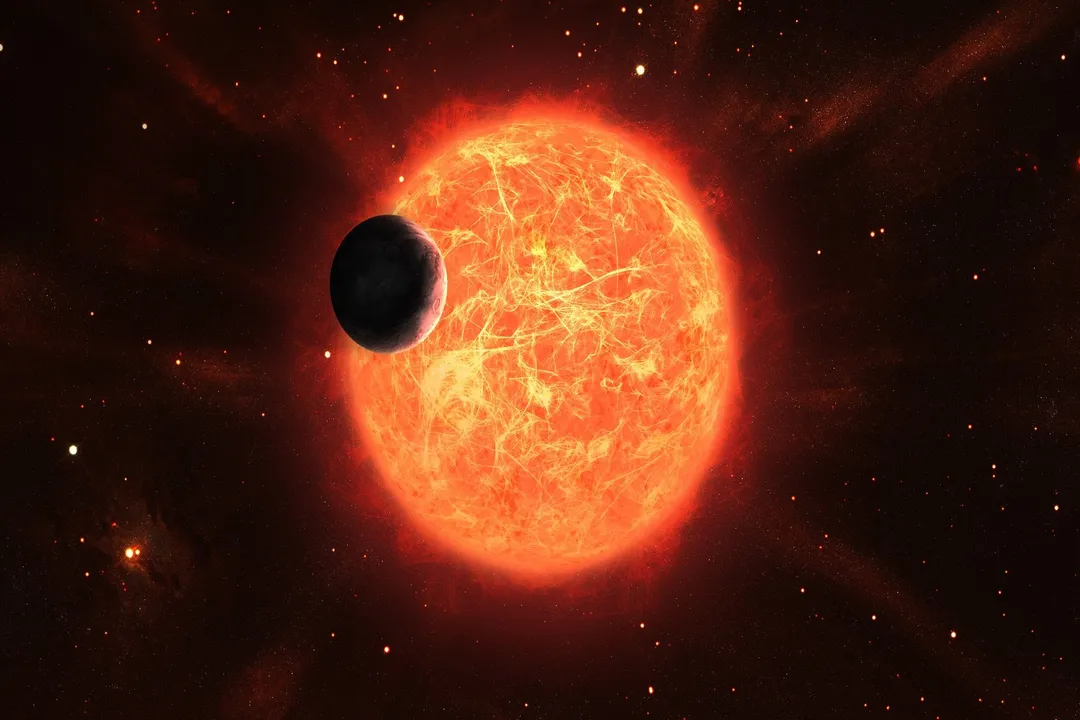
The characteristic reddish hue is a direct consequence of the star's physical restructuring during expansion. When the outer gaseous envelope is forced outward due to extreme pressure from shell fusion, these layers move a much greater distance from the hot, central furnace. This increased separation leads to significant cooling of the star's surface temperature. This relatively low surface temperature is what causes the star to glow with the distinctive, deep reddish or orange color associated with red supergiants.
Related Questions
What initial mass range ($M_{\odot}$) qualifies a star to become a Red Supergiant?What fusion event triggers the expansion phase away from the main sequence for massive stars?What causes the surface cooling responsible for imparting the 'red' color to a red supergiant?What is the typical surface temperature range for a red supergiant on the H-R diagram?How long does the transient existence of a red supergiant phase typically last relative to its main sequence lifetime?Which elements are fused in the successive, nested shells surrounding the core of a very massive red supergiant?What final element forms in the core that causes the star to instantly lose its primary energy source?If a progenitor star was among the most massive (exceeding 20 to 25 solar masses), what remnant forms after the supernova explosion?What is the primary difference between a star evolving into a Red Giant versus a Red Supergiant?How does the energy output from shell hydrogen fusion compare to the star's previous core fusion rate?