Why do red supergiants explode?
The fiery demise of a red supergiant star is one of the most spectacular and violent events in the cosmos, marking the absolute end of a star that has lived a comparatively brief but brilliant life. These colossal stars, which dwarf even our own Sun, don't simply wink out; they undergo a catastrophic structural failure that results in a supernova explosion. [8][9] Understanding why this happens requires tracking their life story, particularly the internal battle between the immense force of gravity and the energy generated by nuclear fusion.
# Massive Evolution
Red supergiants represent the late evolutionary stage for stars that were born with substantial mass, typically starting out at eight times the mass of the Sun or more. [1] These stars burn through their fuel reserves at an alarming rate compared to smaller stars like our Sun, which will evolve into a red giant before gently puffing away their outer layers. [3] The sheer volume of a red supergiant is staggering; they are among the largest stars known, swelling outward as their outer layers cool down and expand. [3]
The structure of these stellar behemoths is characterized by onion-like layers of different burning shells surrounding a dense core. Throughout their main sequence life, they fuse hydrogen into helium in their core. As the core hydrogen is depleted, the star begins fusing heavier and heavier elements, working its way up the periodic table in a series of nested burning stages. [1] This process is a continuous race against time, where each subsequent fuel source burns faster than the last, leading to a highly stratified internal structure. [2] The layers might include burning shells of carbon, neon, oxygen, and silicon, stacked one on top of the other, all directed toward building up the star's center.
# Iron Limit
The engine that powers the star—nuclear fusion—relies on combining lighter elements to create heavier ones, which releases a tremendous amount of outward energy and pressure. This outward push perfectly counteracts the relentless inward pull of the star's own gravity, keeping the star in hydrostatic equilibrium. [2] However, this fusion process hits an absolute chemical wall when the core begins producing iron (). [1][2]
Iron represents the heaviest element that can be synthesized through normal stellar fusion processes. Any attempt to fuse iron atoms together does not release energy; instead, it consumes energy. [2] This is the critical turning point. Once the core is converted predominantly to iron, the energy source that has sustained the star for millions of years—the fusion furnace—shuts down instantly. [2] The star loses its primary source of outward thermal pressure in a fraction of a second, leaving nothing to resist the overwhelming force of gravity bearing down on that massive iron core.
To put this timescale into context, a massive star might spend millions of years fusing hydrogen, and perhaps only a few years fusing carbon, but the silicon burning phase leading up to the iron core might last only a single day. [1] The subsequent collapse of the iron core into a neutron star happens even faster, often in less than a second. [2] Think of a skyscraper that took decades to build, with all its internal systems running perfectly, suddenly having its central support pillar vaporized in the blink of an eye. The internal forces are so powerful that the collapse happens faster than any terrestrial event we commonly experience, creating conditions that simply do not exist naturally anywhere else in the universe except inside these dying stars.
# Inward Crush
With the energy generation terminated, gravity takes complete and immediate control. The iron core, which can be roughly the size of Earth but contains more mass than the Sun, begins to collapse inward upon itself at incredible speeds, reaching up to a quarter of the speed of light. [2]
As this massive shell of material rushes inward, it compresses the iron core down to densities far exceeding that of an atomic nucleus. When the core material reaches this state of extreme rigidity—nuclear density—it suddenly resists further compression. [2] This sudden stop acts like hitting an unyielding wall. The infalling material, still carrying immense momentum from the collapse, slams into this ultra-dense, incompressible core. [2]
The result of this impact is the generation of a powerful outward-moving shockwave. [2] This initial shockwave is often not strong enough on its own to reverse the entire star's structure, especially for the most massive red supergiants, whose outer layers weigh a tremendous amount. [2] In the immediate aftermath, the shockwave can stall as it encounters the dense material it is trying to push through.
# Rebound Ejection
For the explosion to succeed, the stalled shockwave needs a boost. This secondary mechanism is believed to involve the extreme physics occurring right at the surface of the newly formed proto-neutron star. [2] As the core collapses, the protons and electrons are squeezed together under such immense pressure that they merge, a process called inverse beta decay, forming neutrons and releasing a huge burst of subatomic particles known as neutrinos. [2]
These neutrinos carry away a massive amount of the gravitational binding energy released during the core collapse. A significant fraction of these particles stream outward, re-energizing the stalled shockwave, effectively pushing it outward with renewed, catastrophic force. [2] This revitalized shockwave tears through the remaining layers of the red supergiant, heating the material to billions of degrees and accelerating it outward into space at tremendous velocities. This ejection is the brilliant, fleeting light we observe as a Type II supernova. [1][9]
This process dictates what happens next based on the total initial mass of the star. If the remaining core mass, after the explosion, is less than about three solar masses, the remnant will settle down as an incredibly dense neutron star. [4] However, if the star was exceptionally massive to begin with, the core remnant will still exceed this threshold, causing it to collapse again, this time past the neutron star stage, resulting in the formation of a black hole. [4] The key distinction between a neutron star remnant and a black hole remnant hinges entirely on the precise mass that is left behind after the supernova shockwave does its work.
# Observing Death
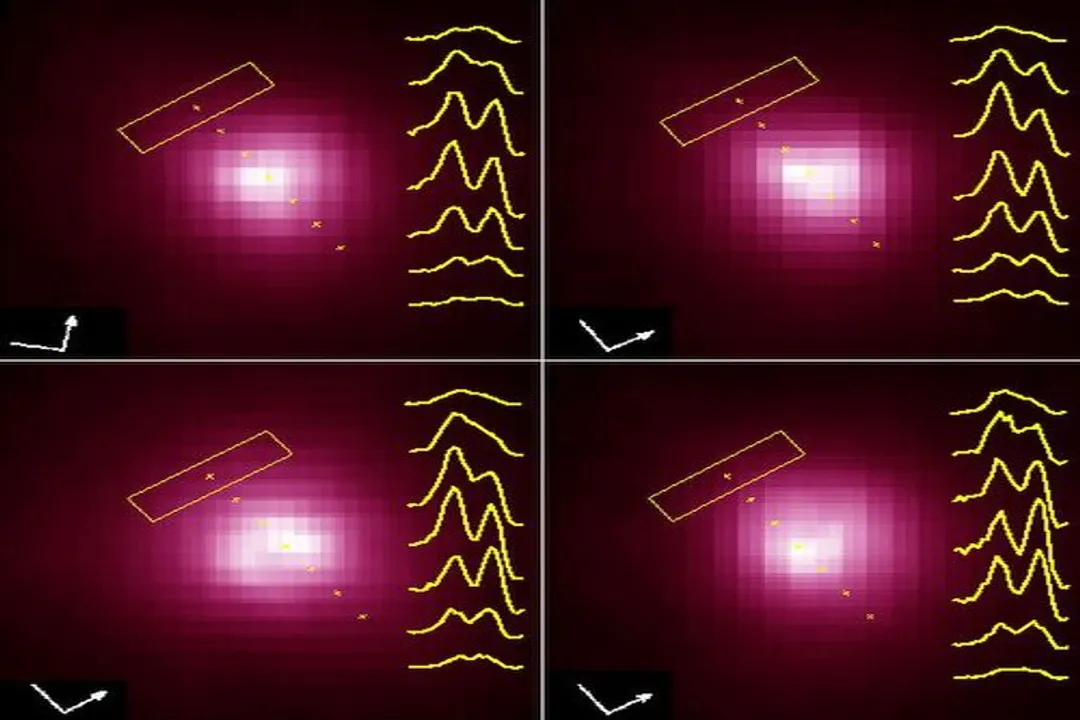
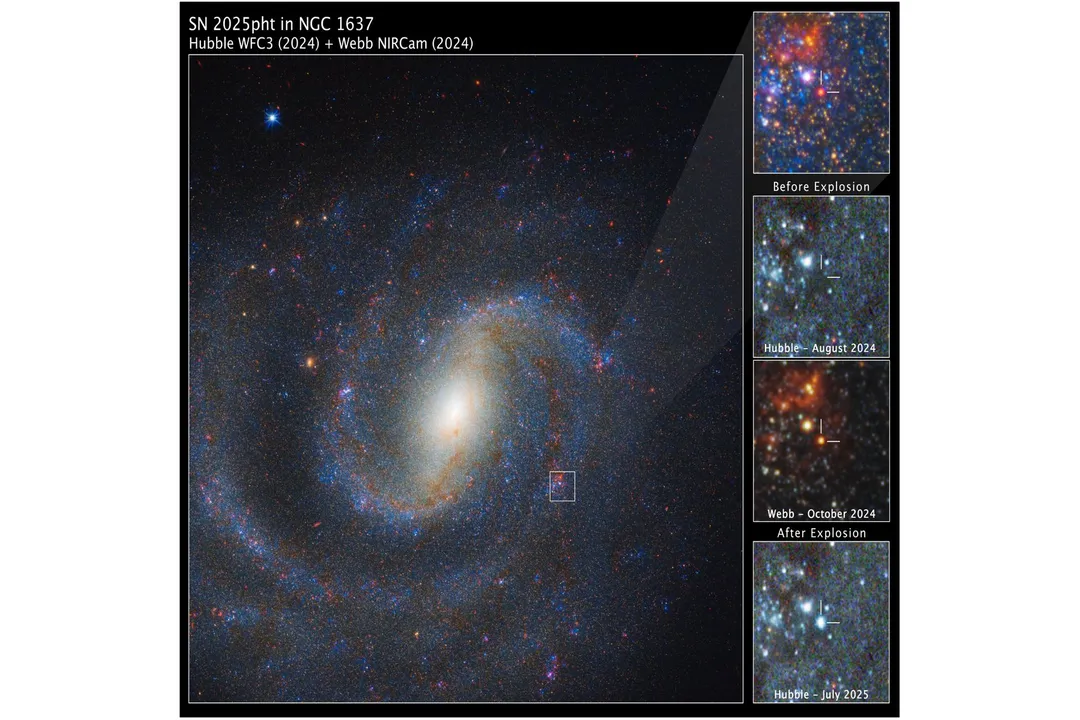
The event is not always perfectly sudden or clean from an observational standpoint. Recent work utilizing telescopes like the James Webb Space Telescope (JWST) has provided fascinating glimpses into the immediate prelude to these explosions. [6] Astronomers have managed to spot red supergiants that appear to be heavily shrouded in dust just before they go supernova. [6] This dust cloaking might be a result of the intense mass loss and structural instability that characterizes the final phase of a red supergiant's life. [7]
Observing these dying stars has shown that significant structural changes can occur very rapidly. [7] In one recorded instance, a star was observed undergoing rapid structural transformations in the months leading up to its detonation, providing evidence that the internal dynamics become chaotic and unpredictable just before core collapse. [7] This observational ability to catch a massive star in its final death throes is relatively new, offering direct empirical constraints on models of late-stage stellar evolution, which previously relied heavily on theoretical calculations. [7]
It is interesting to contrast the outcomes. A star like our Sun ends its life by shedding its outer layers to form a planetary nebula and leaves behind a white dwarf, which slowly cools over eons. [3] The red supergiant, by contrast, initiates a core-collapse supernova, a process that outshines its host galaxy for a brief period and results in either a neutron star or a black hole. [1][4] The initial mass threshold separating these two very different fates—the gentle fade versus the explosive end—is one of the most critical demarcation lines in stellar astrophysics.
# Star Aftermath
The sheer violence of the supernova means that most of the star's material is violently ejected into the interstellar medium. [9] This ejected material, enriched with all the heavy elements forged inside the star during its lifetime—the carbon, oxygen, silicon, and even heavier elements like gold and uranium created during the shock passage—becomes the building blocks for future stars, planets, and, eventually, life itself. [1]
The final state—the compact remnant—tells us a story about the star's original size. While the exact cutoff point remains an area of active research, the remnant mass is generally understood to fall between approximately $1.4$ and $3$ solar masses for a stable neutron star, with anything substantially heavier collapsing into a singularity. [4] The study of the supernova explosion itself is, therefore, a key method for astronomers to gauge the extreme physical limits of matter under pressure and to understand the population statistics of black holes and neutron stars in the galaxy. The mechanism hinges on a chain reaction that takes a star from relative stability to total annihilation within seconds, driven by a transition from energy generation to gravitational domination at the iron core.
#Videos
Why Do Some Red Giant Stars Explode As Supernovae? - YouTube
Related Questions
#Citations
Red supergiant - Wikipedia
Why do red supergiant stars explode when the fusion stops? - Quora
Red Giant - ESA/Hubble
Why does a supergiant star become blackhole only after it dies?
Why Do Some Red Giant Stars Explode As Supernovae? - YouTube
JWST spots dust-cloaked 'red supergiant' star just before it ... - Space
Astronomers capture red supergiant's death throes
Supernovae - Imagine the Universe! - NASA