Is the universe experiencing red shift or blue shift?
The light from the overwhelming majority of objects in the cosmos arrives stretched, meaning the universe, on its grandest scale, is overwhelmingly experiencing redshift. However, this dominant cosmological signal is layered with local effects, leading to exceptions where light is compressed, resulting in a blueshift. To truly understand the current state of the universe, one must distinguish between the different physical origins that can shift the color and frequency of light traveling across space and time.
# Wave Stretching
Fundamentally, redshift and blueshift describe how the wavelength—and thus the frequency and energy—of electromagnetic radiation changes relative to an observer. Think about the familiar sound of a siren: as a police car approaches, the sound waves are compressed, resulting in a higher pitch; as it moves away, the waves spread out, and the pitch drops lower.
Light behaves in an analogous manner, and this phenomenon is known as the Doppler effect.
- Blueshift: Occurs when the light source is moving toward the observer. The waves are effectively squashed, leading to a shorter wavelength and a shift toward the higher-frequency, bluer end of the visible spectrum.
- Redshift: Occurs when the light source is moving away from the observer. The waves are stretched, resulting in a longer wavelength and a shift toward the lower-frequency, redder end.
We determine these shifts not just by guessing the apparent color, but through precise measurement of spectral lines. Atoms create unique patterns of absorption or emission lines in light at known, specific wavelengths in a lab on Earth. When we observe starlight, if these characteristic lines appear shifted to longer wavelengths (red) or shorter wavelengths (blue) compared to their rest positions, we can quantify the relative motion. Blue shift is simply a shift toward higher energy and shorter wavelengths, and a "violet shift" would just be an even more extreme blueshift, as the term refers to the direction of the frequency change, not the color violet specifically.
# Three Origins
While the Doppler effect is the most intuitive explanation for shifts caused by motion, astronomy reveals three distinct physical mechanisms responsible for redshift and blueshift:
# Doppler Shift
This is the classic relative motion effect, where an object is physically moving through space toward or away from the observer, causing the light waves to compress or stretch accordingly. This motion is often called peculiar velocity when discussing galaxies moving relative to one another or relative to the overall cosmic flow.
# Cosmological Shift
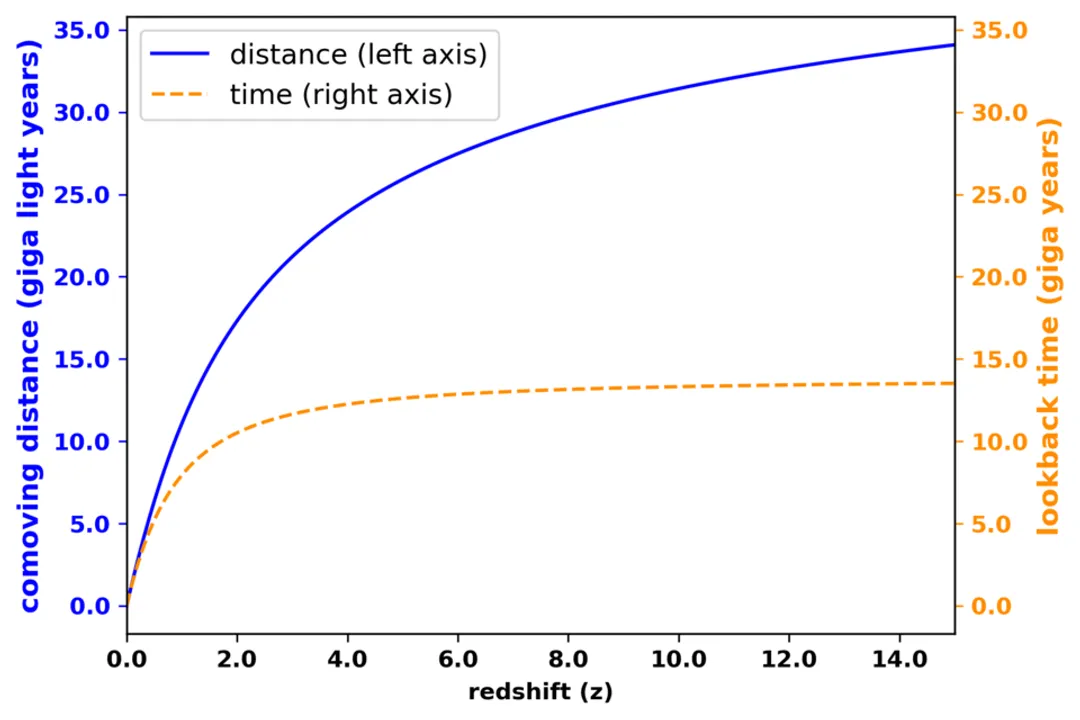
This shift is intrinsically tied to the expansion of the universe itself. It is not caused by galaxies moving through space, but rather by the stretching of the spatial fabric between the emitting galaxy and the observer. As space expands during the light's journey, the photon's wavelength is stretched proportionally. Cosmologist Edward Robert Harrison described it simply: light travels through vast regions of expanding space, and the expansion stretches all wavelengths equally along the path. This effect increases monotonically with distance, meaning the farther away an object is, the greater its resulting redshift due to the longer time its light spent traveling through expanding space.
# Gravitational Shift
General Relativity dictates that gravity warps spacetime, which affects the flow of time—a phenomenon known as gravitational time dilation. When light climbs out of a region of strong gravity (a gravitational potential well), it loses energy and is redshifted (the Einstein shift). Conversely, light falling into a gravity well gains energy and is blueshifted. This effect is minuscule on Earth but significant near black holes and was first measured in the lab via the Pound–Rebka experiment. Astronomers confirmed this gravitational redshift on a galactic scale by analyzing galaxy clusters.
The measurement we take from a distant object is a superposition of all these effects. However, for distant galaxies, the cosmological redshift is so large that it swamps the Doppler motion component.
A key difference in interpretation hinges on energy conservation between the Doppler and Cosmological mechanisms. For a standard Doppler shift due to relative velocity, the photon's wavelength is effectively different in the source's rest frame versus the observer's frame, but the photon itself is measured with the same wavelength the moment it is created and the moment it is intercepted. However, in the case of cosmological redshift, the photon truly loses energy steadily as it travels across the expanding metric of space, a measurable decrease in energy over the long trajectory. This distinction between motion through space and the stretching of space is crucial for accurately modeling the cosmos.
# Cosmic Dominance
When we look at the universe broadly, the answer is decisively redshift. This observation, first systematized by Edwin Hubble using Vesto Slipher's redshift measurements correlated with distances, forms the bedrock of the expanding universe model. The farther a galaxy is, the greater its redshift, leading to the establishment of Hubble's Law.
The most extreme example of this cosmic redshift is the Cosmic Microwave Background (CMB) radiation, the remnant heat from the Big Bang. Light emitted when the universe was only 379,000 years old was extremely hot (around ). Today, that same light has been redshifted by a factor of to a mere temperature. This overwhelmingly redshifted background sets the stage for all other observations.
# Local Velocity
While the expansion dictates that everything distant is moving away, gravity still operates locally. On scales smaller than a galactic supercluster, the mutual gravitational attraction between galaxies can overcome the Hubble flow, causing galaxies to move toward each other. These local motions create blueshifts.
The most famous example is the Andromeda Galaxy (M31). It is moving toward the Milky Way at about (or ) due to local gravitational dynamics. This results in a measurable blueshift, meaning our two galaxies are on a collision course, slated to merge in about 4 billion years. A small population of nearby galaxies, about 100 in total, also exhibit blueshifts for similar reasons. Even within our own galaxy, stellar motion can cause subtle blueshifts for stars moving toward us, which astronomers detect when measuring the rotation of binary star systems or searching for exoplanets.
It is interesting to consider how the ratio of redshifted to blueshifted objects changes as we narrow our observational scope. For stars within the Milky Way, or very nearby galaxies like those in the Local Group, the ratio is close to one-to-one, as local motions dominate. However, when surveying extragalactic objects beyond the immediate neighborhood, the redshift contribution from cosmic expansion ensures that almost every object is receding, making the ratio overwhelmingly skewed toward redshift.
A hypothetical universe undergoing a Big Crunch would be contracting, leading to a cosmological blueshift for all distant objects—the exact opposite of what is currently observed.
# Terrestrial Measurement
The principles of redshift and blueshift are not confined to the distant reaches of space; they are measurable phenomena in everyday technologies and laboratories.
For instance, police speed guns rely on the Doppler effect by bouncing microwave signals off a moving car and analyzing the frequency shift of the returned signal. On a much more precise scale, the Global Positioning System (GPS) satellites must constantly correct for both relativistic blueshifts (due to their speed moving away from the gravitational well of Earth) and gravitational redshifts (due to the slightly weaker gravity they experience high above the surface) to maintain accuracy. If these time dilation and frequency shift corrections were not applied, navigational errors would accumulate rapidly.
This ability to measure minute shifts in frequency allows scientists to study everything from the rotation rate of our own Sun to the dynamics of matter falling onto neutron stars.
| Phenomenon | Dominant Cause(s) | Typical Scale | Observed Effect |
|---|---|---|---|
| Distant Galaxies | Cosmological Expansion | Intergalactic/Cosmic | Predominantly Redshift |
| Andromeda Galaxy | Peculiar Motion (Gravity) | Local Group | Blueshift (Approaching) |
| CMB Radiation | Cosmological Expansion | Entire Observable Universe | Extreme Redshift () |
| GPS Clocks | Gravity/Special Relativity | Planetary/Orbital | Small, measurable shifts requiring correction |
In summary, while the physical mechanism for light shifting toward the blue or red end of the spectrum is rooted in relative motion (the Doppler effect) or gravitational potential, the universe as a whole presents an undeniable picture: light from almost every galaxy beyond our local neighborhood is being stretched by the expansion of space, resulting in a pervasive and measured redshift.
Related Questions
#Citations
Redshift and blueshift: What do they mean? - Space
What does blue-shifted and red-shifted mean and why does ... - Reddit
Redshift - Wikipedia
We say Light is Red-Shifted or Blue-shifted from faraway stars and ...
Do blueshifted galaxies contradict the expansion of the universe?
Are their examples of redshift or blueshift on Earth (not including ...
Blue Shift & Red Shift: Explaining the Universe - Physics Forums
Redshift - Las Cumbres Observatory