Is the universe red-shifted?
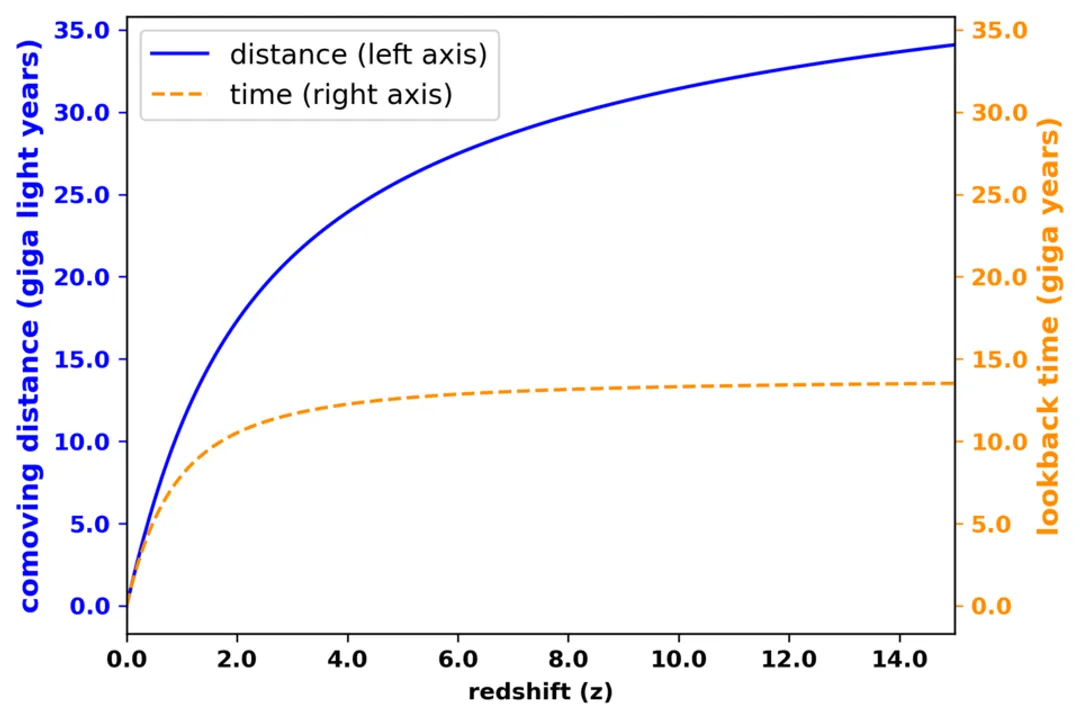
The light reaching us from distant galaxies carries an unmistakable signature written into its very fabric, a clue that has reshaped our understanding of the cosmos entirely. When astronomers look at the light emitted by very distant sources, they consistently find that the wavelengths are stretched out, shifted toward the longer, red end of the visible spectrum. This phenomenon, known to science as redshift, is not just a minor curiosity; it forms the very foundation of modern cosmology, telling a story of a dynamic, evolving universe that has been expanding for billions of years. [1][6]
# Light Stretches
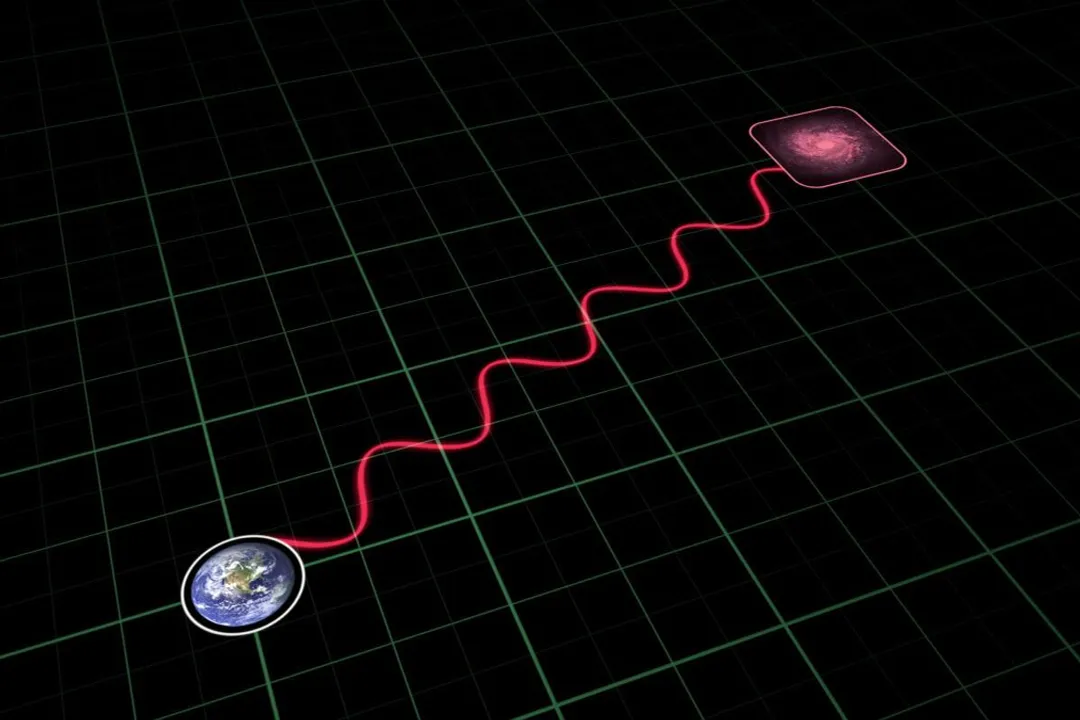
At its most fundamental level, redshift describes a change in the observed wavelength of light compared to the wavelength emitted by the source. [1] Light travels in waves, and color is determined by the distance between the peaks of those waves—the wavelength. Shorter wavelengths appear bluer, while longer wavelengths appear redder. [6] When a source of light is moving away from an observer, the waves get pulled apart, increasing the wavelength, causing a redshift. [1] Conversely, if a source were moving toward us, the waves would be compressed, leading to a blueshift. [1] While this effect is commonly associated with the Doppler effect familiar from sound waves (like a siren dropping in pitch as it passes), in the context of distant galaxies, the primary mechanism is more profound. [1][6]
Consider the light signatures from elements in a star's atmosphere, which appear as dark absorption lines when analyzed with a spectroscope. When these spectral lines are compared to the same element measured here on Earth in a laboratory setting, the pattern is identical, but the entire pattern for a distant galaxy is shifted uniformly toward the red. [1][6] This systematic shift provides a precise, measurable quantity that astronomers can use to gauge the severity of the stretching. The amount of redshift, often represented by the variable z, quantifies how much the light has been stretched relative to its original wavelength. [1] A higher z value means a greater shift and, in the context of cosmology, a greater distance and age for the observed object. [8]
# Space Expands
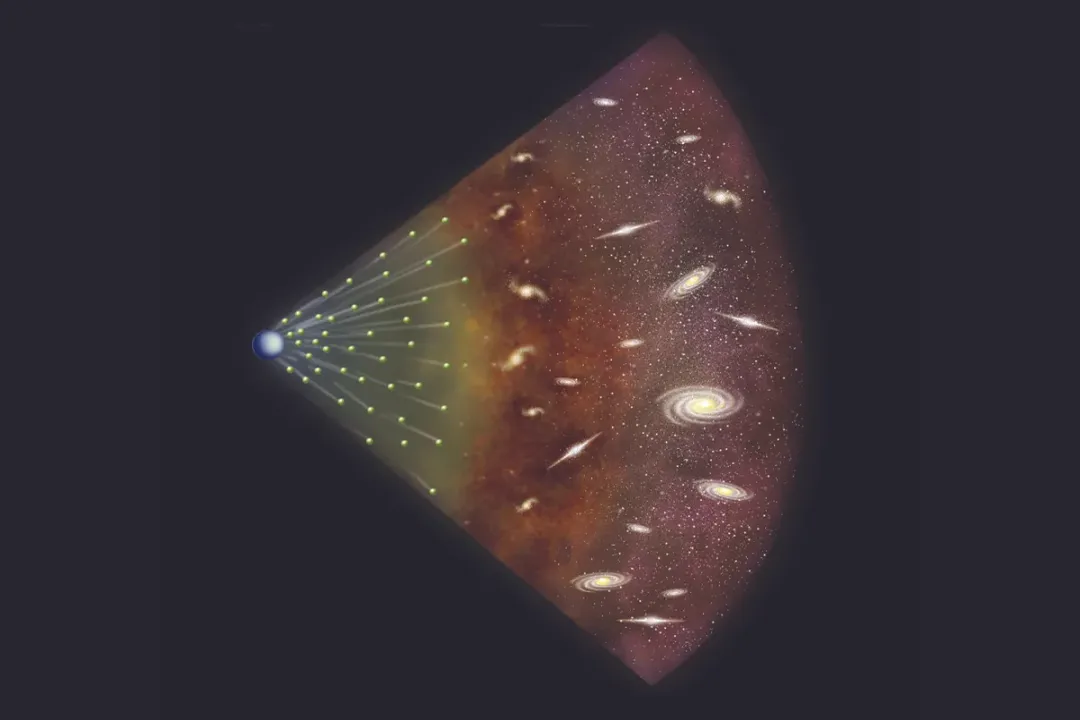
The crucial distinction in understanding the universe's redshift comes from separating the phenomenon into its specific causes. Astronomers recognize three main types of redshift: Doppler, Gravitational, and Cosmological. [1][6] For the vast majority of distant galaxies, the dominant mechanism is the cosmological redshift. [5][8] This is not due to the galaxy physically rushing through space away from us, like a runner moving away from a spectator. Instead, it is caused by the expansion of space itself during the time the light travels across the universe to reach our telescopes. [3][5][8]
Imagine painting two dots on a rubber band and then stretching the rubber band between two fixed points. As the rubber band stretches, the distance between the two dots increases, even though the dots themselves are not moving relative to the rubber band material immediately around them. [6] Similarly, as photons of light travel across the cosmos, the space they traverse expands, stretching the wavelength of the light as it goes. [3][7] The farther away a galaxy is, the longer its light has been traveling, and thus the more the space it has crossed has expanded, leading to a greater observed redshift. [8] This relationship between distance and redshift is precisely what Edwin Hubble observed, forming the empirical basis for the concept of an expanding universe. [3]
The Hubble Space Telescope, among other instruments, has provided clear evidence supporting this expansion model by observing galaxies at tremendous distances. [3] The data consistently show that nearly every galaxy outside our local group is redshifted, and the velocity implied by that shift increases with distance. [7]
# Measuring Light
The reliability of redshift measurements hinges on spectral analysis, which is where the "expertise" of astrophysics truly comes into play. [6] An object's spectrum is like its unique fingerprint, created by the specific pattern of light absorbed or emitted by its constituent elements. [1] For example, hydrogen atoms absorb and emit light at very precise, known wavelengths—these spectral lines are constants of nature. When we observe a distant galaxy, we measure the wavelengths of these same spectral lines, but they appear shifted. [6]
The calculation involves a straightforward ratio: the difference between the observed wavelength () and the emitted wavelength (), divided by the emitted wavelength. [1]
The result, z, is a dimensionless number that quantifies the shift. [1] For nearby objects, this measurement might only show a small shift, perhaps due to local gravitational or motion effects. However, for objects billions of light-years away, z values can be enormous, like or , indicating light that has traveled for most of cosmic history while space expanded around it. [8]
If we were to look at the spectrum of a very distant quasar, say one with a redshift of , this implies that the light has been stretched by a factor of , or $3$, since it left the source. This means that what we observe today as visible light may have originated as ultraviolet or even X-ray radiation, stretched into the infrared spectrum by the time it reaches us. [8] This reliance on repeatable, measurable atomic physics lends immense trust to the cosmological interpretation of these distant observations. [6]
# Different Shifts
While cosmological redshift dominates the story of galactic recession, it is important to differentiate it from its cousins, as overlooking the distinction can lead to misinterpretations. [1]
# Doppler Shift
This is the familiar effect caused by relative motion through space. [6] If two galaxies are gravitationally bound, like our Milky Way and the Andromeda galaxy, they exhibit small redshifts or blueshifts based on their local velocity vector toward or away from each other. This local motion, sometimes called "peculiar velocity," is distinct from the overall Hubble flow caused by cosmic expansion. [1]
# Gravitational Shift
This occurs when light climbs out of a deep gravitational well, like that of a star or a galaxy cluster. [1] The energy of the photon is slightly reduced as it escapes the gravity, which manifests as a longer wavelength—a redshift. [6] This effect is extremely subtle compared to cosmological redshift for all but the most extreme gravitational fields, like those near black holes.
The key difference lies in the cause: Doppler is about speed through a static backdrop; Gravitational is about energy loss in a curved spacetime region; Cosmological is about the expansion of the backdrop itself. [1] When looking at a galaxy millions of light-years away, the observed redshift is overwhelmingly dominated by the expansion of the universe, allowing us to effectively ignore the smaller local motions. [5]
A helpful way to visualize the relative scales is to imagine the universe as a giant, layered cake baking in an oven. Local gravity keeps the raisins (galaxies) stuck together in small clumps (galaxy clusters), which may drift slightly relative to each other (Doppler). The entire cake batter (space) is rising uniformly due to the oven's heat (expansion), stretching the entire structure proportionally to the distance across the cake (Cosmological Redshift). [6]
# Evidence Reliability
The question often arises: If the redshift is real, must the expansion be? Could there be another cause for the wavelength stretching? Skepticism is healthy in science, and alternative hypotheses have been proposed over the decades. [7][9] One idea floated was the "Tired Light" hypothesis, which suggested that photons simply lose energy over vast distances through unknown interactions with the intervening medium, causing the observed shift. [5]
However, observational evidence has largely ruled out these non-expanding scenarios. [7] For instance, if light were simply tiring out, the stretching effect should be independent of time. The cosmological redshift, however, is intrinsically tied to time; light from more distant objects has spent more time expanding with the universe, hence the observed relationship (velocity proportional to distance) that Hubble established. [3][7]
Furthermore, if the light was being stretched by some unknown mechanism along the line of sight, the observed duration of transient events (like supernovae light curves) should remain the same regardless of distance. But they don't. Supernovae observed in very distant, highly redshifted galaxies appear slower than nearby ones; their brightening and fading processes are stretched out in time by the exact same factor as their light wavelength. [7] This time dilation effect is a direct, undeniable prediction of an expanding universe model and is not explained by static models like "Tired Light". [7]
This temporal stretching of events is a powerful verification. Consider a Type Ia supernova—a standard candle—that takes exactly 20 days to brighten and fade in our local neighborhood. If we observe an identical supernova in a galaxy with a redshift of , we would see its entire process stretched by a factor of , meaning it would appear to take 40 days to complete its cycle. The fact that observations perfectly match this prediction strongly affirms that the expansion of space is the primary driver of cosmological redshift. [7]
# Looking Deeper
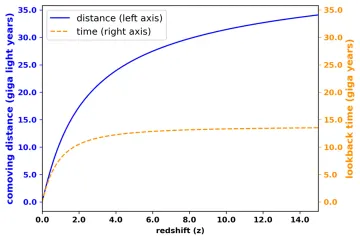
The redshift measurement allows cosmologists to map the universe in both space and time, offering a look back into the early cosmos. [8] When we observe the most distant light, we are seeing the universe as it was billions of years ago, before stars and galaxies had fully formed. [3] The most extreme redshifts correspond to the earliest observable light, tracing back toward the Cosmic Microwave Background, though that specific radiation is observed primarily in the microwave spectrum now due to extreme stretching. [8]
The data collected by programs utilizing the Hubble Space Telescope have been instrumental in pinning down key cosmological parameters, such as the age and expansion rate of the universe. [3] The constant refinement of these measurements, which rely entirely on accurately interpreting the redshift of numerous galaxies, helps scientists determine the fate of the cosmos—whether the expansion will continue forever or slow down. [3]
To illustrate the sheer scale involved in interpreting these shifts, consider a hypothetical scenario in our own solar system versus the cosmos. If the Sun suddenly moved away from Earth at the speed of light (an impossibility, but useful for analogy), the redshift observed in its light would be tiny because the travel time is only eight minutes. However, if a galaxy is 10 billion light-years away, its light has spent 10 billion years expanding with the universe. The relative stretching that occurs over that vast temporal baseline results in a redshift many times larger than any velocity-based shift we could induce locally. It is a cumulative effect built up over cosmic time, which is why high-redshift objects are so precious for studying early universe conditions. [5] The presence of a universal redshift, therefore, is not just a confirmation that things are moving away; it is the observational proof that the spatial metric of the universe itself is dynamic and growing.

# Conclusion
The universe is, definitively, observed to be redshifted. This observation is consistent across all viable astronomical measurements, pointing not to an anomaly in light, but to a fundamental property of spacetime. [1][7] The redshift of distant galaxies is the signature of the ongoing, accelerating expansion of the universe, a dynamic state that began with the Big Bang. [5][8] It is the tool that allows us to reconstruct cosmic history, measuring the distance and age of the universe’s most ancient structures based on how much their light has been stretched by their journey through expanding space. [3][6]
#Videos
Red shift | Astrophysics | Physics | FuseSchool - YouTube
Related Questions
#Citations
Redshift - Wikipedia
How do we know red shift is caused by the expansion of space and ...
Hubble Cosmological Redshift - NASA Science
Red shift | Astrophysics | Physics | FuseSchool - YouTube
Other explanation for cosmological redshift? - Physics Stack Exchange
Redshift - Las Cumbres Observatory
Is the universe really expanding just because of the Red Shift? - Quora
Light from distant galaxies is stretched by the expansion of the ...
Cosmological Redshift | COSMOS