What is the Local Group in the universe?
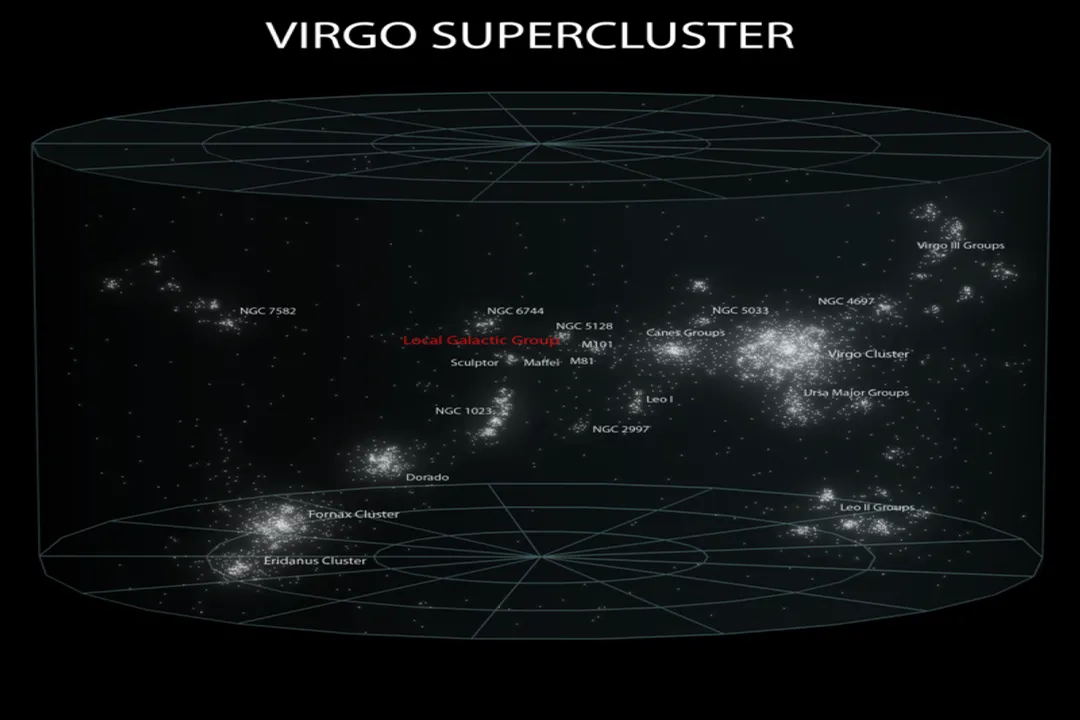
The Local Group is our immediate cosmic neighborhood, a collection of galaxies bound together by mutual gravitational attraction. It is a relatively small structure in the grand scheme of the cosmos, yet it is critically important because it contains our own galaxy, the Milky Way, and our largest nearby neighbor, the Andromeda Galaxy (M31). This collection of island universes is not isolated; it is merely one small component, perhaps one of the smaller systems, within the much larger Virgo Supercluster.
# Galactic Neighbors
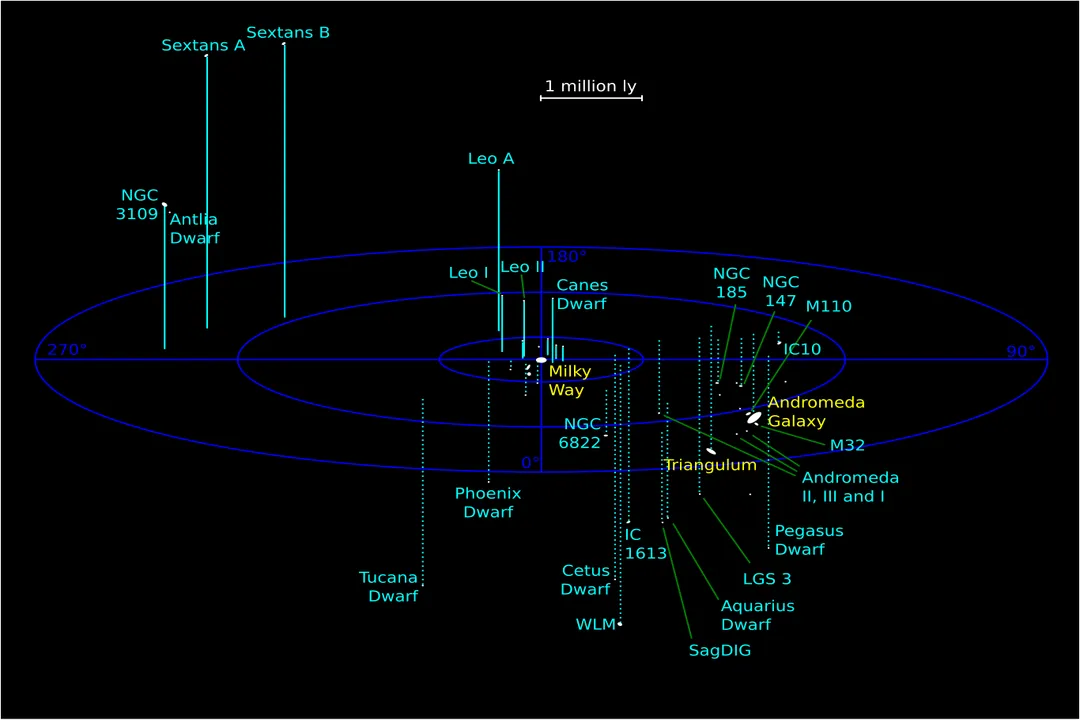
The Local Group is distinguished by its two dominant members, which together contain the vast majority of the mass and a large portion of the luminous galaxies. These two giants are the Milky Way and Andromeda.
Andromeda is the undisputed mass leader of the pair, containing perhaps a trillion stars, significantly outnumbering the Milky Way’s estimated 200 to 400 billion stars. Andromeda is also physically larger, with a diameter estimated to be around 220,000 light-years. While the Milky Way is currently receding from some distant galaxies, the entire Local Group is gravitationally bound, meaning the members orbit a common center of mass.
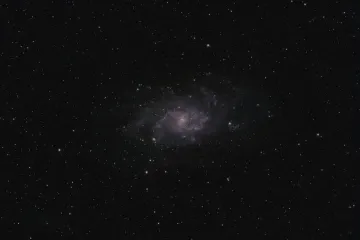
The third-largest spiral galaxy in the group is the Triangulum Galaxy (M33). It is a distant companion to Andromeda, though its exact relationship remains an active area of study. While Andromeda and the Milky Way are clearly the gravitational anchors, the Triangulum Galaxy appears to be less massive than the Milky Way.
The membership roster is more complex than just these three spirals. The Local Group is home to over 50 galaxies, though the exact count fluctuates as fainter, smaller satellite galaxies are discovered. These lesser members are predominantly dwarf galaxies, which are far smaller and less luminous than the major spirals. Many of these are true satellites, orbiting one of the major systems, such as the Large and Small Magellanic Clouds orbiting the Milky Way.
To put the scale into perspective, consider the separation between our two largest neighbors. The distance from the Milky Way to the Andromeda Galaxy is approximately 2.5 million light-years. Given that the entire group spans perhaps 10 million light-years across, it highlights a local density of matter far greater than the average density of the universe.
# Core Galaxies Comparison
A simple look at the primary members helps illustrate the distribution of mass within our immediate vicinity:
| Galaxy | Type | Estimated Stars (Billions) | Diameter (Approx. Light-Years) | Status |
|---|---|---|---|---|
| Milky Way | Spiral | 200–400 | ~100,000 | Primary Member |
| Andromeda (M31) | Spiral | ~1,000 | ~220,000 | Primary Member |
| Triangulum (M33) | Spiral | ~40 | ~60,000 | Tertiary Member |
This distribution shows that while we are part of a grouping, the structure is highly unequal, dominated by two primary gravitational centers. If you were charting the Local Group from a vantage point far outside it, the Milky Way and Andromeda would look like two massive, brightly lit metropolitan areas with dozens of much smaller, dimly lit towns orbiting them.
# Group Dynamics and Future
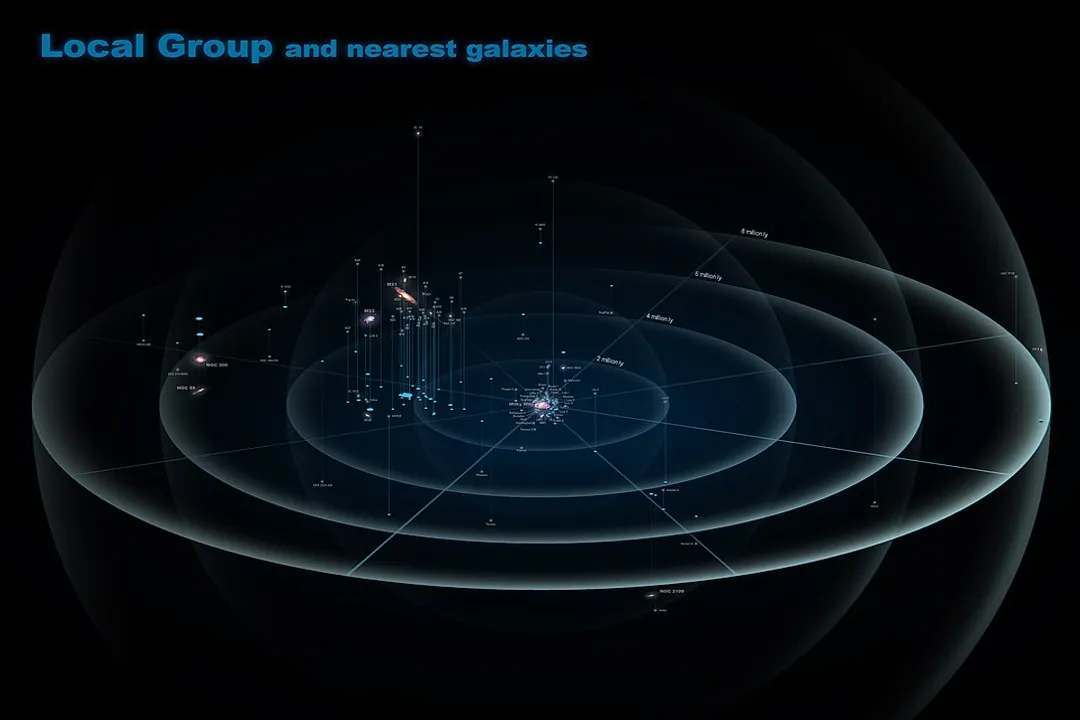
The galaxies within the Local Group are not static; they are actively moving under the influence of gravity, a motion that dictates the group's past and its long-term fate. The entire Local Group is itself moving toward the Virgo Cluster at a speed of about 300 kilometers per second.
However, the most dramatic movement involves the two main players. Andromeda is currently hurtling toward the Milky Way at about 110 kilometers per second relative to us. This inevitable gravitational dance means that in about 4.5 billion years, the Milky Way and Andromeda are predicted to collide and begin merging into a single, larger elliptical galaxy, often nicknamed "Milkomeda". It is fascinating to consider that the structures we see tonight—the familiar bands of stars and nebulae in our own galaxy—are on a collision course that will reshape our galactic environment over time scales far exceeding human history.
The overall dynamics are further complicated by dark matter. Like individual galaxies, the Local Group as a whole must have a significant dark matter halo that dominates its mass budget and governs the orbits of its members. While we cannot see this mass, its gravitational influence is what keeps the group bound together and dictates the paths of the dozens of smaller galaxies scattered throughout the volume.
Thinking about the passage of time on a cosmological scale offers a unique perspective. If you could observe the night sky from a vantage point a billion years in the future, long before the actual merger, the Andromeda galaxy would be visibly larger and brighter in our sky than it is now, its distinctive spiral arms already beginning to distort due to tidal forces as the two massive halos approach each other. This slow, grand collision dwarfs any event visible today, representing a fundamental phase change for the two largest stellar systems in our local environment.
# Beyond the Local View
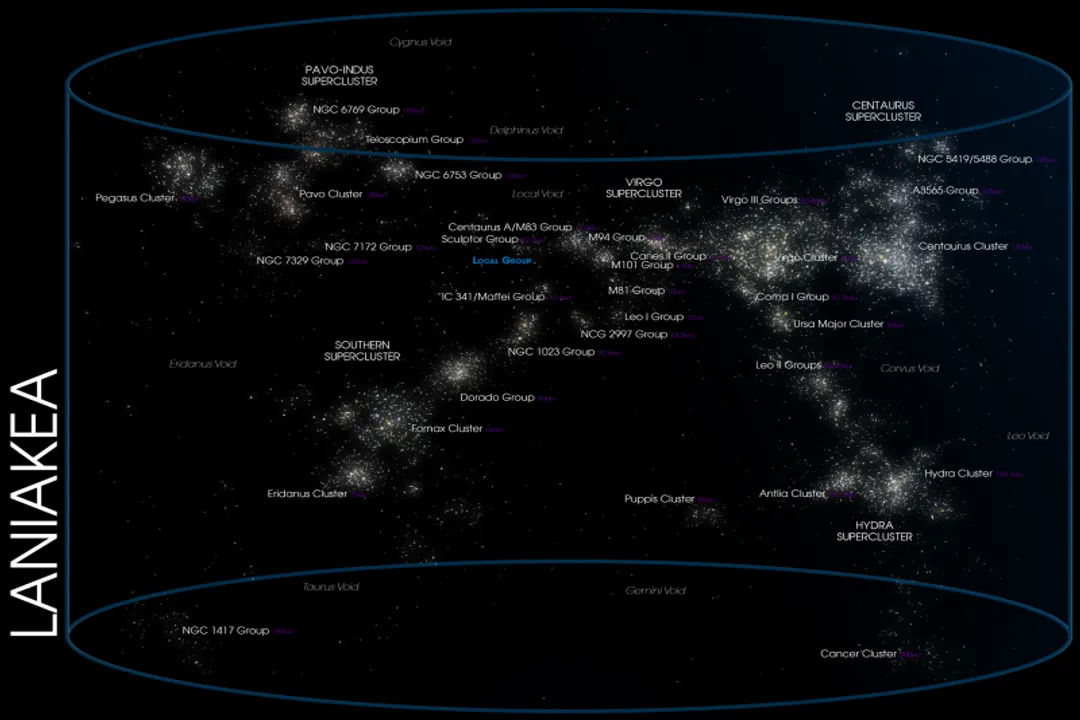
While the Local Group is our galactic home, it is crucial to place it within the larger cosmic architecture. The Local Group resides on the outskirts of the Virgo Supercluster. The Virgo Supercluster is a much larger congregation of galaxy groups and clusters, bound together by gravity, and it contains thousands of galaxies.
Our Local Group is a relatively small, sparsely populated cluster within that larger superstructure. More recent cosmological mapping has placed the Virgo Supercluster itself within an even grander structure known as the Laniakea Supercluster. Laniakea, a name derived from a Hawaiian word meaning "immeasurable heaven," is a massive collection of superclusters that are all flowing toward a common gravitational center known as the Great Attractor. This places the Local Group not just on the edge of one structure, but within a vast, flowing cosmic web of matter.
This hierarchy is key to understanding cosmic structure:
- Local Group: Our immediate, gravitationally bound island of 50+ galaxies.
- Virgo Supercluster: The collection of groups and clusters that contains the Local Group.
- Laniakea Supercluster: The massive structure defining the gravitational flow that includes the Virgo Supercluster.
The study of the Local Group offers a manageable, high-resolution view of galaxy formation and interaction that is impossible to replicate when looking at distant, isolated superclusters. By examining the gas clouds, star formation rates, and stellar populations in Andromeda, Triangulum, and our own Milky Way, astronomers can develop and test theories about how such systems evolve over billions of years. It is essentially a living laboratory for galaxy evolution on the scale of major clusters.
#Videos
What Is The Local Group In Astronomy? - Physics Frontier - YouTube
Related Questions
#Citations
Local Group - Wikipedia
The Local Group is our galactic neighborhood - EarthSky
Local Group galaxies - Imagine the Universe!
The Local Group of Galaxies - An Atlas of The Universe
What is the Local Group? - Universe Today
Our Local Group - Galaxies - Sun.org
What Is The Local Group In Astronomy? - Physics Frontier - YouTube
Local Group | Galaxies, Star Clusters & Nebulae | Britannica
The Universe within 5 million Light Years - The Local Group of ...