What is the largest structure in the hierarchy of the universe?
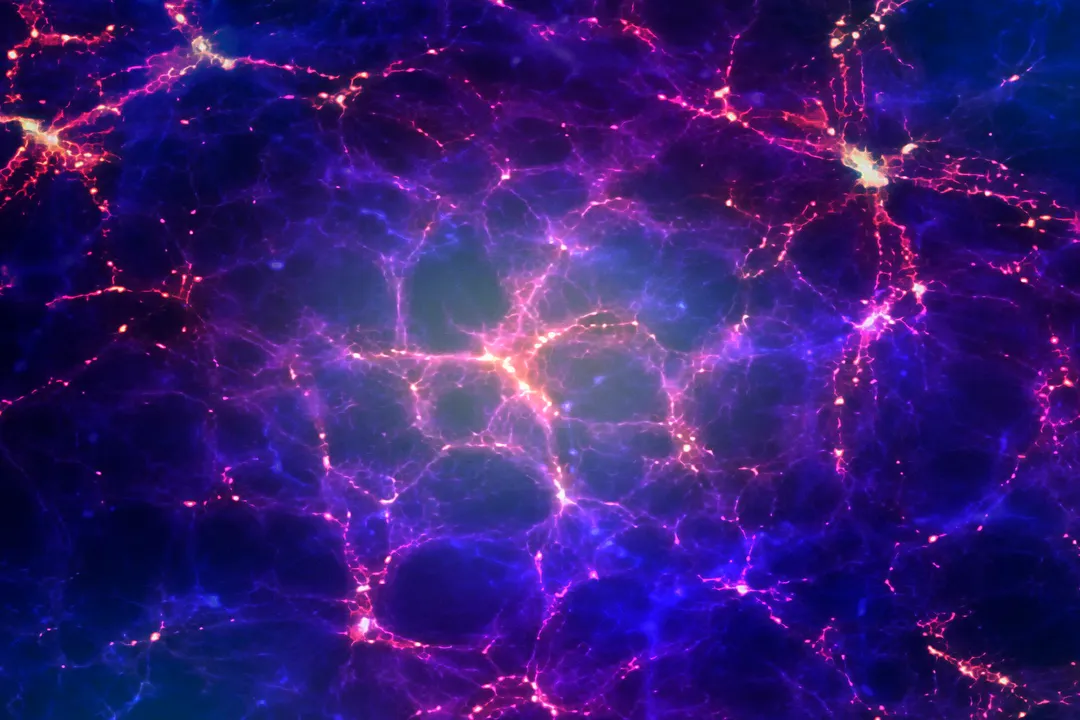
The grand architecture of the cosmos is arranged in a pattern far grander than any human-made city or nation; it is a vast, interconnected scaffolding known as the cosmic web, and at the apex of this hierarchy sits a structure so immense it challenges our current models: Quipu. When we talk about the largest structure in the known universe, we are looking at a colossal chain of galaxy clusters, a filamentary behemoth that stretches across a staggering distance measured in billions of light-years.
The recent identification of Quipu, named after the Incan recording technique that used knotted cords to store numerical data, has placed it at the forefront of discoveries concerning the universe's large-scale organization. Its sheer scale dwarfs even previous record-holders, prompting a re-evaluation of how matter is distributed across the observable cosmos.
# Cosmic Scale
To grasp the immensity of Quipu, one must first appreciate the yardstick of the universe. Distances are measured in light-years—the distance light travels in one Earth year, equating to nearly 9.46 trillion kilometers. Quipu's maximum dimension is estimated to be approximately 1.3 billion light-years long. To put this into perspective, this single structure is over 13,000 times the diameter of our own Milky Way galaxy.
The structure isn't just long; it is profoundly massive. Preliminary research suggests Quipu contains a mass equivalent to 200 quadrillion solar masses. This incredible concentration of mass makes it a dominating feature in its local volume of space.
It is important to note that Quipu's designation as the absolute largest structure comes with caveats inherent to cosmic discovery. It is the largest confirmed structure found so far, identified through specific methods like mapping X-ray emitting galaxy clusters. Historically, other gargantuan entities have held the title. For instance, the Hercules–Corona Borealis Great Wall is often cited as potentially being even larger, around 10 billion light-years across, but its existence as a single, interconnected entity remains disputed. Furthermore, some cosmologists suggest that structures larger than about 1.2 billion light-years might be incompatible with the cosmological principle, which posits that the universe, on the largest scales, should look roughly the same everywhere. The existence of structures like Quipu pushes right against this theoretical boundary, making its analysis crucial for confirming or constraining that principle.
# Mapping the Web
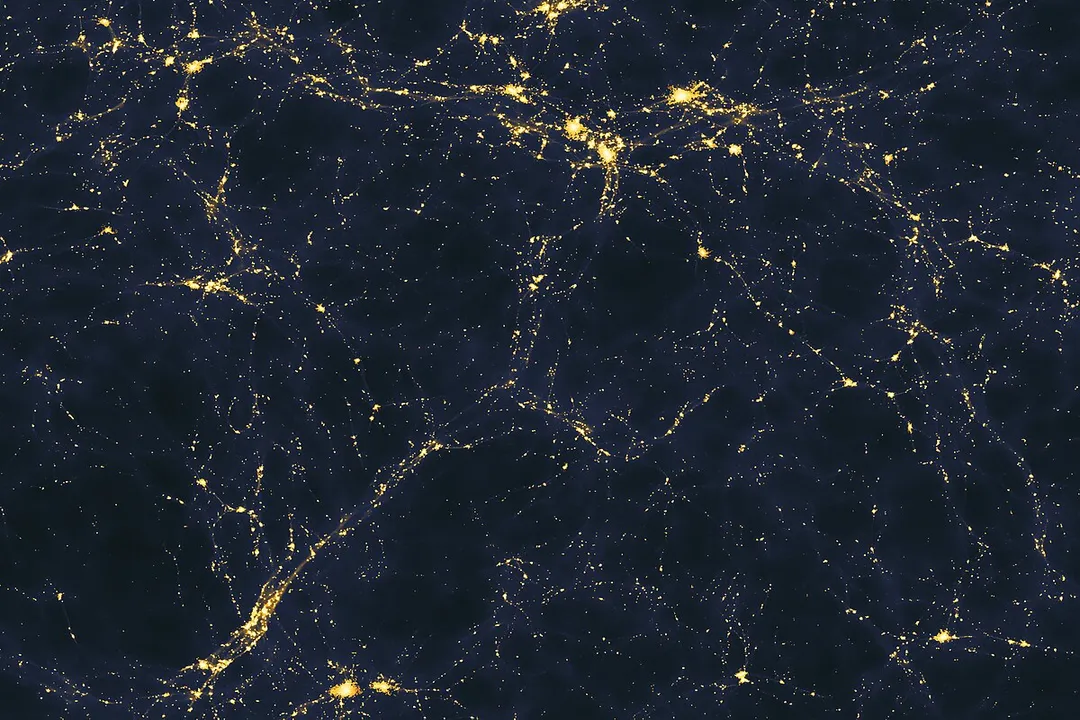
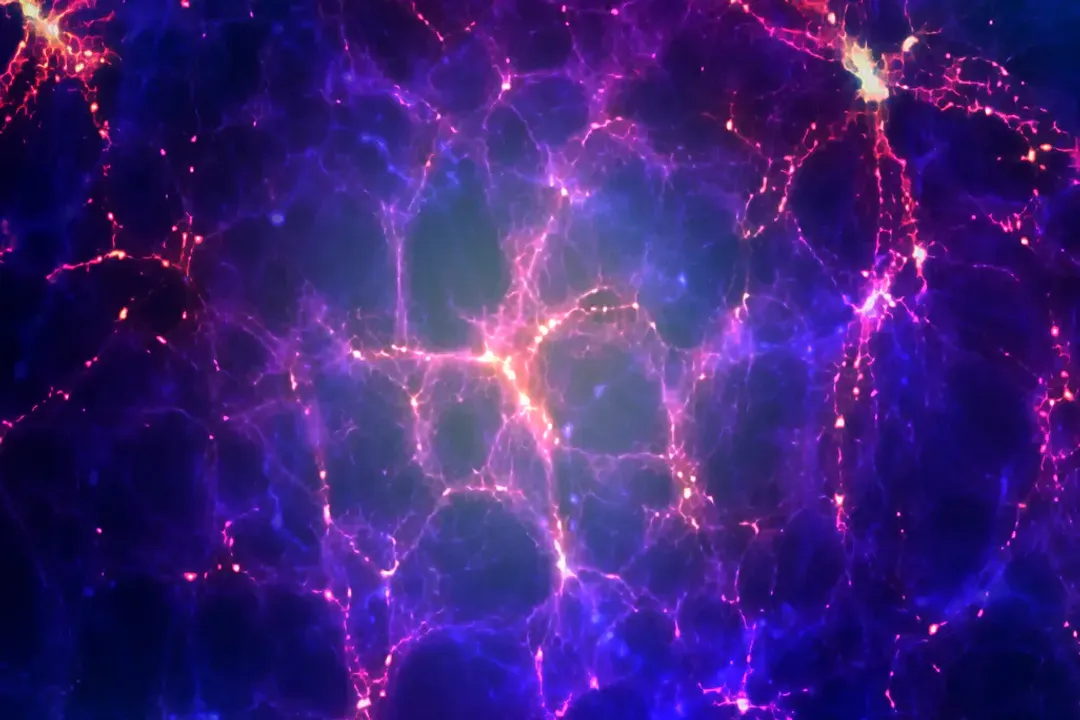
The universe is not randomly sprinkled with galaxies; rather, it organizes itself into a filamentary structure reminiscent of a sponge or a spider's web. This is the cosmic web, composed of nodes (where filaments intersect, forming massive clusters) and the filaments themselves, which are thread-like structures stretching millions of light-years.
Quipu fits perfectly into this picture, though on an entirely different scale. It is classified as a superstructure, a term used for objects exceeding the size of typical superclusters. Its geometry is described as a "giant cluster of galaxy clusters stretching approximately 1.3 billion light-years long," featuring "one main strand of clusters of galaxies from which many strands depart". This branching, string-like appearance is what inspired researchers to name it after the Incan quipu.
The identification of Quipu involved pinpointing matter within a specific distance range, officially between a redshift of 0.03 and 0.06. Redshift is the stretching of light waves due to the universe's expansion; the further away an object is, the higher its redshift. The research team focused on data from the German ROSAT X-ray satellite and employed a "friends-of-friends" algorithm to link galaxy clusters that were close enough in space to be considered part of the same entity.
This investigation revealed five major superstructures in this local volume, with Quipu being the longest. These five include Quipu, the Shapley Supercluster, the Serpens-Corona Borealis superstructure, the Hercules Supercluster, and the Sculptor-Pegasus superstructure. Collectively, these five structures account for a massive fraction of the observable universe: 45 percent of galaxy clusters, 30 percent of galaxies, 25 percent of matter, and occupying 13 percent of the volume.
To better visualize where Quipu sits relative to other known large features, it helps to compare it to some of its neighbors and predecessors, though one must be mindful of their respective distances and confirmed interconnection status.
| Structure Name | Approximate Maximum Dimension (Light-Years) | Key Characteristic/Notes |
|---|---|---|
| Quipu Superstructure | 1.3 Billion | Newly identified, branching filament of galaxy clusters. |
| Sloan Great Wall | 1.38 Billion | Previous contender, also a massive wall of galaxies. |
| South Pole Wall | 1.37 Billion | Massive contiguous feature, similar size to Sloan Great Wall. |
| King Ghidorah Supercluster | 1.3 Billion | Highly massive supercluster discovered in 2022. |
| Hercules–Corona Borealis Great Wall | 9.7–10 Billion | Potentially largest, but existence as a single structure is disputed. |
It’s a fascinating exercise to realize that the Sloan Great Wall, once considered the undisputed champion, is now surpassed in length by Quipu, although the Sloan Great Wall was identified earlier in 2003 by astronomers led by J. Richard Gott III.
# Gravitational Impact
The significance of discovering structures as large as Quipu extends far beyond simply winning a "largest object" contest. These superstructures hold such vast amounts of mass that they exert a measurable influence on the fabric of spacetime and the light traveling through it. Understanding them is vital for calibrating our measurements of the universe's fundamental properties.
One primary area of influence is the Cosmic Microwave Background (CMB), the faint thermal echo left over from the Big Bang—radiation scientists rely on to study the universe’s earliest moments. As CMB photons pass through the gravitational potential wells created by massive structures like Quipu, their wavelengths are altered. This phenomenon, described by the Integrated Sachs-Wolfe (ISW) effect, creates tiny temperature fluctuations in the CMB map. These fluctuations, if not properly accounted for, appear as foreground noise or artifacts, interfering with the pure signal we expect from the Big Bang itself. Filtering out these structure-induced distortions is a necessary, practical step in precise cosmology.
Another critical measurement affected is the Hubble constant (), which quantifies the current rate of the universe's expansion. While galaxies drift apart due to cosmic expansion, they also have inherent local motions, known as peculiar velocities or streaming motions. The immense gravity associated with superstructures like Quipu can dictate the direction and speed of these local motions across vast regions, thereby distorting the local measurements of . Correcting for the mass influence of these large structures provides a more accurate value for the expansion rate.
Finally, these massive congregations of galaxies can cause gravitational lensing on the largest scales, physically bending the light from objects situated behind them. This lensing effect can skew our measurements and interpretations of distant objects.
Observing how the matter within Quipu is distributed—whether the field clusters within it have lower galaxy density compared to the denser superstructure members—offers clues into how mass segregates itself within the cosmic web.
# Enduring or Transient?
A core debate surrounding any structure exceeding the size theoretically expected under the standard cosmological model (CDM) is whether it is truly a bound structure. Gravity is the force responsible for drawing matter together into galaxies, clusters, and filaments. However, the universe is constantly expanding. If a structure is too large, the mutual gravitational attraction between its most distant parts may not be strong enough to overcome the expansion of space over cosmic time.
For Quipu, this means that as the universe continues to stretch, some of its constituent galaxies and clusters might drift apart rather than remain locked in a single, gravitationally coherent entity. Some cosmologists suggest that if they drift apart, it might disqualify Quipu, by some strict interpretations, as a single, bound structure.
However, the researchers who identified Quipu note that their simulations based on the CDM model do produce superstructures with similar properties, suggesting that the structure is physically real within the context of our best current model of cosmic evolution. The researchers conclude that while these superstructures are transient configurations that will likely break up into smaller, collapsing units in the far future, at this present time they are special physical entities worthy of intense study. This gives us a brief, observable window into the extreme limits of gravitational clumping.
Considering the timeline, a structure stretching 1.3 billion light-years across has light traveling for 1.3 billion years to reach us. This means we are observing Quipu as it existed nearly 1.3 billion years ago. The structure we see is a snapshot of the early-to-middle cosmic era, long before the present day. An interesting implication is that any future gravitational collapse or separation of Quipu's components will only be observable to us billions of years from now, based on the speed of light constraint. We are essentially watching a very slow-motion movie of its current state, even as the local universe around us continues to evolve rapidly.
# Hierarchy and Context
Quipu’s existence emphasizes the highly hierarchical nature of the universe, where smaller structures build up into larger ones, even if the largest ones challenge our expectations. The hierarchy typically moves from stars to galaxies, then to groups (like our own Local Group), to superclusters (like Laniakea, which contains the Milky Way), and finally to superstructures.
Quipu is not just an isolated giant; it is part of a collection of five such massive groupings found in the local volume. This clustering of giants suggests that the early universe might have exhibited density fluctuations leading to significantly larger structures than previously assumed or confirmed in the immediate cosmic neighborhood. For astronomers analyzing the large-scale distribution of matter, mapping these superstructures is less about finding the final largest object and more about accurately mapping the voids—the immense, relatively empty spaces between these dense walls and filaments—which are equally important for testing cosmological theories. The existence of massive voids, like the Boötes Void (about 330 million light-years across), is intrinsically linked to the formation of the massive walls that define their boundaries. Quipu is one of the boundaries defining a vast region of lower density, a fundamental characteristic of the cosmic web.
Related Questions
#Citations
List of largest cosmic structures - Wikipedia
At 1.3 Billion Light-Years Wide, Quipu Is Officially The Biggest Thing ...
An Enormous, Branching String of Galaxy Clusters Is the Largest ...