What is the largest unit of measurement in astronomy?

The sheer size of the cosmos renders our everyday measurements completely inadequate when we try to map out the universe. Thinking in terms of kilometers, even millions of them, quickly becomes cumbersome when discussing distances between stars or galaxies. To manage these immense figures, astronomers rely on a hierarchy of specialized units, each designed to make the numbers manageable for the specific scale they are describing. The question of what constitutes the absolute largest unit depends slightly on whether we are talking about standard, professionally adopted units or descriptive terms used for the entire observable volume of space, but the progression reveals how we tackle cosmic immensity.
# Solar Scale Unit
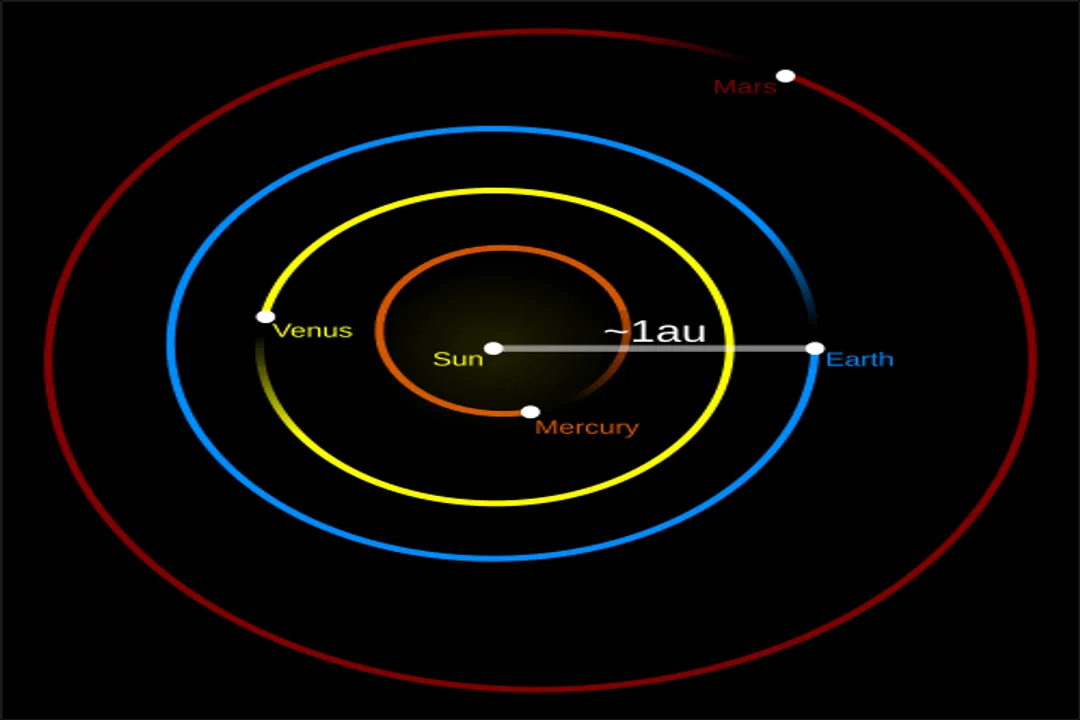
The fundamental building block for measuring within our own solar system is the Astronomical Unit, often abbreviated as AU. This unit anchors our terrestrial perspective to the rest of the planets and probes orbiting our star. Historically, the AU was defined as the average distance between the Earth and the Sun. Today, its value is fixed with extreme precision by international agreement, settling at exactly $149,597,870.7$ kilometers.
Using the AU allows astronomers to express Solar System distances in easily digestible whole numbers. For instance, Jupiter orbits at roughly $5.2$ AU from the Sun, while Neptune is out near $30$ AU. Even the furthest reaches of the classical Solar System, such as the Kuiper Belt, are measured in dozens or hundreds of AUs. This unit offers great utility for solar system dynamics and is straightforward to grasp once its baseline—Earth’s average orbit—is established.
# Interstellar Yardstick
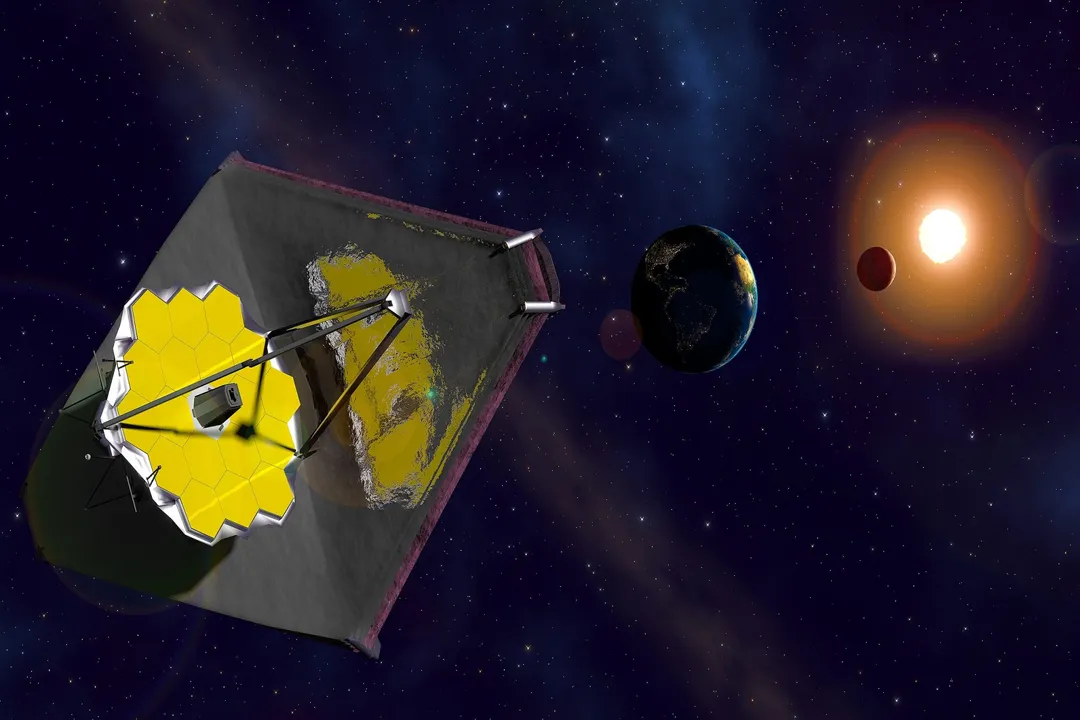
When we look beyond the Sun's immediate gravitational domain to the nearest stars, the AU starts to look rather small, and the kilometer count becomes unwieldy. This is where the Light-Year steps in as a more intuitive, if equally massive, unit.
A light-year is defined not by a physical object or a geometric measurement, but by time and speed. It represents the distance that light—traveling at approximately $299,792$ kilometers per second—covers in one Earth year. This unit gives a tangible sense of the time delay involved in observation; a star one light-year away means the light we see tonight left that star one year ago.
The conversion is significant. One light-year equates to nearly $9.46$ trillion kilometers, or roughly $63,241$ AU. The closest star system to us, Proxima Centauri, sits about $4.24$ light-years away. For describing distances between stars in our Milky Way galaxy, the light-year is a common and useful measure.
# Professional Standard

While the light-year is popular in public discourse, professional astronomers often gravitate toward a unit rooted more directly in observational technique: the Parsec (short for "parallax second"). This preference speaks to the expertise inherent in professional measurements, as the parsec is derived from trigonometry, the mathematical tool astronomers use to measure stellar distances.
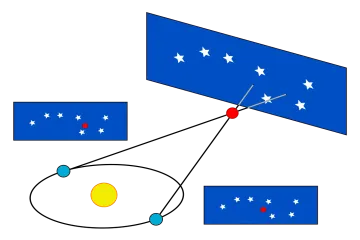
The definition is precise: one parsec is the distance at which one astronomical unit subtends an angle of one arcsecond (1/3600th of a degree). Think of it this way: if you look at a nearby star, then wait six months for the Earth to move to the opposite side of its orbit (a baseline of $2$ AU), the nearby star will appear to shift slightly against the background of much more distant stars. This apparent shift is called parallax. When that angular shift measures exactly one arcsecond, the star is exactly one parsec away.
The parsec proves to be larger than the light-year, making the numbers slightly smaller for interstellar scales. Specifically, one parsec is equivalent to approximately $3.26$ light-years. Therefore, Proxima Centauri is about $1.29$ parsecs away (). This foundational unit allows the entire structure of stellar distances to be built upon a single, observable geometric relationship.
# Scaling Galactic Space
Once distances expand from individual stars to entire galaxies, even the parsec begins to produce large numbers. To keep these figures manageable, astronomers habitually use multiples of the parsec, much like using a kilometer instead of a meter on Earth.
The Kiloparsec (kpc), equal to $1,000$ parsecs, becomes the primary unit for measuring within our own Milky Way galaxy. Our Sun, for example, is located roughly $8$ kiloparsecs from the center of the Milky Way. The diameter of the Milky Way itself is estimated to be around $30$ kiloparsecs.
Moving to the realm of galaxy clusters and the voids between them, the unit of choice becomes the Megaparsec (Mpc), which is one million parsecs. When discussing the distances to other nearby galaxies, like the Andromeda Galaxy, figures are quoted in the low millions of megaparsecs. For example, Andromeda is approximately $0.77$ Mpc away.
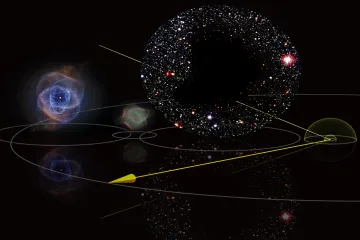
If we stretch our view to the grandest possible scale—the edges of the observable universe—we might encounter even larger terms derived from the light-year, such as the Gigalight-Year (GLY). The radius of the observable universe is estimated to be about $46.5$ billion light-years, which translates to roughly $14,300$ Megaparsecs or $14.3$ Gigaparsecs. In this context, the Gigalight-Year stands as the largest descriptive unit commonly invoked when delineating the boundaries of our observable cosmos, dwarfing the AU by an almost unimaginable margin.
| Unit | Abbreviation | Approximate Value (km) | Primary Scale Used For |
|---|---|---|---|
| Astronomical Unit | AU | Solar System objects | |
| Light-Year | ly | Interstellar distances | |
| Parsec | pc | Nearby stellar/galactic structure | |
| Kiloparsec | kpc | Within the Milky Way galaxy | |
| Megaparsec | Mpc | Intergalactic distances |
# Analyzing Scale Jumps
The most fascinating aspect of these units is the sheer multiplicative leap between them. When moving from the largest solar system unit to the smallest interstellar unit, the jump is profound.
Consider the relationship between the AU and the Parsec. We established that . This means that to travel one parsec, the distance that defines the baseline for measuring the distance to a nearby star, you would have to cross the Earth-Sun distance over sixty thousand times. If you were to take a hypothetical, perfectly straight line from the Sun to Proxima Centauri, you would have to cross the Earth's entire orbital path about $250,000$ times, since Proxima Centauri is about $1.29$ parsecs away. This emphasizes why the AU, while crucial for our local neighborhood, simply breaks down when describing the true spatial separation between stars.
It is also worth noting the subtle difference in why astronomers prefer the parsec over the light-year, even though both describe large distances. The light-year is inherently linked to the speed of light, making it easy to convert into time delays. However, the parsec is derived from the parallax angle, which is a direct measurement obtainable via observation, requiring no prior assumption about the speed of light itself—just the radius of Earth's orbit, which is $1$ AU. This grounding in pure geometry provides astronomers with a measurement scale that feels more intrinsically linked to their observational methodology for mapping the galaxy's structure. This preference is a sign of expertise in the field, favoring a geometrically derived unit over a time-based one when mapping static celestial objects.
# The Implication of Choice
The consistent adoption of prefixes like kilo- and mega- shows that astronomy fundamentally operates on the principle of proportional scaling. Astronomers are not inventing new physics for each scale; they are simply applying the metric system's logical structure to a unit (the parsec) that already works perfectly for the local stellar neighborhood. If we were to insist on using only kilometers, even the nearest galaxy cluster would be described using a number with over twenty zeros, making statistical analysis and comparison nearly impossible. The unit system itself is a functional tool that streamlines complex data analysis across vast ranges of scale.
Related Questions
#Citations
Astronomical unit - Wikipedia
Cosmic Distances - NASA Science
What is the largest unit of length? - Quora
What is the Astronomical Unit? | Science Guys - Union University
Units for Distance and Size in the Universe
The largest unit to measure distance is a light year
Using metric units for astronomy : r/space - Reddit
What are the standard units for measuring large distances?
1.2 Scale of the Cosmos – Introduction to Planetary Geology