What unit is used to measure planets?
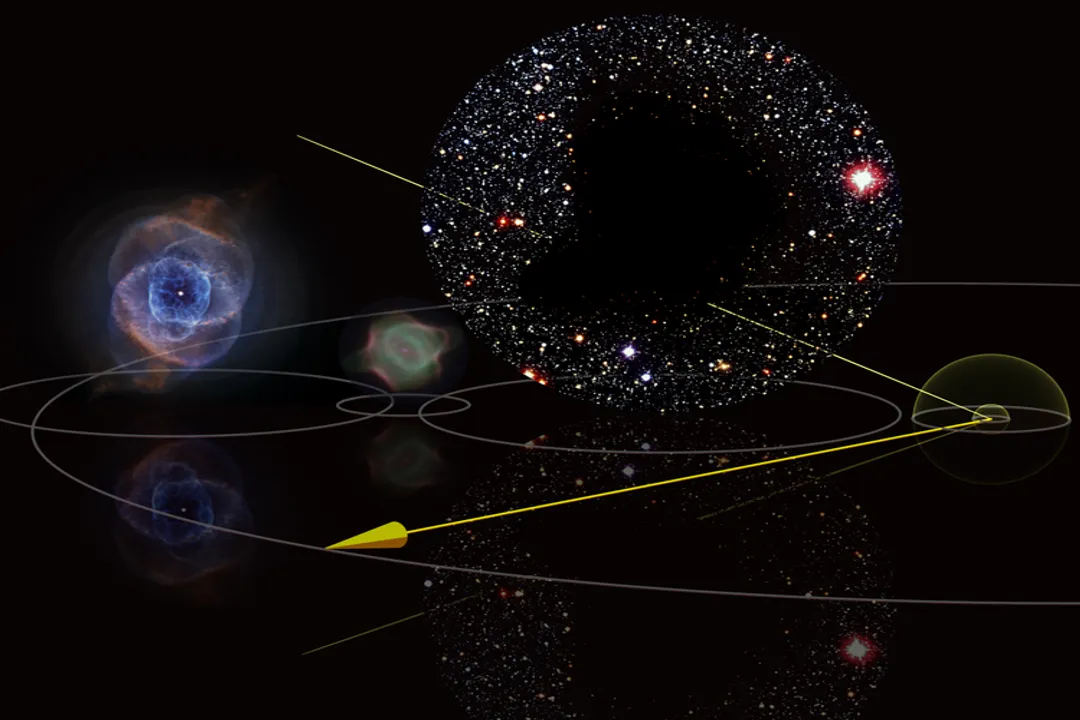
The vastness of space presents an immediate challenge when we try to describe the positions of celestial bodies. Trying to use standard terrestrial units, like kilometers or miles, to map out the solar system quickly becomes unwieldy, leading to numbers so large they obscure any meaningful comparison between objects. To manage this immensity, astronomers developed a specialized, intuitive yardstick, a unit perfectly scaled to the neighborhood we inhabit: the Astronomical Unit. [2][7] This unit anchors our understanding of distances within the Sun’s domain, providing a convenient ruler for everything from the orbits of rocky inner planets to the farthest reaches of the Kuiper Belt. [1][6]
# Defining the Measure
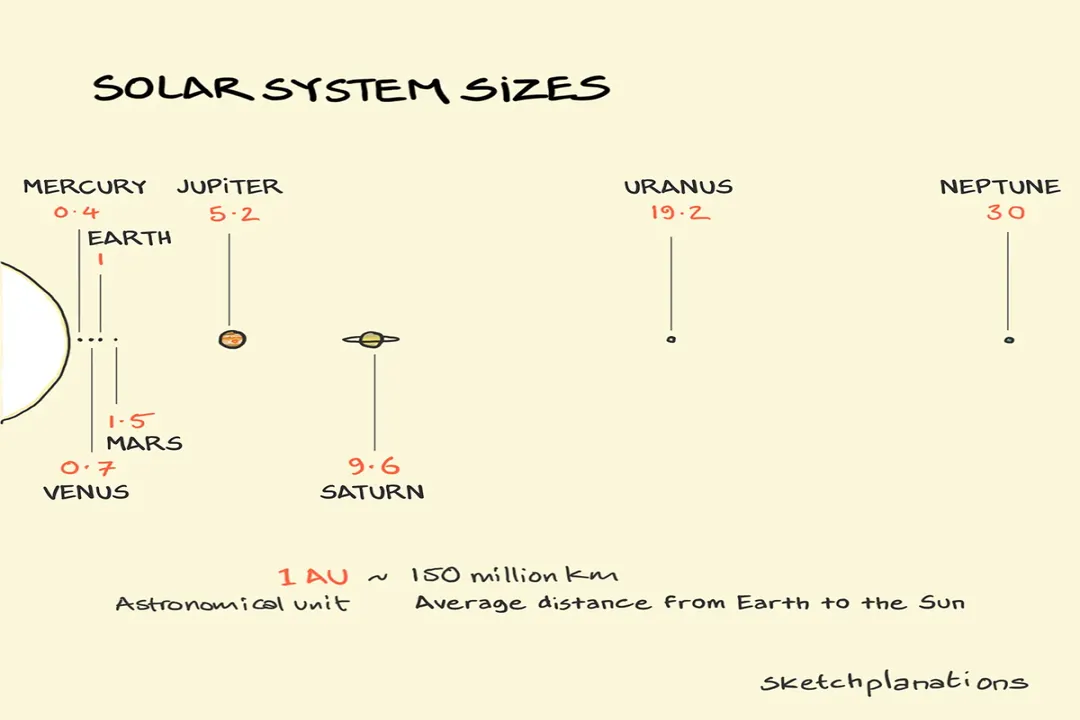
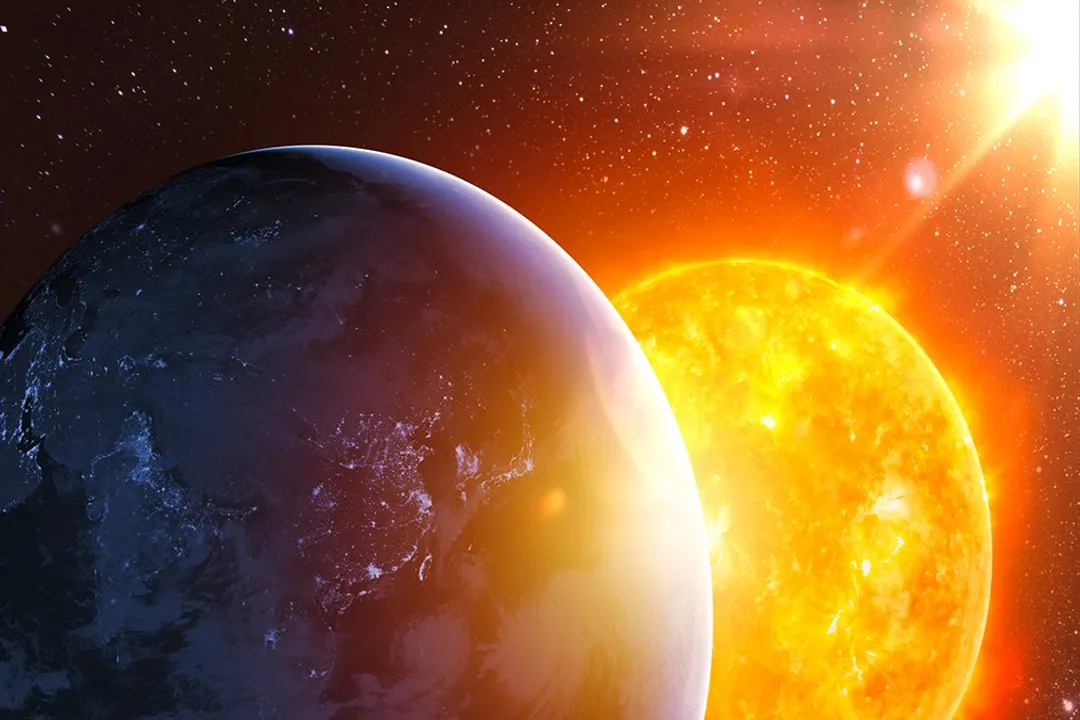
At its most fundamental, the Astronomical Unit, symbolized as AU, represents the average distance between the Earth and the Sun. [1][2][3] This isn't just an arbitrary number plucked from the air; it is derived from the very orbit of our home planet, making it inherently relevant to any discussion of the solar system. [6]
Historically, this distance was determined through complex geometric and trigonometric observations, often involving transits of Venus across the Sun's face. [3] Early measurements, while impressive for their time, carried significant margins of error because they relied on painstaking physical observation and the accuracy of those observations could drift as technology improved. [3]
The modern, official definition is far more precise and remarkably stable. In 2012, the International Astronomical Union (IAU) fixed the value of the Astronomical Unit to an exact, unchanging constant: exactly 149,597,870,700 meters. [1][7] This decision was important because the Earth's actual average orbital distance is constantly changing, albeit very slightly, due to gravitational interactions and orbital mechanics. [1] By fixing the value in meters, the AU transitioned from being a measured quantity dependent on the dynamics of the solar system to a defined standard, much like the definition of a meter itself. [1] This redefinition provides a stable basis for all modern ephemerides—the tables showing predicted positions of celestial objects. [1]
To put this fixed value into perspective, one AU is equivalent to approximately 92.96 million miles or about 150 million kilometers. [2][6] When dealing with solar system objects, this number becomes an essential scaling factor.
# Planetary Distances Scaled
The primary utility of the AU shines when comparing the orbits of the planets. If we were to discuss the distance between Jupiter and the Sun in kilometers, we would be dealing with numbers well over 778 million kilometers. However, stating that Jupiter orbits at approximately 5.2 AU is far more intuitive, immediately conveying that it orbits more than five times farther out than Earth does. [7]
Here is a look at the average distances of the major planets from the Sun, expressed in both the familiar kilometers and the more convenient Astronomical Unit: [1][6]
| Planet | Average Distance (km) | Average Distance (AU) |
|---|---|---|
| Mercury | ~57.9 million | ~0.39 |
| Venus | ~108.2 million | ~0.72 |
| Earth | ~149.6 million | 1.00 |
| Mars | ~227.9 million | ~1.52 |
| Jupiter | ~778.6 million | ~5.20 |
| Saturn | ~1,433.5 million | ~9.58 |
| Uranus | ~2,872.5 million | ~19.22 |
| Neptune | ~4,495.1 million | ~30.10 |
Considering these figures, the inner solar system (out to Mars) spans a relatively tight band of just over one and a half AUs. [4] Then, you hit the main asteroid belt, and the distances begin to expand dramatically. Jupiter, the first of the gas giants, sits more than five times farther out than Earth. [6] The gap between Mars (1.52 AU) and Jupiter (5.20 AU) is massive—nearly 3.7 AU wide. That vast gulf, home to the asteroid belt, perfectly illustrates how the scale of the solar system warps rapidly as you move outward from the Sun. [6] Imagine drawing a line on a piece of paper representing the inner solar system in one centimeter, and then realizing you need another four centimeters just to reach Jupiter; the AU captures that change in scale instantly.
The difference between the orbital radii also reveals the stark contrast in the physical nature of the planets. The small, rocky worlds are packed tightly, while the gaseous giants occupy immense, relatively empty volumes of space defined by these larger AU figures. [4]
# Solar System Measurements
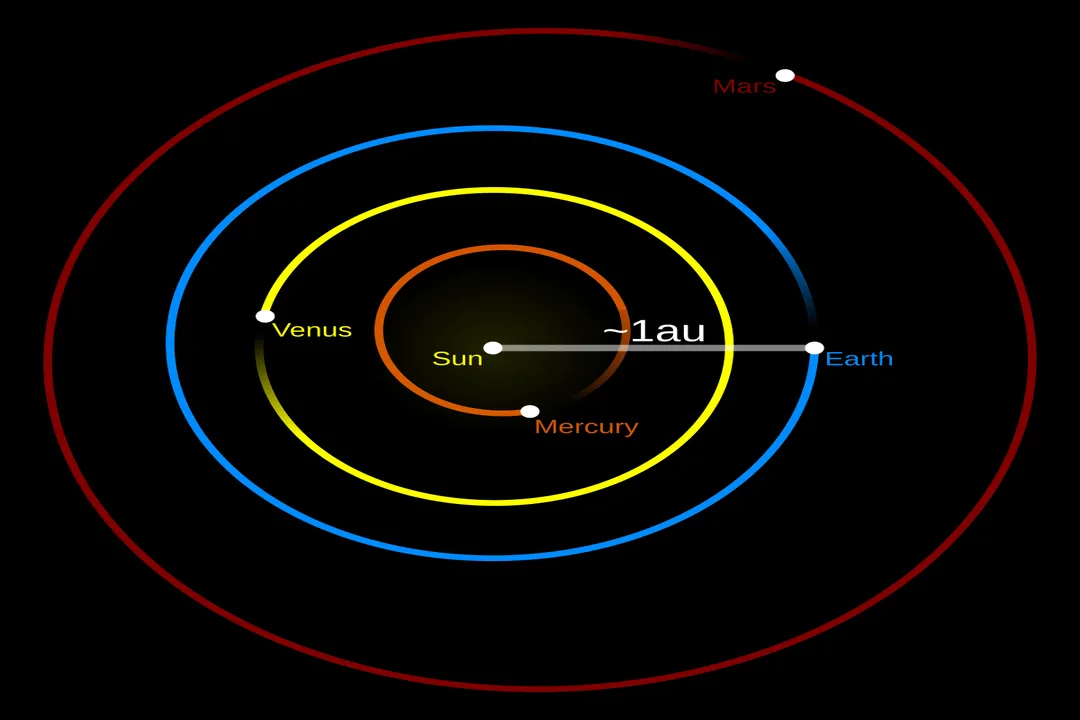
The AU is not limited to measuring distance from the Sun; it is crucial for measuring distances between planets as well. [4] For instance, determining the distance between Earth and Mars requires simple subtraction when using AUs: at their closest approaches. [4] This is significantly easier to grasp than calculating the difference in millions of kilometers.
This unit is also the standard for defining the boundaries of the solar system. Pluto, for example, averages about 39.5 AU from the Sun, placing it firmly within the Kuiper Belt, which begins roughly around . [1][8] The Voyager 1 spacecraft, which officially crossed into interstellar space, is currently measured in tens of thousands of AUs away from the Sun, a distance better expressed in light-hours or parsecs, but the AU remains the foundational unit for tracking its initial departure. [9]
The use of the AU becomes slightly more nuanced when considering the orbits of comets and distant Kuiper Belt Objects (KBOs). Many of these smaller bodies, like the famous Halley's Comet, have extremely elongated, elliptical orbits. [3] For such objects, stating a single "average" distance is less useful than providing the perihelion (closest point to the Sun) and aphelion (farthest point) distances, both expressed in AUs. [3] For example, Halley’s Comet ranges from about at perihelion to about at aphelion. [3]
# Evolution of Precision
The story of the AU is a testament to the advancement of scientific measurement. For centuries, its value was based on methods like observing the parallax of Venus during its transit—measuring the slight shift in its apparent position when viewed from different points on Earth. [3] The resulting calculations were the best available science for their time, but they were inherently imprecise. As astronomical technology improved, especially with the advent of space probes and radar ranging, scientists could measure distances with far greater accuracy than the early geometric models allowed. [3]
This drive for precision eventually made the physical measurement obsolete as the defining factor for the unit. If astronomers continued to redefine the AU based on the latest measurement of the Earth-Sun distance, then every existing catalog, every calculated orbital path, and every historical observation based on the old AU value would need continuous, minor updates. [1] This would introduce unnecessary complexity and potential confusion into scientific literature and data archives.
The 2012 IAU decision solved this by tying the AU not to a physical orbit, but to the speed of light—the ultimate constant in the universe. [1] By setting the AU exactly to $149,597,870,700$ meters, the relationship between the AU and the meter became absolute and unchanging. Now, when scientists need to know the current Earth-Sun separation, they calculate it based on the established solar system dynamics using the fixed meter definition of the AU, rather than measuring the physical distance directly for unit standardization. [1] This switch from empirical measurement to an exact definition represents a major step in standardizing astrophysical measurements for the digital age.
# Beyond the Neighbors
While the AU is perfect for mapping our solar system—from Mercury out to the Oort Cloud boundary—it quickly becomes unwieldy when discussing distances between stars. [7] The nearest star system to us, Alpha Centauri, is approximately $4.37$ light-years away. [7] Converting this to AUs yields a number in the hundreds of thousands (). [7] Stating that Alpha Centauri is about 276,000 AU away might be technically correct, but it is less informative than using the next logical scale up: the light-year or the parsec. [7]
If we look at the center of our own Milky Way galaxy, the distance is about 26,000 light-years, which translates to a figure with about 20 zeros when expressed in meters, and perhaps 16 zeros in AUs. In these regimes, the AU collapses into insignificance as a practical unit of measure. Astronomers use light-years (the distance light travels in a year) and parsecs (which relates to parallax measurements over vast interstellar distances) because they keep the numbers manageable for galactic or extragalactic scales. [7]
The utility of any unit relies on its scale matching the scope of the problem being addressed. For the dance of planets, moons, and asteroids within the Sun’s gravitational influence, the AU remains the undisputed champion of clarity and simplicity, offering an elegant bridge between the microscopic measurements of Earth and the macroscopic scale of the cosmos. [2][5]
# Practical Application and Scale
Understanding the sheer scale captured by a single AU helps contextualize planetary exploration. When a mission is launched to Mars, mission control planners are calculating travel times across a variable distance that swings between (at opposition) and (at conjunction). [4] The trajectory must account for this shifting baseline. Similarly, missions to the outer solar system, like those targeting Jupiter or Saturn, are measuring their progress in terms of the number of AUs covered. Voyager 1, for instance, reached Jupiter in about 1.5 years, covering approximately in that time. [9] This allows engineers to benchmark performance: a mission reaching per year is performing reasonably well for deep-space travel under typical propulsion methods.
The shift to a defined AU also affects how we think about orbital speeds. Since is the Earth's average distance, Earth travels this distance in one year. [3] While the absolute speed is about , in AU terms, Earth covers 1 AU per year. This provides an excellent, readily understandable metric for comparing other objects. For example, a theoretical object orbiting at would take significantly longer than 10 years to complete one orbit, governed by Kepler's Third Law, but the distance itself is immediately understood as ten times Earth’s orbital path. [8] This relationship is foundational to calculating orbital periods based on semi-major axes expressed in AUs. [8]
The persistence of the AU in both professional and amateur astronomy speaks to its inherent value as a conceptual tool. It is a unit born from Earth’s experience, making the otherwise incomprehensible scale of our own solar system immediately accessible to anyone with a passing interest in the stars. [6] It allows us to visualize the solar system not as a series of impossible-to-grasp numbers, but as a series of concentric rings separated by manageable, relatable intervals defined by our own world's orbit.
#Videos
AU and Light Years Explained - How we measure space - YouTube
Related Questions
#Citations
Astronomical unit - Wikipedia
What is an astronomical unit? - EarthSky
Astronomical unit (AU, or au) | Definition, Conversion, & Facts
What unit is used for measuring the distance between planets?
AU and Light Years Explained - How we measure space - YouTube
Astronomical Unit | BBC Sky at Night Magazine
What is an Astronomical Unit? | Cool Cosmos
2.3 The astronomical unit: a convenient way to measure distances in ...
What does the astronomical unit measure? : r/askscience - Reddit