What unit of measurement do astronomers use?
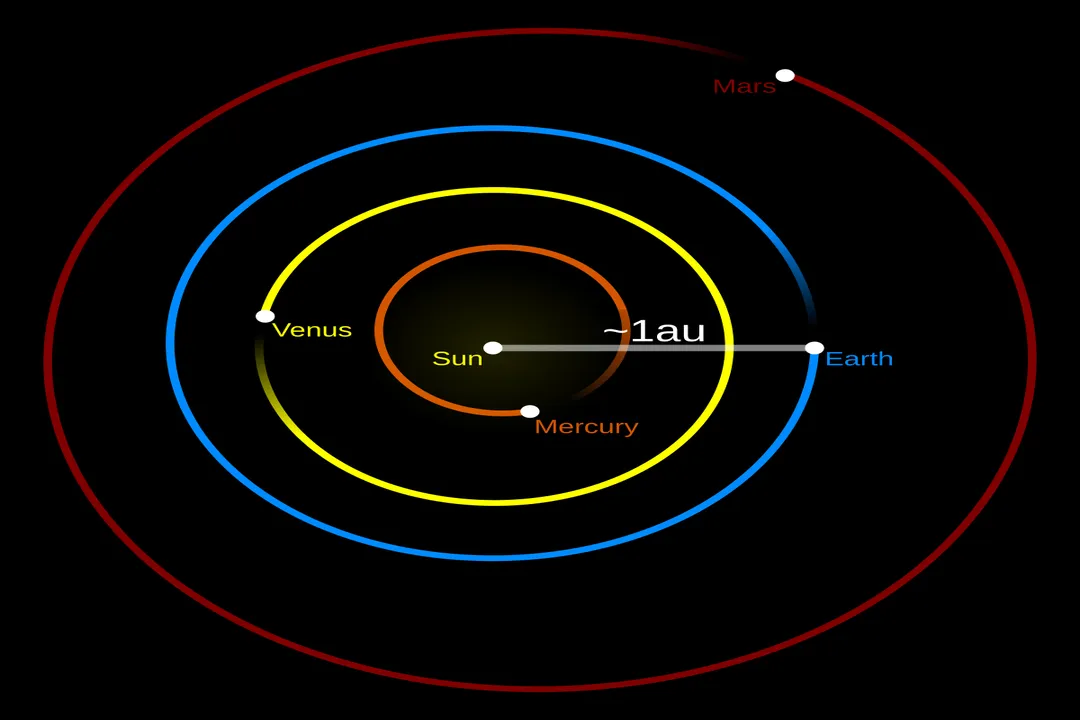
The reason astronomers rarely speak about cosmic measurements in familiar terms like miles or kilometers quickly becomes apparent when one considers the sheer scale of the cosmos. Trying to describe the distance from Earth to Jupiter in miles involves an unwieldy string of digits, which scientists rightly replace with units better suited to the local environment they are observing. [2][6] The foundational unit for understanding our own stellar neighborhood is the Astronomical Unit, symbolized today as au. [3]
# The Solar Yardstick
The Astronomical Unit, or , is defined by the most crucial distance in our immediate cosmic vicinity: the average separation between the Earth and the Sun. [1][2] Historically, this unit was intrinsically tied to observation, being conceived as the mean distance derived from the average of Earth's farthest point (aphelion) and closest point (perihelion) in its elliptical orbit. [1][3] This historical dependence on measuring Earth’s orbital characteristics meant that as measurement techniques improved, the value of the could change slightly. [1]
However, in a move that prioritized exactitude within the standardized International System of Units (), the International Astronomical Union () redefined the in $2012$. [3] It is now fixed at exactly $149,597,870.7$ kilometers. [1][3][4] This fixed value is equivalent to meters. [3] It is important to note that this fixed definition means the is now defined by the meter, rather than being derived from an actual, measured Earth-Sun distance subject to observational error, reflecting a shift where convenience is anchored to the absolute standard of the system. [3]
This standardization was necessary because previous definitions relied on the heliocentric gravitational constant (), which itself depended on the Sun's mass, a mass that is constantly decreasing as it radiates energy. If astronomers had clung to the physics-based definition, the itself would have been a time-varying unit, a situation that complicates precise calculations over long timescales. [1][3] While the modern definition is exact, the older concept—the distance from the center of the Earth to the center of the Sun—still informs the intuition behind the unit, though the few thousand kilometers difference between a center-to-center measurement and a surface-to-center measurement is relatively small compared to the variation in Earth's orbit throughout the year. [4]
# Internal Scales
The power of the lies in its ability to make solar system distances easily comparable. Stating that Jupiter orbits at about and Neptune at about gives an immediate sense of scale: Neptune is nearly six times farther from the Sun than Jupiter is, a comparison far less intuitive when dealing with tens of millions of kilometers. [1][7] For instance, Mercury averages about from the Sun, while Saturn sits at about . [3]
The also relates directly to light travel time. Since the speed of light is a universal constant, the fixed length of the means light takes a specific amount of time to cross it: approximately $499.0047838$ light-seconds, or just over $8$ minutes and $19$ seconds. [3] This is why the Sun appears as it was about $8$ light-minutes ago. [2]
# Interstellar Jumps
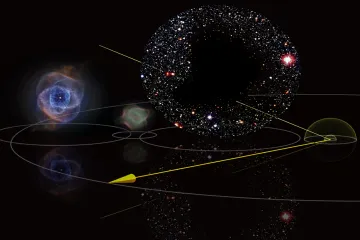
When astronomers look beyond the immediate gravitational influence of our Sun and attempt to map distances between stars, the rapidly becomes too small to be practical. If Proxima Centauri, our nearest stellar neighbor, is approximately away, that number loses its utility. [6] To handle these vast interstellar separations, the unit shifts to the light-year (). [2][6]
A light-year, a unit often confused with time because of the word "year," is purely a measure of distance: the distance a photon travels in a vacuum over one Earth year. [2][6] This single unit condenses incredible distances, equating to about or . [2][6] To put the scale difference into perspective, is equivalent to about . [2][3] Using the light-year, Proxima Centauri is about away—a far more manageable figure than its equivalent. [6]
# Professional Scaling
While the light-year is popular in general interest publications, professional astronomers—those working on star charts, galactic mapping, or theoretical astrophysics—often bypass it entirely in favor of the parsec (). [7] The name parsec is a contraction of PARallax of one arcSECond. [6] This unit is directly linked to the most reliable geometric method for measuring nearby stellar distances: parallax. As the Earth orbits the Sun, nearby stars appear to shift slightly against the backdrop of much more distant stars; this apparent shift is the parallax angle. [6][7] By definition, a star exhibiting a parallax of exactly one arcsecond ($1''$) is away. [6]
The parsec serves as a convenient bridge between the solar system scale and the galactic scale. [3]
When dealing with objects outside our galaxy, even parsecs become too small, leading astronomers to use prefixes like the megaparsec (), which equals one million parsecs, to describe the distances between galaxy clusters. [2][7] For the very furthest observable distances, another method entirely comes into play: redshift. This measures how much the light from a distant galaxy has been stretched toward longer, redder wavelengths due to the overall expansion of the universe, giving a measure of distance where even megaparsecs become too cumbersome. [2]
# Measurement Evolution and Hierarchy
The history of establishing the is a fascinating record of human persistence against the limits of early technology. [3] Early attempts by astronomers like Aristarchus in the 3rd century BCE relied on geometric methods involving the Moon-Sun angle, yielding estimates off by factors of ten or more. [3] It wasn't until the 17th century, with better geometry and instruments, that progress accelerated. The $1672$ measurement of Mars' parallax by Cassini and Richer provided a much closer value. [1][3] Later, the rare but powerful Transits of Venus across the Sun’s face allowed international teams to gather data from widely separated points on Earth to triangulate the distance with greater accuracy. [1][3]
This evolution highlights a key difference in how these units are applied versus how they are defined—a subtlety that is essential for interpreting astronomical literature.
| Scale of Measurement | Primary Unit | Approximate Conversion | Practical Application |
|---|---|---|---|
| Within a Star System | Astronomical Unit () | Planetary orbits, asteroid belts [1][7] | |
| Interstellar Space | Parsec () | Distances between nearby stars | |
| Intergalactic Space | Megaparsec () | Distances between galaxy clusters [2] |
The concept of the "Cosmic Distance Ladder" elegantly illustrates the hierarchy of these units. [6] Astronomers don't just pick one unit; they use a series of interlocking methods where the accuracy of one rung informs the calibration of the next, allowing them to move from measurements within the Solar System to parallax measurements using parsecs for closer stars, and then to 'standard candles' like Cepheid variables and Type Ia supernovae to measure distances in millions of light-years to distant galaxies. [6] The is the first rung, providing the initial scale needed to check all subsequent steps. For example, knowing the allows researchers to use angular measurements from observations like the Tau protoplanetary disk image to determine its physical size in if its distance in parsecs is known. [7]
It's interesting to reflect that while professional astronomers rely on the parsec and its derivatives for their daily work with stars and galaxies, the remains indispensable because of its fixed relationship to the meter and its intuitive scale for our own planet's orbital environment. [7] Even though a light-year is a cleaner concept for popular use, the professional community largely avoids it, suggesting a preference for units derived geometrically () or conventionally fixed to the system () over one tied to the speed of light multiplied by an arbitrary time period. [7] The debate over the 's definition in the early $2000$s, focusing on a suspected increase in its physical length, underscores how closely unit definitions are scrutinized when the accuracy required nears the limits of general relativity and planetary dynamics. The IAU’s $2012$ decision to fix it was a recognition that, for calculating ephemerides and general astronomical models, the unit’s fixed relationship to the meter was more valuable than its transient physical reality based on the Sun's changing mass. [3]
Related Questions
#Citations
Astronomical unit - Wikipedia
Cosmic Distances - NASA Science
What does the astronomical unit measure? : r/askscience - Reddit
What is the Astronomical Unit? | Science Guys - Union University
Astronomical unit (AU, or au) | Definition, Conversion, & Facts
Astronomy 101: Astronomical distances
Do we still use the term "astronomical unit" nowadays?