What is the astronomical system of unit?

The sheer scale of space necessitates special ways of thinking about distance, far beyond the simple miles or kilometers we use on Earth. When charting objects within our own solar system, these vast distances are often best described using a specific yardstick known as the Astronomical Unit, or AU. [1][4][5] This unit provides a much more manageable number for describing the space between planets than dealing with the exponential zeros required by standard metric measurements. [6] Essentially, the AU serves as the fundamental building block for measuring our immediate cosmic neighborhood, bridging the gap between planetary scales and the truly interstellar domain. [8]
# Defining The Unit
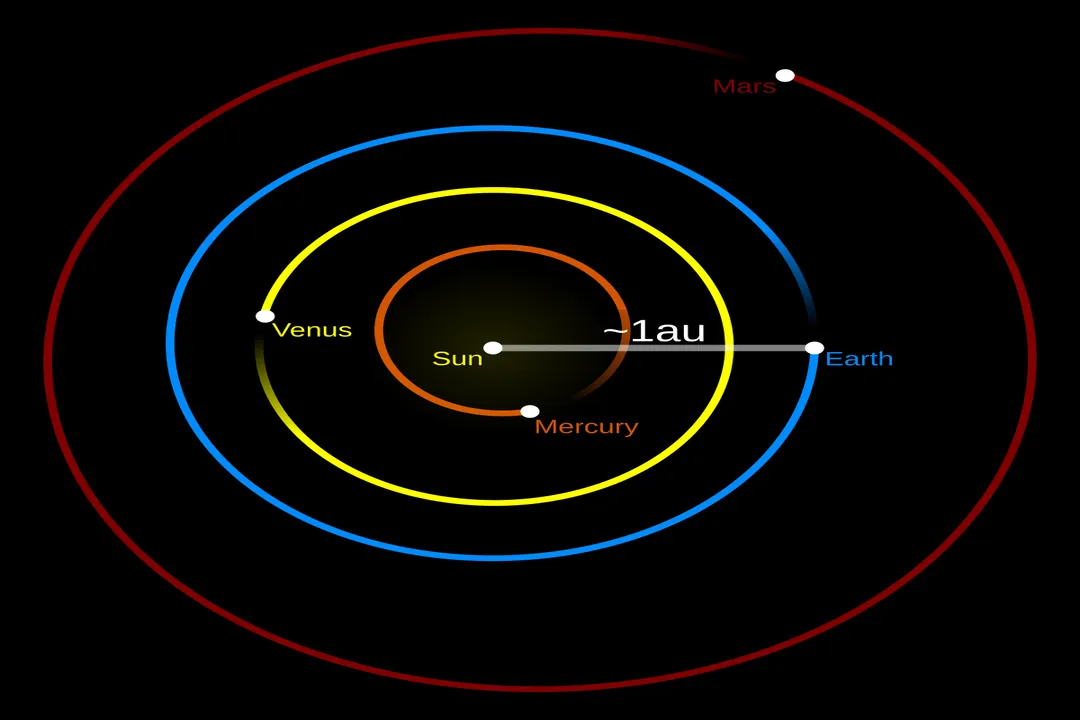
At its most fundamental, the Astronomical Unit is a measure of length. [9] For many decades, the definition was closely tied to the Earth's movement around the Sun, specifically defined as the semi-major axis of the Earth’s orbit. [2][5] However, this connection, while historically intuitive, presented ongoing challenges for precision. Because the Earth's orbit is not perfectly circular—it is an ellipse—and its distance varies throughout the year, basing a fundamental unit on it introduced inherent variability. [2][7] Astronomers needed a stable, unchanging standard for high-precision measurements, especially as spacecraft technology allowed for greater accuracy in determining planetary positions. [7]
# Historical Basis
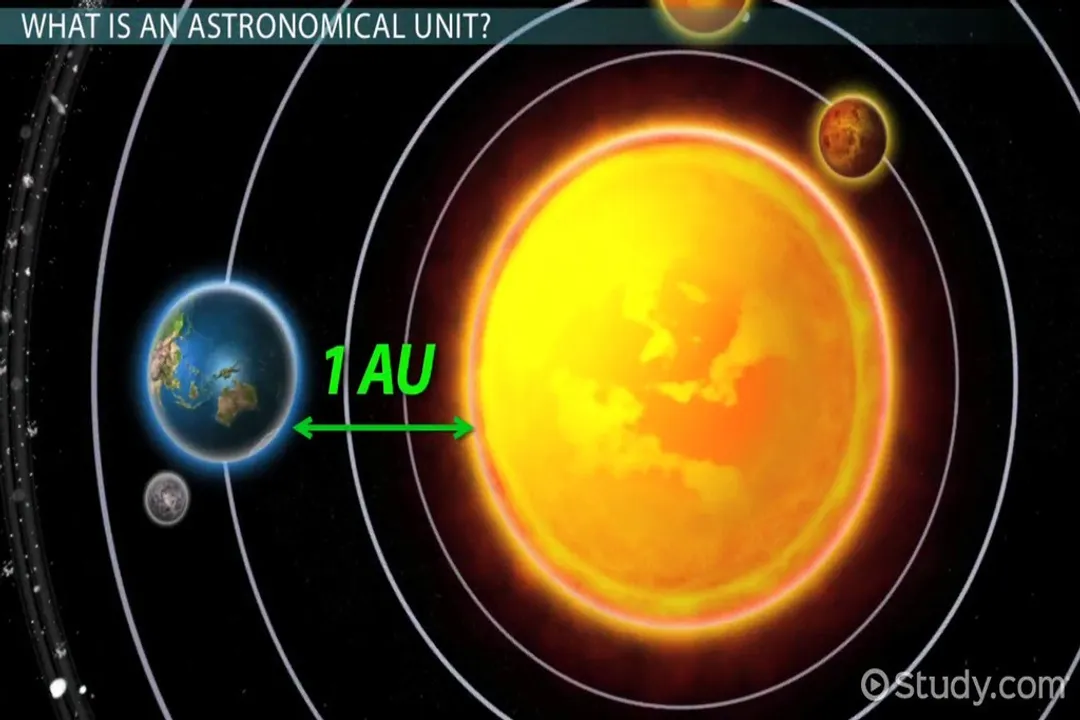
Before the modern, fixed definition, the AU was an empirical measurement derived from astronomical observation. [7] In the early days, it was an approximation of the average distance between the Earth and the Sun. [1][9] This average distance is roughly 93 million miles or about 150 million kilometers. [1][5] This historical understanding was crucial; it gave astronomers a tangible reference point—the path our own world takes—to gauge the sizes and spacing of our planetary neighbors. [5] For instance, Jupiter orbits at about 5.2 AU, meaning its average distance from the Sun is roughly five times that of Earth. [1]
The problem with this observational approach was the continuous refinement of measurement techniques. As instruments improved, the perceived value of the AU subtly shifted. The International Astronomical Union (IAU) had to repeatedly adjust the officially adopted value to reflect better data, which could complicate archival research or long-term data comparison if not handled carefully. [2][7] Imagine trying to compare the orbit of a newly discovered distant Kuiper Belt object measured today versus one measured fifty years ago, where the definition of the "standard mile" might have changed slightly in the interim—that was the challenge with the observational AU. [7]

# Modern Standard
To resolve the long-standing issue of variability and to align with increasingly precise physics, the IAU made a significant decision in 2012: they redefined the Astronomical Unit, giving it an exact, fixed numerical value, independent of the Earth's actual orbit. [2][7] This move standardized the AU globally, much like the meter is fixed by the speed of light. [7]
The modern, fixed value for the Astronomical Unit is precisely:
This exact figure is now used in all official astronomical calculations. [2][7] While the Earth's actual distance from the Sun changes throughout its elliptical path, this defined value represents the nominal distance that was accepted before the 2012 change. [7] This decoupling from the physical reality of Earth’s instantaneous position means the AU is now a constant, theoretical benchmark for solar system scale, ensuring consistency across all modern reference frames. [7] It's a fascinating shift; we moved from defining a unit by observation to defining it by fiat for the sake of precision, though the physical value remains incredibly close to the historical average. [1][5]
Here is a quick look at how the established AU relates to other common metric units:
| Unit | Equivalent in AU |
|---|---|
| 1 Meter | |
| 1 Kilometer | |
| 1 Light-Second | |
| 1 Light-Minute | |
| 1 Light-Hour |
(Data derived from defining constants and established astronomical relationships)
# Scale Comparison
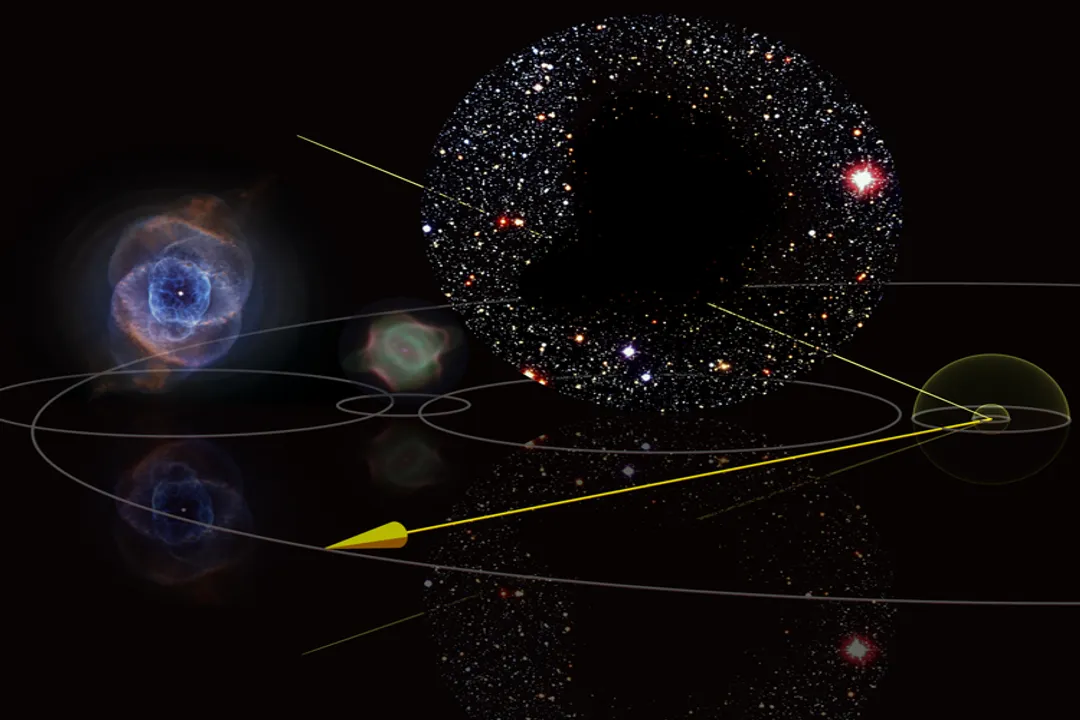
While the AU is perfect for distances within our solar system, it quickly becomes cumbersome when discussing distances outside of it, leading astronomers to adopt even larger units. [5][6] Comparing the AU to the light-year (the distance light travels in one Earth year) really highlights the scale of interstellar space. [6]
A light-year is enormous compared to an AU. Light travels incredibly fast—about $300,000$ kilometers per second. [6] Consequently, one light-year is equivalent to approximately 63,241 AU. [5][6] This comparison shows why the AU is excellent for, say, mapping the orbit of Pluto (which is about 40 AU away at its average distance), but useless for measuring the distance to Alpha Centauri, which is about $4.37$ light-years away, or over $275,000$ AU. [5]
Another common unit is the parsec (parallax second), which is defined based on the geometry of Earth's orbit, making it inherently related to the AU. [9] One parsec is approximately 206,265 AU. [9] These larger units are vital when discussing objects in the galaxy or beyond, where the AU would result in unwieldy numbers. [5]
Thinking about the local solar system, here is a helpful context: light from the Sun takes roughly 8.3 minutes to reach Earth. [1] Since $1$ AU is defined as the distance light covers in about $8.317$ minutes, this means is the distance light travels in $499.00478$ seconds. [7] This tight relationship between the AU and light travel time is one of its greatest practical assets when communicating observations about spacecraft or solar phenomena. [1]
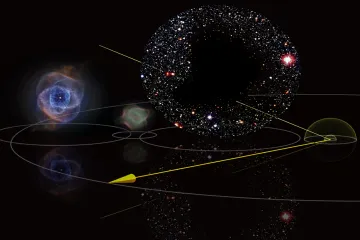
# Measuring Solar System
The primary utility of the AU remains defining the architecture of our local neighborhood. [4] Consider the major planets:
- Mercury orbits at about . [1]
- Venus is around from the Sun. [1]
- Mars averages about . [1]
- Jupiter, as mentioned, is at . [1]
- Saturn rings in near . [1]
- Uranus is about out. [1]
- Neptune sits at roughly . [1]
These numbers are clean, easy to compare, and easily translated back into kilometers or miles when needed for engineering purposes. [4] For example, if a probe is traveling to Jupiter, mission planners know they are sending it across a distance of about after it crosses Mars' orbit, which is a far more intuitive figure to track than a measurement starting in the hundreds of millions of kilometers. [4]
A compelling point arises from considering the outer solar system's fuzzy boundary. The Kuiper Belt, where dwarf planets like Pluto reside, starts around and extends outward. [8] To send a message from the Voyager 1 spacecraft, currently one of the most distant human-made objects, the travel time for a signal can be hours, reflecting its distance in many tens of AU. [8]
One subtle way to appreciate the fixed definition is to consider spacecraft navigation. When a mission like New Horizons was planned, engineers needed extreme accuracy to account for gravity assists and trajectory corrections over years of travel. The stability offered by the fixed $149,597,870,700$ meter value, rather than relying on a potentially drifting historical average, gave them the necessary bedrock for complex orbital mechanics calculations, ensuring the probe hit its target millions of kilometers away with minimal error. [7] This contrasts sharply with early space probes where error margins in initial distance calculations could significantly impact fuel needs or flyby accuracy. [2]
# Astronomical Utility
The AU is more than just a static ruler; it acts as a conceptual anchor in astronomical work. It helps set expectations for the vastness encountered even within a single star system. For example, the diameter of the Sun itself is only about . [5] This single comparison reveals how tiny our star is relative to the orbits it commands.
Furthermore, the AU system assists in establishing relative orbital speeds. Kepler's laws, which govern planetary motion, are often expressed using orbital periods and semi-major axes (which is the AU definition). When analyzing a newly discovered exoplanetary system, if astronomers can determine its scale relative to its host star, they often express that scale initially in AU-equivalents to provide immediate context for Earth-based readers. [9] Does the planet orbit closer than Mercury, or farther than Neptune? The AU provides that instant frame of reference. [1] This direct comparison capability is what maintains its relevance even as light-years dominate interstellar discussions. [5]
Related Questions
#Citations
What is an astronomical unit? - EarthSky
Astronomical unit - Wikipedia
Astronomical System of Units | PDF - Scribd
What is the Astronomical Unit? | Science Guys - Union University
Units for Distance and Size in the Universe
Video: Astronomical Unit | Definition & Conversion - Study.com
The new definition of the astronomical unit : exactly 149 597 870 700m
Cosmic Distances - NASA Science
Astronomical unit (AU, or au) | Definition, Conversion, & Facts