What is the Sagittarius Arm in the solar system?
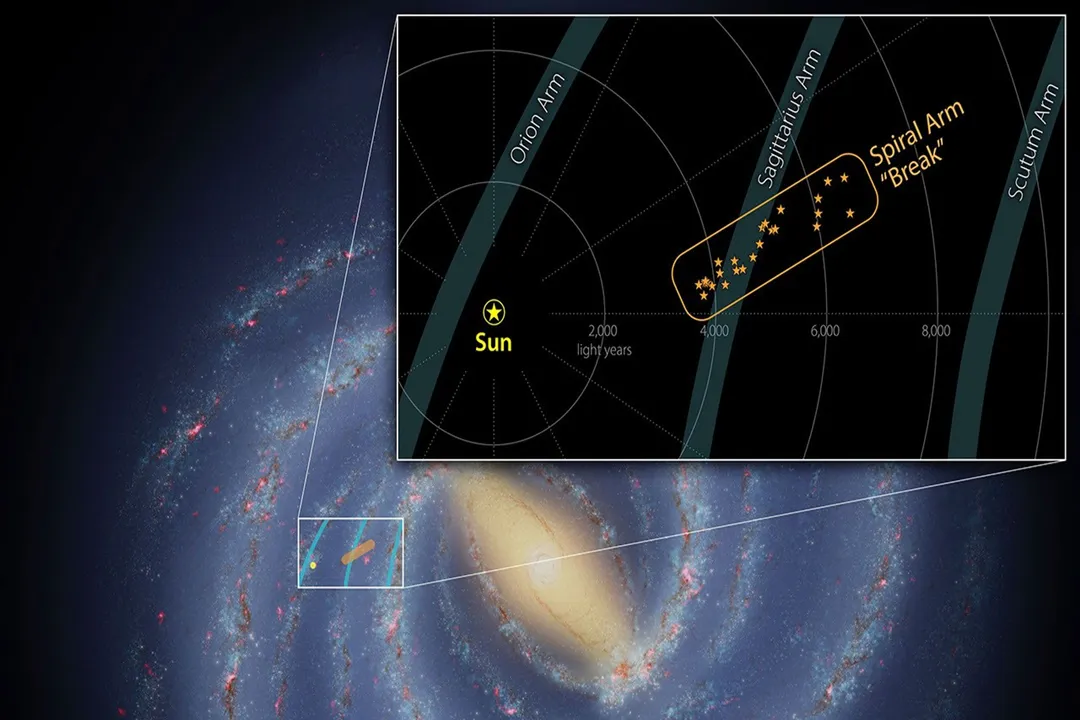
The Sagittarius Arm is a major structural component of our home galaxy, the Milky Way, and understanding its location relative to the solar system helps situate our Sun in the grand cosmic architecture. It is officially recognized as a spiral arm, a sweeping band of stars, gas, and dust that winds outward from the galactic center. When we discuss the Sagittarius Arm in the context of our solar system, we are immediately dealing with matters of scale and relative position, as our local neighborhood is not situated directly within this large structure, but rather near it.
# Spiral Structure
The Milky Way is a barred spiral galaxy, meaning it possesses a central bar-shaped structure composed of older stars, from which its spiral arms emanate. Astronomers classify these arms based on their density waves, which compress interstellar matter and trigger star formation. The Sagittarius Arm is distinguished as one of the primary spiral features of the galaxy.
Its naming convention often causes some initial confusion, as it is sometimes referred to as the Carina–Sagittarius Arm, linking it conceptually with another active region of star formation. This arm is rich in interstellar material and ongoing stellar nurseries, making it a significant region for understanding galactic evolution.
To put this into perspective, imagine the Milky Way as a giant cosmic pinwheel spanning perhaps a hundred thousand light-years across. Our own solar system orbits the galactic core at a distance of roughly 26,000 to 27,000 light-years away from the center. The Sagittarius Arm lies roughly 10,000 light-years deeper toward the galactic center than our Sun's current position.
# Our Local Position
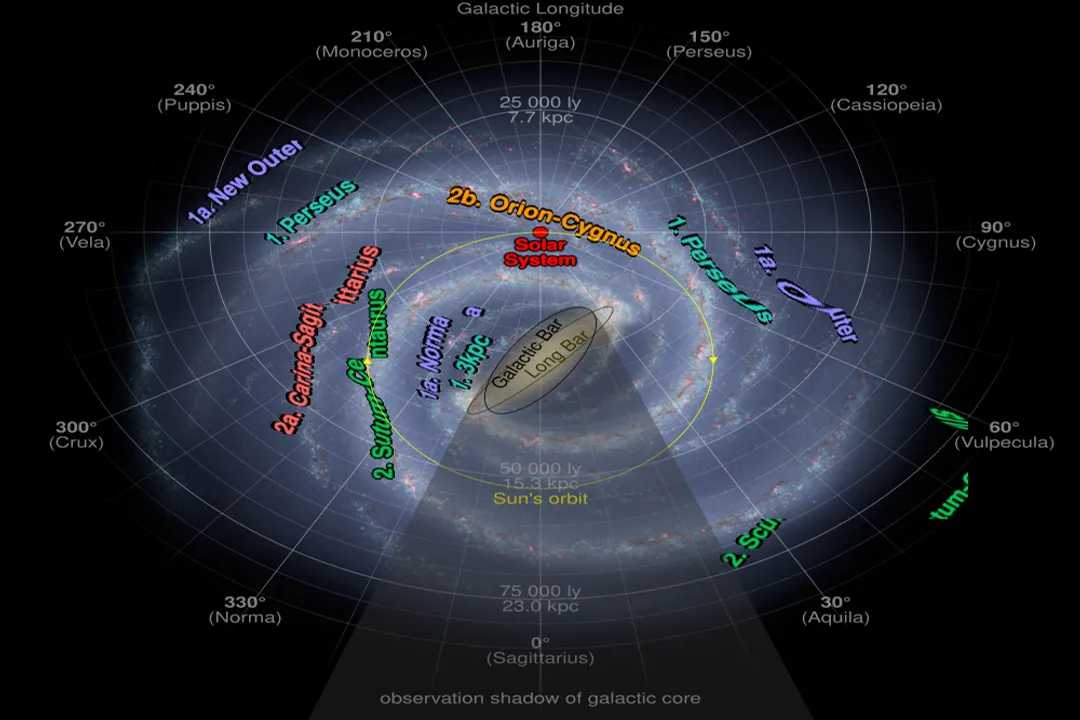
The key to understanding the Sagittarius Arm's relationship to us is understanding what does contain the Sun and the planets. Our solar system resides within a comparatively smaller, local feature called the Orion Spur, sometimes also designated as the Orion Arm. This spur is not considered one of the main, massive spiral arms; instead, it's a lesser structure, essentially a minor offshoot or bridge between the larger Perseus Arm and the Sagittarius Arm.
This distinction is important. If the Sun were embedded deep within the core of the Sagittarius Arm itself, our night sky views would be drastically different, likely overwhelmed by the sheer density of stars and nebulae concentrated within that primary arm. Because we are situated in the Orion Spur, we have a less obstructed, though still dramatic, view of the galactic plane.
If we were to view the Milky Way from an external vantage point—say, from a hypothetical galaxy parked nearby—the Milky Way would appear as a grand spiral, and we would see the structure of the Sagittarius Arm sweeping past us, separated by a gap of dark space and fewer stars. Thinking about our position in the Orion Spur versus being in the Sagittarius Arm is like comparing a small suburban cul-de-sac branching off a major interstate highway versus living directly on the main thoroughfare; both are roads, but their immediate surroundings and traffic density vary significantly.
# Observation and Visibility
When observing the Milky Way from Earth, the appearance of the spiral arms is profoundly influenced by our location within the disk. Since we are positioned between the Perseus and Sagittarius Arms, when we look toward the galactic center, we are essentially looking through the Sagittarius Arm, which appears as a particularly dense and bright band of the Milky Way in the night sky.
Observatories and space probes study these arms through various wavelengths of light. Visible light is often obscured by massive clouds of interstellar dust concentrated in these spiral structures. This dust forms dark lanes that interrupt the view of the brighter stars beyond them. For instance, NASA has documented observations of specific breaks or gaps within the Sagittarius Arm itself, where star formation activity appears less dense at that particular section of the arm. These gaps are likely temporary features in the dynamic life cycle of a spiral arm.
Our perspective from the Orion Spur means that when we look in the direction of the Sagittarius Arm, we see a line of bright, young stars and glowing nebulae concentrated along that sightline. Were we looking in the opposite direction, toward the Perseus Arm (which is farther out from the galactic center than we are), we would see that arm as well, also appearing as a bright band, though perhaps with a different distribution of star types.
# Conceptual Comparisons
It is worth noting how frequently the term "Sagittarius Arm" appears in contexts outside of professional astronomy, which sometimes muddies the waters for the general reader. Due to its imposing nature and location toward the galactic core, the name has found its way into science fiction universes, such as in Star Trek, and appears in various discussions online, sometimes leading to confusion about its actual astronomical parameters.
When comparing the local structure we inhabit, the Orion Spur, to the massive Sagittarius Arm, the difference in scale is immense. The Orion Spur is relatively short and somewhat disorganized compared to the grand, coherent structure of a primary arm like Sagittarius. If the Sagittarius Arm is a massive, sweeping coastal highway, the Orion Spur is perhaps a significant, but localized, off-ramp where our solar system happens to be parked.
This localized environment—our position in the Spur—is what dictates the appearance of the Milky Way in our sky. For example, if we could magically teleport our entire solar system to a location deep within the Sagittarius Arm, the sky would change. The familiar patch of sky we see tonight would be replaced by a far greater concentration of light and obscuring dust clouds, simply because we would be physically inside a much denser region of the spiral. The density gradient shifts dramatically between these structures.
One useful way to conceptualize the difference in structure is to consider the age and activity of the stellar populations traced by these features. Primary arms like Sagittarius are where intense, short-lived, massive blue stars are consistently being born and dying, whereas our local Spur contains a more mixed population, including many older stars that have migrated inward or outward from their original formation sites.
To help visualize the relative distances, consider this comparative scale using the distance from the Sun's location in the Orion Spur:
| Galactic Feature | Approximate Distance from Sun (Light-Years) | Relative Position |
|---|---|---|
| Sun/Orion Spur Center | 0 | Local Residence |
| Sagittarius Arm (Nearest Edge) | ~10,000 | Inward (Toward Center) |
| Galactic Center | ~26,000 | Deep Inward |
| Perseus Arm (Nearest Edge) | ~20,000 - 30,000 (Outward) | Outward (Away from Center) |
| Outer Edge of Galaxy | ~50,000+ | Far Outward |
| [1][3] |
The fact that the Sagittarius Arm is inward from us means that when we look toward the galactic center—the brightest part of our galaxy—we are looking right through the dense bulk of the Sagittarius structure. This alignment is why it is so prominently featured in our night sky maps.
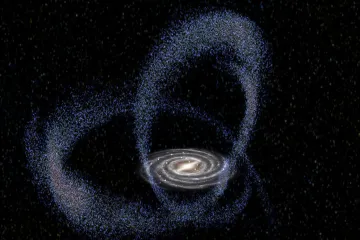
# Perspective and Perception
A fascinating aspect arises when contemplating our view of the structure from our vantage point. When someone on Earth looks up, they perceive the Milky Way as a luminous band stretching across the heavens. If one were standing on a planet located deep inside the Sagittarius Arm, they would also see the galaxy concentrated into a band, but that band would represent a different segment of the galaxy relative to their new position. The perceived "band" is an unavoidable feature of viewing a flat, rotating disk structure from any point within that disk.
This introduces an interesting thought experiment regarding the constancy of sky appearance. If one were situated in the Orion Spur, looking toward the Sagittarius Arm, the view would be a dense ribbon of light. If one were in the Sagittarius Arm, looking back toward the Orion Spur (which would be "outward" from the center), that spur would still appear as a feature against the backdrop of the galaxy, though the perspective geometry—the angle and distance—would be entirely different. The fundamental appearance of a "Milky band" seems intrinsic to being inside the galactic plane, regardless of which spur or minor arm you call home, provided the local dust clouds aren't completely opaque.
Another point that often surfaces in public discussion, as seen in online forums, is the occasional doubt about the established models, perhaps stemming from the complexity of mapping the galaxy from our internal viewpoint. It is a challenge comparable to drawing a map of a forest while standing in the middle of it, with the center of the forest (the galactic core) being obscured by trees (dust clouds). Therefore, the identification of these arms relies heavily on tracing the distribution of young, massive stars and specific molecular clouds that clearly outline the spiral density waves.
If we consider the sheer volume of space the Sagittarius Arm encompasses, it represents a huge reservoir of gas and dust where the stellar cycle is constantly playing out. Its proximity to the center means it is subject to the stronger gravitational influence and rotational dynamics of the inner galaxy, contributing to its defined structure as opposed to the more diffuse nature of the outer arms.
To summarize the human experience of this structure, consider this: the light that strikes our eye tonight from the brightest parts of the Milky Way is often light that has traveled thousands of years from stars currently residing in or near the Sagittarius Arm, showcasing a time lag built into our visual experience of galactic structure. When we consider the dynamics, we are seeing a structure that is dynamic on timescales far exceeding human history, yet its appearance in our sky is relatively stable on human timescales because the entire system rotates slowly relative to us. The subtle "breaks" noted by NASA are the most dynamic features we can observe over relatively short periods.
The persistent nature of the Sagittarius Arm as a landmark in our galaxy is cemented by its massive scale and its defining role in the inner structure of the Milky Way. While our solar system enjoys the slightly quieter neighborhood of the Orion Spur, the Sagittarius Arm remains the dominant, visible neighbor on the inner side of our galactic orbit, a constant, luminous testament to the grand spiraling form of our home galaxy.
#Videos
What Is The Sagittarius Arm Of The Milky Way? - Physics Frontier
Related Questions
#Citations
Carina–Sagittarius Arm - Wikipedia
The Sagittarius Arm : r/MandelaEffect - Reddit
Sagittarius Arm - eSky - Glyph Web
Sagittarius Arm - Memory Alpha - Fandom
A Break in the Milky Way's Sagittarius Arm - NASA Science
Sagittarius arm of the Milky Way galaxy image - Facebook
What Is The Sagittarius Arm Of The Milky Way? - Physics Frontier
Sagittarius Arm - Gineipaedia, the Legend of Galactic Heroes wiki
If we could look at the Orion spur from the Sagittarius arm ... - Quora