Why does the solar system stay together?
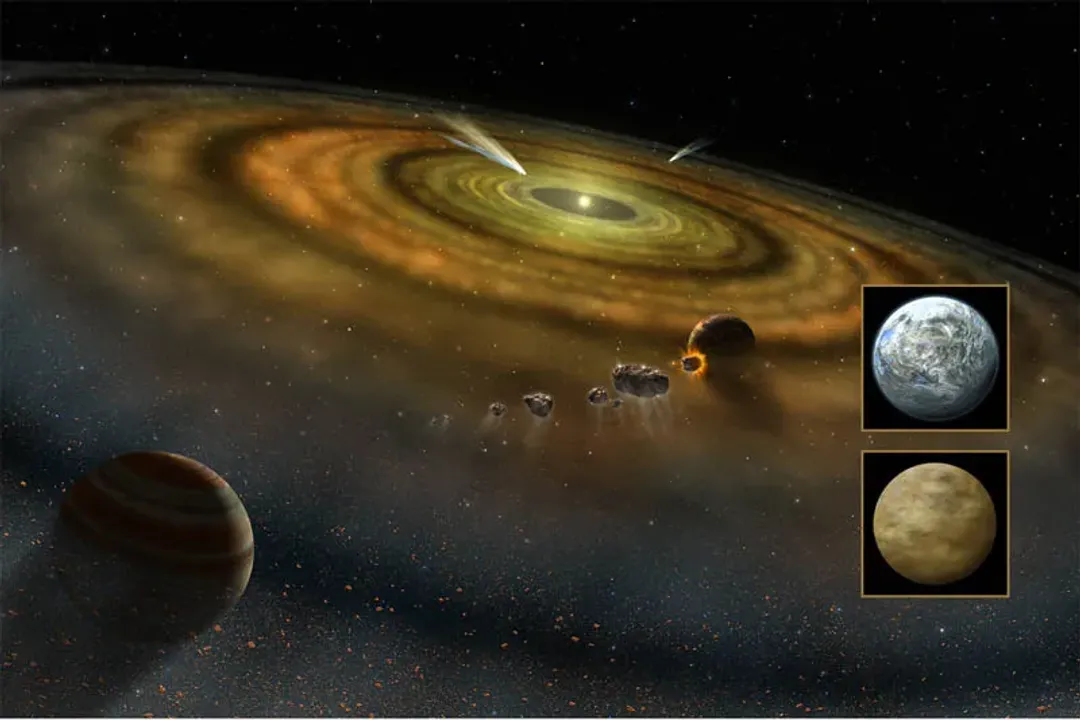
The existence of a relatively ordered collection of planets, moons, asteroids, and comets circling our Sun, rather than a chaotic scattering of debris, is one of the most fundamental aspects of our cosmic neighborhood. This grand structure, the Solar System, remains bound together by a precise and ongoing interplay of forces, a dynamic equilibrium established billions of years ago during its birth. [4][9] The key ingredients enabling this long-term cohesion are gravity, which acts as the constant tether, and the inertia or sideways velocity of every object, which keeps them from simply falling straight into the central star. [10]
# Gravitational Anchor
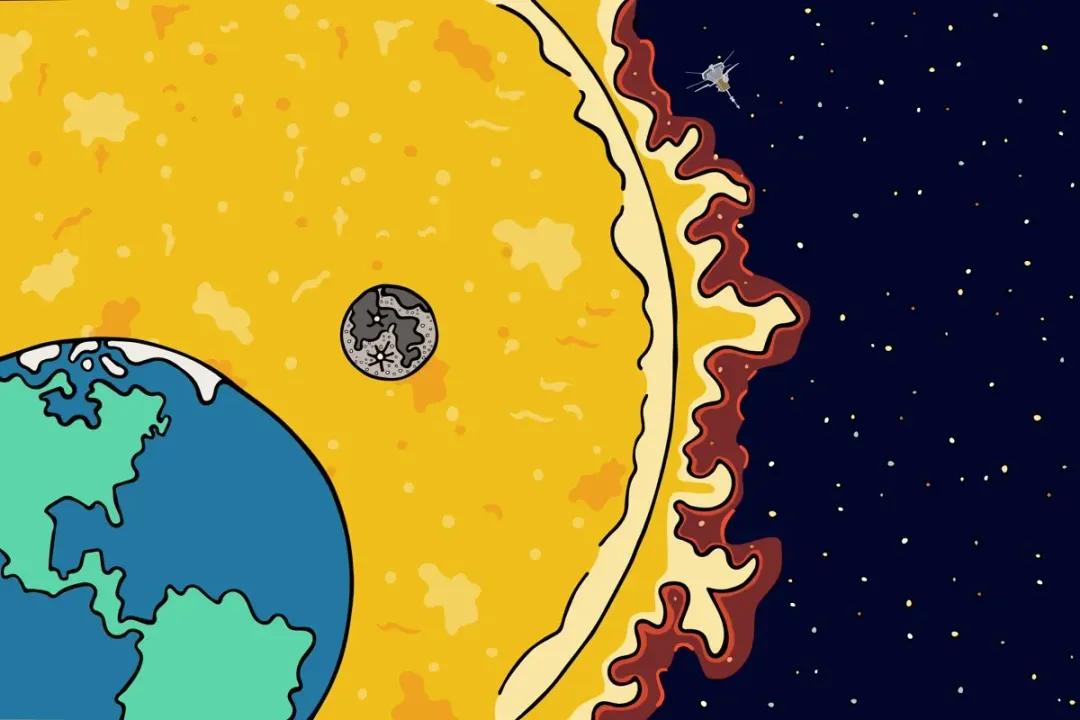
The Sun, by virtue of its immense mass, exerts a gravitational pull strong enough to dominate the motion of every other body within the system. [9] This force is the primary reason the system stays together rather than flying apart into interstellar space. Every object, from the smallest dust particle to the largest gas giant, is attracted toward the Sun. [10]
However, gravity alone is not the whole story. If the planets were merely stationary masses near the Sun, they would eventually collide with it. The stability we observe is a result of how these two factors—the inward pull of gravity and the forward momentum of the planets—are balanced. [4][10] Imagine swinging a weight on a string: the tension in the string is analogous to gravity, constantly pulling the weight inward, while the weight's forward speed is its inertia, constantly trying to carry it away in a straight line. [2] When these forces are perfectly matched for a specific distance, the result is a stable, repeating orbit. [4][10]
This balance dictates the path of everything. For instance, Mercury, being closest to the Sun, must move at a very high velocity to counteract the Sun's strong gravitational grip and maintain its close orbit. [2] Conversely, Neptune, orbiting much farther out where the Sun's gravity is significantly weaker, moves much slower, yet its lower orbital speed is precisely what is needed to keep it from flying off into deep space, given its vast distance from the central mass. [2]
If an object were somehow suddenly slowed down without its distance changing, the gravitational influence would momentarily overpower its forward motion, causing its orbit to become more elliptical or even spiral inward. [10] Conversely, if a planet suddenly gained a massive burst of speed perpendicular to its path, it might escape the Sun's grip entirely, though escaping the Solar System completely requires reaching the escape velocity, which is much higher than typical orbital velocity. [4]
It's useful to consider the relative scales of these forces. The Sun contains about 99.8% of the total mass in the Solar System. [2] This dominance means that while the outer planets do exert gravitational influence on each other and the Sun, their long-term paths are overwhelmingly dictated by the central star. The influence of Jupiter on the inner solar system, while significant in terms of deflecting asteroids, is minor compared to the Sun's overall control. [6]
# Orbital Path
Planets do not simply follow perfect circles; their paths are ellipses, as described by Kepler's laws, although for most major planets, these ellipses are very close to being perfect circles. [4] The shape and speed of the orbit are intrinsically linked to the planet's angular momentum. This is a property related to both its mass and how fast it is moving around the center point. [4] Because of the near-total mass dominance of the Sun, the angular momentum of the entire system is largely conserved along the axis defined by the initial formation process. [3]
When considering how various parts of the system interact, we must look at the gravitational influence between objects beyond the Sun-planet relationship. [6] While the Sun is the primary governor, planets do tug on each other. For example, Jupiter’s gravitational influence is strong enough to dramatically affect the orbits of smaller bodies, like asteroids, sometimes flinging them out of the main belt or pushing them into new trajectories. [6] This is an example of how the system remains interconnected through these mutual attractions, not just tethered to the center point.
A helpful way to visualize this interconnectedness involves thinking about resonant interactions. If a small body's orbital period is a simple fraction of a larger body's period (like $2:1$ or $3:2$), the gravitational nudges it receives from the larger body occur at the same points in its orbit over and over again. This repeated, rhythmic tug can dramatically alter the small body’s path over millions of years, leading to gaps in the asteroid belt or the Kirkwood gaps, which are regions cleared out by Jupiter's influence. [6] The system stays together, but its inner architecture is constantly being sculpted by these subtle gravitational conversations. [6]
# Disk Formation
One of the most fascinating aspects of the Solar System's structure is not just that the planets orbit the Sun, but how they orbit. Nearly all the major planets move in orbits that lie close to the same flat plane, known as the ecliptic. [1][3] Furthermore, they all travel in the same direction—counter-clockwise when viewed from above the Sun's north pole. [1] This remarkable alignment is a direct inheritance from the Solar System's formation process. [3]
The Solar System began as a massive, rotating cloud of gas and dust known as a solar nebula. [3] As this nebula collapsed under its own gravity to form the Sun, the principle of conservation of angular momentum came into play. [3] Think about a figure skater pulling their arms in while spinning: they spin faster. Similarly, as the large, diffuse cloud shrank toward the center, its rotation rate increased dramatically. [1]
Because the cloud was spinning, the material did not fall straight down onto the central point. Instead, the rotation naturally flattened the cloud into a spinning pancake or disk, much like spinning pizza dough flattens out. [1][3] Any material that strayed significantly above or below this mid-plane would have its orbital motion corrected by collisions with other material moving along the plane, effectively dampening out the vertical motion. [1] The planets then formed through accretion—the gradual clumping of material—within this spinning, flat disk. [3] This initial flattening is why the Solar System possesses its characteristic, thin geometry today. [1][3]
If the initial cloud of gas and dust had very little net spin, or if the subsequent evolutionary processes had been very disruptive, we might see a system where planets orbited at highly varied inclinations, some almost perpendicular to the others. The fact that Mercury, Earth, Jupiter, and Neptune all sit within about seven degrees of the ecliptic plane speaks to the sheer efficiency of that early flattening process. [3]
# Stability Factors
The long-term cohesion of the Solar System is also a testament to a kind of self-correcting mechanism inherent in orbital mechanics over vast timescales. [8] While the system is incredibly stable on human timescales—millions of years—it is not perfectly static. Gravitational dynamics are at work, meaning that the positions and velocities of objects are constantly being minutely adjusted. [8]
Consider the concept of the Hill Sphere. This is the region around a planet where its gravity is strong enough to hold onto its own moons, overcoming the Sun's dominant pull. [6] The existence of stable moons around Jupiter, Saturn, and even the Earth demonstrates that the Solar System is not just a collection of objects orbiting the Sun; it is a nested hierarchy of orbiting sub-systems, each gravitationally bound to its primary planet. [6] This structure is preserved because the mass distribution dictates distinct zones of gravitational influence.
To illustrate the efficiency of this structure, let's imagine a hypothetical scenario: What if Earth suddenly had double its current mass? While the Sun's influence would still be dominant, Earth's increased gravity would exert stronger periodic nudges on Mars and Venus. Because the system is already flattened, these nudges would primarily occur within the ecliptic plane, mostly altering the eccentricity (how oval the orbit is) or the inclination (how tilted the orbit is) slightly, but it is unlikely to instantly eject Earth from the system or push Mars out, due to the sheer mass ratio between the Sun and the planets. The Solar System’s structure is resilient because the main force vector (Sun Planet) is so much stronger than the secondary ones (Planet Planet). [8]
Here is a simple comparison of the relative gravitational dominion, based on the total mass contribution to the system's dynamics:
| Object | Approximate Mass (% of Total System Mass) | Dominant Role |
|---|---|---|
| Sun | Primary gravitational anchor and motion dictator [2] | |
| Jupiter | Major perturber of the asteroid belt and outer system bodies [6] | |
| Saturn, Uranus, Neptune | Very small fractions | Stable orbital influence on each other |
| All Other Bodies (including Earth) | Negligible | Subject to the dominant influence of the Sun and Jupiter |
This table highlights why the system remains together: the Sun's mass dictates the overarching structure, while the other planets only introduce minor, long-term perturbations that, over geological time, contribute to the system's overall gravitational dynamics without causing catastrophic failure. [8]
# Dynamic Self-Correction
The concept of gravitational dynamics suggests that while the system is stable, it is not static in the sense of being perfectly fixed in position or shape forever. [8] Instead, the interactions lead to an evolution of orbits that stays within certain bounds dictated by the initial conditions and the laws of physics. If a planet's orbit becomes slightly too wide due to a past close encounter with another body, its orbital period lengthens slightly. Because it is now moving slower relative to its average position, the Sun's gravity can pull it back just a tiny bit, increasing its speed again, which pushes it slightly outward on the next pass—a long-term oscillation around a mean state. [4][10]
This cyclical adjustment is key to long-term stability. The system acts like a set of interconnected pendulums swinging in harmony. If one pendulum swings too far, the tension from the others—and the central anchor—pulls it back toward the stable configuration. [8] This is why gravitational dynamics, the study of how these bodies influence each other over long time spans, is a field of ongoing research; understanding the precise limits of this stability requires complex calculations that account for every interaction. [8]
Furthermore, the sheer emptiness of most of the Solar System is crucial to its stability. Outside of concentrated regions like the asteroid belt or the Kuiper Belt, the vast distances between the major planets mean that the chance of a close, disruptive encounter is incredibly low on timescales relevant to human history. [6] The isolation between the planetary orbits prevents the mutual gravitational forces from leading to rapid orbital decay or ejection. This low density, combined with the high velocity of the planets, ensures that the gravitational tugs are brief and weak compared to the massive, continuous pull of the Sun. The empty space is as important as the matter it contains for keeping the structure intact.
#Videos
The Solar System - What Holds It All Together? - YouTube
Why Do All Planets Move The Same Direction Around The Sun?
Related Questions
#Citations
Why do planets orbit the sun on the same plane? : r/explainlikeimfive
The Solar System - What Holds It All Together? - YouTube
Why Do All The Planets Orbit In The Same Plane? - Forbes
What keeps the planets of the solar system moving in their fixed orbits?
How do parts of the solar system interact with each other? - Quora
How do planets stay in orbit around the sun and what is ... - Facebook
Gravitational Dynamics | Center for Astrophysics | Harvard ...
Gravity And Centripetal Force In Our Solar System - Science Friday
Why are planets in our solar system orbiting the sun on the same ...