What holds Earth's solar system together?

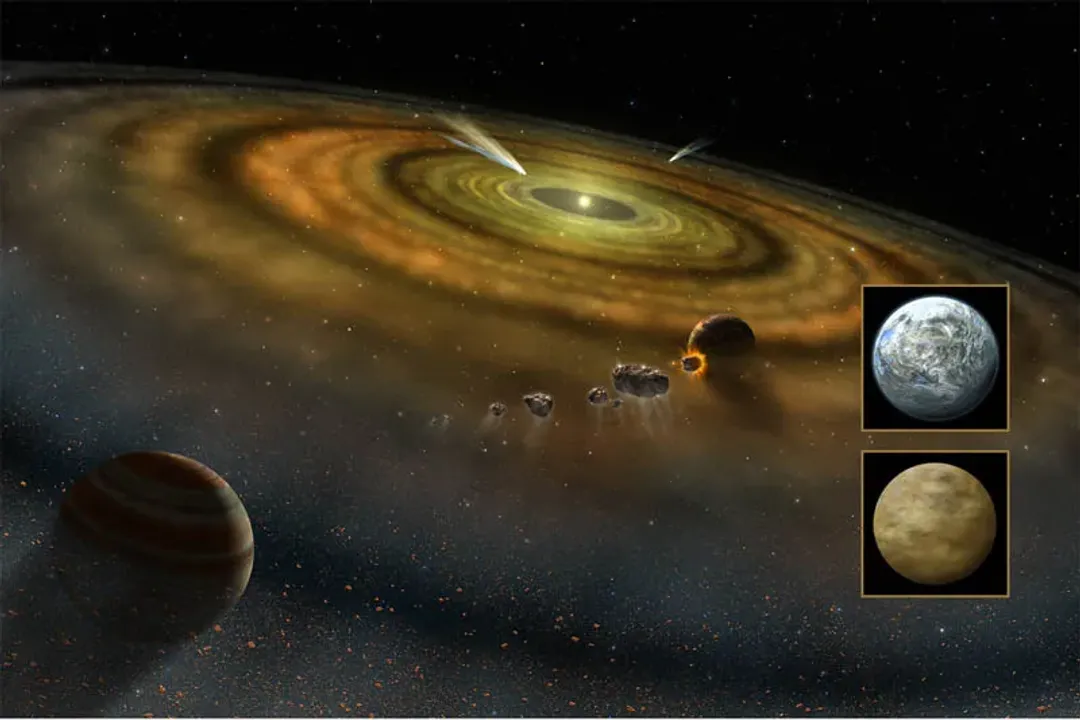
The solar system, with its planets, asteroids, comets, and dust, remains an intricately organized collection suspended across vast gulfs of space. The structure and stability we observe day in and day out are governed by a fundamental force, one that dictates the path of a tiny meteoroid just as surely as it dictates the journey of giant Jupiter. This primary organizing principle is gravity, the attraction between any two objects with mass. [7][4]
# Central Anchor

At the heart of our system lies the engine of its motion: the Sun. It is an immense celestial body, and its sheer size translates directly into overwhelming gravitational power. [1] Over 99.8% of the entire mass of the solar system belongs to the Sun. [1] This staggering dominance means that almost all the gravitational influence originates from this single star. [4] Everything else—from Earth to the farthest reaches of the Kuiper Belt—is essentially in orbit around this massive center of mass. [2]
The definition of gravity is straightforward: it is a universal attraction that occurs between any two objects that possess mass. [7] The more massive an object is, the stronger its gravitational pull. [7] Because the Sun is so much more massive than everything else combined, its gravity is the dominant force ensuring the entire collection stays bound together, rather than drifting off into interstellar space. [4]
# Force Explained
To truly grasp what holds the system together, we need to move past thinking of gravity as just a downward pull, as we experience it on Earth. Gravity is an attractive force acting across space, and its strength decreases as the distance between the two objects increases. [5] This concept means the Sun’s influence is powerful nearby—keeping the inner planets close—but it still extends far enough to govern the distant gas giants and icy bodies. [5]
When visualizing this, it helps to remember that every object exerts a gravitational pull on every other object. [7] Earth pulls on the Sun, and the Moon pulls on Earth, but the Sun’s pull is so much greater that it dictates the primary structure. [4] The Sun's gravity is the invisible tether keeping the planets bound in their respective paths. [2]
# Orbit Mechanics

If the Sun's gravity is constantly pulling the planets inward, why don't they just crash into it? This is where a second crucial element of celestial motion comes into play: velocity, or inertia. [2] Every planet, moon, and asteroid is moving sideways at a specific speed. [2] This sideways motion, often called tangential velocity, wants to carry the body off in a straight line into the void of space. [2]
The orbits we see are the perfect, ongoing negotiation between these two forces: the Sun's gravity constantly pulling the planet in, and the planet’s own forward momentum trying to shoot it out. [2] As an analogy, imagine swinging a ball on a string around your head; the string represents gravity, and the ball’s desire to fly away in a straight line is its inertia. [2] If you cut the string (gravity vanished), the ball flies off straight. If the ball suddenly stopped moving sideways (inertia vanished), it would fall directly into your hand (the Sun). [2] Stable orbits are achieved when the inward tug of gravity is precisely balanced by the outward tendency of the object's motion. [4][2] This balance is what keeps Earth happily circling the Sun rather than spiraling inward or escaping outward. [4]
One way to picture this balance is that the planets are constantly falling toward the Sun, but because of their high sideways speed, they always miss. [2] This concept of perpetual "missing" is the definition of an orbit in a two-body system, like the Sun and Earth. [2]
# Beyond Simple Pull
While the Sun’s gravity provides the main binder, asserting that only the Sun’s gravity holds the entire system together requires a slight oversimplification, particularly when dealing with the long-term stability of the system. [8] The solar system is not just a collection of independent planets orbiting the Sun; it is a complex N-body system where every mass influences every other mass. [3]
For example, the massive gas giants, especially Jupiter, exert substantial gravitational influence on the other planets and smaller bodies. [8] Jupiter's gravity has been key in deflecting or capturing potentially hazardous comets and asteroids, essentially acting as a large gravitational shield for the inner solar system. [8] If we were to model the solar system using only the Sun's influence, our predictions for the exact positions of Mars or Saturn years from now would slowly drift from reality because we omitted the subtle, cumulative tugs from their planetary neighbors. [3]
It is interesting to consider the mass ratios involved here. If we assign the Sun a relative mass of 1,000 units, Jupiter is about 3 units, and Earth is only about 0.0003 units. [1] Even though Jupiter’s mass is only about a thousandth of the Sun’s, that thousandth part is still vastly more influential on, say, Saturn's orbit than Earth's influence is. The system's stability, therefore, is an emergent property of many interacting gravitational fields, not just one central pull. [3]
# Dynamic Equilibrium
The gravitational dynamics within the solar system are mathematically complex. Calculating the precise path of even three celestial bodies interacting gravitationally is extremely difficult, a problem known generally as the three-body problem. [3] For our solar system, which involves many bodies, finding an exact, analytical solution for all time is impossible. [3] Instead, scientists use powerful computer simulations to model these gravitational interactions over millions or billions of years. [3] These simulations help confirm that, despite the constant gravitational nudges between planets, the overall configuration remains stable over cosmological timescales. [3]
This long-term stability isn't maintained by things being perfectly still; it's maintained by dynamic equilibrium. Consider the asteroid belt between Mars and Jupiter. Its population is relatively stable because Jupiter's gravity keeps ejecting debris that gets into unstable orbits, preventing the belt from collapsing inward or scattering completely outward. [8] The chaos introduced by planetary interactions actually helps clean up the system, removing bodies whose orbits would eventually decay and cause a catastrophic collision. [3]
For instance, we can observe Neptune’s strong influence on smaller, icy bodies far beyond it, carving out stable, resonant paths (like the Kuiper Belt objects locked in specific orbital ratios with Neptune). [3] These subtle orbital resonances are another way the system "holds itself together" by locking objects into safe, long-lived paths that avoid chaotic interactions with the major planets. [3] The system isn't just held by the Sun's pull, but by the intricate, mathematical architecture of orbits dictated by all the members influencing each other's velocities and positions over time. [8]
# Stability Insights
The sheer scale of time involved often obscures the constant, low-level adjustments occurring. We often look at the orbits as fixed circles, but they are technically ellipses, and their orientation in space slowly rotates over immense periods—a phenomenon called precession. [4] While the Sun dictates the plane of the orbits, the planets perturb these ellipses. If the solar system were a perfectly fixed machine, the minor gravitational interference from, say, Venus on Mercury might eventually lead to a slight acceleration or deceleration of Mercury’s path over eons. The complexity arising from these second- and third-order gravitational interactions ensures that the system is constantly adapting, rather than being held in a brittle, static arrangement. [3] This adaptability is, paradoxically, what makes the system so enduring.
Related Questions
#Citations
Sun
How does the Sun's gravity hold the entire solar system ...
Gravitational Dynamics | Center for Astrophysics | Harvard ...
Flexi answers - What holds the solar system together?
Gravity And Centripetal Force In Our Solar System
So gravity hold things on earth, sun ...
What Is Gravity?
There's More Than Just Gravity at Work in the Solar System