What holds the stars in the Milky Way together?
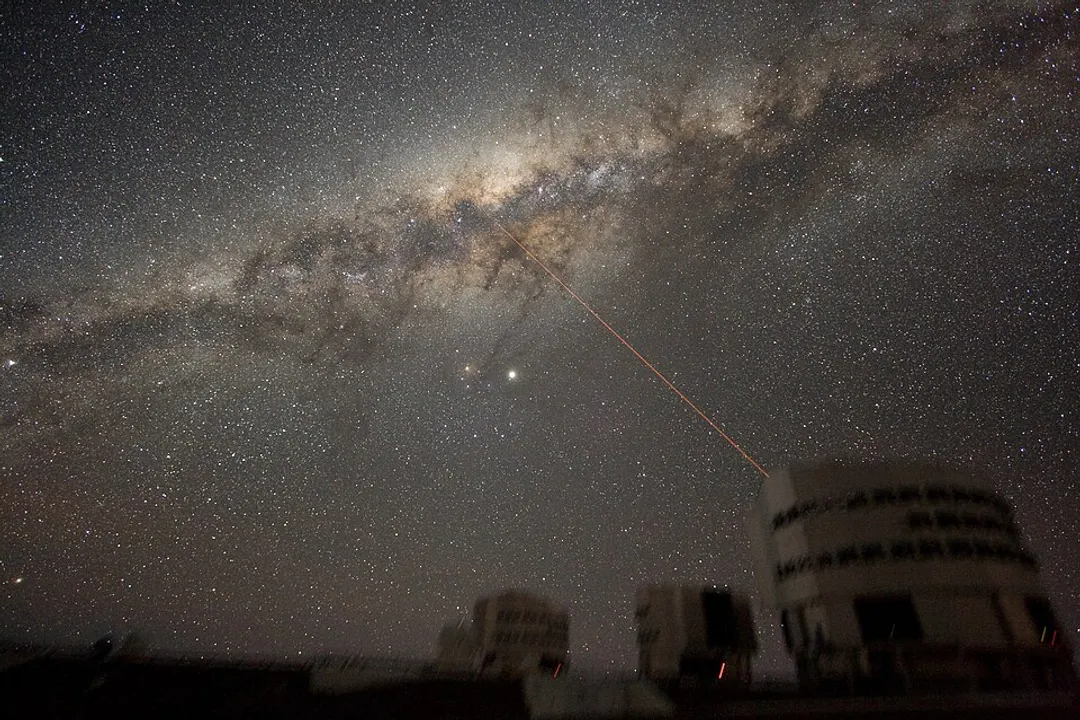
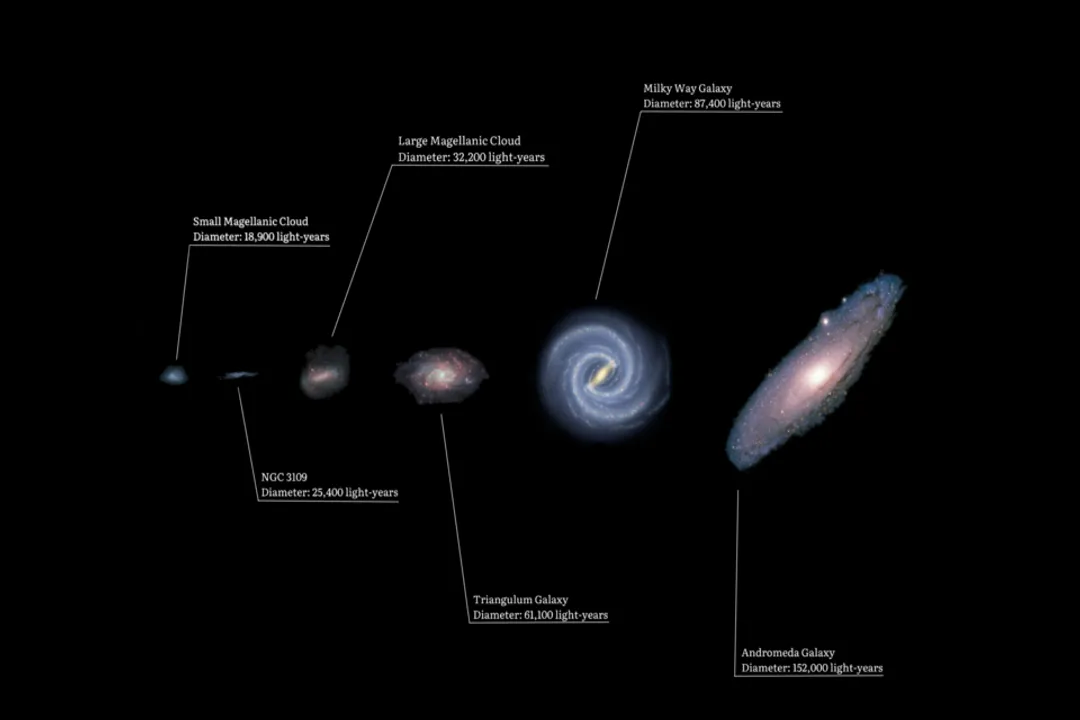
The vast collection of stars that makes up our home, the Milky Way Galaxy, stretches out over perhaps one hundred thousand light-years across its main stellar disk. [4] With an estimated population ranging from $100$ to $400$ billion stars, one might assume that such a massive structure, spinning rapidly through space, would simply fly apart due to centrifugal force. Yet, it remains a cohesive, ordered system, tracing elegant spiral patterns. The essential answer to what keeps all this matter bound together boils down to the most fundamental interaction in the cosmos: gravity. [2][3][5]
# Gravity's Grip
Gravity is the force exerted by mass, pulling all components of the galaxy—stars, gas, dust, planets, and the invisible scaffolding—toward a common center. [4][7] Think of any collection of matter, like a star, which is a self-gravitating ball of gas; without the internal pressure generated by fusion pushing outward, gravity would cause it to collapse. [3][4] Similarly, the Milky Way is a self-gravitating system that constantly experiences this tendency toward collapse. [3]
The scale of this gravitational necessity becomes clearer when considering the speed at which we are moving. Our Sun, located in the disk, is orbiting the Galactic Center at approximately . [3][4] To remain in orbit, the Sun must be constantly pulled inward by gravity, perfectly balancing its outward inertia. The escape velocity at the Sun’s position—the speed needed to break free entirely from the galaxy's influence—is estimated to be around . [4] This means that every star in the galaxy, from the oldest halo member to the youngest stellar nursery in the disk, requires a substantial, continuous gravitational tether to keep from drifting out into intergalactic space. [4]
# Orbital Dance
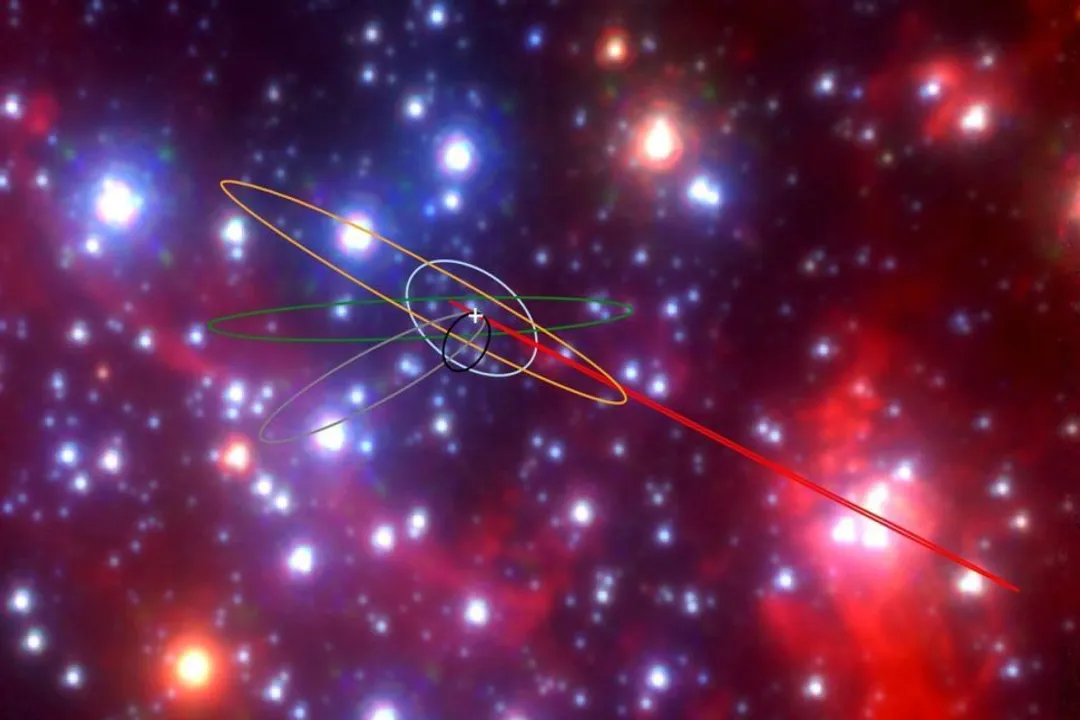
The motion within the galaxy is not like that of a solid object; rather, it is a differential rotation where stars orbit the center at varying speeds depending on their distance from the core. [3][4] A typical star takes roughly $240$ million years to complete one revolution, defining what is sometimes called a galactic year. [3][4] While the central supermassive black hole, Sagittarius A* (), exerts a colossal gravitational influence on the immediate vicinity of the center, its total mass—estimated at about $4.1$ to $4.5$ million times the mass of our Sun—is relatively small compared to the galaxy's overall weight. [4][7] If were to vanish instantly, some stars near the core would alter their paths, but the vast majority of the galaxy’s stars and its structure would remain almost entirely unaffected. [2] This strongly implies that the force binding the entire structure is derived from the total mass distributed throughout the system, not just the central anchor. [2]
If we consider just the visible matter—stars, gas, and dust—it simply does not provide enough gravitational pull to account for the observed orbital speeds. Stars far from the center would be expected to slow down, following Keplerian dynamics similar to planets orbiting the Sun, but they don't; instead, their speeds remain relatively flat, or nearly constant, as distance increases. [3][4] This discrepancy between the mass we see and the mass required to maintain the observed rotation is one of the most significant findings in modern astronomy, pointing toward a dominant, hidden component. [2][3]
# The Unseen Mass
The mechanism that prevents the Milky Way from dissolving into space is the massive, invisible component known as dark matter. [2][3][7] This mysterious substance interacts with ordinary matter only through gravity, betraying its presence by its massive gravitational tug on the things we can see. [3][7]
Calculations suggest that the total mass of the visible stars in the Milky Way is likely in the range of $4.6$ to solar masses. [4] In stark contrast, the estimated mass of the dark matter component is far larger, potentially reaching $1$ to solar masses, or even higher in some estimates. [4][7] This means dark matter could account for nearly $90%$ of the entire galaxy’s mass. [2][7]
This gravitational binding agent is not concentrated at the center like the black hole, but is instead spread out in a large, roughly spherical region called the dark matter halo. [2][7] This halo extends outward far beyond the visible stellar disk—perhaps by a factor of ten or more in radius compared to the stars—providing the essential gravitational scaffolding that keeps the rotating disk and the distant halo stars in their orbits. [2][4] Without this dominant, unseen mass, the outward centrifugal force from the fast rotation would fling the stars away, a scenario that astronomers can rule out by observing how galaxies actually behave. [2]
It is interesting to note the difference in perspective this imposes. When we look up and see the hazy band of the Milky Way, we are seeing the visible part of a structure primarily defined by something we cannot see at all. [4] Our entire understanding of galactic structure—the fact that the disk stars move at roughly even far out—depends on the existence and distribution of this dark material. [3][4]
# Galactic Architecture
The total gravitational influence of the dark matter halo dictates the overall shape and mechanics, but the visible structures also play a role in organizing the flow of matter and energy within that gravitational potential. [3] The Milky Way is classified as a barred spiral galaxy, [4][7] meaning it possesses a central bulge of older stars, a flattened disk containing gas and dust, and an extended stellar halo. [7]
The central bar structure, which is believed to be about $28,000$ light-years long, is a key dynamic feature. [3] While gravity pulls everything inward, the bar's non-circular, elliptical gravitational field helps redistribute angular momentum among the gas clouds. [3] Gas clouds moving in nearly circular orbits can lose this angular momentum near the bar, causing them to flow inward toward the galactic center where they fuel intense star formation. [3]
Similarly, the spiral arms act as density waves—areas where stars and gas bunch up temporarily as they pass through, much like a traffic snarl on a highway. [3] When gas clouds slow down in these denser regions, they can be compressed, heated, and collapse to form new stars. [3] This complex gravitational interplay, managed by the distribution of both visible mass (like the bar) and the pervasive dark matter halo, keeps the entire system from simply settling into a static, dense ball. [3] The system is constantly attempting to organize itself into a state of maximum gravitational binding (collapse), yet this process is slowed and modulated by the conservation of angular momentum and the ongoing creation of new stars. [3]
# The Core Anchor
While the dark matter halo is responsible for the large-scale cohesion, the central supermassive black hole () anchors the dynamics of the very inner region. [7] Its immense gravitational pull dictates the orbits of the stars closest to the core.
However, the black hole's function is localized. If we use an analogy: imagine a massive, rapidly spinning Ferris wheel with thousands of cars (stars) attached by invisible ropes (gravity). The central axle (the black hole) is extremely heavy, but the collective weight of all the cars and the wheel structure itself is what keeps the whole mechanism from flying apart when it spins quickly. [2] The ropes attached only to the innermost cars do almost nothing to secure the outermost cars spinning at the rim. In our galaxy, that collective weight—the invisible ropes holding the far-flung stars—is predominantly provided by the dark matter halo, far outweighing the contribution of the central engine. [2][7]
To conceptualize the delicate balance: the galaxy is a continuous, dynamic balance between the universal tendency of mass to clump together due to gravity, and the counteracting forces of rotational energy and the expansion of entropy as energy is released from fusion and turbulence. [3] What holds the stars in the Milky Way together is the sheer quantity of mass within the dark halo, generating the necessary gravitational field to manage the rotational speeds of billions of stars orbiting over timescales measured in hundreds of millions of years. [2][4]
Related Questions
#Citations
Milky Way - Wikipedia
What keeps galaxies together? - Astronomy Stack Exchange
How the Milky Way works | Astronomy.com
Star Basics - NASA Science
Milky Way's Structure | Research Starters - EBSCO
Our Galaxy: The Milky Way - Cosmic Dark to Cosmic Dawn - UCLA
The black hole at the center of the galaxy is forging a strange new ...