What keeps the stars in a galaxy together?
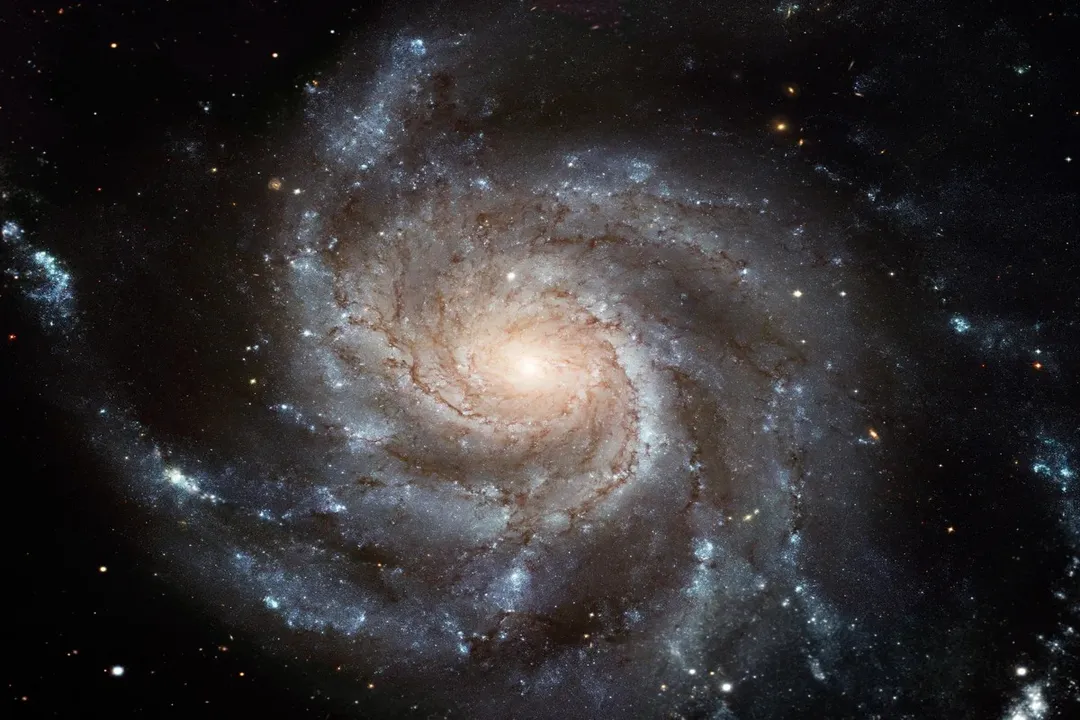
The cosmic glue holding billions of stars, gas, and dust into the immense, swirling structures we call galaxies is fundamentally gravity. It is the pervasive force that dictates the motion and ultimate fate of every star within its island universe, preventing the entire structure from simply flying apart into the void of intergalactic space. This phenomenon is not merely about large objects pulling on smaller ones; it's a complex, continuous balancing act that defines galactic existence.
# Dominant Force
The principle at work is the same one that keeps the Moon orbiting the Earth or a satellite around our planet: the mutual gravitational attraction between all the mass components. In a galaxy like the Milky Way, the total gravitational pull generated by all the visible matter—the stars, nebulae, and interstellar medium—acts as the centripetal force that constrains the stars to their paths. If gravity suddenly vanished, the stars would immediately continue moving in straight lines tangential to their current orbits, scattering into the cosmos.
Consider a star far from the galactic center. Its velocity isn't random; it's precisely tuned to the collective mass enclosed within its orbit. If a star moves too fast for the existing gravitational pull at its distance, it will eventually escape the galaxy entirely. Conversely, if it moves too slowly, it will spiral inward toward the center. This delicate equilibrium dictates a characteristic speed for stars at specific radii, a speed derived directly from the total mass distributed throughout the galaxy. The movement of stars within a galaxy is therefore akin to planetary motion, just on a vastly larger and more complex scale where the central "sun" is replaced by the combined mass of everything closer to the core.
This gravitational influence extends across the entire stellar population. Whether you are looking at a tightly packed globular cluster orbiting the halo or a solitary red dwarf near the outer edge of the spiral disk, the binding agent remains the same attractive force exerted by all other matter. The scale is immense; the Milky Way itself is estimated to be over 100,000 light-years across, yet the gravitational influence keeps its components bound together.
# Orbital Mechanics
Understanding how galaxies stay together requires appreciating orbital mechanics in detail. When observing a galaxy, one might simply see a collection of bright points, but each point is in motion, effectively "falling" toward the center but constantly missing it due to its sideways velocity. This constant state of falling and missing creates the stable orbit.
For a system to remain gravitationally bound, the total kinetic energy (energy of motion) must be less than the total gravitational potential energy (the energy holding the system together). When the kinetic energy dominates, the system is unbound and will disperse; when the potential energy dominates, the system is bound and will hold its shape over cosmic timescales. This ratio, often conceptually related to the virial theorem in astrophysics, is what astronomers look at when determining if a structure, like a small group of stars or a massive galaxy cluster, is truly a gravitationally cohesive unit.
It can be helpful to visualize this using an analogy: imagine a tetherball. The ball swings around the pole because the string provides the constant inward pull (centripetal force). In a galaxy, there is no single physical "string." Instead, the "string" is the distributed gravitational field created by the mass of every other star and gas cloud in the system. The speed at which the outer stars are moving is a direct measurement of how much total mass must be present inside their orbit to keep them tethered.
# Mass Discrepancy
Here is where the traditional view of a galaxy runs into a significant observational puzzle. When astronomers measure the rotational speed of stars and gas clouds at the outer edges of galaxies—regions far from the bright, visible central bulge—they find something unexpected. Based only on the light emitted by the stars and gas we can see (the luminous matter), the gravitational pull at those distant points should be much weaker than it is. The stars are moving too fast.
If the only matter present was what we observe through telescopes, these fast-moving outer stars should have enough velocity to overcome the gravitational attraction and escape the galaxy; the galaxy's structure should literally fly apart. Yet, they remain tightly bound.
This observation leads to one of the most important conclusions in modern astrophysics: the visible matter accounts for only a fraction of the total mass holding the galaxy together. The vast majority of the gravitational influence—often estimated to be around 80% or more of the total mass in large galaxies—must come from something we cannot directly see. This unseen substance is termed dark matter.
Dark matter is non-luminous, meaning it does not emit, absorb, or reflect light or any other form of electromagnetic radiation, making it exceptionally difficult to detect directly. Its presence is inferred only through its gravitational effects on visible matter, such as bending light (gravitational lensing) or, most critically here, maintaining the observed high orbital velocities of stars in galactic disks.
To provide a comparative structure, consider the relative distribution of mass in a typical spiral galaxy:
| Component | Estimated Mass Fraction | Primary Interaction |
|---|---|---|
| Stars & Visible Gas | ~10-20% | Electromagnetism (Light) & Gravity |
| Dark Matter Halo | ~80-90% | Gravity Only |
This distribution implies that the stars are not orbiting the visible center of the galaxy; they are orbiting the center of mass of the entire structure, which is dominated by the massive, invisible halo of dark matter extending far beyond the visible stellar disk. Without this massive, non-luminous component providing the necessary gravitational anchor, the rapid rotation observed in spiral galaxies would cause them to disintegrate quickly.
# Galactic Scale
Galaxies themselves are not isolated entities; they exist in groups and clusters, held together by gravity on even larger scales. Our own Milky Way is part of the Local Group, which is gravitationally bound to thousands of other galaxies in structures called galaxy clusters. In these environments, the binding force is the collective gravity of entire galaxies pulling on one another.
Galaxy clusters represent the largest known gravitationally bound structures in the universe. Just as dark matter dominates the mass balance within a single galaxy, there is an analogous mass problem on the cluster scale. The galaxies within a cluster move too quickly relative to each other to remain bound only by the visible mass of the constituent galaxies; the cluster itself requires immense amounts of unseen mass—dark matter—to keep the member galaxies from flying out of the cluster's gravitational embrace.
This hierarchical clustering shows that gravity is the organizing principle across all observed scales, from the stability of a single star's path to the cohesion of super-structures composed of millions of galaxies. A helpful perspective here is to think about the required escape velocity. For the solar system, the escape velocity from the Sun's gravity is about 11.2 km/s. For the entire Milky Way, the gravitational pull is so extensive that the escape velocity from its edge is much higher, requiring a speed that only the fastest stars or unbound gas clouds can achieve, and even then, only if they are moving in the right direction relative to the background gravitational field provided by that dark matter envelope.
# Formation and Evolution
The answer to what keeps them together is also tied to how they formed in the first place. Galaxies likely started as small, relatively uniform clumps of dark matter and gas in the early universe. Gravity then caused these initial clumps to attract more matter, causing the denser regions to collapse and spin up. As gas fell toward the center of these gravitational wells, it heated up, cooled, and eventually collapsed further to form the first stars and spiral disks.
The initial angular momentum—the property related to the system's spin—is preserved through this collapse, but it is tempered by the ever-increasing gravitational attraction of the growing mass, leading to the observed rotational patterns. The current structure is a snapshot of a system still governed by these initial conditions, constantly being refined by gravitational interactions, mergers, and the steady pull of the dominant dark matter component. Understanding the present-day configuration is therefore a direct study of the long-term consequences of universal gravitational attraction acting on enormous reservoirs of mass, both visible and invisible. The stability is not static; it is dynamic equilibrium maintained over billions of years by the relentless pull of mass on mass.
#Videos
What Force Binds A Galaxy Together? - Physics Frontier - YouTube
Related Questions
#Citations
How do galaxies stay together/what's holding them together? - Reddit
What keeps galaxies together? - Astronomy Stack Exchange
Galaxy Basics - NASA Science
What force keeps the stars and matter in the Milky Way Galaxy ...
Galaxies and gravity (video) | Khan Academy
What Force Binds A Galaxy Together? - Physics Frontier - YouTube
Galaxy Clusters | Center for Astrophysics | Harvard & Smithsonian
What's keeping galaxies and stars in place? - Facebook
What keeps the stars in a galaxy together? A. Nebulas B ... - Brainly