How does star formation differ in elliptical and spiral galaxies?

The character of a galaxy, from its shape to the color of its light, is deeply tied to its history of star formation. When we look up at the night sky, we generally see two dominant forms: the flat, swirling spiral galaxies and the smooth, often giant elliptical galaxies. These two archetypes represent vastly different stellar nurseries, reflecting distinct evolutionary paths that dictate when, where, and how new stars ignite. [1][9]
# Morphological Distinction

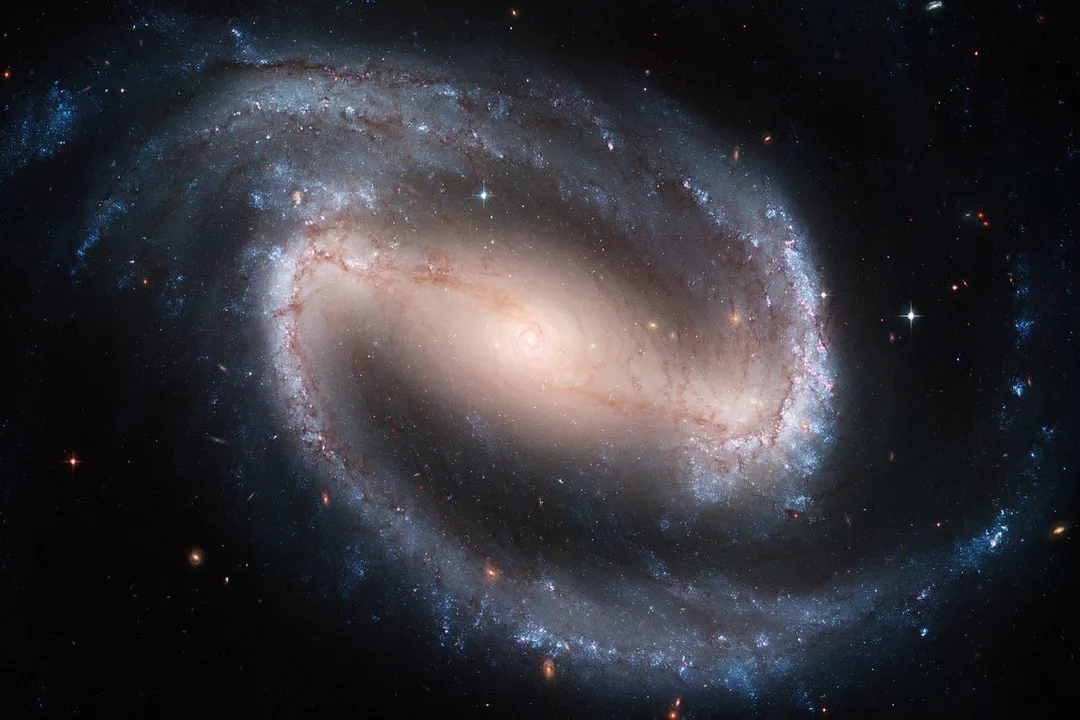
Spiral galaxies, like our own Milky Way, are characterized by a prominent disk structure, often featuring spiral arms emanating from a central bulge. [1] This structure is dynamically supported by rotation, and it is within the arms that much of the ongoing action happens. [4] Elliptical galaxies, conversely, are generally featureless, ranging from nearly spherical to highly elongated shapes, lacking the defined disk and spiral arms seen in their cousins. [1] Their stellar motions are typically more random, resembling a swarm of bees rather than the orderly rotation of a disk. [4]
The difference in their appearance is not merely aesthetic; it is a direct consequence of their past and present gas content, which fundamentally controls the birth of stars. [9]
# Fuel for Stars
Star formation requires cold, dense molecular gas and dust. This raw material needs to be present and cool enough to collapse under gravity, overcoming the internal pressure and magnetic fields that resist collapse. [7] The availability and state of this gas reservoir is perhaps the single most significant differentiator between active spiral galaxies and relatively quiescent elliptical galaxies. [9]
# Spiral Gas Reservoirs
Spiral galaxies are rich in the necessary ingredients for new stars. [6] They possess substantial reservoirs of cold gas and dust, primarily located within their flat, rotating disks. [1] This gas is not uniformly distributed; it tends to concentrate in the spiral arms. [3] As the galaxy rotates, the density waves that form these arms sweep up the interstellar medium, compressing the gas clouds until gravitational collapse is triggered, leading to bursts of star formation along these structures. [3] Stars forming in these regions tend to be young, hot, and massive, emitting powerful blue light, which is why spiral arms often appear bright blue. [6]
# Elliptical Gas States
Elliptical galaxies, in stark contrast, have largely exhausted or expelled their supply of cold molecular gas. [9] Observations show that they contain very little of the cold gas and dust needed to sustain star birth. [6] While they are composed of stars, the stellar populations found within them are generally much older. [2][6] The lack of cool gas means that significant, large-scale star formation has either already occurred or ceased entirely long ago. [9] Any small amount of gas present is often hot and diffuse, maintained at temperatures too high to collapse and form stars effectively. [7]
# Stellar Populations and Color

The color of a galaxy acts as a visual proxy for its star formation history. [6] This distinction is easily observable, even with modest telescopes.
# Blue Spirals
Spiral galaxies are characterized by a mix of stellar populations, but the young, newly formed stars dominate the visual impression of the disk. [6] These massive, short-lived stars burn fiercely hot, emitting copious amounts of blue and ultraviolet light. [6] Because star formation is an ongoing process distributed throughout the disk and concentrated in the arms, the overall appearance of a spiral galaxy trends toward blue. [6] The central bulge, however, often contains older, yellower stars, similar to the dominant population in ellipticals, hinting at an earlier, more intense period of star formation within the core. [4]
# Red Ellipticals
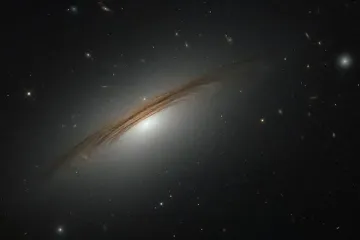
Elliptical galaxies present a predominantly red or yellowish hue. [2][6] This color indicates that the vast majority of their stars are old, low-mass stars that have evolved off the main sequence, such as red giants, or main-sequence stars that are intrinsically cooler and redder than their massive blue counterparts. [2] The lack of bright, massive blue stars signals the near cessation of star formation for billions of years. [9]
It's interesting to consider that the colors are derived from the most massive stars currently alive. If a galaxy made stars heavily 10 billion years ago and hasn't made any since, it will look red, even though its total mass of stars might be enormous. A spiral galaxy, even if it made most of its mass long ago, will look bluer if it is currently forming just a few percent of its total mass in new, bright blue stars today.
# Mechanisms Driving Differences
The differences in star formation activity are ultimately rooted in the physical processes that shaped these galaxies over cosmic time.
# Spiral Dynamics
Spiral galaxy evolution is characterized by relatively calm, sustained growth within a rotating disk environment. [4] Their structure allows for the continuous cycling of gas: gas flows inward, forms stars, and enriched material is recycled back into the interstellar medium. Their stability prevents sudden, catastrophic loss of gas. [9] A spiral galaxy needs a continuous supply of gas—either from accretion from the cosmic web or internal replenishment—to maintain its steady star formation rate. [7]
# Elliptical Formation Events
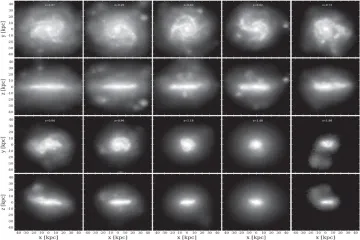
Elliptical galaxies are generally believed to have reached their peak star-forming phase very early in the universe's history, or they have experienced major dynamic events that halted star production. [9] The most common theory posits that large ellipticals result from the merger of two or more spiral galaxies. [9] When two spirals collide, the violent gravitational disruption destroys the organized rotation of the disks, resulting in a massive, randomized stellar system—the elliptical shape. [4]
This merger process has a dramatic effect on the gas:
- Compression and Burst: The collision violently compresses the available cold gas, often triggering an intense, rapid "starburst" phase where nearly all the remaining gas is converted into stars over a relatively short period—perhaps a billion years or less. [7]
- Feedback and Removal: The intense starburst generates numerous supernovae, whose explosions release vast amounts of energy. This energy, combined with feedback from an active supermassive black hole in the center (Active Galactic Nucleus or AGN feedback), can heat up or completely eject the remaining cold gas from the galaxy's halo. [7][9] Once the cold gas is blown away or heated beyond the temperature needed for collapse, star formation effectively stops, leaving behind an "old" stellar population. [9]
This scenario explains why massive ellipticals are often seen in dense environments like the centers of galaxy clusters; they are the product of numerous mergers that have stripped them of their star-forming fuel.
# Contrasting Star Formation Sites
The location of star formation within the galaxy structure provides another clear contrast.
# Spiral Arm Concentration
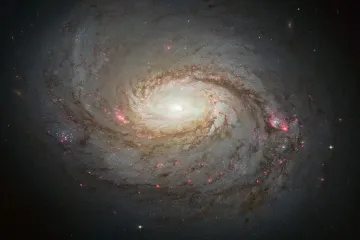
In spirals, the star formation is concentrated in the spiral arms. [3] Think of the arms as traffic jams for gas clouds. The density wave forces the clouds together, leading to localized collapse. This process is relatively gentle and allows the spiral structure to persist even while new stars are being made. The star formation activity is distributed and ongoing. [3]
If we were to map the most recent star-forming regions (marked by H II regions or young O/B stars) in a typical grand-design spiral, we would find them tracing the pattern of the arms with remarkable fidelity. An analytical view using radio telescopes to map molecular hydrogen () would confirm this high density within the arm structure compared to the inter-arm regions. [7]
# Elliptical Uniformity and Silence
Ellipticals lack these organized features. If any residual star formation is occurring in a large elliptical galaxy, it is generally confined to the very center, or it is so low-level and diffuse that it is functionally insignificant compared to the massive output of a spiral. [9] The light profile of an elliptical galaxy is smooth, indicating a more uniform, though ancient, distribution of stellar ages across its volume, consistent with a past, complete consumption of star-forming fuel. [4]
To put this into a more relatable context, imagine a factory line. A spiral galaxy is like a modern assembly line—efficient, continuous, with designated zones for construction (the arms). An elliptical galaxy is like a factory that completed one massive, rapid production run long ago, used up all its raw materials in that single push, and has since been shut down, its machinery rusting over but still standing. [9]
# A Data Comparison View
To make the physical differences stark, we can summarize the key parameters defining their current star formation status:
| Feature | Spiral Galaxy | Elliptical Galaxy |
|---|---|---|
| Cold Gas/Dust Content | High, concentrated in the disk [1][6] | Low to negligible [6] |
| Star Formation Rate | Ongoing, active, sustained [1][6] | Very low to effectively zero [3][9] |
| Dominant Stellar Age | Mixed, with young blue stars prominent [6] | Old, red stellar populations [2][6] |
| Structural Support | Rotational support in a disk [4] | Pressure/velocity dispersion support [4] |
| Morphology | Defined disk, arms, bulge [1] | Smooth, featureless spheroid [1] |
This data view emphasizes that the difference is primarily one of process versus result. Spirals are processes; ellipticals are results—the results of either early, rapid formation followed by exhaustion, or violent mergers that quenched activity. [9]
# The Role of Environment
Galaxy environment plays a major role in dictating which path a galaxy follows, profoundly affecting its star formation capability. [9]
Spiral galaxies are often found in less dense regions, sometimes in small groups, where they can accrete fresh gas from the intergalactic medium over cosmic time without frequent disruptive collisions. [9] This steady supply helps maintain their disks and ongoing star formation. [7]
Ellipticals, particularly the massive ones, tend to reside in the crowded cores of galaxy clusters. [9] In these high-density environments, mergers are frequent, rapidly transforming disks into spheroids and stripping them of their gas reservoirs through violent interactions or ram-pressure stripping (where hot, fast-moving cluster gas acts like a wind, blowing the cold gas out of the galaxy's disk). [7] An elliptical galaxy's current state is often a testament to an environment that actively quenches star formation. [9]
# Analyzing Formation Longevity
One subtle, yet important, analytical point involves the efficiency of star formation over time. A spiral galaxy might have a lower instantaneous star formation rate than an elliptical experienced during its brief, intense starburst phase, but the spiral's longevity in forming stars may ultimately lead to a comparable total stellar mass over cosmic time, provided it avoids a major merger. [7] The crucial factor is the sustained versus burst conversion of gas into stars. Ellipticals burned their fuel rapidly; spirals sip their fuel slowly. The former results in a dead galaxy now; the latter results in a living one that may eventually die through merger or exhaustion. [9]
For example, imagine two galaxies, both starting with 100 units of gas.
- Galaxy A (Elliptical Path): Converts 80 units into stars in one 1-billion-year burst due to a merger. The remaining 20 units are heated/ejected. Star formation stops.
- Galaxy B (Spiral Path): Converts 1 unit into stars per billion years continuously for 100 billion years.
Galaxy A has a higher peak star formation rate but an earlier end to its life. Galaxy B has a lower, steady rate but remains active much longer. The observed mix of galaxies suggests both paths are common in the universe's history. [9]
# Interpreting Stellar Light
When astronomers study the light spectrum of a galaxy, they are essentially reading its biography. [6] For a spiral galaxy, the spectrum will show strong emission lines indicative of active processes like ionization from young, hot stars, mixed with absorption lines from older stars. The presence of strong emission, for instance, is a direct sign of recent star formation. [6]
In an elliptical galaxy, the spectrum is dominated by the absorption features characteristic of old, evolved stars, particularly those rich in metals like iron, which were created and dispersed by supernovae from earlier generations of massive stars. [2] The lack of recent massive star birth means no bright, blue-ionizing sources are present to produce strong emission lines. [6] Looking at the light curves from these two types over time reveals that the redshift distribution (which indicates distance and age) of ellipticals peaks much earlier in the universe's history than the peak for spirals. [9]
This difference in spectral signature is vital for classifying galaxies remotely. While morphology requires observing the structure, spectroscopy provides an immediate chemical and chronological fingerprint that confirms the structural appearance. [2]
# Future Star Formation Trajectories
The future of star formation in these galaxy types is quite distinct, dictated by their present physical state.
# Spiral Persistence
A spiral galaxy will continue to form stars as long as it has a supply of cold gas in its disk. [7] Its fate depends on its environment. If it remains isolated, it may slowly convert its existing gas into stars over many more billions of years, or it might eventually accrete enough fresh gas to sustain itself far into the future. If it moves into a dense cluster, however, its fate might change rapidly. [9]
# Elliptical Quiescence
For most large elliptical galaxies, the main star-forming episode is long over. [9] They are often called "red and dead" systems. [6] Their stellar populations are aging, and their light is fading subtly as their existing stars evolve into white dwarfs or are lost into the intergalactic medium. While minor mergers with small, gas-rich galaxies can occasionally inject minor amounts of fuel, these events are usually not enough to restart the kind of massive star formation seen in spirals or early ellipticals. [7] Therefore, the trajectory for an elliptical is one of slow, inevitable decline in luminosity driven by stellar aging, not by gas depletion. [2]
This long-term stability of the elliptical population presents a fascinating puzzle for cosmological models: precisely how quickly did the processes (mergers, AGN feedback) shut down star formation so completely in these massive systems so early in the universe? The rate and efficiency of that quenching process are central to understanding galaxy evolution. [9]
In summary, the contrast between elliptical and spiral galaxies is a story written in gas and time. Spirals are ongoing workshops fueled by cool, rotating gas, decorated with the blue light of youth. Ellipticals are grand museums, built from the chaotic mergers of spirals long ago, their star-forming fires banked and their light dominated by the soft glow of ancient stellar populations. [1][6] The physical processes that dictate gas availability—ordered rotation versus violent collision—carve these two distinct cosmic archetypes. [4][9]
#Videos
Differences Between Spiral And Elliptical Galaxies? - YouTube
Related Questions
#Citations
Galaxy Types - NASA Science
How do the stars in an elliptical Galaxy differ from those in spiral ...
Star Formation in Irregular Galaxies
The two main galaxy families: spirals and ellipticals - AEGIS
Differences Between Spiral And Elliptical Galaxies? - YouTube
What are the differences between galaxies? - ESO Supernova
[PDF] Properties of Ellipticals and Spirals
Video: Elliptical, Irregular & Spiral Galaxies | Formation & Differences
Why do galaxies differ so much in size, shape, composition and ...