Are elliptical galaxies disc-shaped?
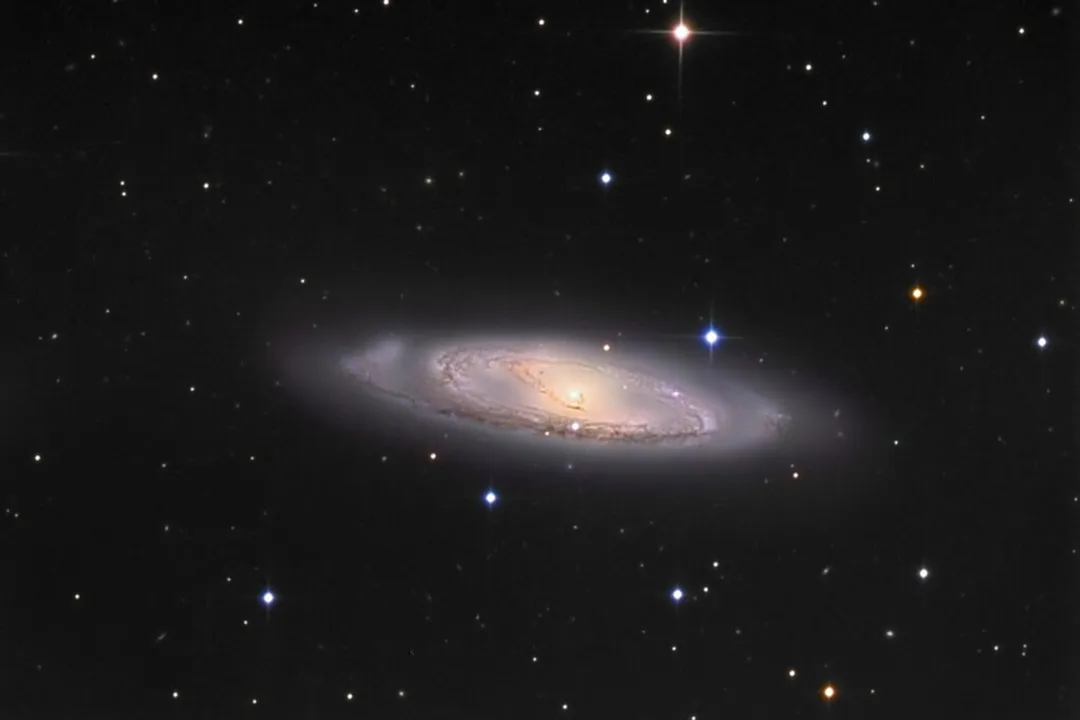
The visual representation of many galaxies, particularly our own Milky Way, immediately brings to mind a flat, spinning structure—a distinct disc. This image leads many to wonder if all galaxies adhere to this two-dimensional model, especially when considering the category known as elliptical galaxies. However, the reality is that elliptical galaxies represent a fundamentally different class of stellar systems, one whose shape is emphatically not a disc in the spiral sense. They range instead from nearly perfect spheres to significantly elongated, three-dimensional ellipsoids. [1][3][5] While spiral galaxies are defined by their flat, rotating arrangements of stars, gas, and dust organized around a central plane, [3][10] ellipticals are characterized by a smoother, featureless distribution of mostly older stars, often described as appearing like a giant, fuzzy ball or a football. [8][10]
# Galactic Shapes Defined
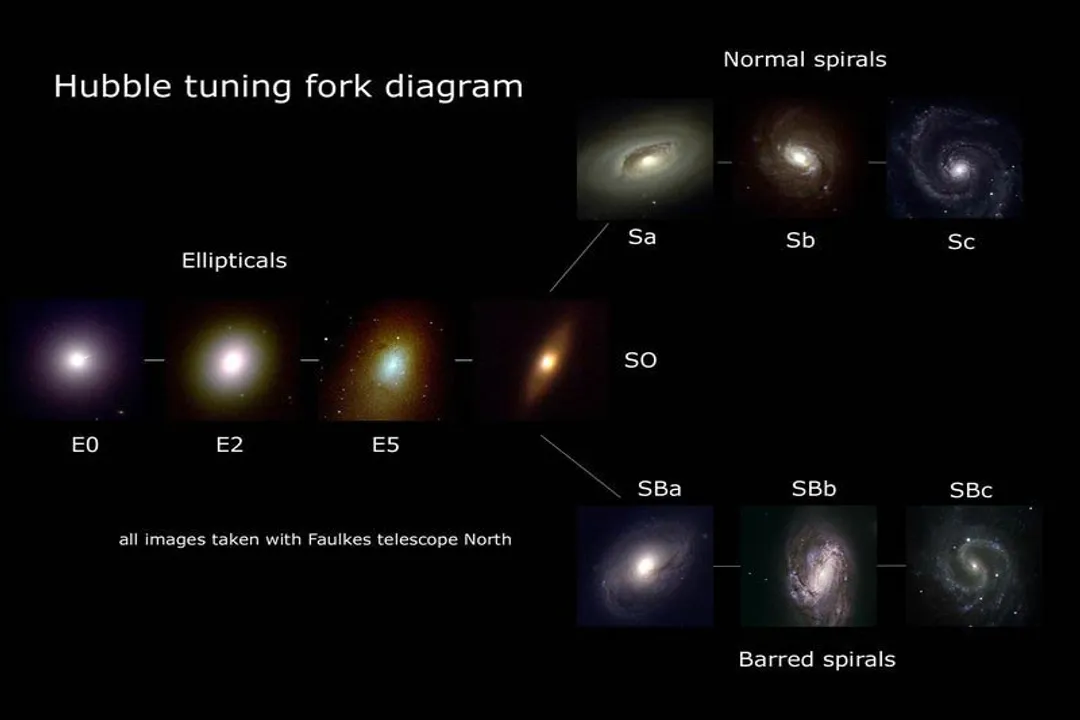
The primary distinction between spiral and elliptical galaxies lies in their geometry and internal dynamics. Spiral galaxies possess a clear, defined disk component, along with a central bulge and, frequently, recognizable spiral arms extending outward. [10] This disk structure is a direct consequence of how these galaxies formed. Early on, large clouds of gas collapsed under their own gravity. As they contracted, the conservation of angular momentum caused them to spin faster and flatten out perpendicular to the axis of rotation, resulting in the characteristic thin disk. [4]
Elliptical galaxies, in sharp contrast, lack these defining spiral arms and show no clear evidence of a thin, organized rotational plane. [5] Instead, their structure is three-dimensional, described as an ellipsoid—a stretched or squashed sphere. [9] These systems vary widely in appearance. Some, designated E0, are very close to being perfectly spherical, while others, classified towards the E7 end of the scale, are visibly flattened or highly elongated. [1][5] This wide spectrum of shapes suggests a different evolutionary path and internal support mechanism compared to the orderly rotation found in spiral disks. [2]
# The Ellipsoid Classification
Astronomers categorize elliptical galaxies based on their apparent degree of flattening, using a numerical scale that ranges from E0 to E7. [1][8] This classification system provides a systematic way to describe the visual morphology observed from our vantage point. The index is used to quantify this apparent shape, calculated using the galaxy's major axis () and minor axis () with the formula: . [8]
An E0 galaxy represents the least flattened form, appearing nearly circular or spherical in the sky. [1][8] As the value of increases, the galaxy appears progressively more stretched out. An E7 galaxy is the most elongated type classified within this sequence. [1][5] It is important to remember that this classification primarily describes the apparent flattening we see. Due to projection effects—the angle from which we view the galaxy—a galaxy that is truly elongated might appear more spherical if we happen to view it nearly pole-on, and vice versa. [8] This means that even within the E7 category, the actual three-dimensional shape can vary, though all members share the defining characteristic of lacking a disk structure supported by ordered rotation. [4] For instance, a galaxy might look like a very flat E7 on the sky, but if we were to look directly down its rotational axis, it might look closer to an E2 or E3, but it would still fundamentally lack the characteristic thin disk of a spiral. [2]
# Dynamics of Shape
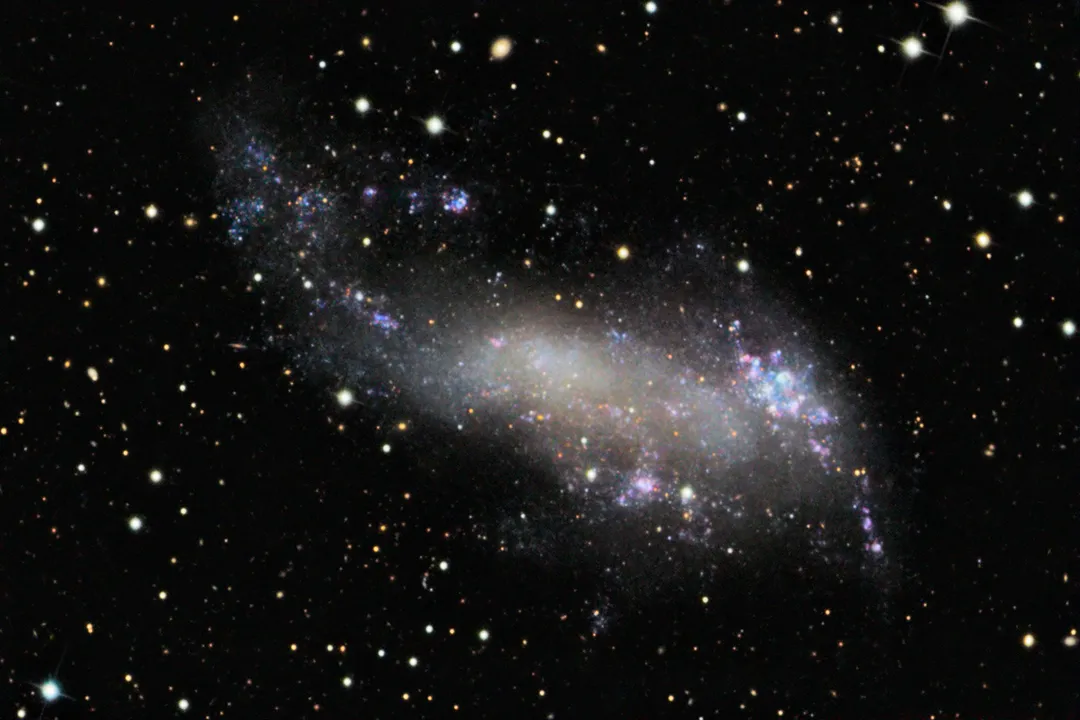
The reason elliptical galaxies don't maintain a flat, disc-like geometry is rooted in their internal motions. The rotation that dictates the shape of a spiral galaxy provides a restoring force that keeps the stars in a relatively thin plane, much like how the speed of rotation keeps water from flying out of a spinning bucket. [4] Elliptical galaxies, conversely, are supported primarily by the random motions of their constituent stars. [1]
Imagine a rapidly spinning vinyl record; its shape is determined by the uniform speed of revolution. If you were to stop the record and simply start throwing the vinyl particles around randomly within the same general area, the resulting collection of particles would settle into a more spherical or three-dimensional, irregular shape, constrained only by the average path taken by the particles and their mutual gravitational pull. [2] This latter analogy better describes the interior dynamics of an elliptical galaxy. The stars move on varied, often highly eccentric, orbits throughout the galaxy’s volume rather than being confined to a single plane. [4] This chaotic, three-dimensional velocity dispersion acts as the pressure that resists gravitational collapse into a flat structure. [1] The result is a system that is supported against gravity by the velocity of its components, but that velocity is oriented randomly, not preferentially along one axis like in a disk galaxy. [2]
# Stellar Populations Contrast
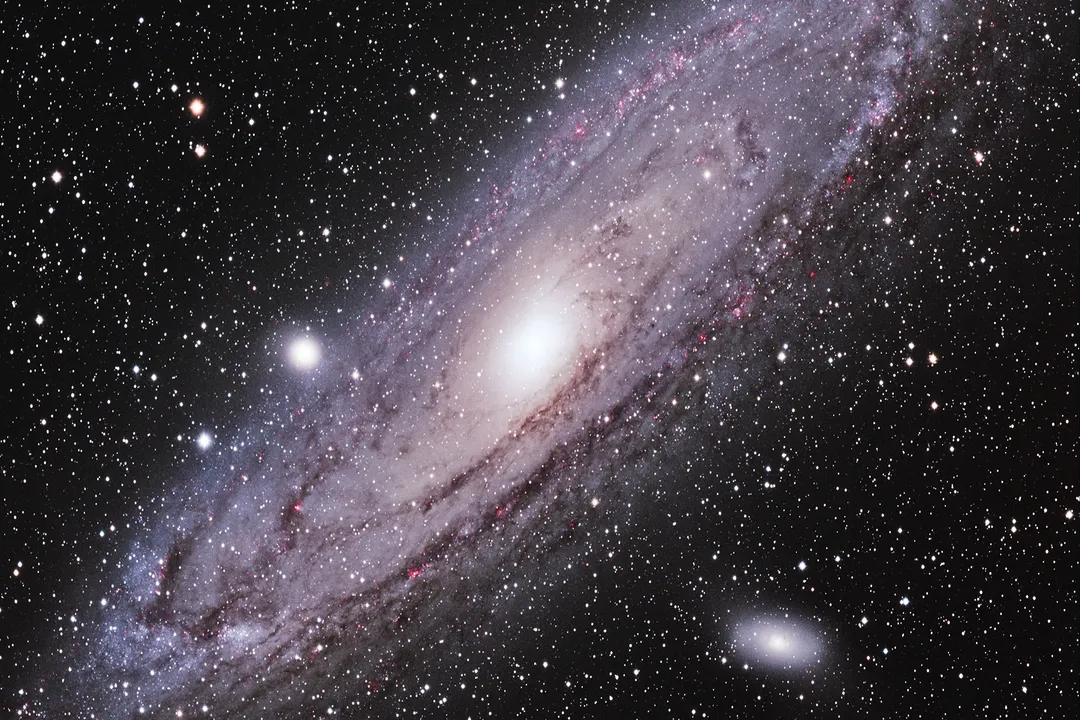
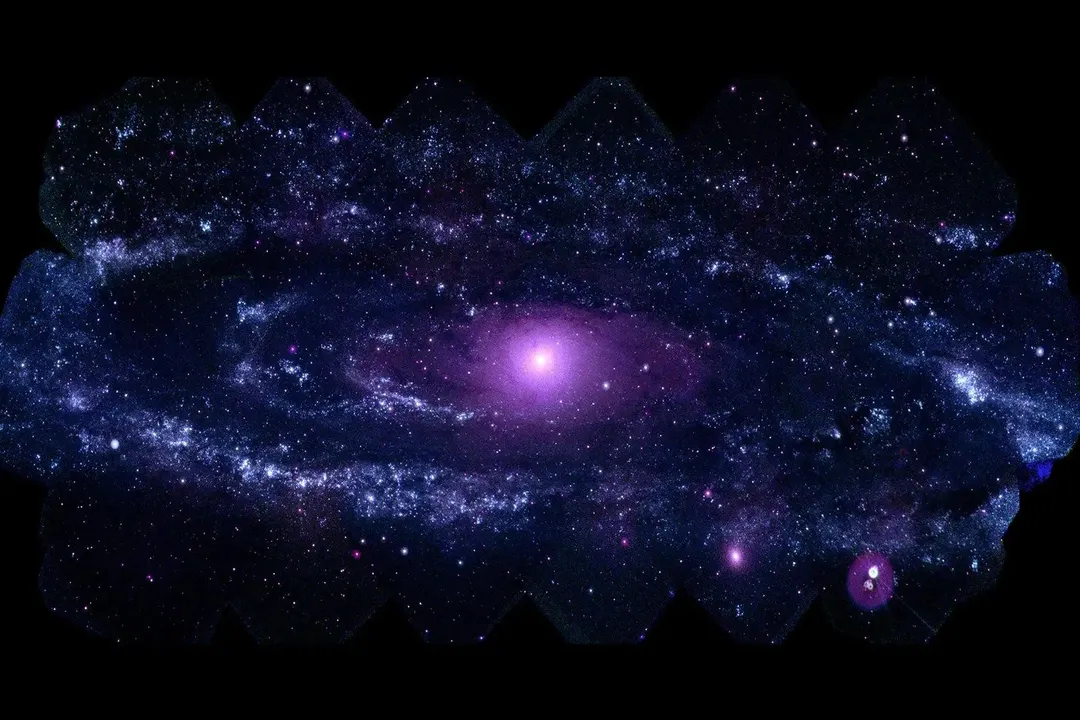
The differing shapes are also mirrored in the composition and current activity level of these galaxies. Spiral galaxies, with their gas-rich disks, are often sites of active, ongoing star formation, giving them a bluer, more vibrant appearance due to the presence of hot, young stars. [10]
Elliptical galaxies, particularly the larger ones, present a much older stellar population. [9] They are generally depleted of the cool gas and dust required to fuel new generations of star birth. [1][5] Consequently, they tend to glow with a reddish or yellowish hue, dominated by old, lower-mass stars. [9] This lack of fuel for star formation suggests that whatever process created the elliptical shape also consumed or expelled the raw materials for disk maintenance and growth. If a spiral galaxy’s disk is the factory floor where new stars are actively built, the elliptical galaxy is the well-kept, historic archive, its contents settled and aged. [6]

# Formation and Evolution
The prevailing astrophysical model suggests that the distinct, disk-free structure of elliptical galaxies arises from violent gravitational interactions—specifically, galaxy mergers. [2][4] When two or more spiral galaxies collide, the immense tidal forces and rapid gravitational interactions effectively scramble the ordered, rotational motion that defined their original disk shapes. [4]
A major merger between two large, roughly equal-sized spirals is believed to be the primary driver for creating a large elliptical galaxy. The collision redistributes the angular momentum among the stars, converting the organized, planar rotation into the randomized, three-dimensional velocity field characteristic of ellipticals. [2] This merger scenario neatly explains why ellipticals are largely devoid of the structure and gas associated with disks. The violence of the merger triggers intense, short-lived bursts of star formation that quickly use up the remaining gas, leaving behind an aging stellar population within a dynamically "hot" system. [6] While minor mergers or internal processes might cause some evolution within the elliptical population itself—perhaps turning a more elongated E7 closer to an E0 over immense timescales by damping the motions—the origin of the non-disc shape is fundamentally linked to this disruptive merger history. [2] The study of these galaxies provides a window into the universe's history of gravitational cannibalism, where organized structures are destroyed to form the more spheroidal behemoths found in the centers of dense galaxy clusters. [9]
#Videos
Do Elliptical Galaxies Have A Disk Component? - Physics Frontier
Related Questions
#Citations
Elliptical galaxy - Wikipedia
Will elliptical galaxies eventually form disks again? : r/askastronomy
Galaxy Types - NASA Science
Why are galaxies disk shaped? - Astronomy Stack Exchange
Elliptical Galaxies | Space
Most elliptical galaxies are 'like spirals' - Phys.org
Do Elliptical Galaxies Have A Disk Component? - Physics Frontier
Galaxy Classification - Las Cumbres Observatory
Elliptical Galaxy | ESA/Hubble
The Different Shapes of Galaxies - Cosmos at Your Doorstep