Can elliptical galaxies be spherical?
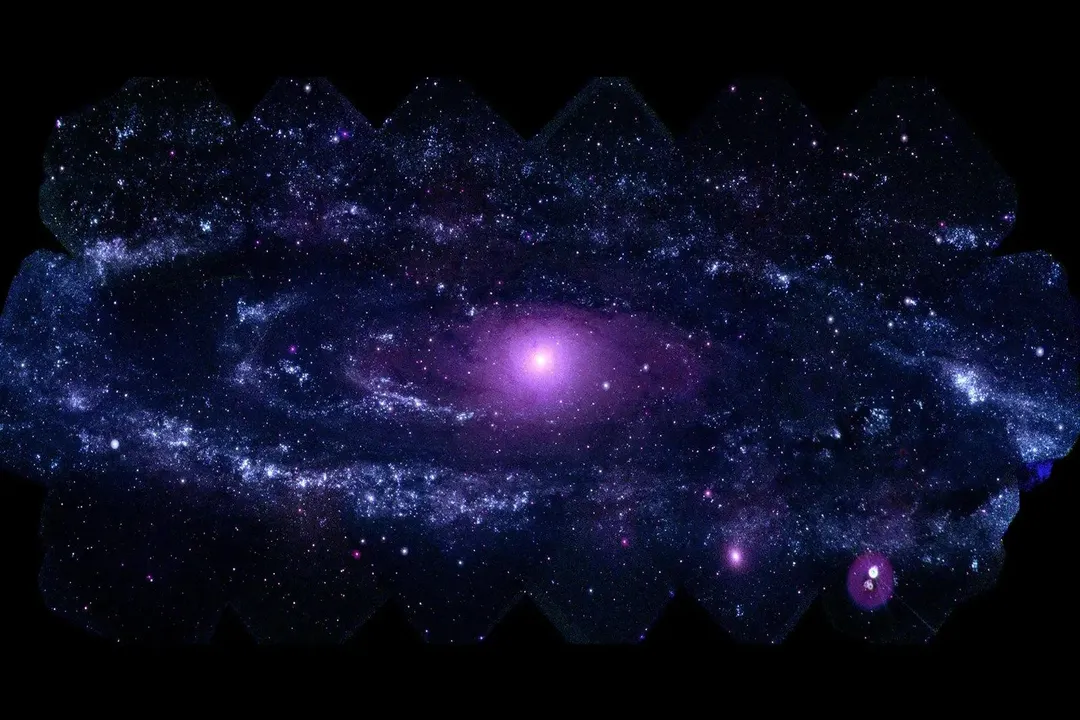
The diversity within the universe of galaxies is staggering, ranging from the grand, pinwheeling structures of spirals to the vast, featureless smudges categorized as ellipticals. [4][6] When astronomers classify galaxies based on their visual appearance, the elliptical category immediately signals a departure from the flattened, disk-like shapes typical of our own Milky Way or Andromeda. [6][8] The fundamental question then arises: can these elliptical systems achieve a truly spherical geometry, or are they all inherently flattened to some degree?
# Galaxy Morphology
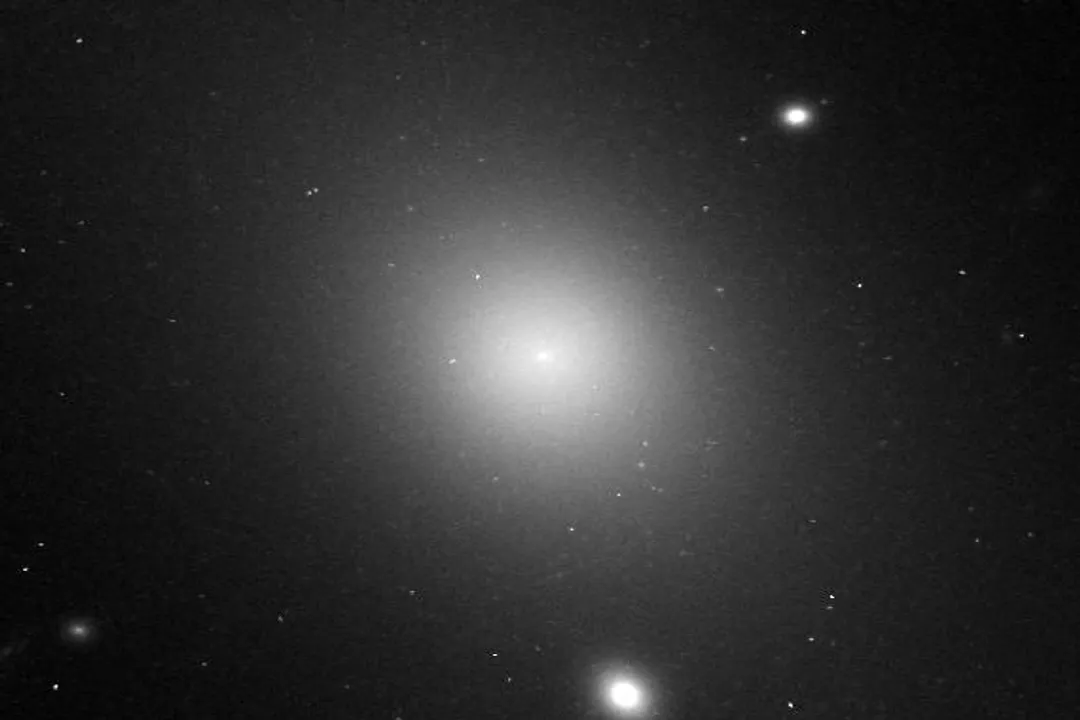
Galaxies are generally grouped into three broad categories: spirals, ellipticals, and irregulars, though there are many sub-types and transitions between them. [4] Elliptical galaxies are defined by their smooth, featureless light profiles, lacking the prominent spiral arms, dust lanes, or active star formation seen in their flatter cousins. [6][7] They are essentially spheroidal collections of stars, often dominated by older, redder stellar populations. [1][7]
What sets them apart dynamically is that their stars move on randomly oriented, generally elongated orbits, rather than the highly ordered, nearly circular rotation common in the disks of spiral galaxies. [1] This difference in internal motion is key to understanding their shape. A galaxy that has experienced multiple violent mergers, for example, tends to have its original rotational structure destroyed, leaving behind the random stellar motions characteristic of ellipticals. [5]
# Elliptical Classes
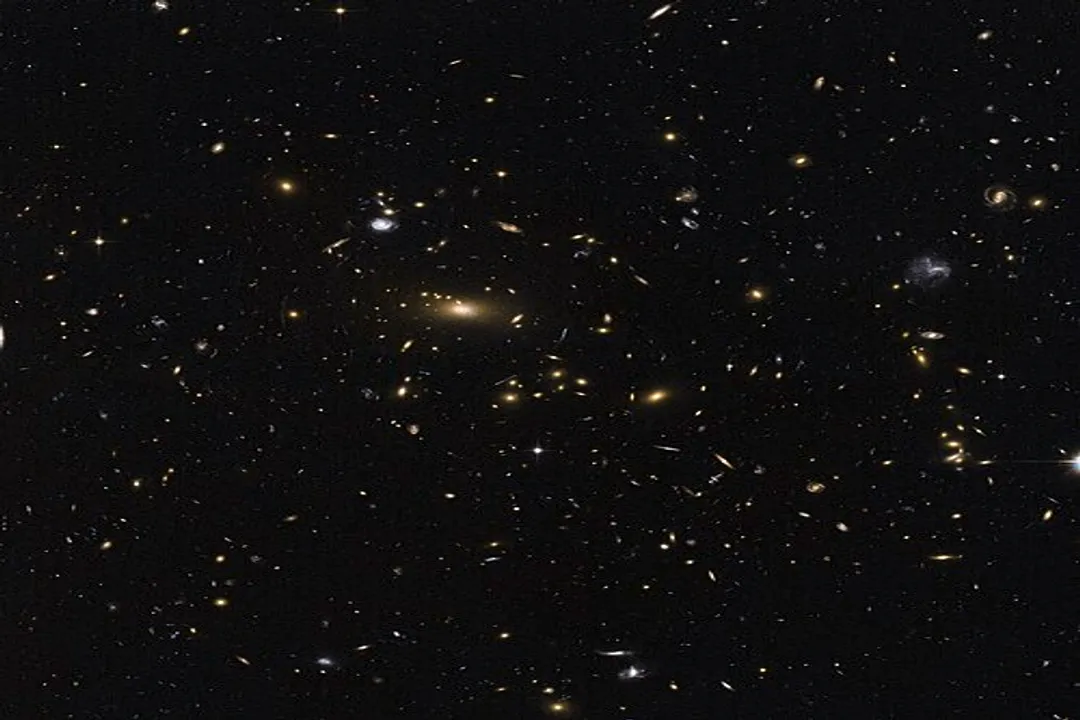
Elliptical galaxies are not a monolithic group; rather, they represent a continuous spectrum of elongation, formally classified using the Hubble sequence designation E followed by a number. [1][9] This number quantifies the degree of apparent flattening. The scale runs from E0 to E7. [1]
The E0 designation is reserved for those galaxies that appear almost perfectly circular when viewed from Earth. [1][6] This is the class that comes closest to the theoretical ideal of a spherical galaxy. In contrast, the E7 designation describes the most elongated or flattened ellipticals, which appear significantly oblong. [1] The visual classification depends on how much the apparent major axis () exceeds the minor axis (); specifically, the number in the E designation is calculated as . [1][9]
If a galaxy truly were a perfect sphere, the ratio would equal one, resulting in an E0 classification. [1] However, the reality is more complex. Even those designated E0 are not guaranteed to be perfectly symmetrical three-dimensional objects. [2]
# Near Symmetry
The concept of a perfectly spherical galaxy is often viewed by astronomers as an idealization rather than an observed reality in the same way one might calculate the properties of a perfect vacuum. [2] While an E0 galaxy presents a near-circular face to us, this visual appearance is heavily influenced by the orientation of the object in space. [8]
If a galaxy that is actually quite elongated happens to be pointed directly toward us, it will appear circular, receiving an E0 classification erroneously. [2][8] Conversely, a truly spherical galaxy pointed edge-on might be difficult to distinguish or might be misclassified depending on the faintness of its outer edges. [2] This observational effect is significant: for any given true shape, there is a range of viewing angles that will cause it to mimic a less elongated state. [8]
The internal dynamics provide another layer of argument against perfect sphericity. For a galaxy to be truly spherical, the random velocities of its stars must be equal in all three spatial dimensions (radial, tangential, and vertical). [2] In reality, while the motions are more random than in a spiral galaxy, there is often still a residual asymmetry or preferred axis in the velocity dispersion, meaning that perfect, time-averaged isotropy across all stellar orbits is difficult to achieve or maintain. [2]
To put this into perspective, consider the difference between the two main types of dynamically supported galaxies:
| Galaxy Type | Dominant Motion | Shape Tendency | Merging Fate |
|---|---|---|---|
| Spiral (Disk) | Ordered Rotation | Flattened (Disk) | Becomes Elliptical |
| Elliptical (E) | Random Velocity Dispersion | Spheroidal to Elongated | Remains Elliptical |
This difference in internal support mechanisms—rotation dominating in disks, velocity dispersion dominating in ellipticals—is what drives the morphological distinction. [1][7] A galaxy supported purely by random motions could theoretically settle into a sphere, but the chaotic nature of the mergers that create ellipticals often leaves behind non-spherical remnants. [2][5]
# Formation History Shaping Form
The path a galaxy takes to its current form heavily dictates its final geometry. Spiral galaxies are generally thought to be young or to have experienced relatively quiet evolutionary histories, allowing gas to cool and settle into a rotationally supported disk. [3]
Elliptical galaxies, conversely, are often the products of major galaxy mergers. [5] When two large spiral galaxies collide violently, their organized rotational energy is quickly randomized into the three-dimensional motions of their stars. [1] This process effectively "fluffs up" the structure, transforming the flat disks into a more volumetric, elliptical shape. [5] The resulting galaxy's final elongation is determined by the impact parameter and the initial rotation rates of the merging partners. [2] A merger between two nearly identical, non-rotating systems might yield a near-perfect sphere, but such precise initial conditions are statistically rare in the dynamic universe. [2]
It is interesting to note that the reverse process—an elliptical turning into a spiral—is generally considered highly improbable or impossible under normal circumstances. [3][5] Once the ordered rotation is lost through violent merging, it is not easily re-established in a stable disk structure. [5]
# Observation Versus Reality
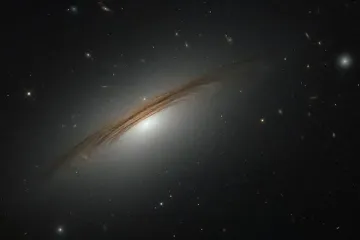
The human tendency to think of shapes in two dimensions often complicates the study of these massive three-dimensional systems. Astronomers are limited to observing the projection of the galaxy onto the plane of the sky. [8] This introduces inherent ambiguity.
Imagine three galaxies:
- A truly spherical E0 galaxy viewed face-on.
- A significantly elongated E5 galaxy viewed perfectly face-on.
- A flattened E7 galaxy viewed at a precise intermediate angle.
All three could potentially be classified as E0 or near-E0 based solely on the apparent minor-to-major axis ratio measured in the optical image. [2][8] To resolve this, astronomers often employ techniques that look at the velocity field (how stars are moving), which can sometimes reveal an underlying elongation even if the light profile looks circular. [2] However, for systems dominated by velocity dispersion, the kinematic data can also be degenerate, meaning the complex 3D velocity map might look spherically symmetric even if the mass distribution is slightly prolate (cigar-shaped) or oblate (pancake-shaped). [2]
When considering the vast scales involved—some elliptical galaxies span hundreds of thousands of light-years [9]—the technical challenge of confirming perfect \text{100%} symmetry across the entire volume is immense. While we can measure the axis ratios of the visible light distribution with high precision, confirming that the entire dark matter halo and the stellar population within share that exact same perfect symmetry is beyond current observational capabilities, leading most researchers to treat the E0 designation as approaching spherical, rather than perfectly spherical. [2]
# Scale and Definition
When we talk about a shape being spherical, we usually imply a high degree of precision, often comparing it to a sphere generated computationally or in a laboratory setting. For a galactic structure, the sheer scale and the nature of its formation—a slow accumulation of mass and the chaotic interactions of smaller systems—suggest that the structure will always retain some subtle deviation from the mathematical ideal. Think of it like trying to create a perfectly smooth marble by smashing two slightly irregular pebbles together; the resulting shape is vastly more uniform than the starting materials, but it will never meet the stringent definition of perfect mathematical smoothness. [1]
Therefore, while the E0 classification acknowledges the visual existence of galaxies that are essentially non-flattened, the consensus in modern astrophysics leans toward these objects being nearly spherical, possessing some degree of triaxiality (being stretched differently along three axes) that is too slight to register clearly in a 2D projection or is masked by viewing angle effects. [2] They are the closest analog to spherical galaxies in the observable universe, born from the most energetic past mergers, but absolute mathematical sphericity remains an elusive, perhaps unattainable, state for such large, dynamically complex structures.
Related Questions
#Citations
Elliptical galaxy - Wikipedia
Why aren't there spherical galaxies? - Physics Stack Exchange
Can elliptical galaxies eventually become spirals? : r/askastronomy
Galaxy Types - NASA Science
Most elliptical galaxies are 'like spirals' - Phys.org
Elliptical galaxies
Elliptical Galaxies - The XMM Newton Satellite Schoolpage
Are there any spherical galaxies out there or is every galaxy flat like ...
Elliptical Galaxy | All dimensions Wiki - Fandom