Why do galaxy rotation curves remain flat?
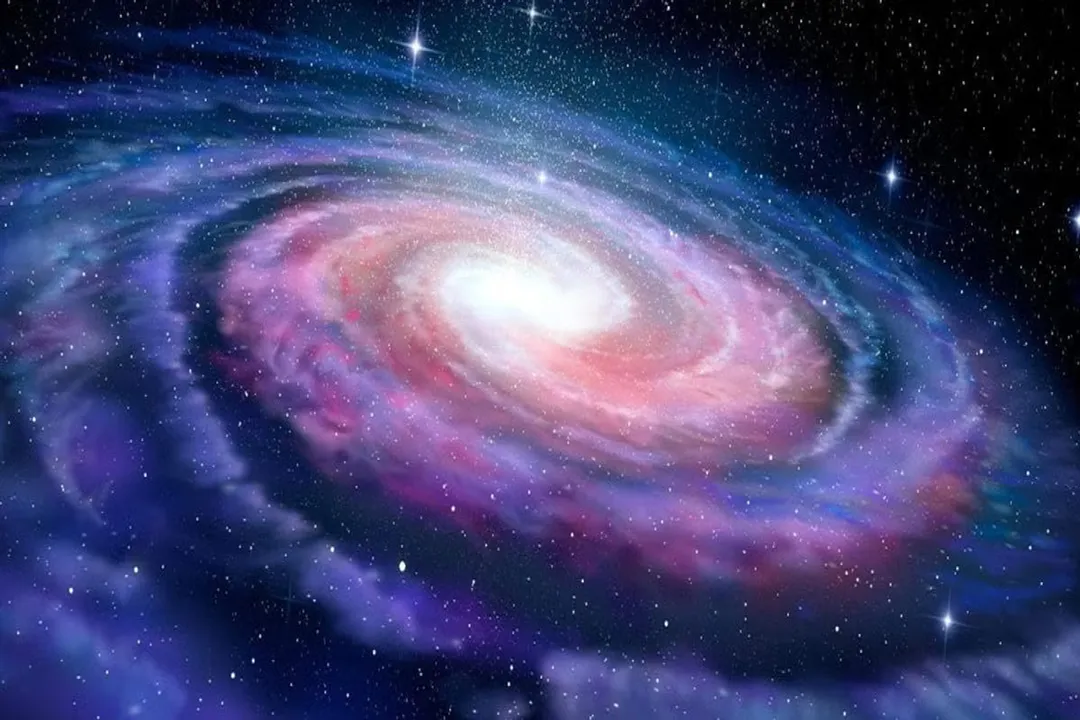
The speeds at which stars and gas orbit the centers of spiral galaxies present one of the most compelling puzzles in modern astrophysics. When astronomers plot these orbital velocities against their distance from the galactic core—creating what is known as a rotation curve—the resulting graph stubbornly refuses to behave as simple Newtonian gravity predicts based only on the light we can see. [9][4]
This deviation from expectation is the core issue. If a galaxy's mass were concentrated only in the visible matter—the stars, gas, and dust—then the rotational speed of objects far from the center should steadily decrease. This expected behavior follows Kepler's third law of planetary motion: the further away you are from the main gravitational source, the slower you move. [4] Think of the solar system; Neptune orbits much slower than Mercury because the vast majority of the Sun’s mass is concentrated near the center. [4]
# Expected Decline
In an ideal, visible-matter-only galaxy, once you measure orbital speeds past the brightest, densest central bulge and out toward the faint edges, the velocity, v, should fall off inversely proportional to the square root of the radius, r—symbolically, . [4] This decline is the natural consequence of mass being concentrated centrally, as is the case with the Sun in our solar system. [5]
# Observed Flatness
What observers actually measure tells a different story. Instead of falling off, the rotational velocities of stars and gas clouds remain surprisingly constant, or flat, as they move outward into the galactic outskirts. [9][4] The speed measurement stays nearly the same hundreds of thousands of light-years from the center, long after the visible stellar population thins out dramatically. [5] A galaxy's rotation curve remains flat indefinitely, failing to show the expected Keplerian decline. [1]
To put this into perspective, consider a typical spiral galaxy like the Milky Way. If the rotation curve is measured out to a radius of 50 kiloparsecs (kpc), this implies that the total mass enclosed within that 50 kpc radius is far greater than the mass contributed by all the stars and gas we can detect. [5] A simple back-of-the-envelope calculation demonstrates this scale: if the visible disk mass amounts to roughly solar masses within the inner 20 kpc, the necessary total mass required to keep the curve flat at 50 kpc might approach solar masses. This suggests the gravitational influence of the unseen component outweighs the visible matter by a factor of five or more in these outer regions, making the hidden mass the dominant gravitational feature. [5]
# Dark Matter Answer
The overwhelming consensus among astrophysicists is that this discrepancy arises because galaxies are embedded within massive, extended halos of invisible material: Dark Matter. [5][9] For the orbital speed to remain constant (), the amount of mass enclosed within the orbit, , must continue to increase linearly with the radius, (). [4] Since there is no corresponding visible source for this mass increase at the edges, the existence of a vast, gravitationally influential, non-baryonic Dark Matter halo is inferred. [5] This halo provides the necessary gravitational tether to keep the outermost stars moving at high speed, long past the reach of the luminous disk. [5]
This phenomenon isn't limited to a single galaxy type or size. The consistency of the flat curve across the entire population of observed spiral galaxies provides a powerful observational constraint on cosmological models. [3]
# Scale and Persistence
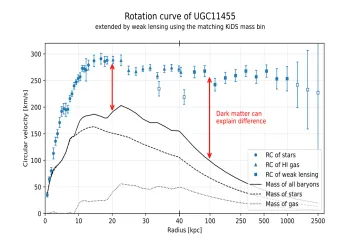
One of the most striking aspects of the flat rotation curve is its longevity in terms of distance. It is not a brief plateau; the flatness persists over enormous scales. [1] Observations have confirmed that this trend holds steady even when tracing material out to distances exceeding one million light-years from the galaxy’s nucleus. [7][8] The curve simply refuses to drop, even across spatial extents far larger than the light generated by the stars themselves. [1] This remarkable stability over vast distances strengthens the argument that some unseen component provides a steady gravitational gradient that mirrors the distance itself. [2]
# Gravity Modification
While Dark Matter provides the standard explanation, it remains an inferred substance—we know it is there by its gravity, but we have not directly detected the particle itself. [6] This has prompted investigations into alternative explanations rooted in modifications to the laws of gravity themselves. [6] Theories like Modified Newtonian Dynamics (MOND) propose that standard gravity breaks down or changes its behavior in regimes characterized by extremely low accelerations, such as those found in the outskirts of galaxies. [6] These approaches attempt to explain the observed flat rotation by altering how mass dictates gravity at great distances, rather than invoking extra, unseen mass. [6]
The real challenge for any model, whether it invokes Dark Matter or modified gravity, is its ability to explain the entire population of galaxies consistently. [5] A successful theory must account for the observed relationship between a galaxy’s intrinsic luminosity (brightness) and its final rotation speed, sometimes formalized in relations like the Tully-Fisher relation. [5] A model that requires an arbitrary, finely tuned amount of Dark Matter for every single galaxy risks becoming merely a descriptive tool rather than a fundamental physical law. Contemporary research, such as that found in preprint servers, focuses on testing these models against the most precise new observational data available, forcing specific candidates—like certain Dark Matter particle masses or specific MOND parameters—to make detailed, testable predictions about the exact shape of the curve near the transition point. [3]
Related Questions
#Citations
Rotation Curves of Galaxies Stay Flat Indefinitely - Universe Today
Rotation curves: still flat after a million light-years : r/astrophysics
[2412.17869] Why do galaxies have extended flat rotation curves?
What is a flat rotation curve? - dark matter - Physics Stack Exchange
Rotation Curves
Why Do Galaxies Have Extended Flat Rotation Curves? - Scirp.org.
A million light years and still going | CWRU Newsroom
Rotation curves: still flat after a million light-years - Triton Station
Galaxy rotation curve - Wikipedia