What type of galaxies have gas and dust in them?
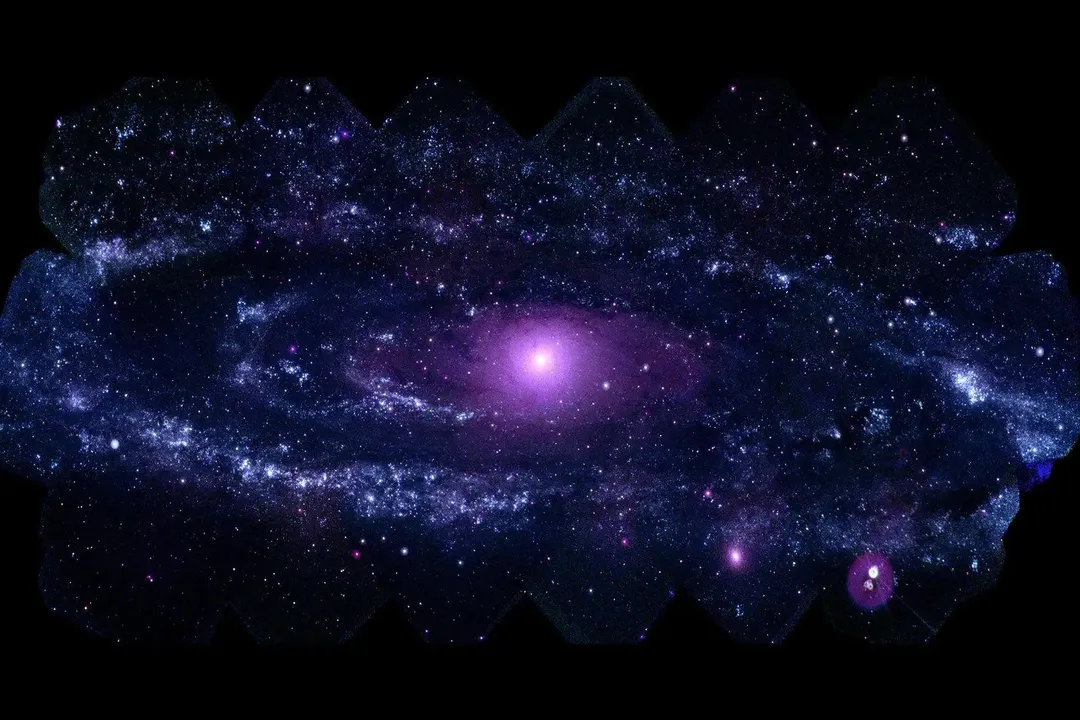
The makeup of a galaxy—specifically, the presence or absence of the raw materials for new stars—is fundamentally tied to its structure and evolutionary history. When astronomers survey the Universe, they classify galaxies into three primary morphological groups: spirals, ellipticals, and irregulars, and the amount of cold gas and dust they harbor varies dramatically across these categories. [1][4] Generally speaking, the systems most visibly rich in the ingredients for stellar birth are the grand, rotating spirals and the often chaotic irregulars, while the smooth, massive ellipticals are typically starved of these essential components. [1][4]
# Gas Rich Spirals
Spiral galaxies, like our own Milky Way, are the quintessential star-forming engines of the local Universe. These galaxies are characterized by a flat, rotating disk containing prominent spiral arms that wind outward from a central bulge. It is within this disk structure where the interstellar medium (ISM)—the mix of gas and dust—is concentrated. [4]
The dust component, appearing as dark lanes silhouetted against the bright light of background stars, consists of tiny solid particles, mostly silicates and carbon compounds. [5] Interspersed with this dust is the hydrogen gas, the fuel for future stars. [5] This cold, molecular gas and dust are not spread uniformly; they clump together, often tracing the spiral arms themselves. The bright blue appearance of these arms is a direct result of the ongoing, active star formation fueled by this abundant material. [1] When massive, short-lived blue stars form, they light up the surrounding nebulae, making the spiral structure stand out. [1]
The Hubble classification system further breaks down spirals into barred (SB) and unbarred (S) types, which are then organized based on how tightly wound their arms are and the size of their central bulge. Regardless of this fine-tuning, the fundamental characteristic remains: spirals possess the necessary cool, dense molecular clouds needed for gravitational collapse and the birth of new stellar generations. [5]
# Elliptical Makeup
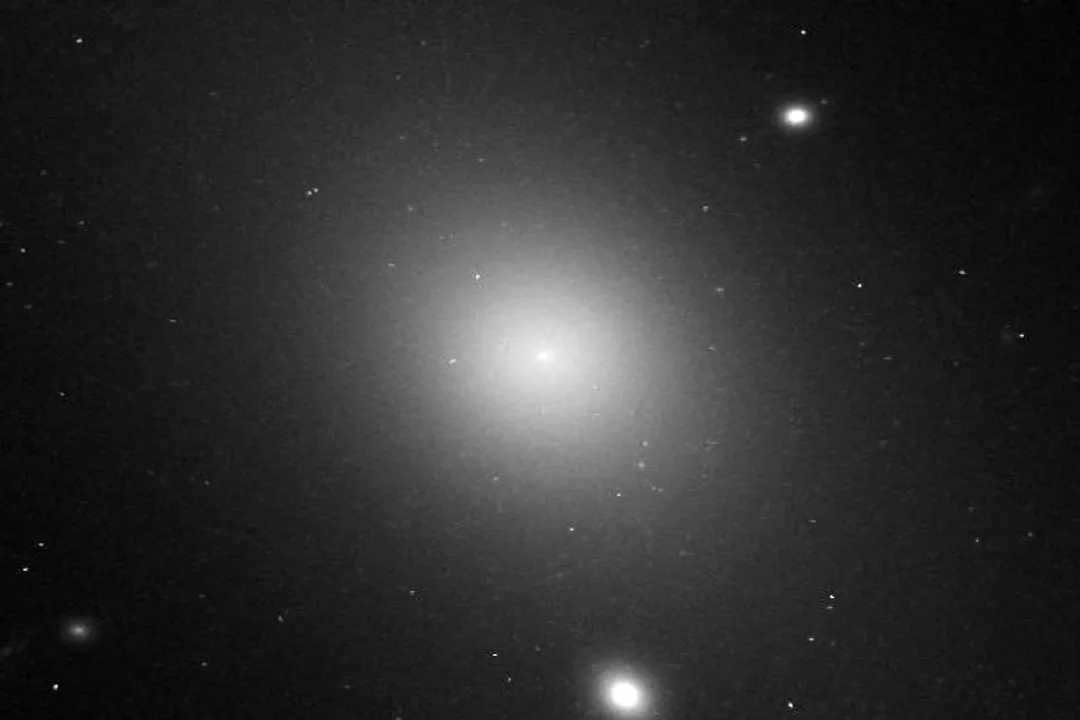
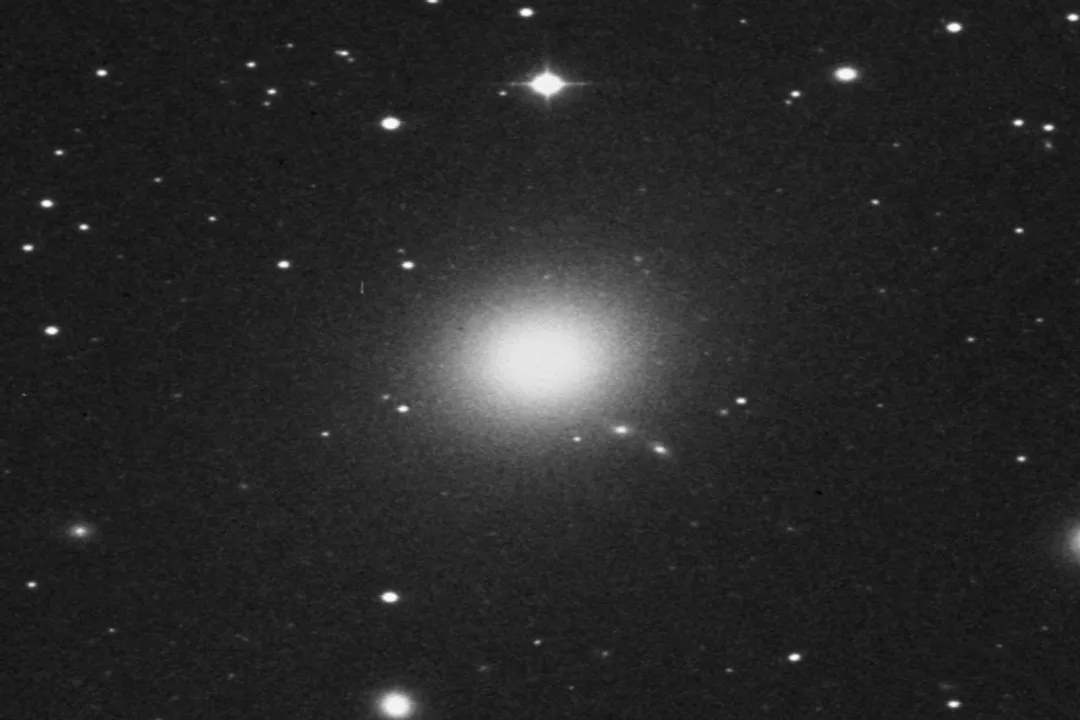
In stark contrast to the bustling spirals are the elliptical galaxies, which present a much more placid appearance. [2][3] These range in shape from nearly perfectly round (designated E0) to quite elongated (E7). [6] A defining feature of elliptical galaxies is their lack of spiral arms and their composition dominated by older, redder stars. [2][3]
Ellipticals typically contain very little cool gas and dust. [1][4] Because star formation requires these cold reservoirs of material, elliptical galaxies have largely ceased producing new stars, or at least produce them at a vastly reduced rate compared to spirals. [2][3] The material that might have once existed has either been consumed by past star formation or ejected from the galaxy over cosmic timescales. [5]
However, to say they have no gas is an oversimplification often encountered in general descriptions. Many large ellipticals are enveloped by enormous halos of hot gas, which can be detected through X-ray observations. [5] This gas is heated to millions of degrees, perhaps through galactic mergers or accretion from the intergalactic medium. [5] While this hot gas certainly exists, it is not conducive to forming stars; the high temperature keeps the gas too diffuse and energetic to collapse into dense molecular clouds. [5] Therefore, while ellipticals are reservoirs of hot gas, they are generally depleted of the cold gas and dust required for active stellar nurseries. [1][2]
# Irregular Forms
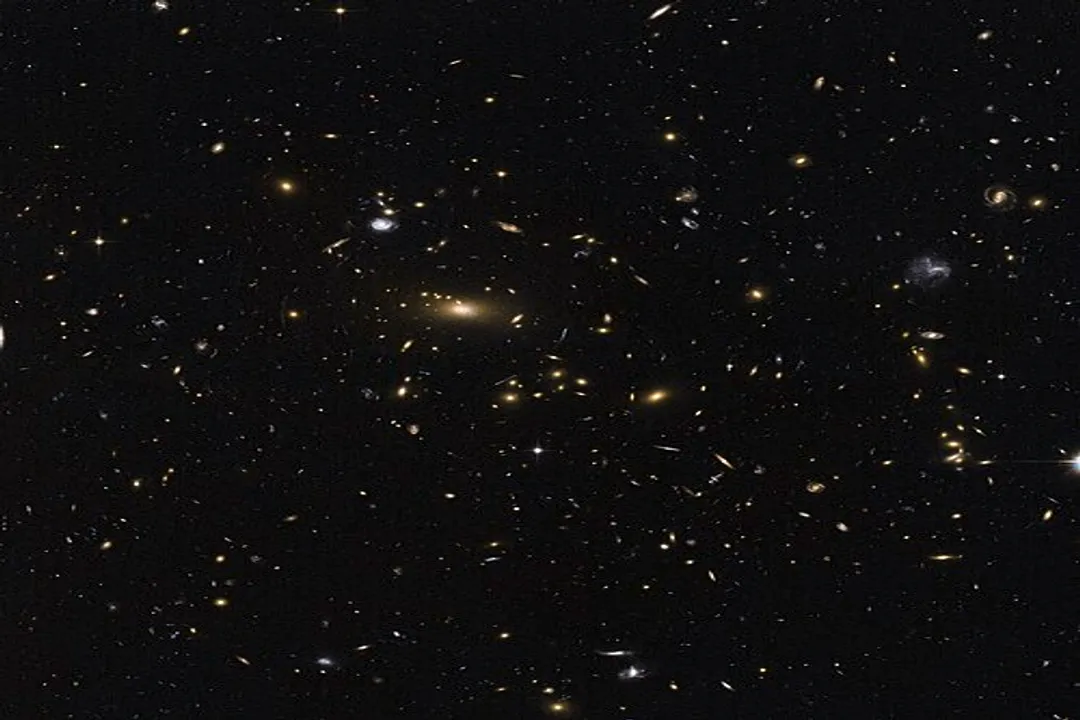
The third major class, irregular galaxies, are those that do not fit neatly into either the spiral or elliptical mold. [4] Lacking a distinct, regular structure, they often appear chaotic or clumpy. [4] These galaxies frequently exhibit vigorous star formation, which is directly linked to their high content of gas and dust. [1][4]
Irregular galaxies are often the result of gravitational disturbances, such as close encounters or mergers with other galaxies. [4] These interactions can strip away gas or compress existing clouds, triggering intense bursts of star formation—a phenomenon sometimes called a "starburst". [4] Because they are dynamically unsettled, the gas and dust necessary for star birth may not be confined to a neat disk but distributed throughout the entire messy structure. [1] In some respects, an irregular galaxy can be viewed as a spiral galaxy in the midst of a violent transformation or a remnant of past interactions that rearranged its contents, leaving behind a rich, albeit disorganized, supply of star-making material. [4]
# Gas Distribution
The location of the gas and dust within a galaxy dictates the galaxy’s appearance and its ongoing stellar life cycle. In spiral galaxies, the gas resides primarily in the mid-plane of the disk. This planar concentration means that star formation is generally confined to the spiral arms and the thin disk itself, leaving the central bulge, which is composed mostly of older stars, relatively quiescent from a star-forming perspective.
Consider a hypothetical comparison between a typical grand design spiral and a large elliptical galaxy, both observed across the electromagnetic spectrum. The spiral would show clear infrared signatures from dust obscuring starlight, strong radio emission from cold hydrogen gas (the 21-cm line), and bright UV/visible light from young blue stars clustered in its arms. The elliptical, conversely, would be dominated by near-infrared emission from old stars and perhaps strong X-ray emission from its diffuse, hot halo gas, but would be remarkably silent in the radio and far-infrared wavelengths associated with cold, star-forming material. [5] It is a powerful illustration of how galaxy environment dictates observable processes.
# Evolutionary Links
The presence or absence of cold gas and dust is often a marker of a galaxy's evolutionary stage. Gas-rich spirals are considered "alive," actively converting their fuel into stars. [1] Ellipticals, conversely, are often seen as "dead" or dormant systems, having either exhausted their fuel supply or been stripped of it. [5]
A key mechanism linking these states is galactic mergers. When two large spiral galaxies collide and merge, the violent gravitational interactions can drive large amounts of gas and dust toward the center, sometimes triggering a massive, short-lived starburst event. Following this burst, the resulting galaxy settles into a larger, more elliptical form, having used up or ejected most of its remaining cold reservoir during the merger and subsequent intense star formation phase. [4] This process effectively converts a gas-rich spiral population into a gas-poor elliptical population over cosmic time, a transformation that explains the prevalence of older stars in giant ellipticals today. [2]
This transition highlights an interesting point: a galaxy’s current morphology is not necessarily static. A galaxy currently categorized as "irregular" might simply be a spiral or elliptical system caught in the middle of an event—a merger or a close flyby—that temporarily alters its appearance and compresses its gas content, potentially leading to a future classification change. The gas and dust content, therefore, acts as a sort of cosmic timer, indicating how recently the galaxy has experienced significant gravitational disruption or star formation activity. [4]
Related Questions
#Citations
Galaxy Types - NASA Science
Elliptical galaxy - Wikipedia
Elliptical Galaxy | ESA/Hubble
Characteristics of Galaxies - SDSS Voyages
Lecture 32: Types of Galaxies
Types of Galaxies | NASA Space Place – NASA Science for Kids
Galaxies are classified into three main types based on their shape ...
Galaxy Types - Introduction to Cosmology
Spiral Galaxies