What type of galaxy contains mostly old stars?
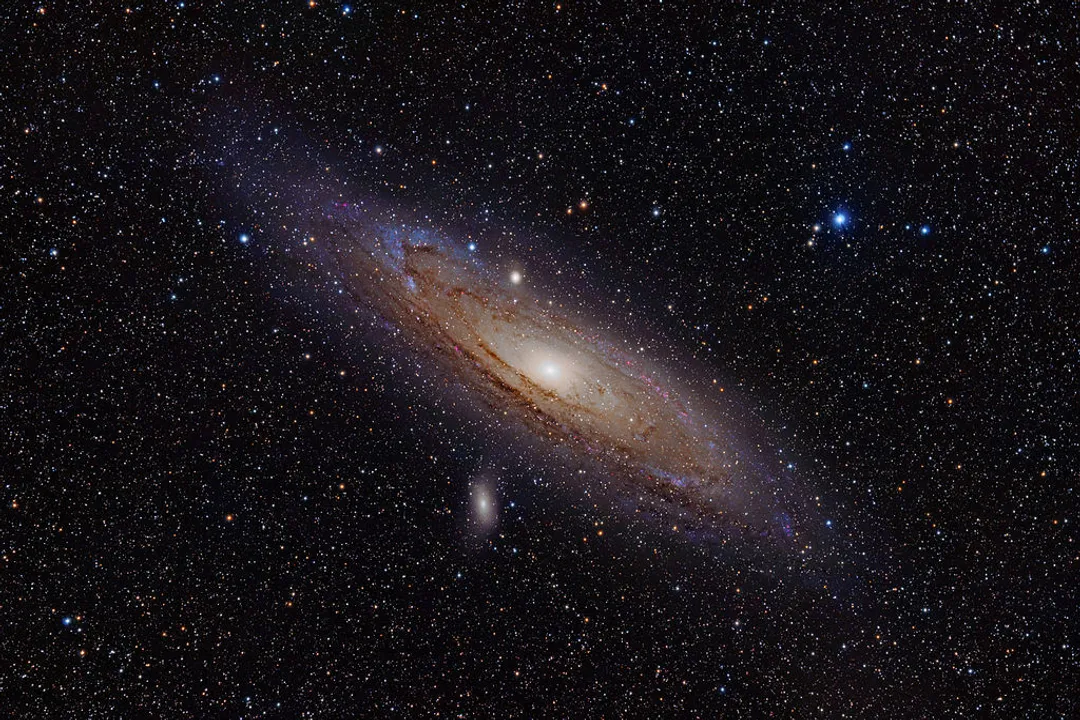
The galaxy type that predominantly hosts ancient stars, shimmering in shades of red and yellow across the cosmos, is the elliptical galaxy. [6][7] These vast, often seemingly featureless systems represent the end state of a specific evolutionary path, one that has largely ceased the birth of new, hot, blue stars. [3] When astronomers look at an elliptical galaxy, they are looking into a system dominated by stellar relics, stars that formed long ago when the galaxy was perhaps more active and gas-rich. [1][7]
# Stellar Populations
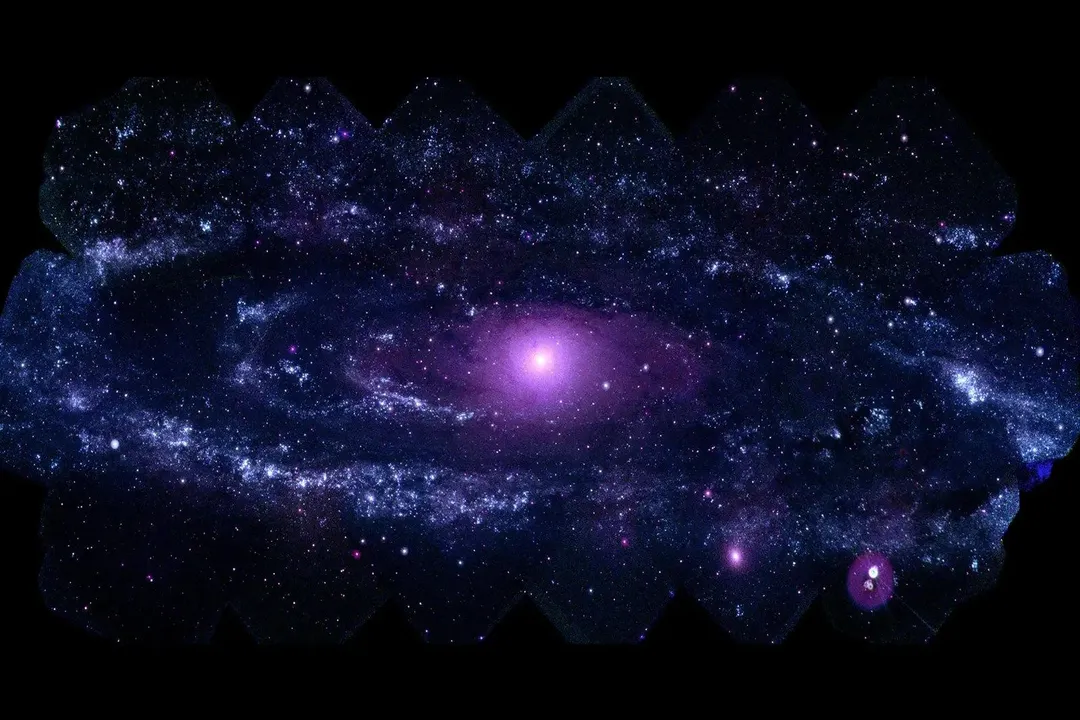
The defining characteristic separating elliptical galaxies from their spiral counterparts is the age distribution of their stellar inhabitants. [1][3] Elliptical galaxies are known to contain a much greater proportion of older stars compared to spiral galaxies. [3] This leads to a distinct color profile; because massive, hot, young stars burn through their fuel quickly and emit blue light, their absence leaves the older, cooler, redder stars to dominate the overall light output. [7] Consequently, these galaxies are often colloquially described by astronomers as red and dead. [3]
Conversely, spiral galaxies, such as our own Milky Way, are characterized by ongoing star formation within their spiral arms. [2] These arms are reservoirs of the raw materials—cool gas and dust—necessary to ignite stellar nurseries. [2] The young stars born in these regions are bright and blue, lending the spiral arms a youthful, vibrant appearance that contrasts sharply with the settled glow of an elliptical system. [2]
Within an elliptical galaxy, the environment is typically characterized by a very sparse interstellar medium. [1] The lack of significant reservoirs of cold gas and dust means there is virtually no raw material available to fuel the formation of new stars. [3][7] While spiral galaxies are constantly churning out new generations, elliptical galaxies are, for the most part, retired from that process. [1]
It is fascinating to consider the stellar composition in terms of activity. Imagine a large, active spiral galaxy as a sprawling industrial complex running multiple shifts daily—always producing new products (stars). An elliptical galaxy, however, is more like a massive, historical monument—beautifully constructed, composed of magnificent, time-tested materials (old stars), but the construction site has been silent for eons because all the necessary raw materials were used up in the initial, energetic building phase.
# Shape and Structure
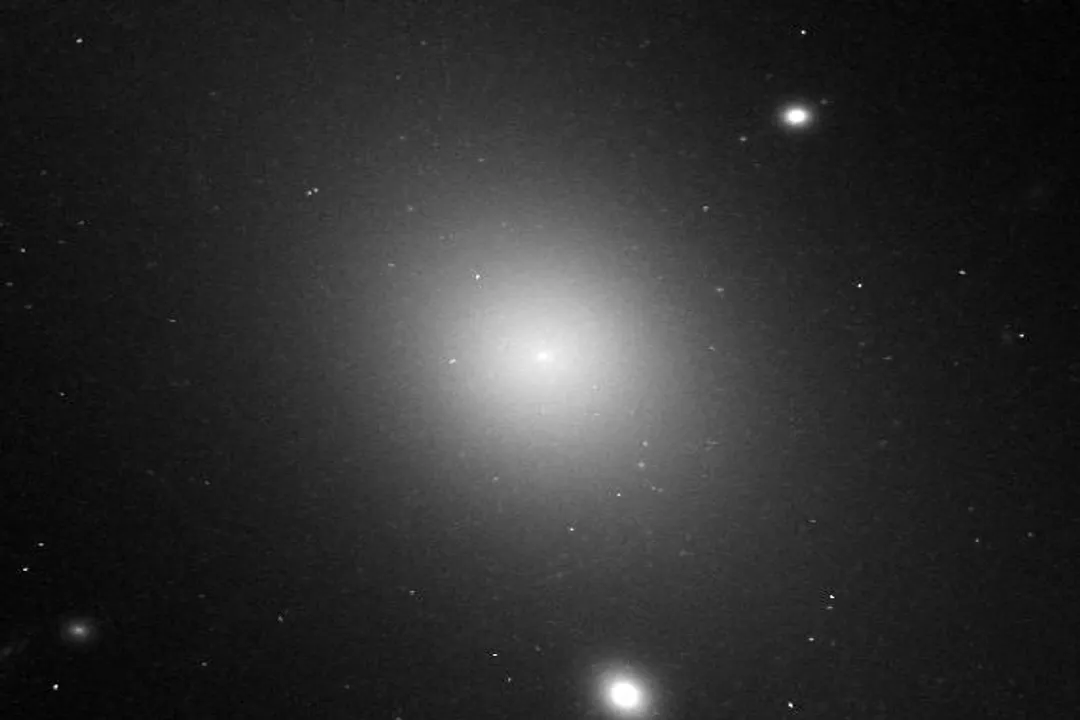
The appearance of an elliptical galaxy is one of smooth, ellipsoidal shapes, ranging from nearly perfectly spherical to highly elongated or oval. [1][3][5] Unlike the organized, flat disk and clear spiral arms seen in other types, the stars in ellipticals orbit the core in somewhat random, three-dimensional paths, contributing to their lack of defined structure. [1]
Edwin Hubble initially classified these shapes using an integer from E0 (nearly spherical) to E7 (most elongated), based on the ratio of the major to minor axes. [1] However, subsequent observations revealed a complication in this simple shape classification: the apparent elongation often depends on the angle from which we view the galaxy. [1] Furthermore, some galaxies classified as highly elongated ellipticals (E4 through E7) have since been shown through spectral analysis to possess disks inclined at various angles, suggesting some might actually be lenticular galaxies viewed edge-on. [1]
Elliptical galaxies span an enormous range in both size and mass, a variability broader than any other galaxy type. [1] The smallest examples, dwarf ellipticals, can contain as few as tens of millions of stars, approaching the size of large globular star clusters. [1][7] On the opposite extreme are the supergiant ellipticals that dominate the cores of massive galaxy clusters, containing over one hundred trillion stars and spanning diameters potentially exceeding 700,000 light-years. [1][7] The largest known galaxies, such as M87, fall into this supergiant category. [7]
A key structural feature in the most massive ellipticals is the presence of an extensive system of globular clusters surrounding them. [1] These systems often exhibit two distinct populations: one older, redder, and metal-rich, and another younger, bluer, and metal-poor, hinting at a complex history involving accretion or multiple merger events. [1]
# Formation and Location
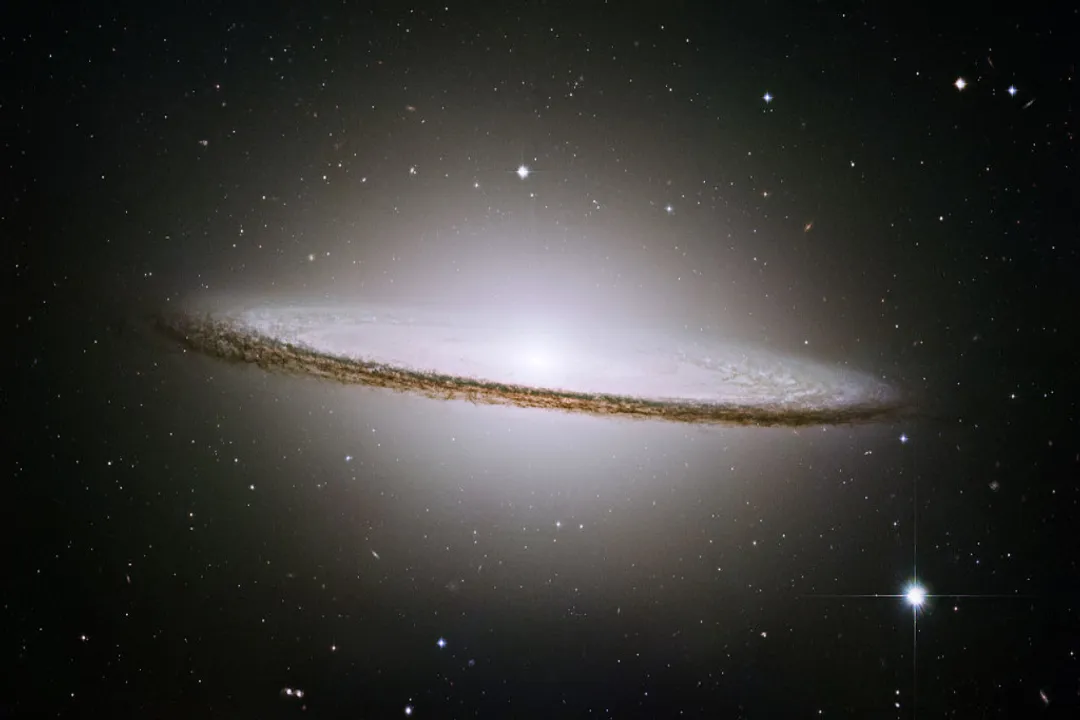
The primary theory explaining the existence of these elderly stellar collections points toward violent past interactions: most massive elliptical galaxies are thought to have formed through the collisions and subsequent mergers of spiral galaxies. [1][3][7] When two or more spiral galaxies collide, the destructive gravitational forces and gas shockwaves trigger rapid, intense bursts of star formation, rapidly consuming the available gas supply. [1][7] Once this fuel is exhausted in the merger chaos, the resulting, larger galaxy settles into its smooth, elliptical shape, populated only by the stars that existed before and during the cataclysm, now observed as a collection of old stars. [3][7]
This formation mechanism strongly dictates where these galaxies are found: they are preferentially located in the most crowded regions of the universe, such as the centers of galaxy clusters and in compact galaxy groups. [1][3][7] In these dense environments, galaxy interactions happen much more frequently, leading to more mergers and thus a higher concentration of 'red and dead' elliptical systems. [7]
The existence of these merger remnants helps explain the Hubble classification system's historical confusion. Hubble initially labeled ellipticals as 'early-type' and spirals as 'late-type,' implying an evolutionary sequence from elliptical to spiral, which has since been proven incorrect. [1][3] The evidence, particularly the age difference of the stellar populations, now suggests the reverse: spirals can evolve into ellipticals through collision. [3]
While the typical elliptical galaxy is indeed gas-poor, modern observations have shown that a small but significant minority—around 25%—of these early-type galaxies still retain residual gas reservoirs and show low-level, ongoing star formation. [1] This suggests that not all mergers completely strip the gas, or perhaps some gas is later supplied through faint external streams or fed by the central supermassive black hole, though the exact processes halting star formation entirely are still subjects of deep investigation. [1]
# Comparisons across Types
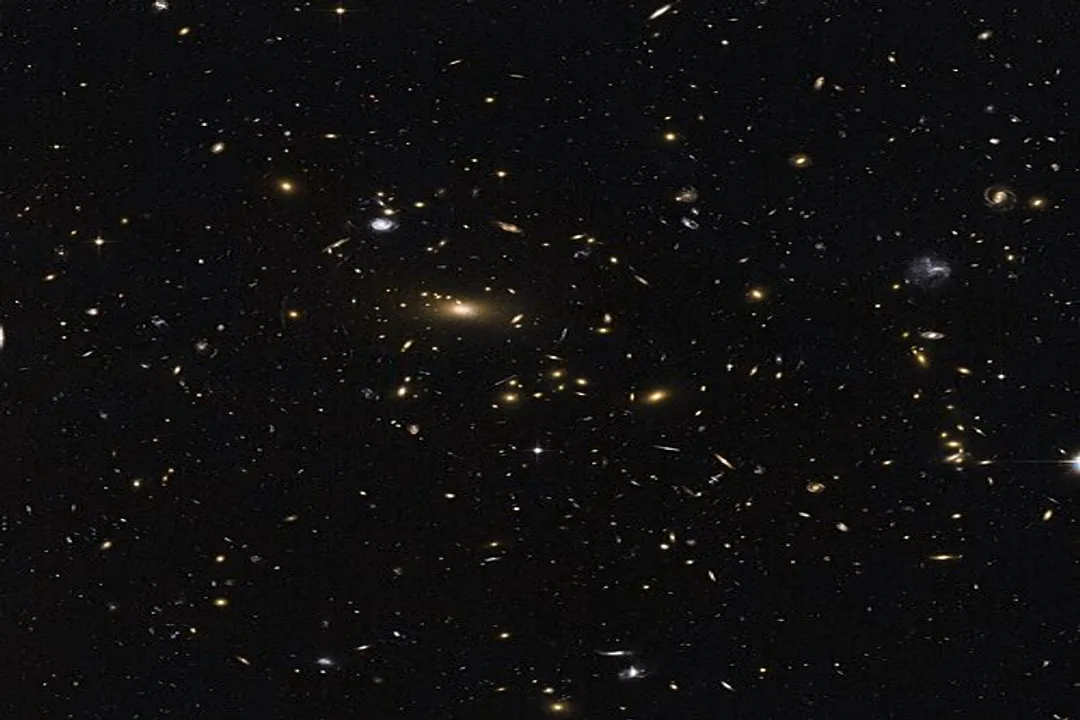
To fully appreciate why elliptical galaxies are the home of old stars, it helps to contrast them against the other major categories defined by structure.
| Galaxy Type | Key Structural Feature | Dominant Star Age | Gas/Dust Content | Star Formation Rate | Typical Location |
|---|---|---|---|---|---|
| Elliptical | Smooth, ellipsoidal/spherical shape [1][7] | Predominantly Old (Red/Yellow) [3][7] | Very little [1][6] | Minimal/None ("Dead") [1][3] | Galaxy Clusters/Groups [1][7] |
| Spiral | Flat disk, central bulge, spiral arms [2] | Mix, with young stars in arms [2] | Rich reservoirs [2] | Active ("Living") | Field, less crowded areas |
| Irregular | No defined shape [3] | Mix of old and young stars [3] | Often high [3] | Variable, often high | Field, often near larger galaxies [3] |
It is important to note that size does not strictly determine stellar age. Dwarf galaxies, which are the most common type in the universe, can be irregular, spiral, or elliptical. A dwarf elliptical, though small, still adheres to the chemical and age profile of its larger elliptical cousins—it is a small island of old stars.
# Classification Nuances
While Hubble’s sequence is a cornerstone of morphology, the reality is more complex, leading to types that bridge the gap. Lenticular galaxies (S0) are often considered a transitionary or separate "early-type" galaxy alongside ellipticals. [1] They possess the disk and central bulge structure of a spiral but lack the spiral arms. [3] Crucially, like ellipticals, lenticular galaxies are characterized by older stellar populations and little ongoing star formation, suggesting they may be faded spirals or the result of a merger that maintained some disk structure. [1][3]
The sheer contrast in the stellar life cycles between spirals and ellipticals offers a critical clue about galaxy evolution itself. The presence of abundant cool molecular gas is a prerequisite for star formation, and this gas cools best in the relatively quiescent, undisturbed environments of spiral disks. [1] Once a galaxy like a spiral undergoes a major merger, the kinetic energy injected into the gas heats it, preventing gravitational collapse into the dense cores needed to form stars, effectively turning the factory off and creating an elliptical system. [1]
There is a less frequently discussed dichotomy within the ellipticals themselves, separating the giant ones with "boxy" isophotes—whose shapes reflect anisotropic random motion—from the "disky" dwarf ellipticals that retain a disk component. [1] This internal variety suggests that the merger process, which creates ellipticals, might not always wipe out all remnants of the original disk structure, leading to a continuity between E, ES (intermediate disk), and S0 galaxies. [1]
# Central Black Holes and Dead Cores
Nearly every massive elliptical galaxy harbors a supermassive black hole at its very center. [1] The mass of this central object is tightly correlated with the mass of the entire galaxy, a relationship evidenced by concepts like the M–sigma relation. [1] In some massive ellipticals, like the famous M87, this black hole can power an Active Galactic Nucleus (AGN), manifesting as powerful jets of particles flung outward millions of light-years away. [1][5]
This central activity might actually contribute to the "dead" state of the galaxy. Some researchers hypothesize that the intense energy output or outflow driven by the central black hole actively prevents the remaining gas from cooling sufficiently to condense into new stars. [1] If the central engine is powerful enough, it acts as a galactic thermostat, keeping the temperature too high for stellar birth and ensuring that the existing population of old stars remains the final picture of the galaxy’s stellar life. [1]
If we consider the total energy output versus the total mass, it reveals a striking difference. A typical spiral galaxy might be radiating a lot of blue light from its current, vigorous star formation, leading to a high luminosity relative to its mass history. An elliptical, being "dead," has a lower current luminosity, yet it is often vastly more massive than many spirals. [7] Its light comes from stars that have been evolving for many billions of years—stars that have long since left the main sequence and become dimmer red giants or white dwarfs, a direct consequence of the fact that the majority of its stars ignited billions of years ago, likely during the explosive merger event that created it. [1]
# Looking Deeper Into the Past
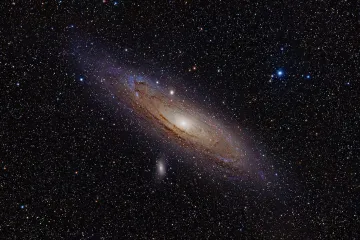
Studying these ancient elliptical populations is akin to looking at living fossil collections. Since the light we see from distant galaxies has traveled for billions of years, observing very distant, massive ellipticals gives us a snapshot of what the precursors to these massive galaxies looked like when the Universe was young. [1] Evidence suggests that these massive ellipticals were, in their youth, extremely active, filled with gas and forming stars at phenomenal rates—far more productively than today's spirals. [1] The observations from powerful telescopes have helped map out how this vigorous star formation sputtered out billions of years ago, leaving behind the quiescent, massive, old-star-filled structures we measure today. [1]
The observation that elliptical galaxies are overwhelmingly populated by old stars is not just a matter of classification; it is a fundamental piece of evidence underpinning our models of structure formation in the cosmos. It confirms that the largest structures in the universe—the massive ellipticals found at cluster centers—formed rapidly and violently in the early epochs, consuming their resources quickly, while the more graceful, sustained star formation continues in the disk structures of spiral galaxies that have avoided such dramatic gravitational trauma. [3]
# Unseen Components
While the visible stars in an elliptical galaxy are overwhelmingly ancient, the mass budget of these systems presents a challenge for simple visual analysis. Even though the stellar population is old and red, these galaxies possess enormous dark matter halos. [1] Dwarf ellipticals, for instance, may contain a considerable amount of dark matter that is not present in globular clusters. [1] This invisible scaffolding means that even though the visible components are aging relics, the galaxy's overall gravitational structure is still immense and governs the motions of its ancient stellar population. [1] Understanding the orbits of these old stars, which are randomized rather than confined to a rotating disk, provides dynamic information about this unseen mass distribution, something that astronomers can map using techniques like the velocity dispersion measurement described in the M-sigma relation. [1]
Related Questions
#Citations
Elliptical galaxy - Wikipedia
Galaxy Types - NASA Science
Elliptical Galaxy | ESA/Hubble
Glossary term: Elliptical Galaxy - IAU Office of Astronomy for Education
Types of Galaxies | Physical Geography - Lumen Learning
Elliptical Galaxy - Universe Today
Galaxies | CK-12 Foundation
Types of Galaxies | NASA Space Place – NASA Science for Kids