What type of galaxy has old red stars?
The light reaching us from certain galaxies carries a distinct, aged hue, a reddish or yellowish glow that speaks volumes about the history of the stars within. When we observe a galaxy where the overwhelming majority of stellar inhabitants are old, their collective light signature shifts away from the brilliant, energetic blues of youthful, massive stars and settles into the warmer tones characteristic of long-lived, evolved giants. This specific stellar demographic—the old, red stars—is the defining feature of the Elliptical Galaxy class.
These galaxies represent a stage in galactic evolution where the intense period of star formation, which characterized their youth, has largely wound down. Unlike the vibrant, blue-tinted arms of a majestic spiral galaxy, the elliptical system presents a more serene, quiescent appearance, dominated by stars that have already spent billions of years fusing hydrogen. Understanding why these stars are red and old requires delving into the environment and structure of the elliptical galaxy itself.
# Red Stars Dominance
The color of a galaxy is a direct tracer of its star formation history. Hot, massive stars burn through their fuel quickly, shining intensely blue for only a few million years. Consequently, a galaxy actively birthing new stars will display significant blue light. In contrast, the stars that populate elliptical galaxies are predominantly low-to-intermediate mass stars that have evolved into red giants, or older, smaller stars like red dwarfs that simply have exceptionally long lifespans.
When a galaxy’s star-forming fuel—cold gas and dust—is exhausted or ejected, the remaining stellar population ages together. As the blue giants die out, the remaining light is dictated by the longer-lived, cooler stars, resulting in an overall yellowish-red appearance. This population is ancient; many stars within these systems are believed to have formed roughly ten billion years ago. If we consider a hypothetical, "average" elliptical galaxy whose light is dominated by K-type giant stars (which are inherently reddish-yellow) rather than O or B type main-sequence stars (which are blue), the resulting integrated spectrum will be heavily weighted toward the redder wavelengths. For a typical spiral to maintain even a slight blue tint, a small but critical fraction of young, massive stars must still be present and active. In contrast, an elliptical that hasn't formed a star in a billion years will present a remarkably static color profile, making age estimation based purely on integrated broadband color quite reliable, even if resolving individual stars is difficult.
# Galactic Shape Measure
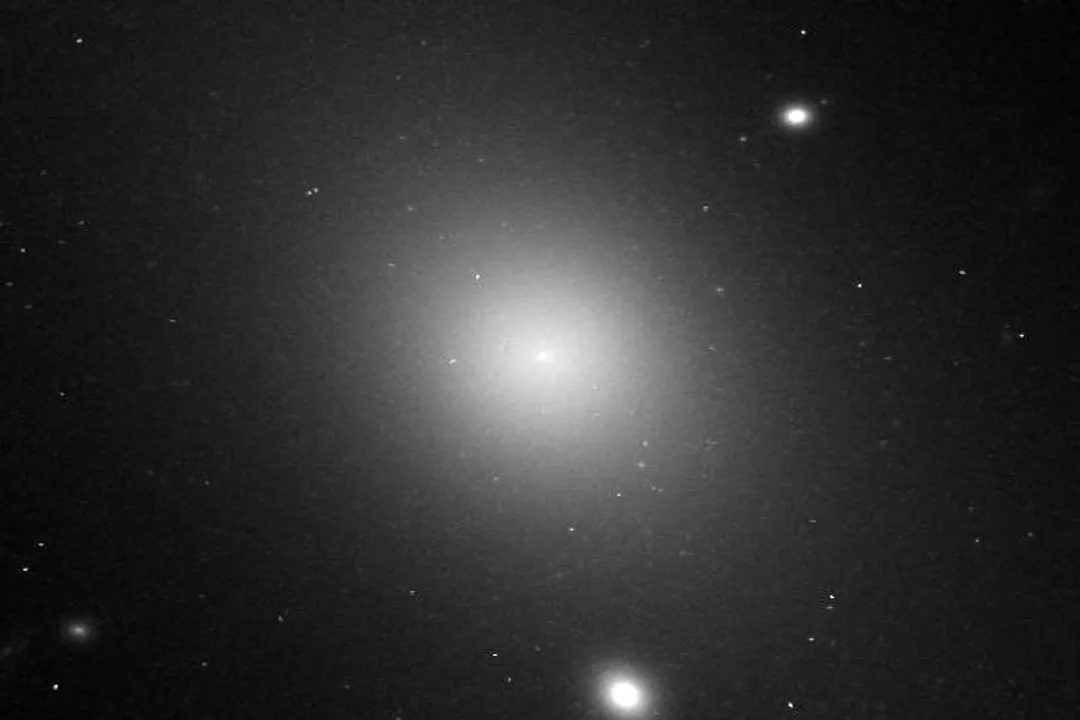
Elliptical galaxies are classified based on their apparent visual shape, which ranges from nearly perfectly round to highly elongated spheroids. This morphological classification system is standardized using the letter 'E' followed by a number from 0 to 7.
The designation signifies a galaxy that appears almost perfectly spherical, lacking any noticeable elongation. As the number increases, so does the apparent flattening of the galaxy. An galaxy, for instance, is significantly flattened or cigar-shaped when viewed from Earth. It is important to note that this numbering system describes the projected shape we see on the sky, not necessarily the true three-dimensional structure, which could be a flattened disk viewed edge-on rather than a truly elongated ellipsoid. They lack the distinct spiral arms, central bulge, and disk structure seen in other types. Their appearance is generally smooth and featureless.
# Star Birth Cessation
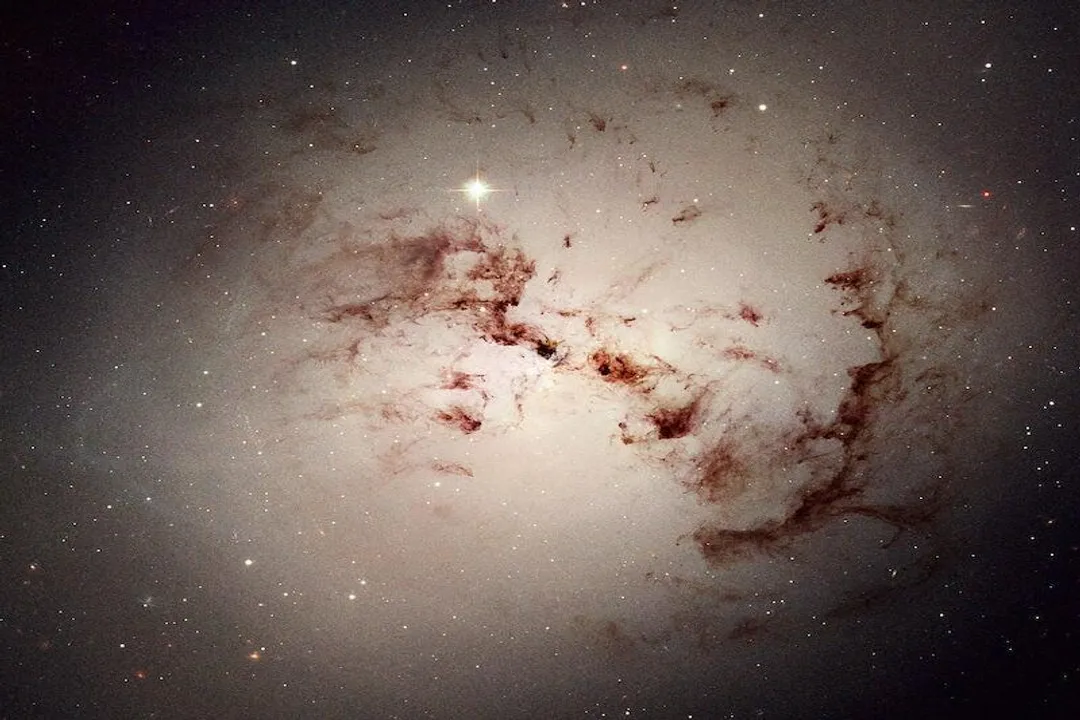
The lack of blue stars directly implies an almost complete absence of current star formation, which is a hallmark of these systems. This cessation is intrinsically linked to the depletion or removal of the raw materials needed for new stars: cold molecular gas and dust clouds.
Compared to spiral galaxies, which often harbor vast reservoirs of interstellar medium within their dusty disks, ellipticals are relatively poor in cool gas and dust. While they contain plenty of older stars, the components necessary to create new ones are scarce. Astronomers often refer to elliptical galaxies as "stellar graveyards" because their active star-forming life is over. Observations confirm that cold molecular gas, which traces the sites of future star formation, is either entirely absent or present only in trace amounts in many ellipticals. Some of the largest ellipticals have been observed to contain hot, diffuse gas, but this gas is too hot for collapse and star formation to occur.
# Merger Origins
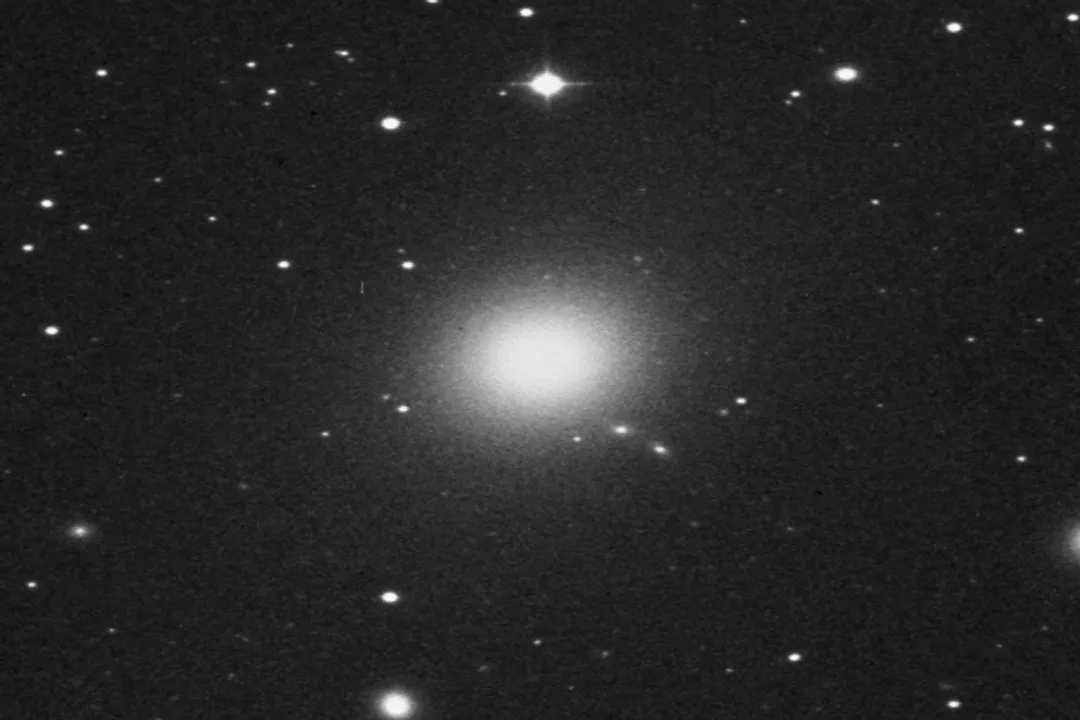
The smooth structure and lack of rotational organization in elliptical galaxies suggest a violent past, distinct from the gradual, relatively quiet formation process often attributed to spirals. The leading theory for the creation of the largest ellipticals involves major galaxy mergers.
When two spiral galaxies of roughly equal mass collide, the gravitational dynamics often destroy the ordered disk structures, mixing the stars into a randomized, ellipsoidal configuration. This merger process is also extremely efficient at triggering bursts of star formation—a rapid consumption of the available gas supply in a short period—followed by the subsequent ejection or heating of the remaining gas, effectively "quenching" star formation afterward. This event transforms two organized, star-forming systems into one large, relatively static elliptical galaxy. Dwarf ellipticals, which are smaller and fainter, may form through different routes, perhaps as the remnants of smaller mergers or through the stripping of gas from larger galaxies that venture into dense environments.
The prevalence of these old, red ellipticals in dense environments like the Virgo Cluster suggests that the environment itself acts as a powerful mechanism for accelerating this transition from a star-forming spiral to a quiescent elliptical. This process of environmental transformation, involving ram-pressure stripping as a galaxy moves rapidly through the hot intracluster medium, might be more critical to their current gas-starved state than the initial merger event alone, as mergers happen everywhere, but giant, gas-poor ellipticals are most common in the densest knots of the cosmic web.
# Spiral Contrast
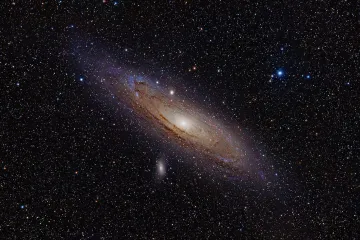
To fully appreciate the "old red star" galaxy, it helps to place it beside its primary counterpart, the spiral galaxy. Spiral galaxies, like our own Milky Way, are characterized by flat, rotating disks populated by a mix of stellar ages.
In a spiral galaxy, star formation is ongoing, concentrated in the spiral arms where cool gas clouds are compressed. This continuous birth rate keeps the arms visibly blue due to the presence of young, hot stars. The light from a spiral is therefore a mixture: the central bulge might be older and yellower, but the disk introduces significant blue light from recent stellar birth.
The difference in gas content is stark:
| Feature | Elliptical Galaxy | Spiral Galaxy |
|---|---|---|
| Stellar Population | Primarily old, red stars | Mix of young (blue) and old (yellow/red) stars |
| Gas and Dust Content | Very little cold gas | Rich in cold gas and dust in the disk |
| Star Formation Rate | Very low or none (quiescent) | Ongoing, active in the arms |
| Typical Structure | Smooth, featureless spheroid | Flat disk, spiral arms, central bulge |
# Size Range
Elliptical galaxies exhibit the widest range in physical size among all galaxy types. At one end of the spectrum are the giant ellipticals, which can be absolutely enormous, sometimes containing trillions of stars. These behemoths frequently reside at the dynamical centers of massive galaxy clusters, suggesting they have grown large by continuously absorbing smaller neighbors over cosmic time.
At the other extreme are dwarf ellipticals. These are much smaller, fainter, and more common in the local universe than their giant cousins. While they share the same smooth, featureless morphology and old stellar population as the giants, their formation history might involve less dramatic mergers and more processes related to tidal stripping in less dense environments.
The observation that these ancient stellar populations are distributed relatively smoothly throughout the entire volume of the galaxy, rather than being confined to a thin plane like in a spiral, gives the elliptical its characteristic three-dimensional, blob-like appearance. This lack of internal structure confirms that any initial disk component has been thoroughly randomized by gravitational interactions over eons. The light from these systems offers a nearly pristine glimpse into the composition of the universe when it was significantly younger, preserved through the cessation of subsequent star birth.
Related Questions
#Citations
Elliptical galaxy - Wikipedia
Elliptical Galaxy | ESA/Hubble
Elliptical Galaxy - Universe Today
Galaxy Types - NASA Science
Glossary term: Elliptical Galaxy - IAU Office of Astronomy for Education
Characteristics of Galaxies - SDSS Voyages
Elderly Ellipticals | Ask An Earth And Space Scientist
The Three Types of Galaxies - Slooh
Elliptical Galaxy | All dimensions Wiki - Fandom