Why do galaxies turn red?
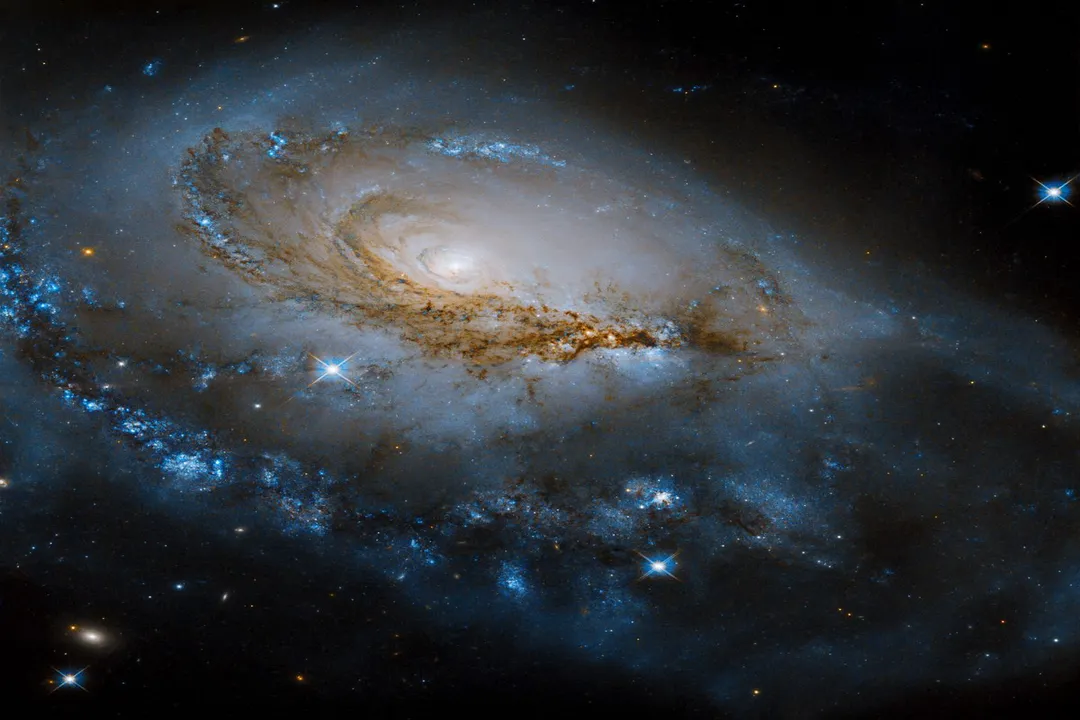
The myriad of galaxies scattered across the cosmos presents a spectrum of colors, from vibrant blues to deep crimsons, raising a fascinating question about what dictates this celestial palette. It isn't merely a trick of the viewing equipment or the atmosphere; the color we perceive is a complex message carrying information about the galaxy's life cycle and its place in the expanding universe. [5] To truly understand why a galaxy appears "red," we must disentangle two distinct physical phenomena: the actual color dictated by the stars inside, and the apparent color altered by the vast distances light has traveled. [5][6]
# Star Color
The intrinsic color of a galaxy is primarily determined by the types of stars currently dominating its population. [4] In astronomical terms, the bluest galaxies are those undergoing vigorous star formation. [4] These stellar nurseries are teeming with young, hot, massive stars. Blue light has a shorter wavelength, and these colossal, short-lived stars burn so brightly in the blue and ultraviolet portions of the spectrum that their light overwhelms any older, redder stars present. [5] Think of it like a newly ignited bonfire: while there are embers, the initial bright blue-white flames are what catch the eye first.
Conversely, a galaxy that appears distinctly red, yellow, or orange is typically one whose period of intense star birth has largely passed. [5] These systems are populated predominantly by older, cooler, less massive stars. Red light has a longer wavelength, and as the blue-hot stars exhaust their fuel and die off, the remaining population of aging, stable, or dying stars—like red giants—gives the entire galaxy a distinctly reddish cast. [4] The star formation rate is a powerful predictor of a galaxy's color, acting like a cosmic clock; a blue galaxy is relatively young in its star-making phase, while a red one is more mature or even elderly. [4]
# Light Shift
Beyond the color imparted by stellar populations, there is a fundamental shift in light caused by motion, known as the Doppler effect applied to light waves. [6][9] When a light source is moving away from an observer, the light waves are stretched out as they travel across the intervening space. This stretching shifts the observed wavelength toward the longer end of the spectrum—the red end—a phenomenon called redshift. [2][3][6] Conversely, if an object were moving toward us, its light waves would be compressed, causing a blueshift. [9]
For galaxies, this isn't the simple Doppler shift you hear with an ambulance siren passing by; it's a consequence of the expansion of space itself. [3][6] As the universe expands, the space between the galaxies grows, and this expanding space stretches the light waves traveling through it. [6] The more distant a galaxy is, the longer its light has been traveling, and therefore the more the space has expanded around those light waves, resulting in a greater measured redshift. [2][5]
The relationship is so consistent that Edwin Hubble famously established that galaxies are moving away from us, and their recessional velocity is proportional to their distance, which is the foundation of the understanding that the universe is expanding. [7] Astronomers measure this effect by looking at specific spectral lines—like those created by hydrogen or calcium—which have known wavelengths when measured in a stationary laboratory. When these lines appear shifted toward the red end of the spectrum in a distant galaxy's light, it confirms the light has been stretched by cosmic expansion. [3]

# Redshift Role
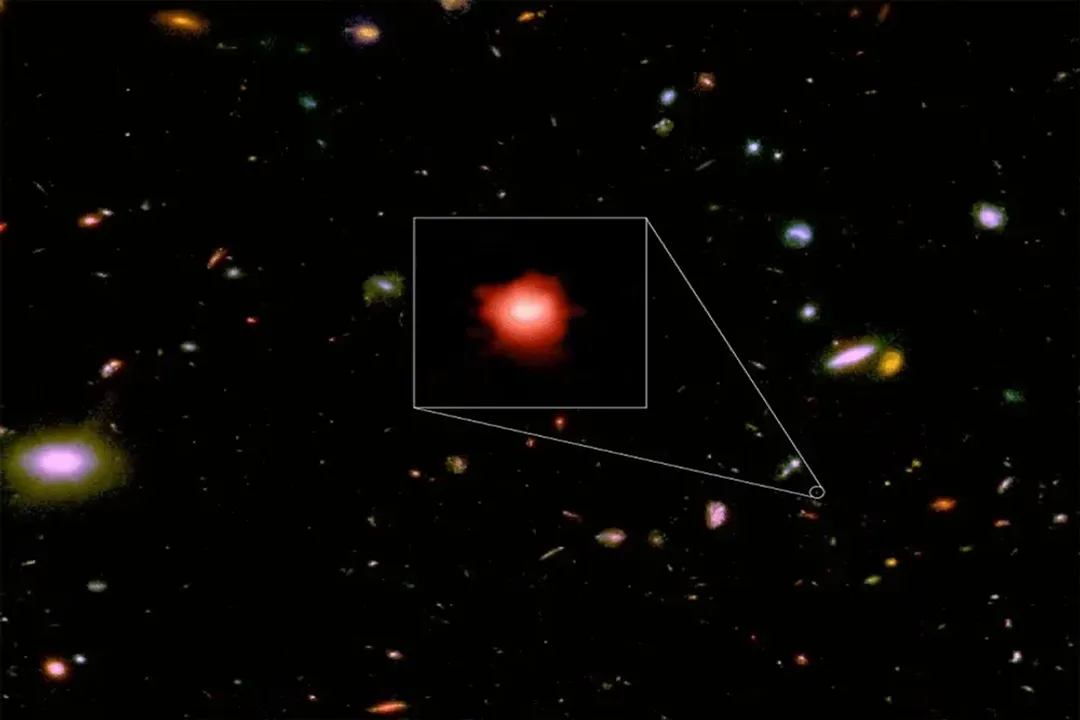
The concept of redshift introduces a crucial ambiguity when interpreting a galaxy's color. A galaxy might appear red for two completely different reasons: it is intrinsically old and red (stellar population), or it is intrinsically young and blue, but it is so incredibly far away that its light has been stretched significantly into the red end of the spectrum (cosmic distance). [5][6]
Consider a galaxy that began forming stars recently, making it a bright blue object billions of years ago. As the universe continued to expand over the last several billion years, that light journeyed toward us. By the time the light reaches our telescopes today, the expansion of space might have redshifted the light so severely that the object now appears a dull orange or red, even though its internal composition is still dominated by young stars. [5][7] This makes observing the very first galaxies extremely challenging; they were intrinsically blue, but their light has experienced the maximum amount of stretching, pushing their observable signature far into the infrared, which visible-light telescopes cannot detect. [5] This is precisely why powerful infrared instruments, like those on the James Webb Space Telescope, are essential for seeing these ancient, highly redshifted objects. [5]
A fascinating point of comparison arises when considering two galaxies at vastly different distances. Imagine Galaxy A is relatively nearby, looking bright blue because it is actively forming young stars. Now, imagine Galaxy B, which is billions of light-years away, and its light has been stretched by a factor of five. If Galaxy B was also a blue star-forming galaxy when it emitted its light, its spectral features would be redshifted by that factor of five. From our perspective, Galaxy B might appear dimmer and redder than Galaxy A, even though its internal processes are much younger than what we might infer from its observed color alone. [7] The amount of redshift tells us the distance and the amount of stretching, allowing astronomers to mathematically correct the observed color back to what it was near its source. [7]
# Color History
To accurately chart the history of the universe, astronomers must learn to separate the intrinsic color (age/star formation) from the apparent color (redshift/distance). [7] If a galaxy has a high redshift value (), we know it is very distant and its light has been stretched considerably. Astronomers then employ specific techniques to analyze the shape of its spectrum, looking for known emission lines that have been shifted, effectively calculating the redshift value first.
Once the redshift is known, say , they know the light has been stretched by a factor of , or 4 times its original wavelength. [3] They can then apply a correction to the observed light to determine what the galaxy looked like when it emitted that light three billion years ago. If the corrected light still indicates a dominance of old, cool stars, then the galaxy truly is an old system that shut down star formation long ago. If the corrected light reveals a population of young, massive stars, then the galaxy was a vigorously blue system that has simply been moving away from us for a long time. [5]
Here is a conceptual table illustrating how the final observed color is an interplay of two factors:
| Galaxy Type | Intrinsic Stellar Population (Actual Color) | Distance/Expansion (Redshift) | Observed Color Tendency |
|---|---|---|---|
| Local Spiral | Young, hot stars (Blue) | Very low (Negligible stretch) | Blue/White [5] |
| Distant Quencher | Old, cool stars (Red) | Moderate to High (Significant stretch) | Deep Red/Infrared [5] |
| Distant Starburst | Young, hot stars (Blue) | Very High (Extreme stretch) | Redshifted into Infrared [5] |
The process is effectively detective work. If a galaxy is red, we ask: Is it red because the residents are elderly, or is it red because the road it's on is incredibly long?

# Analyzing Red
The process of calculating redshift and blueshift relies on precision measurements of specific wavelengths of light, often using spectroscopy. [3] While the concept is accessible—stretching equals red shift—the actual application requires sophisticated instruments capable of measuring the exact position of spectral features. [2] For instance, the Lyman-alpha line from hydrogen, which should appear at a specific wavelength, might be detected at a much longer wavelength from a distant object. [3]
In the case of a blueshift, which indicates an object is moving toward us, this is far less common for distant galaxies because the overall expansion of the universe dominates on large scales. [6] Blueshifts are more typically observed in close neighbors or within our own Local Group, such as the Andromeda Galaxy, which is gravitationally bound to the Milky Way and is approaching us. [9]
When astronomers look at the very first light in the universe, such as the Cosmic Microwave Background (CMB), they are observing radiation that has been redshifted from the hot, glowing plasma of the early universe down to microwave frequencies by the expansion of space over 13.8 billion years. [3] This demonstrates the sheer power of redshift as a cosmological tool—it is the key to tracing the universe's evolution from its earliest moments to the present day, painting the history of galaxies in shades of color derived from stretched light. [2][6]
Related Questions
#Citations
Eli5 Why are different galaxies different colors? : r/explainlikeimfive
Redshift - Wikipedia
Why galaxies look redder, the further away they are
ESA - What is 'red shift'? - European Space Agency
Why are some galaxies red while others are blue/green ... - Quora
Why are distant galaxies in the deep field image not all red shifted?
How did Hubble know the red shift difference between "moving ...
Redshift - Las Cumbres Observatory
Redshift and blueshift: What do they mean? - Space