Are red galaxies further away?
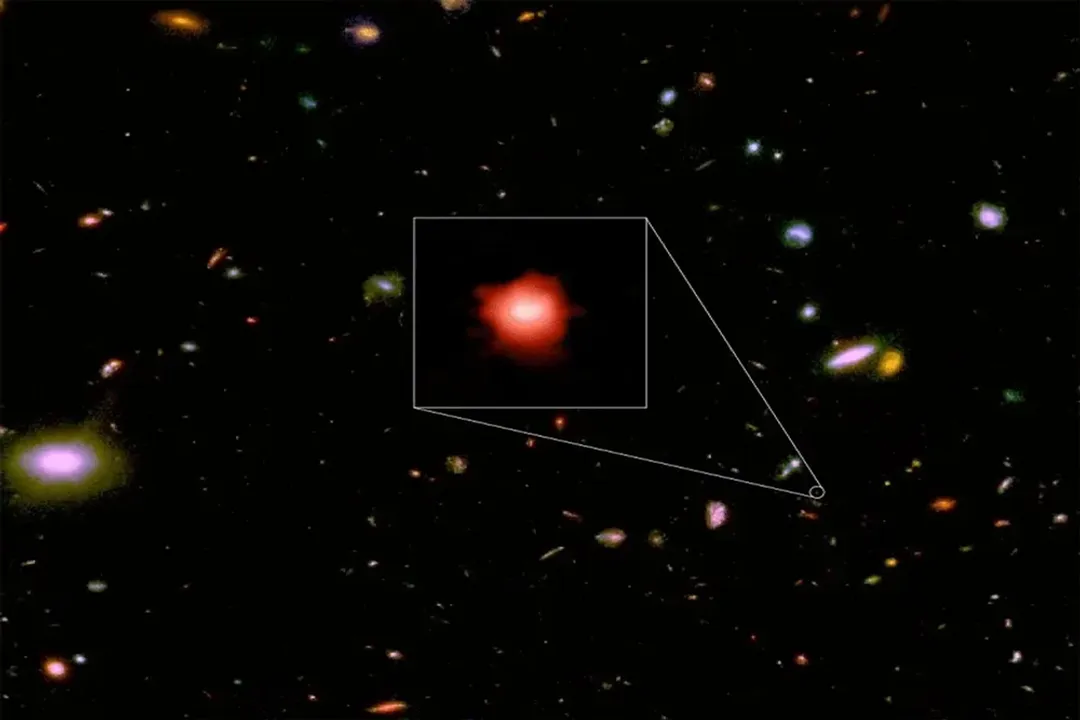
The light arriving at our telescopes from far-off galaxies carries a crucial message about its origin, primarily concerning how far away it has traveled. When astronomers discuss whether red galaxies are further away, they are often touching upon one of the most fundamental concepts in modern cosmology: redshift. This effect allows scientists to gauge the immense distances across the observable universe by analyzing the spectrum of light emitted by these distant stellar systems. [1][6]
# Light Spectrum

Light travels in waves, and the color we perceive is determined by the length of these waves; shorter waves appear blue, while longer waves look red. [6] A common analogy used to explain this phenomenon relates to sound, like the pitch of a siren dropping as an ambulance moves away from you—this is the Doppler effect in action. [1] A similar principle applies to light, but instead of describing motion through space, the redshift observed in deep space primarily describes the expansion of space itself. [3]
When an object emitting light moves away from an observer, the light waves it emits are stretched out. This stretching shifts the observed wavelength toward the longer, red end of the electromagnetic spectrum, hence the term redshift. [3][6] Conversely, if a galaxy were moving toward us, its light would be compressed, causing a blueshift. [3] While Doppler shifts occur due to relative motion within the universe, the dominant cause for the shift seen in very distant galaxies is cosmological redshift. [3]
# Expansion Effect
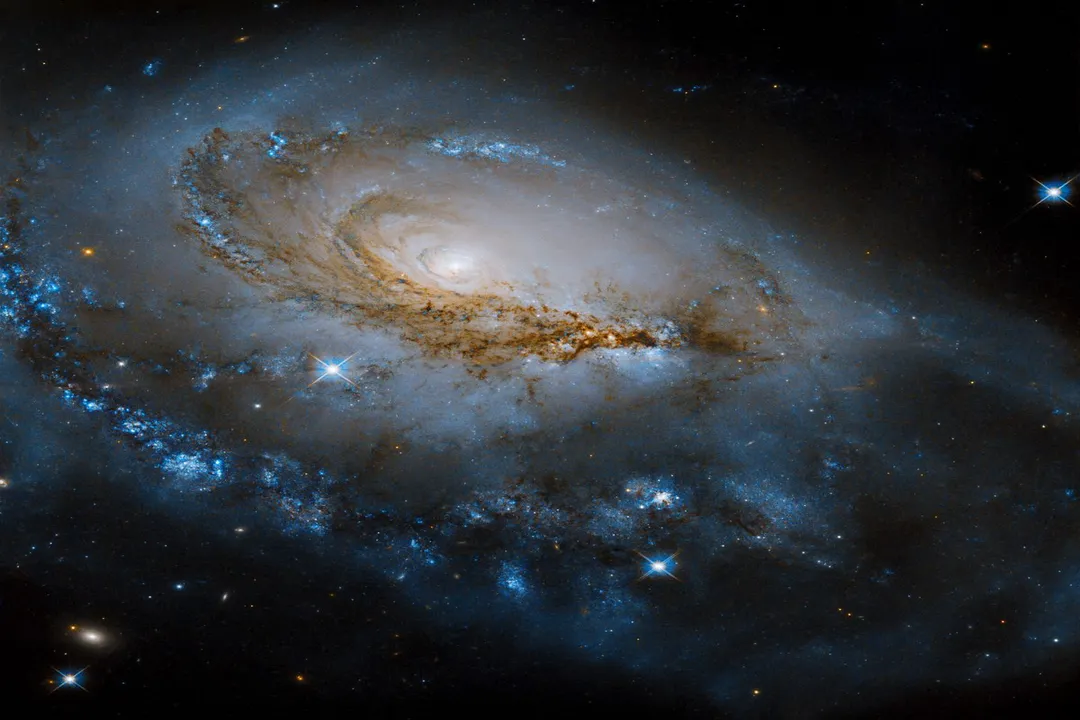
The universe is not static; it is expanding, and this expansion has been stretching the fabric of spacetime since the Big Bang. [3][6] As a photon of light travels across billions of light-years toward Earth, the space it traverses expands, carrying the light source further away and, in the process, stretching the light wave itself. [3] This stretching is the reason the light appears shifted toward the red end of the spectrum. [4][5] It is critical to understand that the light is stretched while it is traveling, not just because the galaxy is moving away in a static void. [3]
This effect means that the degree of redshift we measure is directly proportional to the amount of time the light spent traveling and the cumulative expansion that occurred during that journey. [6] If a galaxy shows a small redshift, it implies a relatively short journey and less accumulated expansion, meaning it is closer. [5] A significantly high redshift indicates that the light has been stretched by a massive amount of expansion over a very long duration, placing the source much farther away. [5][4]
# Distance Measure
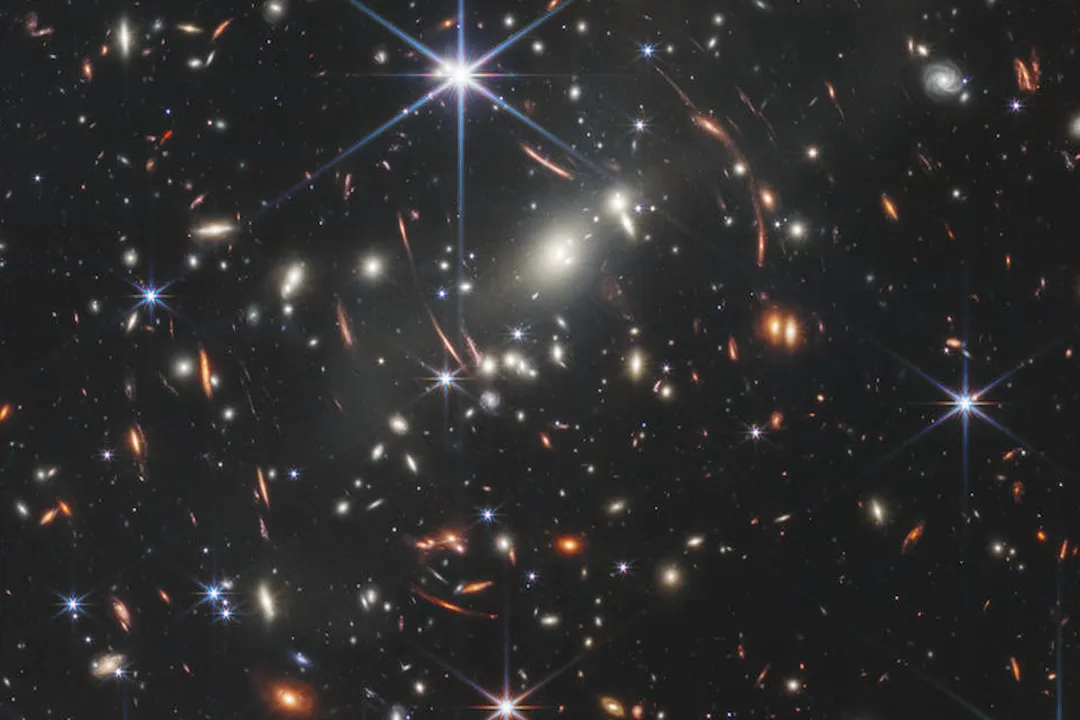
The empirical link between redshift and distance was codified by Edwin Hubble, establishing what is now known as Hubble's Law. [7] Hubble observed that almost all galaxies exhibit redshift, and crucially, the farther away a galaxy is, the greater its redshift. [5][7] This observation became the foundational tool for mapping the cosmos. By measuring the spectral lines of a distant object, astronomers can determine its redshift value, which then allows them to calculate its recessional velocity and, consequently, estimate its distance. [7]
This technique is immensely powerful because redshift is a measurable property, unlike attempting to gauge distance directly across cosmological scales. It offers a clear metric: higher redshift equals greater distance. [5] For example, a galaxy observed with a redshift () of is significantly closer than one measured at . While implies the light has traveled a relatively short distance across the expanding universe, means the light has experienced a doubling of its original wavelength due to the intervening expansion, placing it much deeper in space. [6]
It is important to note that while redshift is the primary indicator of distance for cosmological objects, the difference between a very distant, high-redshift galaxy and a nearby galaxy showing a small Doppler redshift must be carefully accounted for by applying the correct cosmological model. [7]
# Color Ambiguity
When asking if "red galaxies" are further away, a layer of potential confusion arises because "red" can describe two different physical phenomena. The first is the observational redness caused by high cosmological redshift, as discussed above. [5] The second is the intrinsic color of the galaxy itself, determined by the stars within it and the amount of obscuring dust. [8]
An intrinsically "red" galaxy is one dominated by older, cooler, lower-mass stars, or one whose visible light is heavily absorbed and re-radiated by intervening cosmic dust. [8] These intrinsically red galaxies might be relatively nearby. Conversely, a very distant galaxy, regardless of its internal stellar population, will have its light significantly stretched toward the red end of the spectrum simply due to the universe's expansion. [5] A young, blue star-forming galaxy billions of light-years away can easily appear much redder to us than a nearby, intrinsically red elliptical galaxy. [5][8]
Consider this contrast: A nearby elliptical galaxy, perhaps only $50$ million light-years away, might appear visually red because its star formation ceased long ago. However, a starburst galaxy at $10$ billion light-years will appear intensely red or even infrared due to an enormous cosmological redshift, even if its stars are intrinsically blue when they first emitted the light. [5] The distance correlation holds true for the observational redshift, but one must be cautious when using the word "red" to describe the type of galaxy if distance is the intended variable.

# Analyzing Measurements
Astronomers have cataloged galaxies across the entire spectrum of redshift. The extremely high-redshift objects represent the earliest epochs of the universe we can currently observe, showing us galaxies as they were when the cosmos was young. [7] The ability to measure this shift allows cosmologists to create a three-dimensional map of the large-scale structure of the universe. [4]
To gain true insight into the physical state of a remote object, scientists must disentangle the factors influencing its observed color. If an object shows a redshift of , the light has been traveling for perhaps $13$ billion years, meaning we see it as it was shortly after the Big Bang. The observed color is overwhelmingly dominated by the stretching of space itself. [6] However, if we were looking at a galaxy at a modest redshift, say , we would need to account for the galaxy's actual stellar evolution. A galaxy at is closer, and its current color might genuinely reflect a population of older, redder stars, rather than solely being a product of cosmological stretching. [8] The expertise lies in knowing which component—the cosmological stretch or the intrinsic stellar population—is responsible for the observed spectrum.
When trying to determine the furthest objects, the sheer magnitude of the redshift value is the definitive yardstick, eclipsing any intrinsic color information from the galaxy itself. The deepest probes into the universe rely entirely on precisely measuring the spectral lines—such as hydrogen or oxygen lines—and calculating how far they have shifted from their known rest wavelengths on Earth. [3] This spectroscopic confirmation is what solidifies the "further away" conclusion, making the connection between redshift and distance one of the most reliable distance indicators we possess for extragalactic astronomy. [4]
Related Questions
#Citations
Why galaxies look redder, the further away they are
How do scientists know that the red shift means the universe is ...
Redshift - Wikipedia
Redshift - Las Cumbres Observatory
The farther away a galaxy is, the redder it appears to our telescopes ...
ESA - What is 'red shift'? - European Space Agency
How did Hubble know the red shift difference between "moving ...
Mysterious red galaxies - Phys.org
Why Distant Galaxies Look Red | NOVA - PBS