What is a red galaxy?
The term "red galaxy" in astronomy is not a singular classification but rather a descriptive observation that can arise from several fundamentally different physical phenomena, all resulting in light appearing shifted toward the longer, redder wavelengths when observed from Earth. [4] A galaxy might appear red because its stars are old and have exhausted their supply of blue, hot fuel, settling into a population of cooler, dimmer red giants and dwarfs. [2][4] Conversely, a galaxy can look red because it is so incredibly far away that the expansion of the universe has stretched its light traveling across billions of light-years into the red part of the spectrum—a phenomenon known as cosmological redshift. [7][4] Understanding a red galaxy, therefore, requires knowing why it appears red, which dictates whether we are looking at an ancient, quiescent system nearby or a rapidly receding, potentially star-forming behemoth in the early cosmos. [2]
# Color Origins
Distinguishing the source of a galaxy's redness is paramount for cosmologists. One primary mechanism is stellar aging. Stars spend most of their lives fusing hydrogen in their cores, remaining relatively hot and blue. [4] When a galaxy runs out of the cold gas needed to form new, massive blue stars, the existing stellar population ages; the massive stars die off, leaving behind a population dominated by middle-aged and old stars, which are intrinsically redder and cooler. [2][4] This leads to the concept of "red and dead" galaxies, which are systems that have ceased significant star formation. [1]
However, the cosmological redshift offers an entirely different explanation for extreme redness, particularly in deep-field observations. [4] As the universe expands, the distance between galaxies increases, and the light waves emitted by distant objects are stretched during their long transit to us. [7] This stretching shifts the entire spectrum of light towards the red end; an object that might have originally appeared blue or green can look significantly redder simply due to its immense distance. [4] For the most distant galaxies observed by the James Webb Space Telescope (JWST), the effect of redshift is so profound that it dominates the observed color, making them appear extremely red even if their stars are relatively young. [8] It is often the case that very distant galaxies exhibit both intrinsic redness due to dust or age and extrinsic redness due to redshift. [4]
The distinction can be illustrated by considering the scale of observation. A nearby galaxy appearing red likely has an intrinsically old stellar population or is heavily obscured by intervening dust lanes, which preferentially scatter blue light. [2] If we are looking billions of light-years away, that observed redness is overwhelmingly due to the expansion of space itself, placing the galaxy in a time before the Milky Way even formed. [8]
# Dead Systems
When astronomers speak of red and dead galaxies, they are referring to elliptical galaxies that have stopped forming new stars—they are quiescent. [1] In these systems, the process that fuels star formation, which requires cold molecular gas, has essentially stopped. [1] While the light from these galaxies is dominated by older, redder stars, the absence of new, bright blue stars makes them appear faint compared to actively forming spirals. [2]
Using data from the Chandra X-ray Observatory, researchers have found evidence explaining why some massive galaxies go dormant. In the Virgo Cluster, massive red and dead galaxies were found to contain enormous reservoirs of hot gas, temperatures reaching millions of degrees. [1] This hot, X-ray-emitting gas is too energetic to cool down and condense into the cold molecular clouds necessary to ignite star birth. [1] Essentially, the galaxy’s own internal processes—perhaps originating from a past merger or feedback from a central supermassive black hole—heat the surrounding gas so much that star formation is effectively shut off, leaving behind an ancient, fading population of red stars. [1] This provides an excellent case study where "red" equates directly to "no more star birth."
# Extreme Redness
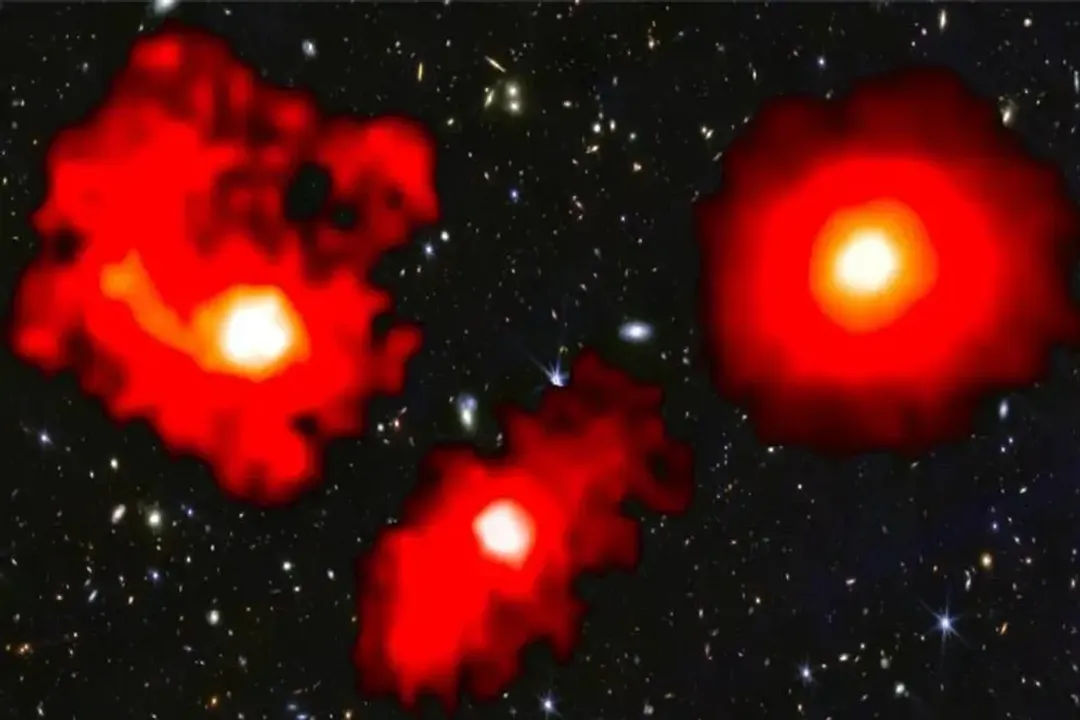
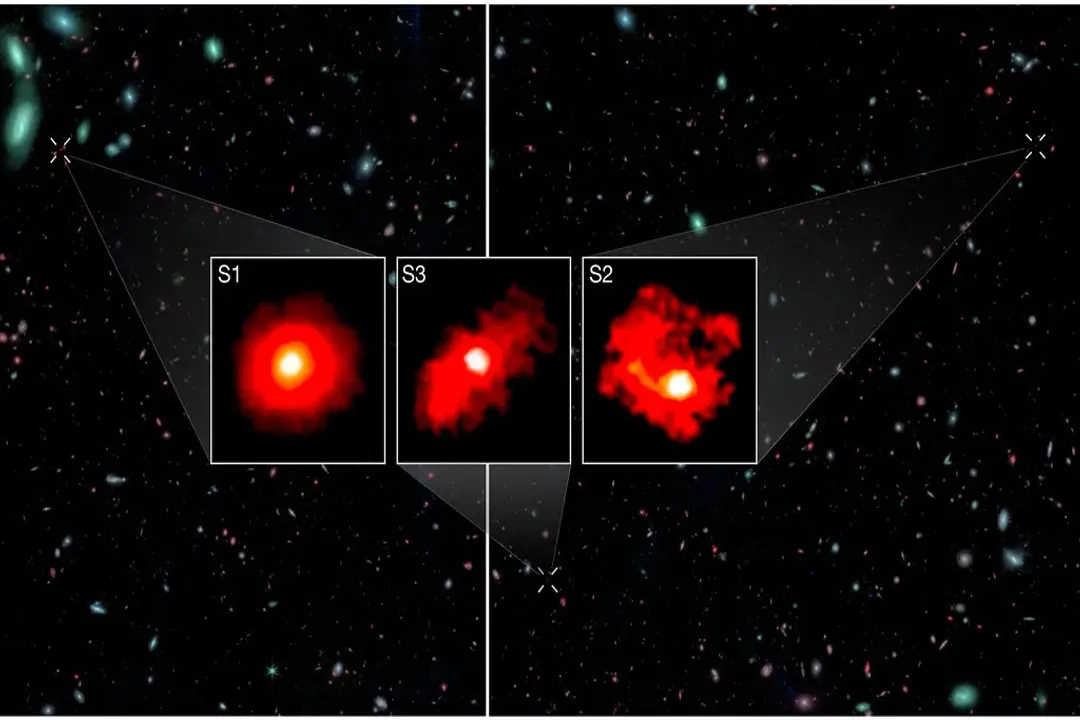
While standard aging or redshift causes redness, astronomers have identified populations that are exceptionally red, sometimes termed ultra-red galaxies or red monsters. [6][8] The discovery of these objects often pushes the limits of our understanding of galaxy evolution, especially in the early universe. [6][8]
One fascinating discovery involved an ultra-red galaxy observed through the Hubble Space Telescope, which was extremely faint but possessed an unusually pronounced red color for its age. [6] Such extreme redness, when not entirely attributable to redshift, suggests a combination of factors. One strong candidate is the presence of vast quantities of dust. Dust grains are highly effective at absorbing and scattering blue light, allowing only the longer, redder wavelengths to pass through to our telescopes. [6] If a galaxy in the early universe was forming stars incredibly rapidly, it would generate an enormous amount of dust, quenching its own visible blue light and making it appear extremely red. [6][8] These dusty, rapidly assembling systems from the early universe are sometimes called red nugget galaxies. [3] Observations of these objects, which were often hiding in plain sight due to their dimness in optical light, suggest that massive galaxies assembled their bulk much earlier than previously theorized. [3]
The newer capabilities of instruments like the JWST are proving instrumental in peeling back the dust veil. By observing these galaxies in infrared light—which passes through dust more easily and is also what highly redshifted light appears as—scientists can confirm that some of these "red monsters" are not actually old and dead, but rather prolifically forming stars, just entirely shrouded by their own dusty cocoons. [8]
# Observing the Redshift Effect
To appreciate the effect of distance, it helps to conceptualize the light travel path. If a source emits light with a known property, like the peak wavelength of its spectrum, the observed shift tells us its recessional velocity. [4] For galaxies far outside our local gravitational group, their movement away from us is dominated by the Hubble flow—the uniform expansion of space. [7]
Imagine a theoretical spectrum originating from a galaxy. If that galaxy is close, its spectrum peaks around the visible blue or green range, and we see it as a typical spiral. [4] Now, imagine that same galaxy located so far away that the universe has expanded by a factor of, say, three times during the light's travel time. The entire spectrum is stretched by that factor of three, moving the peak from blue/green into the red/near-infrared. [7] A galaxy observed today with a redshift value, z, of around 1 to 2 is deep into the epoch of significant star formation, and its observed redness is a direct, quantifiable measure of cosmic expansion. [4][8]
A Conceptual Comparison for Observers
When looking at a nearby star, its color tells you its surface temperature; a cool star looks orange or red. When looking at a very distant galaxy, its observed color tells you how much space has expanded since the light left that galaxy, revealing its age in the cosmic timeline. The near-galaxy color is about stellar evolution; the distant-galaxy color is primarily about cosmological expansion. This dual interpretation is the fundamental challenge in classifying any "red galaxy."

# Types and Interpretations
The ambiguity of "redness" requires a systematic approach to interpretation, often requiring observations across multiple wavelengths. Astronomers categorize these systems based on their observed properties and models.
# Locally Red Systems
For galaxies in our relatively local neighborhood, the redness is typically intrinsic:
- Old Stars: Dominated by aging stellar populations, they show little to no ongoing blue star formation. [2]
- Dust Obscuration: Bright spiral galaxies often possess lanes or thick disks of dust that dim and redden the light from stars behind them. [2]
When these galaxies are studied using X-ray telescopes like Chandra, they often reveal the consequence of their quiescent state: pervasive, hot gas that prevents future cooling and star formation. [1]
# Distantly Red Systems
For objects at high redshift, the interpretation shifts:
- High Redshift (): The expansion of the universe stretches the light significantly. [4]
- Dusty Starbursts: Many distant, highly luminous galaxies are actually undergoing intense, rapid bursts of star formation, but this blue light is completely hidden by copious amounts of dust created by that very star formation. [6][8] JWST observations are critical here, as its sensitivity to longer infrared wavelengths pierces this dust shroud, revealing very young, actively forming stars. [8] These are not "dead" galaxies; they are often the most vigorously active galaxies in the early universe, just deeply obscured. [2]
To put this into context for a reader interested in observing, consider a simple mental model for judging the physical nature of a galaxy's color:
- Check Distance (Redshift ): If is high (e.g., ), the observed color is overwhelmingly due to the universe expanding. The galaxy is seen as it was billions of years ago. [4]
- Check Infrared vs. Optical: If the galaxy is optically red but bright in the infrared (as seen by JWST), it is likely a dusty starburst system, full of young stars. [8]
- Check X-ray Emission (If Local): If the galaxy is nearby and appears red, low X-ray emission (indicating cooling gas) and a lack of blue light suggest a truly "red and dead" quiescent galaxy. [1]
A Note on Spectral Measurement
The precise measurement of how red a galaxy is involves calculating its color index, which is the difference in magnitude between two different filters, often near the blue and visible-red parts of the spectrum. [4] A larger, positive color index signifies a redder object. [4] However, this index must always be corrected for the cosmological redshift before it can be used to infer intrinsic stellar temperature or dust content. A galaxy that is physically dust-free but at will have a large color index due to expansion, mimicking the index of a nearby, very dusty galaxy.
# The Assembly of Massive Systems
The study of these extremely red galaxies, particularly the early, massive ones, is central to understanding how the largest structures in the cosmos formed. The "red nugget galaxies" found at high redshifts demonstrate that a significant portion of the mass in what will become massive elliptical galaxies today was already assembled very early on. [3] These nuggets appear to be compact, already rich in old stars, and perhaps on the cusp of merging to form larger structures. [3] They represent the building blocks that had already ceased rapid, widespread star formation in their compact cores by the time the universe was only a fraction of its current age. [3]
In contrast, the very distant, intensely red galaxies being uncovered by JWST often challenge these older notions. [8] Some of these systems are so massive and so mature-looking in terms of stellar mass so early in time that they demand a re-evaluation of how quickly the first generations of stars and galaxies formed and built up their stellar content. [8] They imply that the processes that halt star formation and lead to the accumulation of a dominant red population were already highly effective, or that the initial burst of star formation was powerful enough to create significant dust extinction very quickly. [6][8] The constant refinement of these models shows that "red" is not a sign of stagnation, but a clue pointing to extreme conditions, whether that condition is environmental (dust), evolutionary (age), or spatial (distance). [2]
#Videos
3 Red Monster Galaxies Are So Large They Shouldn't Be Possible
Related Questions
#Citations
Chandra Helps Explain “Red and Dead Galaxies” - NASA
Red Galaxies Aren't Necessarily Dead Galaxies - Universe Today
"Red Nugget" Galaxies Were Hiding in Plain Sight
What does a redder galaxy mean? - Physics Stack Exchange
3 Red Monster Galaxies Are So Large They Shouldn't Be Possible
Strange New “Species” of Ultra-Red Galaxy Discovered
The farther away a galaxy is, the redder it appears to our telescopes ...
What do JWST's "red monster" galaxies mean for cosmology?