When stellar aging causes a galaxy to appear red, what kind of stellar population dominates the system?
Answer
A population dominated by middle-aged and old stars, which are redder and cooler.
When a galaxy exhausts the cold gas needed for new blue star formation, the existing stellar population ages. This leaves behind a system dominated by intrinsically redder and cooler middle-aged and old stars.
#Videos
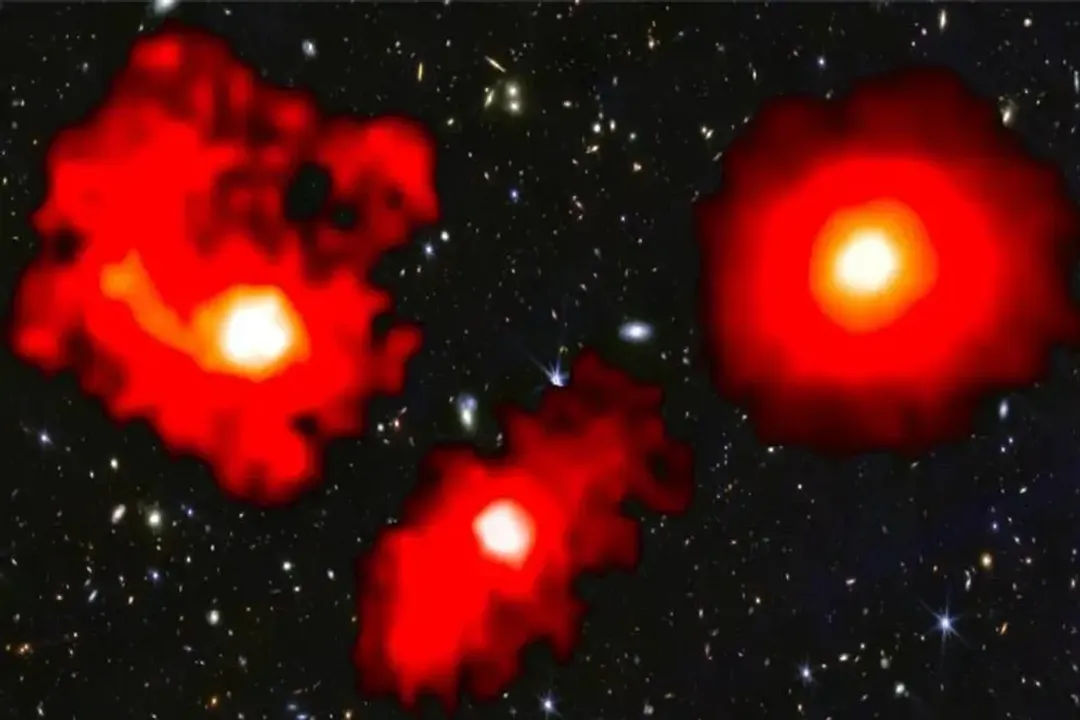
3 Red Monster Galaxies Are So Large They Shouldn't Be Possible
Related Questions
What is the descriptive observation that defines a galaxy as a "red galaxy" in astronomy?When stellar aging causes a galaxy to appear red, what kind of stellar population dominates the system?What is the primary physical cause for the extreme redness observed in very distant galaxies?What is the defining characteristic of galaxies referred to as "red and dead"?What physical mechanism explains why massive red and dead galaxies in the Virgo Cluster appear unable to form new stars?In the context of extremely red galaxies not explained solely by redshift, what component is strongly implicated in causing the redness?How do instruments like the James Webb Space Telescope (JWST) aid in studying "red monsters" whose redness is caused by obscuration?What does the observed color of a nearby red galaxy typically reveal, compared to a very distant one?What do "red nugget galaxies" found at high redshifts suggest about early cosmic structure formation?When calculating a galaxy's color index to determine its intrinsic temperature, what must always be corrected for?