Why is light red-shifted more from distant galaxies than nearby ones?

The observation that light from galaxies farther away appears systematically "redder" than light from those relatively close to us is one of the most fundamental pieces of evidence in modern cosmology. This phenomenon, known as redshift, tells us more than just which way things are moving; it reveals the dynamic nature of the universe itself. When astronomers analyze the light spectrum from distant galaxies, they find that the characteristic patterns—the specific absorption or emission lines caused by elements like hydrogen or calcium—are stretched out toward the longer, red end of the visible spectrum. [1][7] This shift is more pronounced the further away the light source is, creating a clear correlation: greater distance equals greater redshift.
# Light Wavelengths

To understand why the distance matters so much, we first need a solid grasp of what redshift is. Light travels as a wave, and the color we perceive is determined by the length of that wave. Shorter wavelengths appear bluer, while longer wavelengths appear redder. [7] When an object emitting light is moving away from an observer, the light waves traveling toward the observer get stretched out, causing a shift toward the red end of the spectrum—this is the Doppler effect, familiar from the pitch of a siren dropping as an ambulance drives away. [1][2] Conversely, if an object were moving toward us, the waves would be compressed, resulting in a blueshift. [7]
# Two Causes

While the Doppler effect is the most intuitive explanation for a redshift, it is not the only one, and in the context of very distant galaxies, it is often not the primary driver. There are fundamentally two ways light can become redshifted when observed from Earth: one due to motion through space, and the other due to the expansion of space itself. [2][4]
The first mechanism is peculiar velocity, which is the actual movement of a galaxy relative to its neighbors, often caused by gravitational tugs from other massive objects in its local neighborhood. This is akin to a car driving down a road; its speed is its velocity relative to the road surface. [2] This motion causes a Doppler-like redshift or blueshift depending on the direction of travel. [5]
The second, and far more significant factor for the most distant objects, is cosmological redshift. This arises because the fabric of spacetime itself is expanding. As light from a distant galaxy travels across billions of light-years toward us, the space it is traversing stretches. This stretching physically lengthens the light's wavelength during its journey. [4][7] It is not the galaxy moving faster through space that causes this specific type of redshift; rather, the accumulation of space expansion between the source and the observer increases the wavelength proportionally to the distance covered. [6]
# Distance Proportionality
The key observation that separates these two causes, and which directly answers why distant galaxies show more redshift, is the systematic relationship between distance and the observed shift. If redshifts were primarily due to the random, peculiar motions of individual galaxies, we would expect to see large variations. Some nearby galaxies might be moving away quickly (large redshift), and some distant galaxies might be moving toward us (blueshift), depending only on their local gravitational interactions. [2][5]
However, observations show that almost all galaxies beyond our immediate local group exhibit a redshift, and the amount of that redshift scales directly with their distance. This linear relationship is encapsulated by Hubble’s Law. [1][6] This means that the farther away a galaxy is, the faster it appears to be receding from us, as measured by the redshift. [6]
Consider two light beams sent out simultaneously from two different galaxies, one near and one far. The light from the nearer galaxy passes through a relatively small amount of expanding space on its way to us. The light from the farther galaxy, however, must traverse a much, much larger volume of spacetime that has been expanding for the entire duration of its trip. [4] Therefore, the longer the journey through expanding space, the more the light wave gets stretched, resulting in a greater accumulation of redshift. [7] The nearby galaxies, while also being carried along by the expansion, show a much smaller shift because the distance traveled through the expanding medium is minimal in comparison. [5]
To illustrate the difference in the mechanism dominating the signal, imagine an analogy involving dots painted on an inflating balloon. If two dots (galaxies) are painted close together, and the balloon inflates slightly, the dots move apart very little. If two dots are painted on opposite sides of the balloon, the inflation causes a much greater separation over the same short time period. In the cosmological context, the rate of separation between any two points is proportional to the distance between them, which is precisely what the Hubble relation describes for distant objects. [6] For nearby galaxies, like those in the Local Group, the gravitational pull between them keeps their relative motion (peculiar velocity) strong enough that the cosmological expansion effect is minor or even masked by local movement, resulting in a smaller or sometimes non-existent net redshift. [2]
# Spacetime Stretching
The fact that the redshift is linked to distance, rather than just appearing randomly, is the primary scientific justification for concluding that the universe is expanding. If the galaxies were simply moving away from us within static space, like shrapnel from an explosion centered on us, we wouldn't see this neat proportionality with distance; we'd see movement dictated by gravity and initial momentum. [6][4]
Instead, the cosmological redshift signifies that the expansion of space itself is responsible for the increased shift seen in distant sources. This implies that the universe does not have a center from which everything is flying away; every point in the expanding universe sees all other distant points receding from it. [6] The redshift is a direct measure of the scale factor of the universe at the time the light was emitted, relative to its value now. [4]
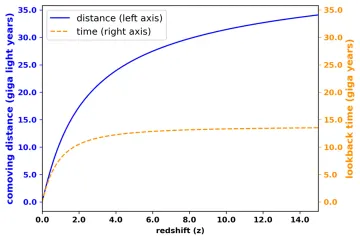
To put this into context, we can observe how different redshifts translate into inferred distance and age, although this requires complex models of cosmology involving dark energy and matter density.
| Galaxy Example | Observed Redshift () | Dominant Interpretation | Implied Feature |
|---|---|---|---|
| Andromeda (Nearby) | Blueshift (Local Motion) | Peculiar Velocity | Gravitationally bound, not expanding away. |
| Virgo Cluster (Mid-Range) | Low () | Local Expansion + Peculiar Velocity | Beginning to show Hubble Flow dominance. |
| Distant Quasar | High () | Cosmological Redshift | Light has traveled through billions of years of expanding space. |
This comparative idea shows that while local motion dictates the shift for our immediate neighbors, the sheer scale of the universe dictates that for the most distant objects, the cumulative stretching of space over eons overwhelms any local motion effects. [5]
# Measuring Spectra
Astronomers don't simply look at a color change; they employ sensitive instruments called spectrographs attached to telescopes. These instruments spread the incoming light into a detailed spectrum. [1] By identifying the precise spectral fingerprint of known elements—say, the specific pattern of dark lines caused by calcium absorbing photons—scientists can measure exactly how far these patterns have been shifted compared to where they would appear if the galaxy were stationary in a laboratory setting. [1] The magnitude of this measured displacement, , is the redshift value. The higher the value, the greater the stretching, and consequently, the farther away the object is believed to be, because that light has experienced a greater accumulated expansion of the intervening space. [4]
Ultimately, the pattern—where nearby light has small shifts (or even blueshifts) dominated by local gravity, and distant light exhibits increasingly larger redshifts tied directly to distance—is the observational proof that space itself is expanding, causing the light waves to stretch more simply because they have farther to travel through that stretching medium. [6][7]
Related Questions
#Citations
Why galaxies look redder, the further away they are
How do we know red shift is caused by the expansion of ...
Redshift
Hubble Cosmological Redshift
How did Hubble know the red shift difference between ...
Why does the redshift of light from distant galaxies lead ...
ESA - What is 'red shift'?
Why are distant galaxies in the deep field image not all red ...