What does redshift tell us about distant galaxies?

The light arriving at our telescopes from galaxies millions or billions of light-years away carries a crucial message about their motion and the nature of the cosmos itself. This message is encoded in a phenomenon called redshift. Simply put, redshift describes the shifting of light waves toward the longer, redder end of the electromagnetic spectrum as we observe them from Earth. This shift is analogous, though fundamentally different in its cause for distant objects, to the change in pitch we hear in an ambulance siren as it speeds away from us—a sound phenomenon known as the Doppler effect. When an object emitting light moves away from an observer, the light waves it emits are stretched out, increasing their wavelength, which corresponds to a shift toward the red end of the spectrum. The opposite effect, where light shifts toward the shorter, bluer end, is known as blueshift, indicating an object moving toward the observer.
# Spectral Fingerprints
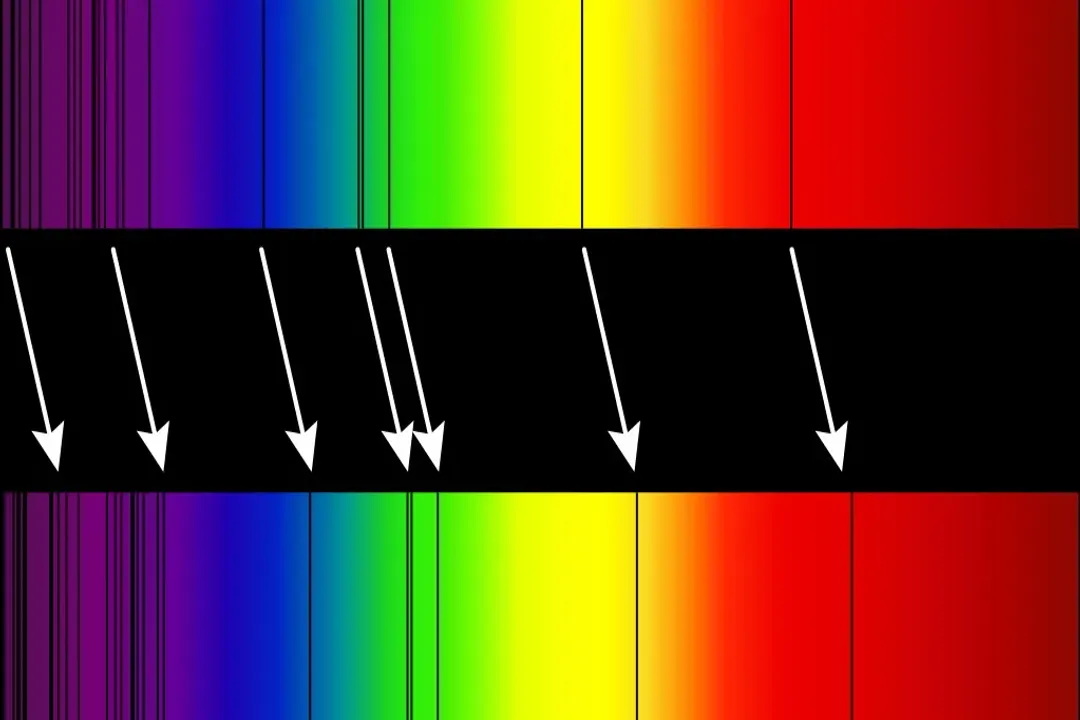
To measure this phenomenon precisely, astronomers don't just look at the overall color of a galaxy; they examine its spectrum. Every chemical element, such as hydrogen or calcium, absorbs or emits light at very specific wavelengths, creating unique absorption or emission lines—like a chemical fingerprint. When we observe the light from a distant galaxy, we look for these known spectral lines. If the galaxy is moving away, these characteristic lines will appear at longer wavelengths than their expected, or "rest," wavelengths measured in a stationary laboratory on Earth. The amount of this displacement allows scientists to calculate a precise numerical value for the redshift, commonly denoted by the symbol . A very large value means a significant shift and, consequently, a great deal of recession or distance.
# Cosmic Stretching
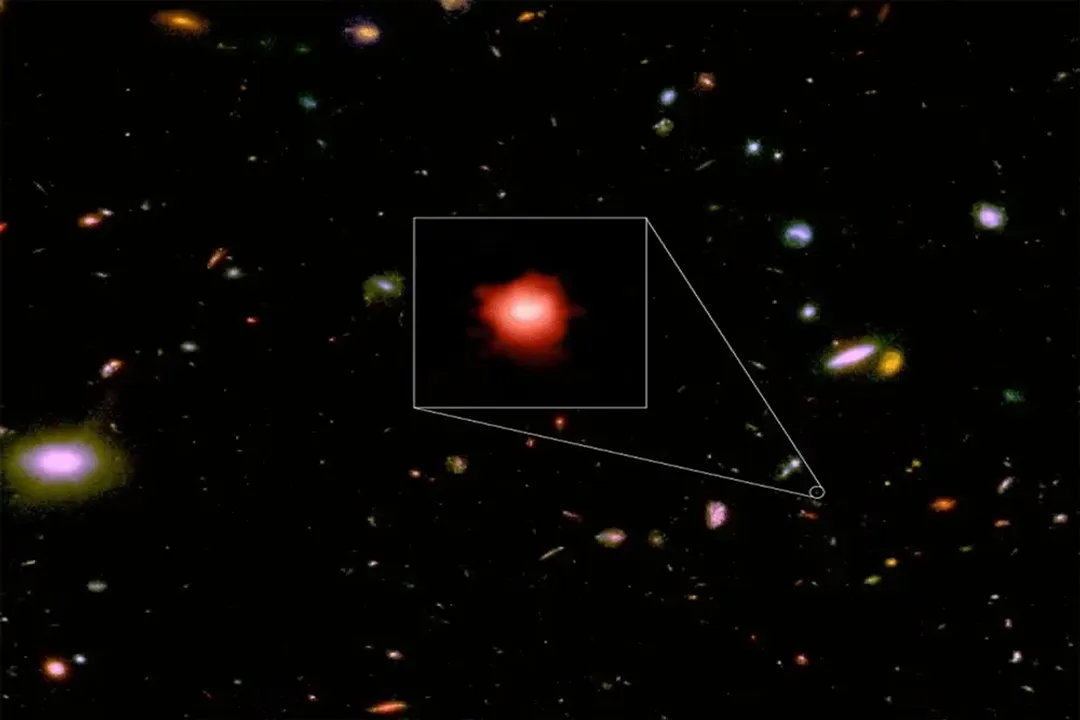
While the analogy of an object physically moving away in space is useful for understanding the concept, the redshift observed for the vast majority of distant galaxies is more profound than simple movement through space. This primary cause is known as cosmological redshift. It arises because the universe itself is expanding. As light travels across the immense gulf of space separating a distant galaxy from us, the fabric of spacetime itself stretches. This stretching physically elongates the light wave during its transit time.
This distinction is vital. For a relatively nearby galaxy, its observed redshift might be a combination of its own "peculiar motion" (its movement relative to its immediate neighbors through space) and the overall expansion of the universe. However, for galaxies that are very far away, the effect of the expansion of space completely dwarfs any individual galactic motion. It's as if the galaxy is sitting still on a rapidly inflating balloon; it's not running across the surface, but the surface carrying it is growing, increasing the distance between it and the observer. This concept implies that nearly every galaxy outside our local group is moving away from us, not because we are at a special center, but because the expansion is happening everywhere simultaneously.
Consider this comparison derived from examining motion types. If we observe a galaxy with a small redshift, say , we might attribute a large portion of that shift to its local velocity imparted by gravitational interactions within its cluster. Conversely, observing a galaxy with tells us that the majority of that staggering shift is almost entirely due to the expansion that occurred while the light was traversing nearly 12 billion light-years of space, making the cosmological component dominant. This realization, often attributed to Edwin Hubble's work, forms the bedrock of our understanding of an expanding universe.
# Distance and Time
The direct relationship between redshift and distance is one of the most powerful insights provided by measuring . The greater the redshift, the farther away the object is, and by extension, the further back in time we are seeing it. When we look at a galaxy with a redshift of , we are observing light that has traveled for approximately 7.7 billion years. If we look even further, perhaps at a quasar with , we are seeing it as it existed when the universe was only about one billion years old.
This means redshift acts as a direct cosmic distance ladder, allowing astronomers to map out the three-dimensional structure of the universe across vast epochs. The light itself has been physically stretched by the expansion that occurred during its long trip. This stretching also has an effect on time perception for the observer. If a galaxy emits a light signal that takes 100 units of time to cross a certain distance, and the universe expands by a factor of two during that transit time (corresponding to a specific value), we on Earth will observe that process taking 200 units of time. Astronomers call this time dilation. We see the distant galaxy's processes unfold in slow motion relative to our own timescale.
Here is a simple way to conceptually organize the implications of different redshift values, synthesizing the idea of distance and age:
| Redshift () | Approximate Lookback Time (Years) | Implication for Observation |
|---|---|---|
| ~1.3 Billion | Primarily local motion combined with early expansion. | |
| ~7.7 Billion | Light has been traveling for almost half the current age of the universe. | |
| ~12.8 Billion | Seeing the universe in its infancy, approximately 1 billion years after the Big Bang. |
A point that often causes confusion is the relationship between redshift and temperature, which can be counterintuitive. While the Doppler effect for sound involves cooling as speed decreases, in cosmology, higher redshift does not automatically mean the object is colder. Instead, higher redshift indicates light from an earlier, hotter epoch of the universe. The light we receive is stretched, but the source galaxy itself existed at a time when the universe, on average, had a higher ambient temperature.
# Observing The Young Cosmos
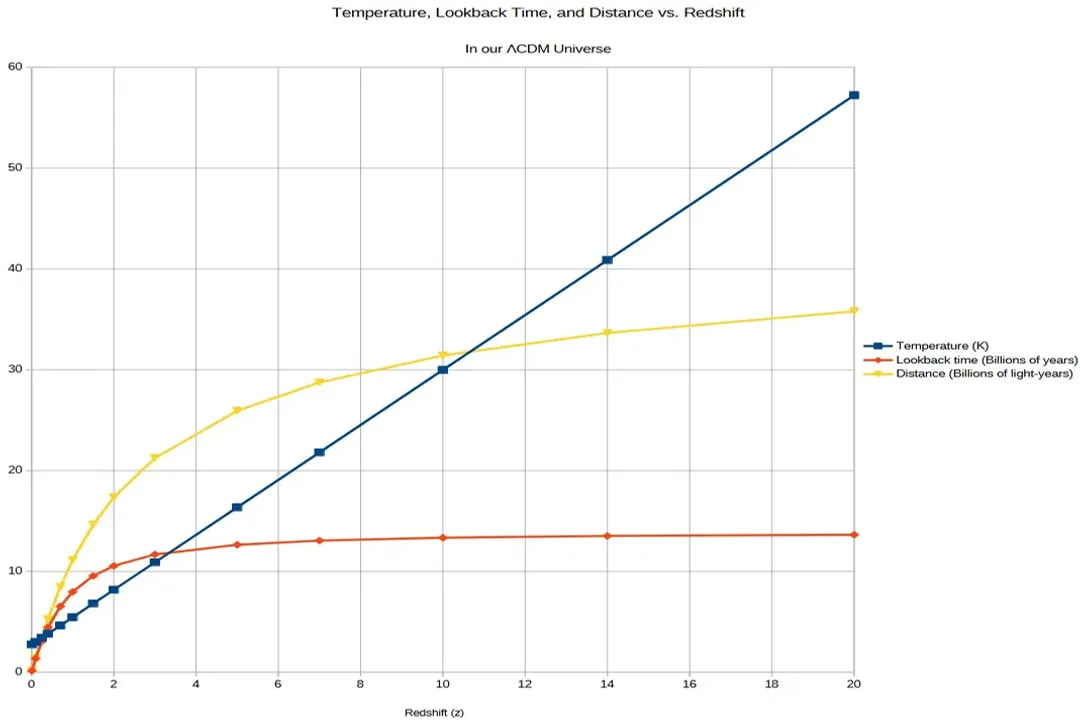
The ability to measure high redshifts is fundamental to modern cosmology because it allows us to probe the universe when it was significantly younger and different from today. The most distant galaxies we detect are those that formed when the cosmos was still in its very early stages.
When we look at an object with , we are seeing galaxies that formed perhaps only a few hundred million years after the Big Bang. Because light takes time to travel, these observations effectively provide a snapshot of the early universe, letting us test our models of structure formation and stellar evolution under conditions far removed from our current local environment. The fact that we can observe these highly redshifted, ancient objects confirms the underlying theory that space is expanding at a consistent rate across cosmic history, though that rate itself changes over time (due to dark energy, a concept that builds upon redshift measurements). Without redshift, the distances to these galaxies would be largely unknowable, and the evidence for a dynamic, evolving cosmos would be missing its most powerful indicator. The observation of these very distant, high-redshift systems provides direct, measurable evidence that the universe has a history spanning billions of years, rather than being static.
To truly understand what we are seeing, we must move beyond thinking of light as just a stream of particles; it is a wave stretched by the expansion of the medium through which it travels. The observed redshift is a measure of this stretching factor, allowing scientists to reconstruct the physical scale and time elapsed during the journey. It is an indispensable tool in our quest to map the cosmos and understand its expansion history.
#Videos
What Does Redshift Tell Us About Distant Galaxies? - Physics Frontier
Related Questions
#Citations
ESA - What is 'red shift'? - European Space Agency
Hubble Cosmological Redshift - NASA Science
Redshift - Wikipedia
What Does Redshift Tell Us About Distant Galaxies? - Physics Frontier
Why galaxies look redder, the further away they are
How do scientists know that the red shift means the universe is ...
The red shine you glimpsed through your telescope might actually ...
How are redshift, temperature, distance and time related? - Big Think
Redshift and blueshift: What do they mean? - Space