What is the rotation curve of a galaxy?
This fundamental concept in astrophysics, the galaxy rotation curve, is essentially a graph mapping out how fast material orbits the center of a galaxy compared to how far away it is from that center. [3] Astronomers plot the rotational velocity, usually measured in kilometers per second, against the radial distance, often in kiloparsecs, from the galactic core. [1][8] It serves as a crucial diagnostic tool, allowing scientists to infer the underlying distribution of mass within the galaxy, whether that mass is visible or hidden. [9]
# Keplerian Expectations
If a galaxy were composed only of the matter we can see—stars, dust, and gas—its rotation should follow patterns dictated by simple Newtonian gravity, much like the planets in our own Solar System. [2] In the Solar System, Mercury orbits much faster than Neptune because the vast majority of the system’s mass is concentrated in the Sun at the center. Following Kepler’s laws, once you move past the bulk of the visible mass, the orbital velocity should decrease as you move further out; the speed falls off with the square root of the distance. [9]
If we were able to construct a rotation curve based only on the light emitted by the stars in a spiral galaxy, we would expect a distinct profile. Near the center, where most of the visible mass is densely packed, the velocity would rise sharply. As the measurement radius moves outward into the galaxy's thinner disk, the velocity should begin to drop off steadily. [2] This expected profile, derived purely from visible baryonic matter, acts as the baseline against which real observations are compared. [1]
# Observing Speeds
Measuring the speeds of objects—stars or clouds of gas—that are hundreds of thousands of light-years away requires techniques sensitive to the Doppler effect. [5] While one could try to measure the movement of individual stars directly, this is difficult for objects far from the core. The most effective method involves observing clouds of neutral hydrogen gas, often referred to as the line. [1][5]
Neutral hydrogen atoms emit a faint radio wave at a very specific wavelength of about 21 centimeters when they transition between two low-energy spin states. [5] When this gas is moving towards Earth, the observed wavelength is slightly shorter (a blue shift); when it is moving away, the wavelength is slightly longer (a red shift). [1] By measuring this tiny shift in the radio signal across different regions of the galaxy, astronomers can calculate the precise line-of-sight velocity of the gas cloud. [5] Radio telescopes map these speeds across the entire galactic disk, providing enough data points to construct the full rotation curve. [1][2]
# The Flat Anomaly
When astronomers, most famously Vera Rubin and her colleague Kent Ford during the 1970s, actually plotted these measured velocities against distance for many spiral galaxies, the results were astonishingly different from the Keplerian prediction. [1][5] Instead of seeing the velocity curve drop off significantly past the radius containing most of the visible light, they found that the orbital speeds remained surprisingly high—they became nearly constant, or flat, far out into the galaxy's edges. [2][3]
Consider the outer regions of a galaxy like Andromeda. If the mass were only what we see, the stars orbiting miles out should be moving much slower than those orbiting closer in, yet they move at comparable speeds. [1] This observation holds true even at radii extending beyond where most of the luminous matter resides. [2] The velocity curve essentially fails to decline as predicted by the laws governing visible objects. [9]
This difference between prediction and measurement is perhaps the single strongest piece of evidence for something entirely new in our understanding of the cosmos. [5] If we use the standard formula to find the enclosed mass (), a flat rotation curve ( is constant) implies that the mass enclosed () must increase linearly with the radius () out to the edge of observation. [9] This means that for every step you take outward, you must find roughly the same amount of additional mass as you found in the preceding step, all the way to the edge of the observable galaxy. [2]
# Missing Mass
The immediate and unavoidable consequence of a rotation curve that refuses to drop is the conclusion that galaxies contain vastly more mass than can be accounted for by their light. [1][8] The necessary mass required to keep the outer stars moving so quickly must be there gravitationally, but it emits no detectable light across the electromagnetic spectrum—it is dark. [2][9]
This discrepancy implies that the luminous matter—the stars and gas we observe—only makes up a small fraction of the total mass budget of a galaxy, sometimes as little as 10 to 15 percent. [2][9] If we were to look at the mass distribution within a galaxy like the Milky Way, the visible disk might end around 50,000 light-years, but the rotation curve might continue to show high velocities out to 200,000 light-years or more, demanding a source of gravity that stretches far beyond the stars. [5] This unseen substance is what we call Dark Matter. [1]
Here is a conceptual breakdown of the mass components inferred from the curve shape:
| Feature on Rotation Curve | Implied Mass Distribution | Dominant Component |
|---|---|---|
| Steep rise near center () | Mass concentrated at the very center | Bulge/Central Stars |
| Flattening phase () | Mass distributed roughly linearly with radius | Dark Matter Halo |
| Slow decline (rare, further out) | Mass contribution starting to fall off | Galactic Disk/Gas |
An interesting point emerges when comparing different types of galaxies. Elliptical galaxies, which lack the distinct disk structure of spirals, also show evidence of dark matter through their velocity dispersions (how spread out the stellar motions are), but the rotation curve provides a cleaner, more direct measure of mass distribution in spirals. [3]
# Halo Dominance
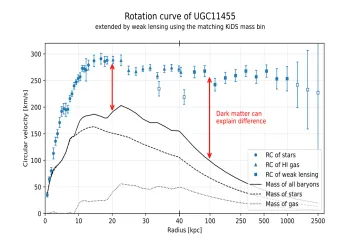
The mass required to sustain the flat rotation curve cannot be concentrated in the visible disk; if it were, the disk would be far too thick and unstable to explain its observed structure. [2] Instead, the model that successfully explains the rotation curve postulates that the dark matter forms a vast, roughly spherical structure called a dark matter halo that encompasses the entire luminous galaxy. [2][5]
This halo extends much further out than the visible starlight and contains the majority of the galaxy's total mass. [2][9] For many spiral galaxies, the dark matter mass inside a given radius can be five to ten times greater than the visible mass within that same radius. [9] The precise shape of this halo—whether it is perfectly spherical or slightly flattened (prolate or oblate)—is a topic of ongoing research, but the necessity of its sheer existence is cemented by the rotation measurements. [5]
Understanding the rotation curve is not just about finding missing mass; it is about mapping the gravitational scaffolding of the universe. For instance, if we know the velocity () at a particular radius (), we can calculate the total mass () enclosed within that radius using a rearranged form of Newton's law: , where is the gravitational constant. [9] This calculation allows astronomers to create a mass profile for a galaxy, showing how the total mass accumulates as one moves outward, revealing the dark matter's gravitational dominance. [5] If you were an aspiring astrophysicist trying to model galactic structure, you would treat the observed rotation curve not as a data point, but as the target the mass distribution must fit perfectly. Any model that produces a falling curve at large radii is immediately inconsistent with observation.
The sheer scale of this discrepancy encourages alternative theories, such as Modified Newtonian Dynamics (MOND), which suggests that the law of gravity itself changes at very low accelerations (like those found in the outer edges of galaxies) rather than invoking unseen mass. [1][9] However, MOND struggles to explain phenomena observed on larger scales, like the dynamics of galaxy clusters, where the dark matter inference remains the most consistent explanation across multiple lines of evidence. [2] The rotation curve, therefore, stands as a primary pillar supporting the standard cosmological model that includes dark matter. [1][9]
#Videos
Astrophysics: Galaxy Rotation Curves and Dark Matter - YouTube
Related Questions
#Citations
Galaxy rotation curve - Wikipedia
Rotation Curves
Rotation Curve | COSMOS
Astrophysics: Galaxy Rotation Curves and Dark Matter - YouTube
galactic rotation curves
[PDF] Chapter 5 Rotation Curves
Galaxy Rotation Curves - an overview | ScienceDirect Topics
galaxy rotation curve in nLab
[PDF] Galaxy Rotation Curves and Dark Matter