What is inside of the Andromeda Galaxy?
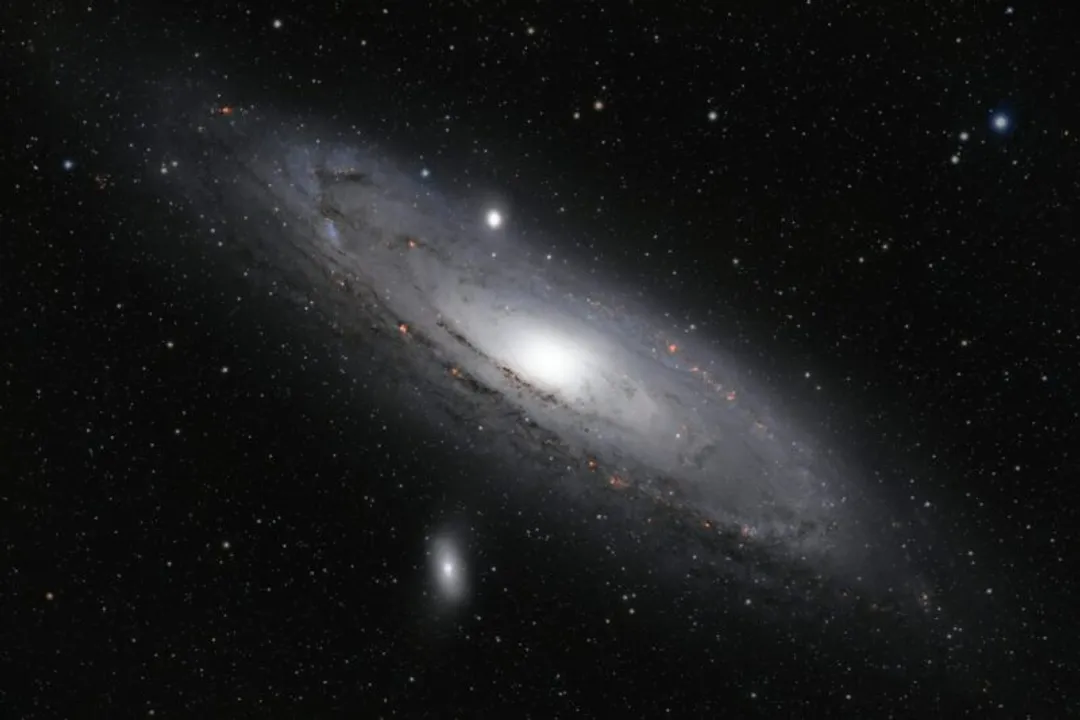
The Andromeda Galaxy, known formally as Messier 31 (M31), is our nearest major galactic neighbor, a massive spiral structure swimming through the local group of galaxies. [2][6] At a distance of roughly 2.5 million light-years, it presents a staggering view of what a mature galaxy can contain, offering a stark comparison to our own Milky Way. [6] Looking into Andromeda is to gaze upon a collection of matter and energy so immense that it dwarfs our familiar celestial neighborhood.
# Trillion Stars
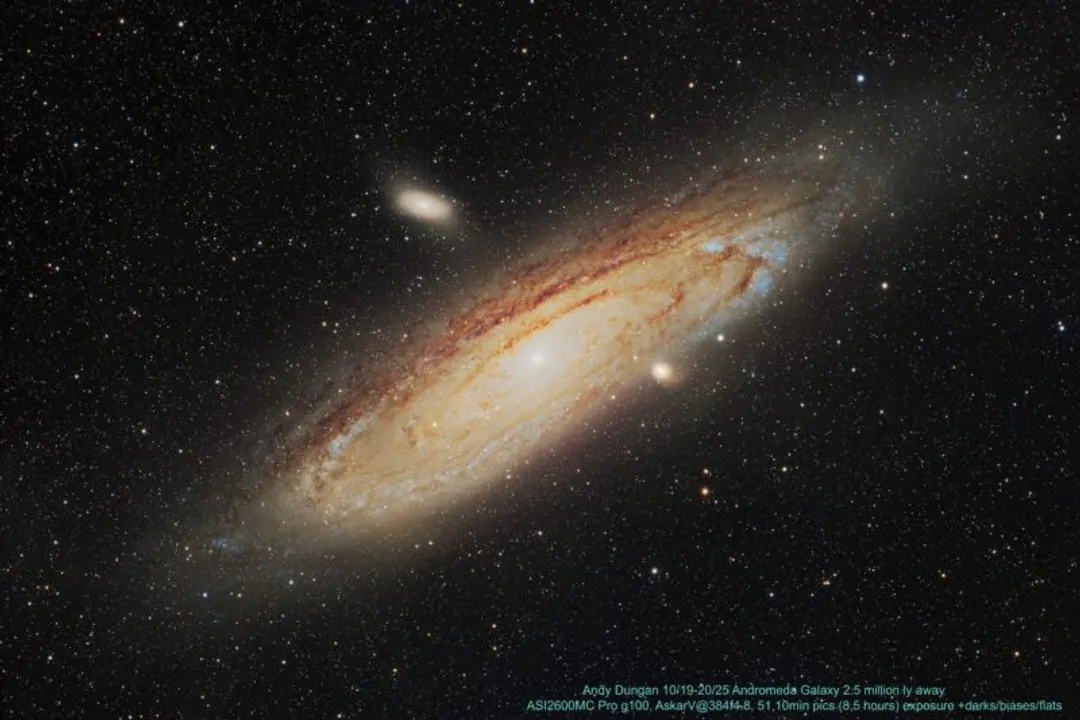
The sheer scale of Andromeda is perhaps its most defining feature when compared locally. While estimates for the Milky Way generally hover around 200 to 400 billion stars, Andromeda is believed to host approximately one trillion stars. [5][6] This huge population difference clearly establishes Andromeda as the more massive of the two primary spirals in our immediate cosmic vicinity. [6]
This massive star count isn't just a larger number; it suggests a different evolutionary history or simply a far greater reservoir of material available for stellar formation over cosmic timescales. If we consider the Milky Way's estimated total mass as a baseline, Andromeda’s higher stellar count implies either a much greater proportion of baryonic matter or a substantially denser packing of stars within its primary structures, especially its central bulge and disk regions. [1] When we observe M31, we are seeing a galaxy that has accrued stars on a truly grand scale, making it a fascinating object for understanding galactic growth models.
# Galactic Center
Like most large galaxies, Andromeda’s interior structure follows a pattern typical of spiral systems, though magnified. It possesses a disk, a flattened component containing gas, dust, and younger stars, which gives it its spiral appearance. [1] Surrounding this is a vast, spherical halo of older stars and globular clusters, extending far beyond the visible disk. [1]
At the very heart of the galaxy lies its engine: a supermassive black hole. [1] This is the gravitational anchor around which the entire trillion-star system rotates. Observations have focused intensely on this core region. For instance, imaging efforts using the Hubble Space Telescope have captured mosaics spanning hundreds of light-years across this central area, revealing the complex interplay of older stars packed tightly around the nucleus. [3] Furthermore, the central region shows evidence of a peculiar structure—some observations suggest a double nucleus, possibly related to an ancient merger event or the dynamics near the central black hole itself. [1]
# Dense Star Groups
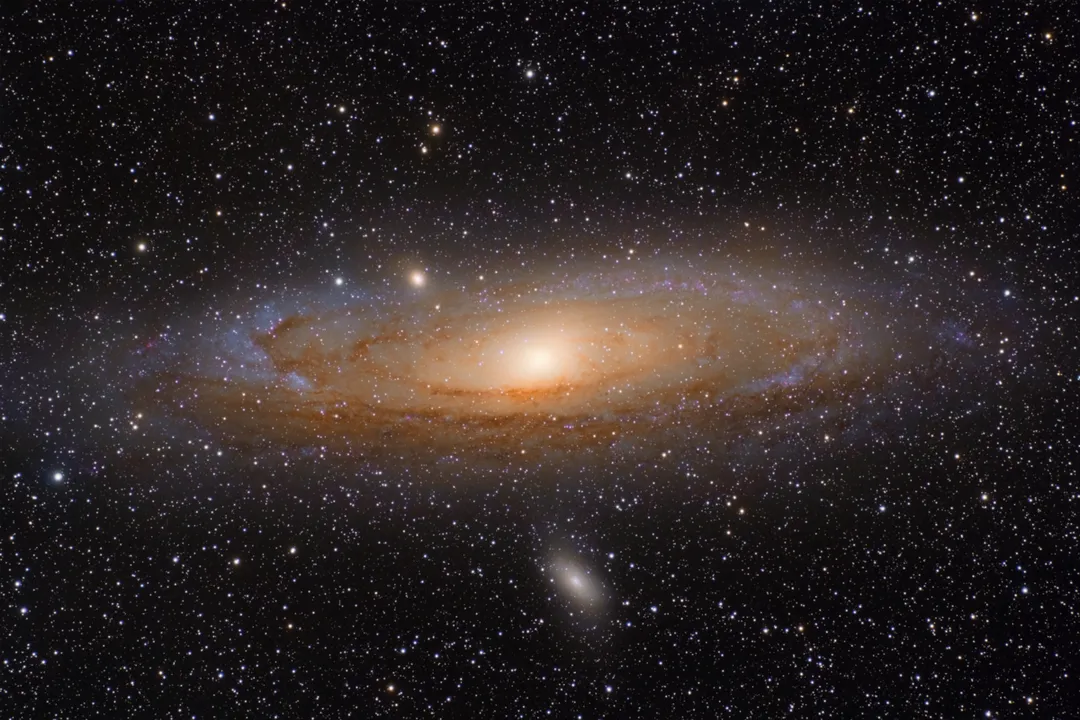
One of the critical components inside Andromeda that contributes to its overall mass and history is its population of globular clusters. These are dense, spherical collections of old stars, gravitationally bound and orbiting the galactic center. [1]
While the Milky Way hosts around 150 to 180 known globular clusters, Andromeda appears to possess a much larger collection. Estimates place the total number somewhere around 450, but some analyses suggest the true number could soar as high as 7,000. [1] This abundance offers an unparalleled resource for astronomers studying the earliest stellar populations in the universe. Each of these ancient, compact groupings acts like a fossil record, preserving stars that formed when the galaxy itself was young. [1] Studying the chemical compositions and motions of these distant groups helps scientists piece together the timeline of Andromeda's assembly.
# Orbiting Neighbors
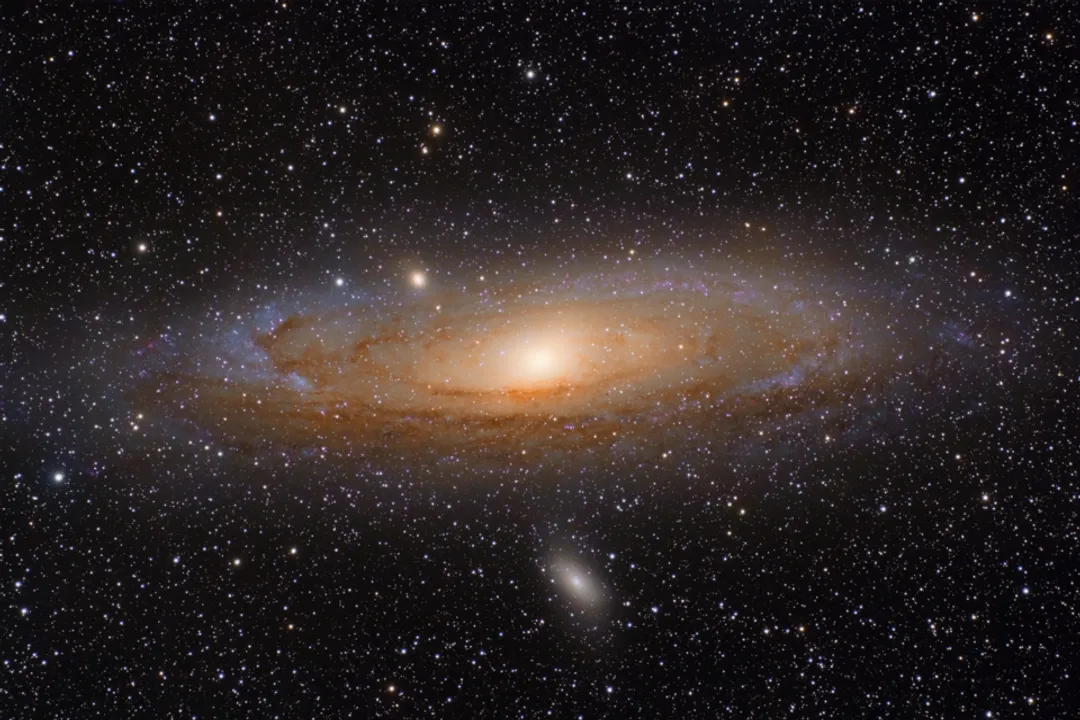
Andromeda is not an isolated island; it exists within a small retinue of smaller galaxies that are gravitationally bound to it, much like the Milky Way has its own satellite system. These orbiting companions are crucial parts of the Andromeda system. [1]
The most prominent of these satellites are M32 and M110. [1] M32 is a compact elliptical galaxy, while M110 is a dwarf elliptical galaxy. [1] These smaller systems are locked in orbits around the larger mass of M31, periodically passing close enough to experience tidal forces that strip away some of their own stellar material, feeding the massive disk and halo of their parent galaxy over vast stretches of time.
# Hubble Views
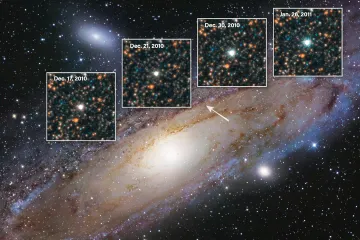
Our current understanding of what resides inside M31 has been significantly advanced by powerful instruments like the Hubble Space Telescope. Hubble’s sharp vision allows astronomers to resolve detail in the distant galaxy that was previously blurred. [2]
Images captured by Hubble have revealed the galaxy's extensive spiral arms, intricate patterns of dust lanes, and regions where new stars are actively forming, indicated by bright, blue clusters of hot, young stars. [2][3] Because Andromeda is so close—cosmically speaking—we can resolve features that are impossible to see in farther galaxies. Researchers from institutions like UC Berkeley and UC Santa Cruz have used these deep Hubble images to create vast mosaics, piecing together a clearer picture of the galaxy's structure across hundreds of light-years. [4]
When we look at this light, we must remember the journey it has taken. The light revealing the star formation happening right now in M31 began its voyage 2.5 million years ago, long before early humans even began to fashion stone tools. This means that every observation is a direct look into the galaxy’s past state, providing an immense time perspective unavailable for closer, or even more distant, objects in a single snapshot. This lookback time is a constant consideration when interpreting the data we receive from M31.
# Collision Course
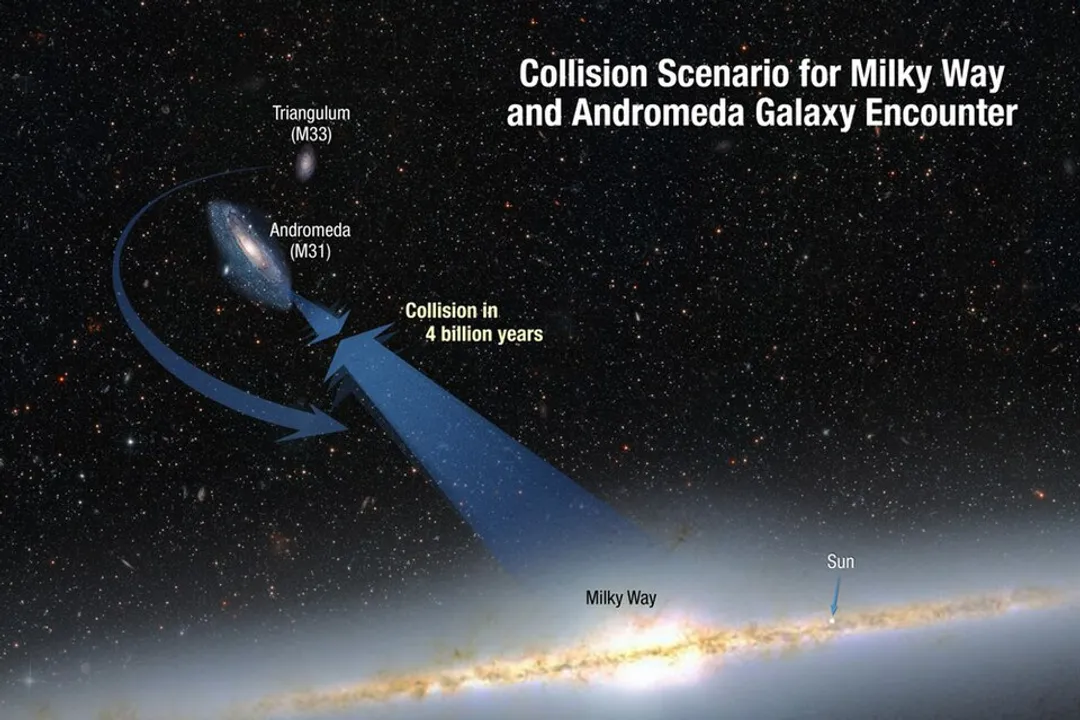
While this article focuses on what is inside Andromeda, it is impossible to discuss its context without noting its ultimate fate in relation to us. Andromeda is moving toward the Milky Way at a speed of about 110 kilometers per second (68 miles per second). [6] This means the two galaxies are destined to merge in an event expected to occur in about 4.5 billion years. [6] The contents described—the trillion stars, the black hole, the clusters—will eventually mix and reform into a single, much larger elliptical galaxy. [6] For now, however, the contents of Andromeda remain distinct, offering us a magnificent, separate island universe to study.
#Videos
What Hubble Saw Inside Andromeda Is Shocking - YouTube
What Scientists Discovered Deep Within the Andromeda Galaxy is ...
Related Questions
#Citations
Andromeda Galaxy - Wikipedia
Messier 31 (The Andromeda Galaxy) - NASA Science
Our neighboring galaxy's unusual core - ESA/Hubble
What Hubble Saw Inside Andromeda Is Shocking - YouTube
The Andromeda Galaxy contains 1 trillion stars and is 2.5 million ...
The Andromeda galaxy: All you need to know - EarthSky
The Andromeda galaxy is finally viewed in all its glory, thanks to the ...
Some mind-blowing facts about the Andromeda Galaxy - Facebook