How did Hubble measure the distance to the Andromeda Galaxy?
The moment Edwin Hubble confirmed the immense distance to the Andromeda Nebula settled one of the most profound debates in 20th-century astronomy. Before his measurements, the nature of objects like the Andromeda Nebula (now known as M31) was fiercely contested; were they clouds of gas within our own Milky Way, or were they distant "island universes" of stars beyond our own island? Hubble’s meticulous work, relying on a specific type of pulsating star, definitively proved the latter, redrawing the boundaries of the cosmos. [1][3]
# Galactic Debate
At the time, astronomers were deeply divided. The prevailing view for many was that the Milky Way comprised nearly the entire universe. Objects cataloged as nebulae, like the Pinwheel or Andromeda, were suspected to be just that—patches of gas and dust within our own galactic boundaries. [3] Conversely, a minority, including figures like Heber Curtis, argued that these spiral nebulae were, in fact, separate galaxies, each containing billions of stars, just like the one we inhabited. [3] Settling this required an accurate method to gauge the distance to one of these objects. If the distance exceeded the accepted diameter of the Milky Way, Andromeda had to be its own entity. [3]
# Variable Stars
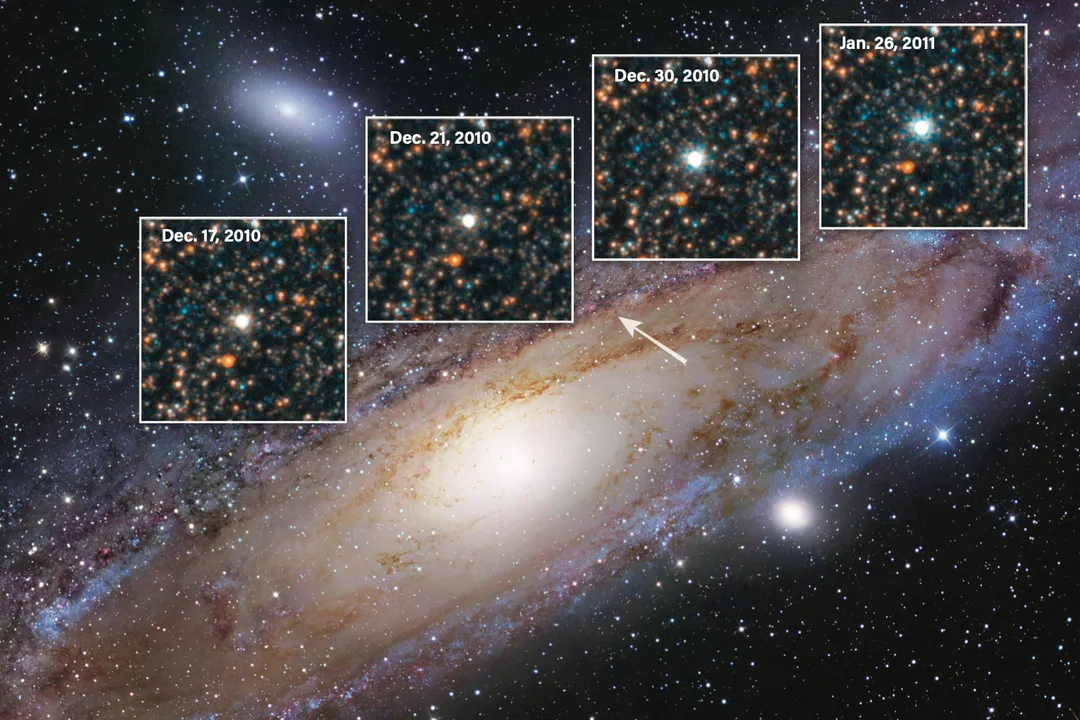
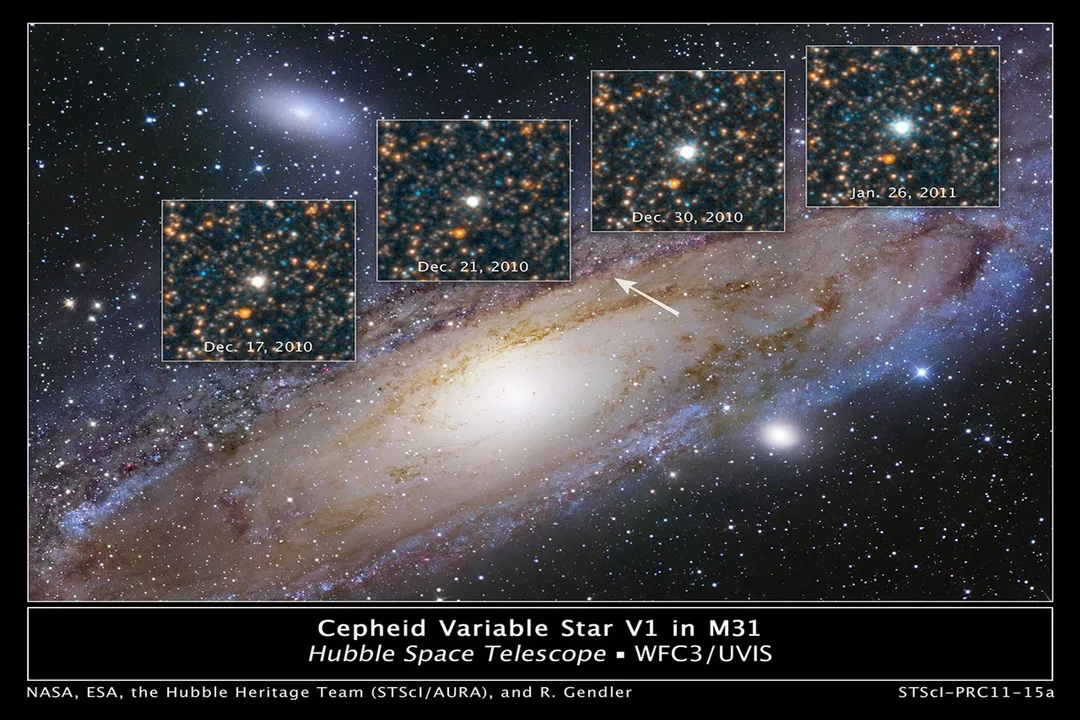
The key to unlocking this distance lay not in a new telescope technology initially, but in the behavior of certain stars discovered decades earlier: Cepheid variables. [1][5] Discovered by Henrietta Swan Leavitt, these stars exhibit a unique, reliable characteristic: their brightness changes rhythmically over a predictable period. [1][5] More importantly, Leavitt established the Period-Luminosity Relationship. [1][5] This fundamental law states that the longer a Cepheid takes to cycle from bright to dim and back again, the intrinsically brighter (more luminous) the star truly is. [1][5]
This relationship turned the Cepheid into a perfect standard candle—an object whose true wattage (absolute magnitude) is known if its period is measured. [1] By comparing this known absolute magnitude with how bright the star appears from Earth (its apparent magnitude), astronomers possess the two necessary components to calculate distance using basic principles of light fall-off. [1][5]
# Mount Wilson Work
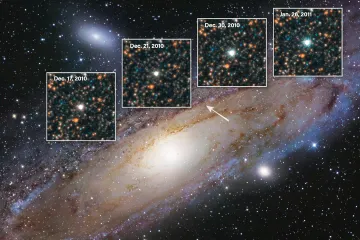
Hubble’s task was to find these distinct, pulsating stars within the fuzzy spiral structure of Andromeda. [4] He did this using the powerful 100-inch Hooker Telescope situated at the Mount Wilson Observatory in California, a ground-based instrument, not the later orbiting telescope that shares his name. [1][3][5] Resolving individual stars within M31 was an immense technical hurdle; the target was millions of times fainter than the brightest star visible to the naked eye. [4] He needed to confirm that the variables he spotted were actually embedded within the Andromeda structure and not just foreground stars in the plane of our own galaxy that happened to lie along the same line of sight. [4] Over several years, through painstaking observation, he tracked the light curves of several of these variables, establishing their periods. [4]
A subtle but important step in this process involved ensuring the Cepheids observed were the correct class. Later investigations would show that there are two main types of Cepheids, each with a slightly different period-luminosity relationship; Hubble’s initial success stemmed from correctly identifying the brighter, longer-period class within Andromeda, allowing him to see far enough out. [5]
The sheer difficulty of isolating the light from a single, variable star amidst the collective glow of billions of other stars in the galaxy's dense core provides context for his achievement. [4] It required isolating a faint, periodic flicker against a constant, overwhelming stellar background. [4]
# Distance Formula
Once the period was measured for a Cepheid in Andromeda, Hubble could use the Period-Luminosity curve—calibrated using nearer Cepheids within the Milky Way—to determine that star’s true, intrinsic brightness (absolute magnitude). [1][5] He then compared this calculated absolute magnitude to the actual brightness he measured through the telescope (apparent magnitude). [1][5] The difference between the true brightness and the observed brightness is entirely attributable to the distance the light traveled. [5]
This comparison allowed him to calculate the distance using the distance modulus relationship, which links the difference in magnitudes to the logarithm of the distance. [5] His initial findings, published around 1924-1925, placed Andromeda at approximately 900,000 light-years away. [1][5] For context, the accepted diameter of the Milky Way at that time was estimated to be around 100,000 light-years. [1] A distance of 900,000 light-years meant Andromeda resided firmly outside the confines of our own stellar system. [3]
The initial distance derived was highly dependent on the calibration constants known at the time. If we look at the contemporary value, the distance to Andromeda is usually cited closer to 2.5 million light-years. [1] This nearly threefold difference highlights that while Hubble proved Andromeda was external, the standard candle itself required refinement later on as our understanding of cosmic scales evolved, particularly with the clearer definition of the Hubble Constant. [1] This demonstrates that the early success established the method and the extragalactic nature of M31, even if the precise numerical distance required later adjustments. [5]
# Cosmic Scale
Hubble’s measurement effectively shattered the prevailing, limited view of the universe. By proving that Andromeda was an independent galaxy located millions of light-years away, he immediately expanded the known size of the universe by a factor of at least twenty. [3] This confirmed the "island universe" hypothesis and established the Cepheid variable as the fundamental first rung on the cosmic distance ladder. [3][5] The subsequent measurement of distances to further galaxies relied directly on extending this technique. [5] What began as identifying a faint flicker in a distant smudge culminated in a complete revision of humanity’s place in the vastness of space. [3][9] Even today, the Hubble Space Telescope continues to observe these same stellar indicators, refining the accuracy of the fundamental distances Hubble first established over a century ago. [9]
Related Questions
#Citations
Hubble Determines the Distance to the Andromeda Nebula - EBSCO
Astronomy Quiz 10 Flashcards - Quizlet
How did Edwin Hubble prove Andromeda was a galaxy?
How did Hubble determine that the Cepheid was actually located ...
How did Hubble determine the distance to the Andromeda Galaxy?
Andromeda Question? : r/Astronomy - Reddit
[FREE] How did Edwin Hubble measure the distance to the ... - Brainly
Hubble Views the Star that Changed the Universe - NASA Science
A century ago, Edwin Hubble's study of Cepheid variable V1 in ...
UGS 303: Cosmology