How are galaxies measured?
Determining the distance to a galaxy millions or even billions of light-years away is one of the greatest intellectual achievements in astronomy, requiring a layered approach because no single method works across the entire cosmos. [2][7] Imagine trying to gauge the distance across a continent; you might walk a few blocks to get the scale, use a car odometer for a few hundred miles, and rely on flight navigation for the rest of the trip. Astronomers use a similar concept called the Cosmic Distance Ladder, [2] where each rung allows us to measure farther out, calibrating the next rung up. [4][7]
# Nearby Rungs
For the very closest stars, astronomers can sometimes use geometry—specifically, parallax. [4] This technique measures how much a star appears to shift against the background of more distant stars as the Earth orbits the Sun. [4] This is the most direct method, but it only works out to a few thousand light-years, far too short for measuring other galaxies. [4][7]
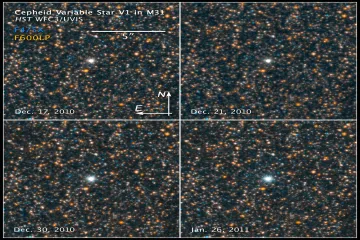
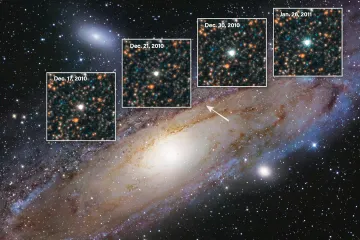
Once we move beyond direct parallax, we rely on objects that have a known, consistent intrinsic brightness, often referred to as "standard candles". [2][7] One critical rung involves Cepheid variable stars. [2] These stars literally pulse, growing brighter and dimmer over periods ranging from a few days to a few months. [7] Henrietta Leavitt discovered that the period of this pulsation is directly related to the star’s true average luminosity—the longer it takes to pulse, the brighter it intrinsically is. [1][7]
If we know how bright a Cepheid truly is (its absolute magnitude) and we measure how bright it appears from Earth (its apparent magnitude), simple physics allows us to calculate the distance. [4][7] This method is highly dependable but has a limit; Cepheids are simply too faint to be reliably seen in galaxies billions of light-years away. [2] They are essential, however, because they calibrate the next, brighter rung on the ladder. [7] Furthermore, we can use other standard candles, such as the Tip of the Red Giant Branch (TRGB), which marks the luminosity at which stars of a certain mass begin fusing helium in their core, providing another benchmark for closer galaxies. [2]
# Brighter Candles
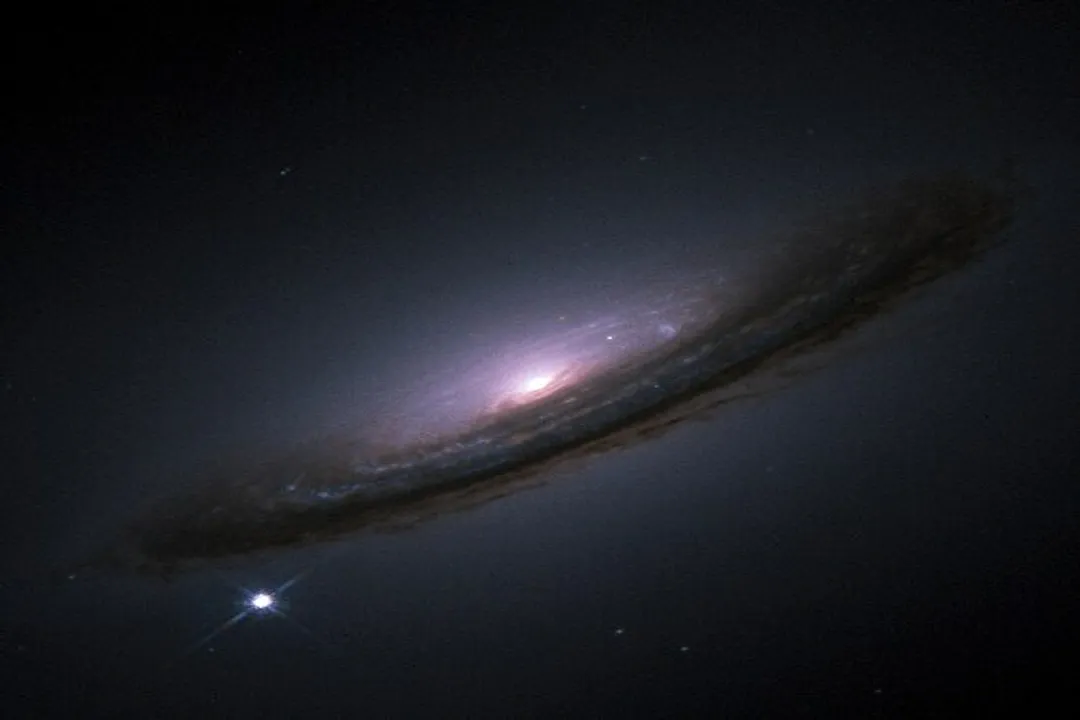
To measure galaxies further afield, astronomers need something much brighter than a single Cepheid star. This brings us to Type Ia Supernovae. [2] These aren't just stars; they are catastrophic explosions marking the death of a white dwarf star in a binary system. [7] Because they are thought to explode when they reach a very specific mass limit (the Chandrasekhar limit), the resulting explosion has a nearly uniform peak brightness across the universe. [2]
This incredible, consistent peak luminosity means a Type Ia supernova can outshine an entire galaxy for a few weeks, making them visible across vast cosmic distances. [7] For example, if a supernova is observed at a distance where a Cepheid is no longer visible, we can measure its light curve and determine its distance. [4] The measurement process involves observing the light curve—how quickly the supernova fades after its peak—which helps refine the true peak brightness, correcting for slight variations. [2]
It is perhaps an interesting thought exercise to consider that if we found a Type Ia supernova that appeared dimmer than expected based on its measured redshift (discussed next), it would imply the universe is expanding faster than our current models predict, or that there is some intervening dust dimming the light, a key measurement that helped confirm dark energy. [5] The precision we need for these measurements is immense; being off by just a tenth of a magnitude in brightness can translate to a distance error of about 25 percent. [4]
# Hubble Flow
When we look at galaxies so distant that we cannot resolve individual stars like Cepheids, we must turn to a different physical phenomenon: the expansion of the universe itself. [2] This is where the concept of redshift becomes paramount. [7] As the universe expands, the space between galaxies stretches, and this stretching also stretches the light waves traveling through that space. [1][3] Longer wavelengths of light appear "redder," causing the spectral lines of light emitted by the galaxy to shift toward the red end of the spectrum—hence, redshift (). [3][7]
Edwin Hubble established that, generally, the farther away a galaxy is, the faster it appears to be receding from us, leading to the relationship known as Hubble's Law. [2][7] This law states that recessional velocity is proportional to distance (), where is the Hubble Constant. [2]
To use this for measurement, we first need a highly accurate value for . This value is derived by measuring the distance to relatively nearby galaxies using the standard candles (Cepheids, Supernovae) from the previous rungs. [2][7] Once is set, measuring the redshift of a very distant galaxy immediately yields its recessional velocity, which we then convert back into a distance estimate. [7] For the very farthest objects, like those observed by the James Webb Space Telescope, redshift values can exceed . [5] This method relies less on the brightness of individual objects and more on the fundamental expansion rate of the universe. [2]
# Weighing Galaxies
Measuring the distance to a galaxy is different from determining its mass, which requires looking at how things move within or around it. [6] We cannot simply count all the stars, as most of the mass in galaxies, particularly spiral galaxies, is composed of invisible dark matter. [6]
To estimate the total mass, astronomers observe the rotation of spiral galaxies. [6] Stars orbiting the galactic center should slow down the farther out they are, following Kepler’s laws, much like the outer planets in our solar system orbit slower than the inner ones. [6] However, when astronomers plot the actual orbital speeds of stars or gas clouds versus their distance from the center, they find that the outer stars move just as fast, or sometimes even faster, than the inner ones. [6] This observation implies that there must be a huge amount of unseen mass extending far beyond the visible edge of the galaxy, providing the necessary gravitational pull to keep those outer stars moving so quickly. [6] This technique, analyzing the rotation curve, is how we infer the presence and distribution of dark matter and calculate the galaxy's total dynamical mass. [6]
# Scale Refinement
The entire Cosmic Distance Ladder operates under a critical vulnerability: systematic error accumulation. [2] Each rung must be perfectly calibrated by the one below it. [4] If the distance measurement for the Cepheids (Rung 2) is systematically off by just 2 percent, that small error gets magnified when used to calibrate the next step up, say, the Type Ia Supernovae (Rung 3), which in turn affects the calibration of the Hubble Constant itself. [7] Think of it like a chain of dominoes where the first domino is slightly nudged in the wrong direction; by the time you reach the 100th domino, the final placement might be significantly displaced from where it should have been. [4]
This is why new telescopes and improved observation techniques are so important—they don't just help us see farther; they help us pin down the closest rungs with greater certainty. For instance, improved parallax measurements from missions like Gaia provide an invaluable, independent check on the absolute luminosity of nearby Cepheids, tightening the anchor point of the entire structure. [2] Having independent confirmation for the low rungs ensures that when we extrapolate billions of light-years out, we are starting from a foundation that is as solid as possible. [5]
# New Views
Modern instruments are specifically designed to address the calibration issues that have plagued distance measurements for decades. [5] The James Webb Space Telescope (JWST), for example, is exceptional at observing in the infrared spectrum. [5] This capability allows it to pierce through cosmic dust clouds that obscure visible light observations, letting astronomers see fainter, older, or more distant standard candles with greater clarity than ever before. [5]
In the realm of very local measurements, even determining the size of our own Milky Way requires careful technique. [8] To map out the location of our solar system relative to the galaxy's center, astronomers must measure distances to objects within the Milky Way, often using masers (microwave equivalents of lasers) as highly precise distance markers to map out the geometry of our stellar neighborhood. [8] This local, detailed mapping provides essential context for understanding the structure that gives rise to the grand cosmic measurements. [8] When we discuss the near side of the galaxy, the distances involved are hundreds or thousands of light-years, requiring meticulous triangulation and parallax measurements, quite different from the cosmological distances measured in megaparsecs. [8]
Ultimately, measuring galactic distances is a collaborative effort across multiple physical principles. We begin with geometry for the nearest objects, graduate to the light curves of specific stellar events as calibrated rulers, and finally rely on the universal stretching of spacetime quantified by the redshift of distant objects. [2][7] Each method confirms, or challenges, the others, pushing our understanding of the scale and age of everything we see. [4]
#Videos
How Do We Measure Distance In The Universe? - YouTube
Related Questions
#Citations
Measuring Distances to Galaxies - Frontiers for Young Minds
Cosmic distance ladder - Wikipedia
ELI5: How do we measure distance of a galaxy? : r/explainlikeimfive
How do astronomers measure distances to stars and galaxies?
Measuring the Distances to Galaxies With Space Telescopes
How does one measure the mass of a galaxy? And other such large ...
How do we calculate distances to other galaxies?
Measuring the Distance to the Far Side of the Galaxy
Measurement of Galaxy Distances
How Do We Measure Distance In The Universe? - YouTube