How big is the Virgo galaxy cluster?
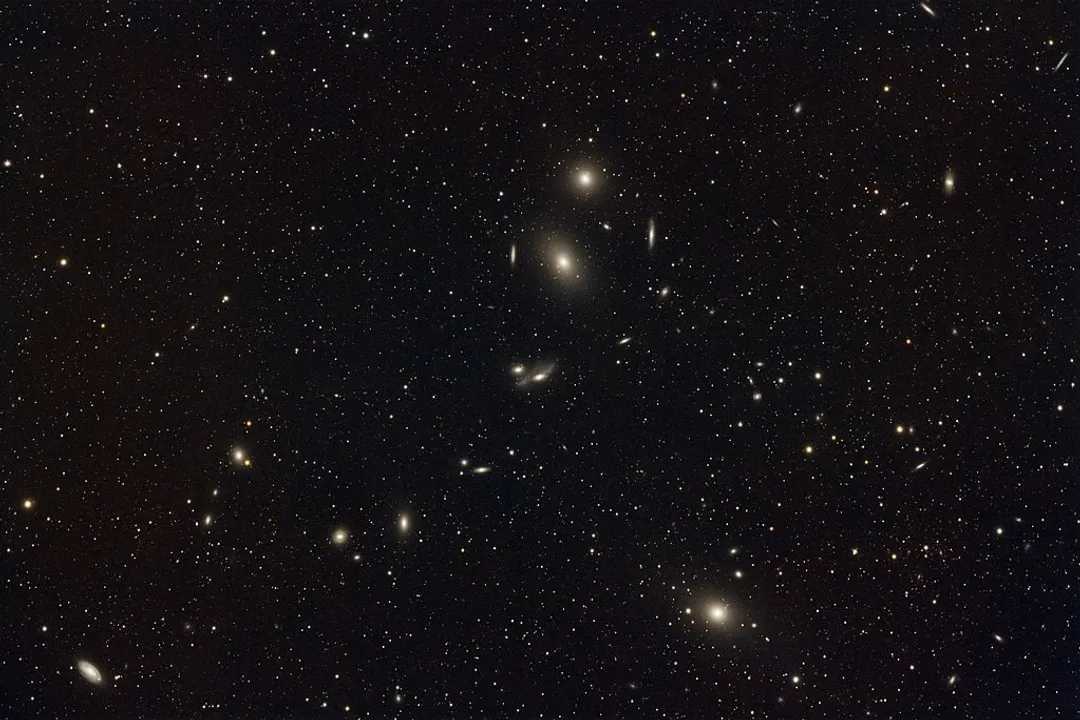
The Virgo Cluster stands as the closest massive collection of galaxies to our own Milky Way, making its scale a key benchmark in understanding cosmic structures. Defining "how big" this collection is requires looking beyond a single number, touching upon its distance from us, the sheer number of galaxies it contains, and its actual physical span across space. This vast agglomeration, residing in the general direction of the constellation Virgo, anchors the larger, less dense structure we call the Virgo Supercluster.
# Distance Quoted
Pinning down the exact distance to the Virgo Cluster has historically been essential, as it serves as a fundamental reference point—a "stepping stone for the cosmological distance scale". Contemporary measurements place the center of the cluster roughly $50$ to $55$ million light-years away from Earth. When translated into the metric unit astronomers often use for such large structures, this distance equates to about $16$ to $16.5$ megaparsecs (Mpc). Researchers have also published values slightly further out, such as $20$ Mpc. This slight variation in distance estimates directly impacts how we calculate the Hubble Constant, the rate at which the universe expands.
The cluster's gravitational dominance is so significant that the Milky Way's Local Group is not receding from it due to universal expansion at the expected rate. Instead, the Local Group is being pulled toward the cluster's center, a motion known as the Virgocentric flow. The gravitational pull from Virgo is estimated to slow our Local Group's recession by roughly ten percent.
# Galaxy Count
The number of galaxies within the Virgo Cluster is substantial, though the precise count depends on how faint a system is included. Most sources agree that the cluster contains at least $1,300$ member galaxies. However, other estimates put the total closer to $2,000$ or even more than $2,000$ known galaxies.
When we consider the fainter, less luminous systems, the true number is likely much higher. Researchers studying the cluster population have noted that dwarf galaxies, particularly the dwarf elliptical types, numerically dominate the count. Given the difficulty in detecting these low surface brightness systems, it is highly probable that thousands more extremely faint and diffuse cluster members await discovery. If the Local Group, which contains our Milky Way, is the set of neighbors, the Virgo Cluster is the immediate neighborhood, containing about $50$ times more members than our own group, even though its physical size is not overwhelmingly larger.
# Cluster Dimensions
The physical extent of the Virgo Cluster proves to be complex, largely because it is not a settled, spherical system. While some sources cite an overall diameter of about $15$ million light-years across, other mass estimations suggest an expanse covering a radius of about $2.2$ Mpc (roughly $7.2$ million light-years) out to an angular distance of $8$ degrees from the center. One report gives the diameter as at least $8$ Mpc, which is closer to $26$ million light-years.
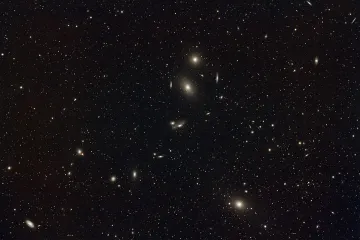
This difference in physical size may stem from focusing on different parts of the structure. For instance, the largest, most concentrated group of galaxies, centered around the dominant giant elliptical galaxy M87 (Virgo A), is estimated to be only about $5$ million light-years in diameter. The cluster also spans a broad area of the sky as seen from Earth, covering approximately $8$ degrees, or about $10$ degrees in diameter based on a wider mapping of members. To put that angular size into perspective, the full Moon covers about half a degree in the sky; thus, the Virgo Cluster spans an area equivalent to about $16$ to $20$ full Moons across.
# Subclump Structure
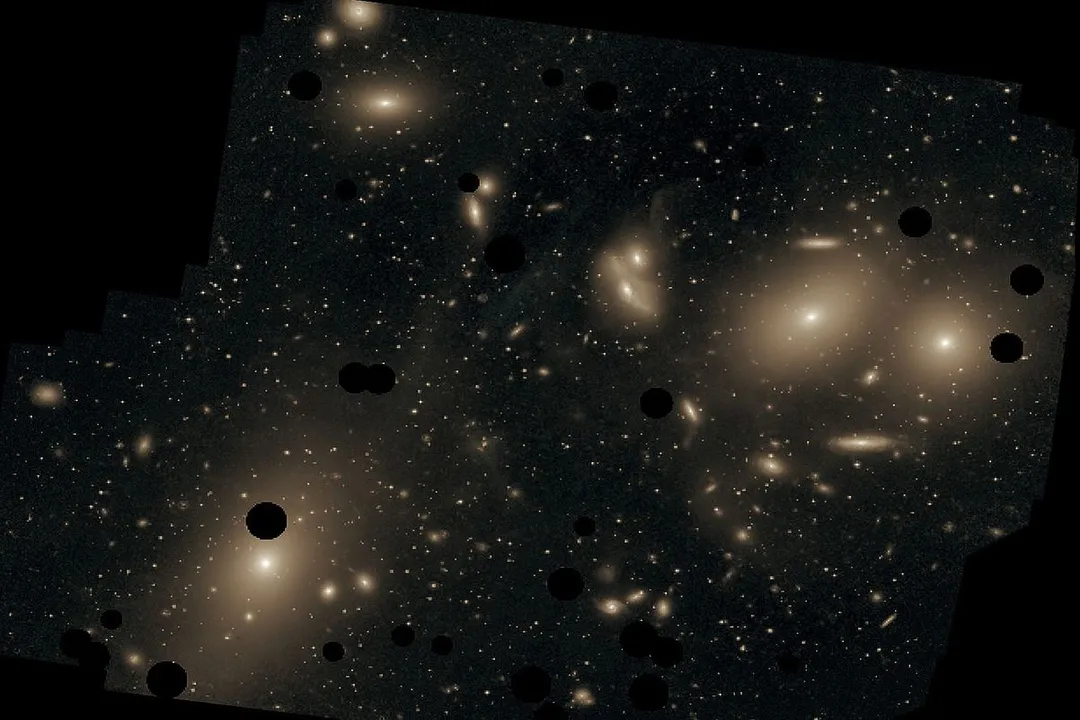
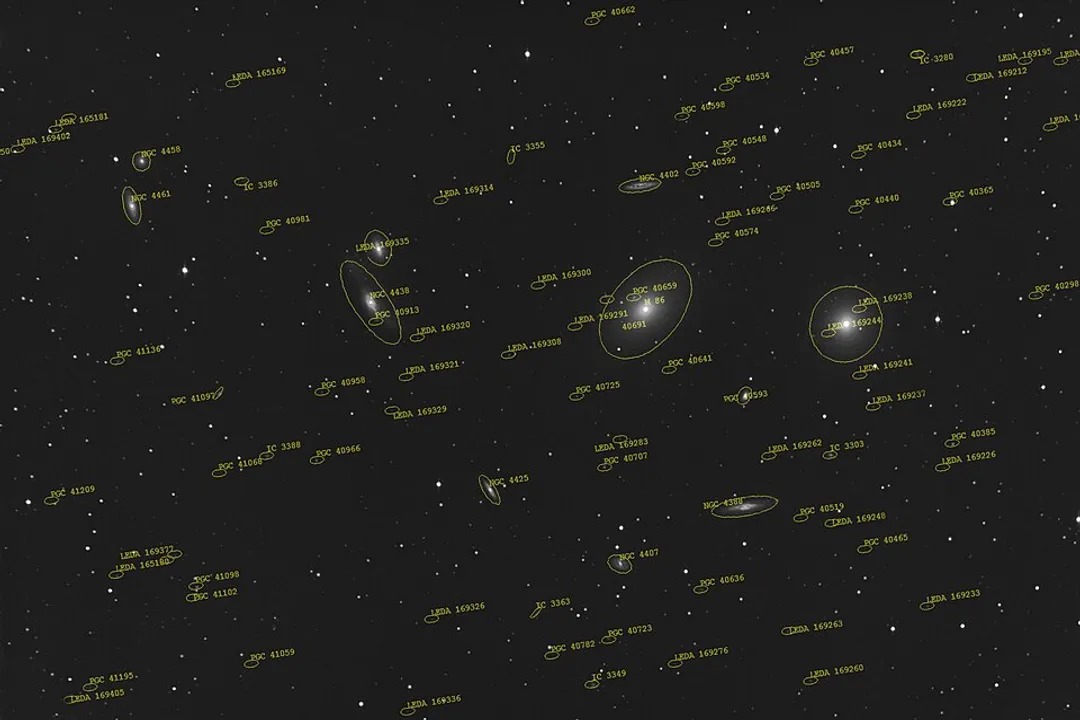
A key aspect influencing its measured size is that the Virgo Cluster is not a single, relaxed entity; rather, it is an aggregate composed of several distinct subclumps that are currently interacting or merging. The cluster is described as irregularly shaped and only loosely concentrated.
The primary components identified include:
- Virgo A: Centered on the enormous elliptical galaxy M87, this is the dominant subclump, possessing a mass about ten times greater than the others.
- Virgo B: Centered on M49, the brightest galaxy overall in the cluster.
- Virgo C: Sometimes identified around the galaxy M60.
- M86 Group: A separate, smaller concentration around the galaxy M86.
These subclumps, along with surrounding smaller galaxy clouds like the N Cloud and S Cloud, are actively in the process of merging to form one larger, single cluster. This dynamic state means the cluster is "dynamically young" and "still in the making". The elliptical and lenticular galaxies form the cluster's "skeleton," being more centrally clustered, while the spiral and irregular galaxies are more widely scattered, suggesting they have fallen into the main body more recently and have not yet settled dynamically. The very axis along which the main concentration is stretched appears to align with the jet emanating from M87, hinting at powerful internal dynamics.
# Gravitational Reach
While the physical diameter of the central concentration is only a few million light-years, the cluster's gravitational influence is much broader. The cluster's total estimated mass is in the order of solar masses. This enormous mass dictates the cluster's role in the cosmic web, as it forms the nucleus of the much larger Virgo Supercluster.
This gravitational footprint means that while the cluster itself might be defined by its tightest bound members in an radius, its overall effect shapes the motion of galaxy groups much further afield. This ongoing gravitational tug-of-war is precisely what astronomers map when they chart the relative motions of galaxies, revealing the larger Laniakea Supercluster complex that both the Virgo Supercluster and our own Local Group are flowing toward. The fact that the cluster is still dynamically messy and is actively pulling in surrounding material suggests that the "size" measured today is significantly smaller than its eventual size when dynamical equilibrium is finally achieved, perhaps a billion years from now.
Related Questions
#Citations
Virgo Cluster - Wikipedia
Virgo Cluster
Can someone explain the difference between the Virgo Cluster ...
The Virgo Cluster - ESO.org
Virgo cluster | Distant Galaxies, Superclusters & Ellipticals - Britannica
Virgo Cluster - Messier Objects
Virgo Cluster - MPIFR Bonn
Virgo Cluster - Universe Today