How did Edwin Hubble measure the distance of the Andromeda Galaxy?
The universe, as understood in the early 20th century, was largely confined to the boundaries of the Milky Way, a vast, but finite, collection of stars. Yet, faint, fuzzy patches of light known as "spiral nebulae," chief among them the Andromeda Nebula (M31), sparked a fundamental astronomical debate: were these objects simply gas clouds existing within our galaxy, or were they entirely separate "island universes" of stars, far beyond our own? Edwin Hubble was the man who provided the definitive answer, and the method he employed to settle this cosmic question was a brilliant application of newly understood stellar physics to measure an extraordinary distance.
# Nebulae Debate
The scale of the cosmos was hotly contested. Many astronomers believed the Milky Way encompassed everything observable. If the Andromeda Nebula was part of our galaxy, it would be relatively nearby, perhaps a few thousand light-years away. If, however, it truly represented another galaxy, its distance would be staggering, pushing the boundaries of known space dramatically outwards. Hubble's task was to find a way to accurately measure that distance, a feat that required looking past the entire stellar population of the Milky Way. He targeted the Andromeda Nebula specifically because it was one of the brightest of these mysterious objects.
# Hubble's Tool
To resolve such a colossal distance, simple trigonometric parallax—the standard method for measuring nearby stars—was completely inadequate; the angle would be far too small to detect. What was needed was a celestial yardstick that could be seen across intergalactic space. Hubble turned to the 100-inch Hooker Telescope located at the Mount Wilson Observatory in California. This instrument was, at the time, the largest and most powerful telescope available, providing the necessary light-gathering capability to resolve individual stars within the distant swirl of Andromeda. It was this specific observational power that made his subsequent discovery possible.
# Variable Stars
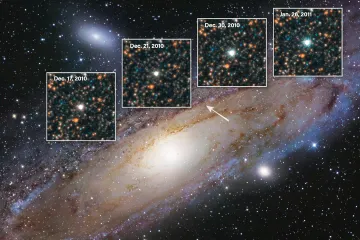
Hubble’s breakthrough relied on identifying a specific class of star whose behavior could reveal its true brightness: Cepheid variable stars. These stars are intrinsically luminous, meaning they shine with a known, massive amount of energy, but their apparent brightness changes predictably over time as they pulsate, brightening and dimming in a regular cycle. If one could observe one of these stars in Andromeda, its observed variation could be translated into a distance marker.
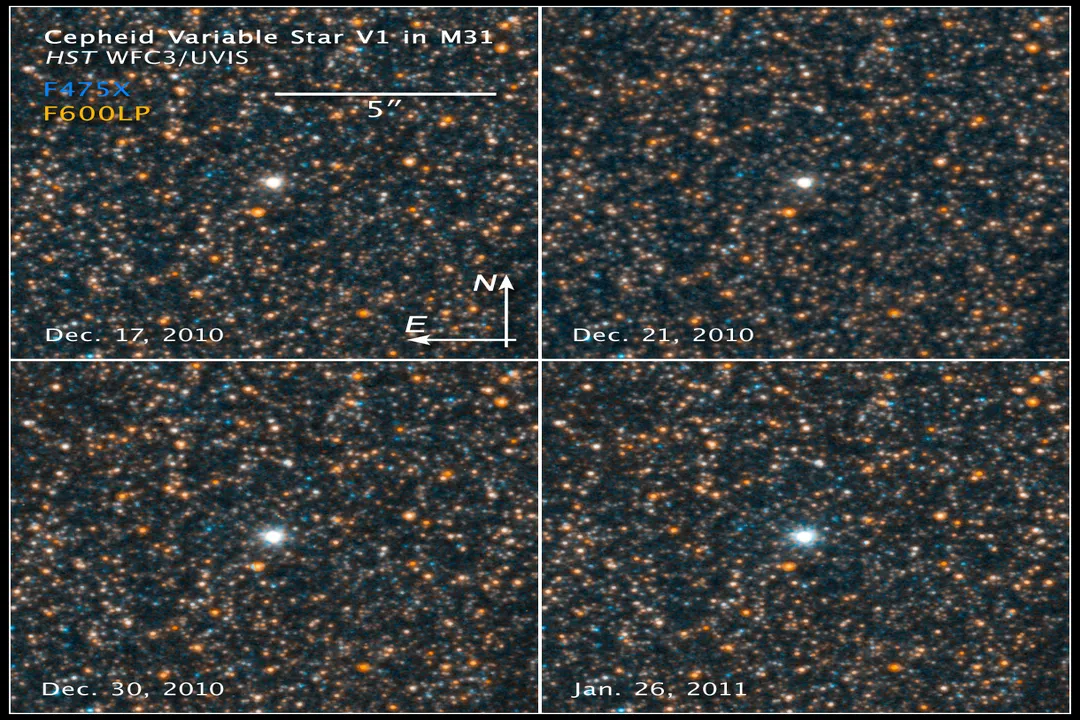
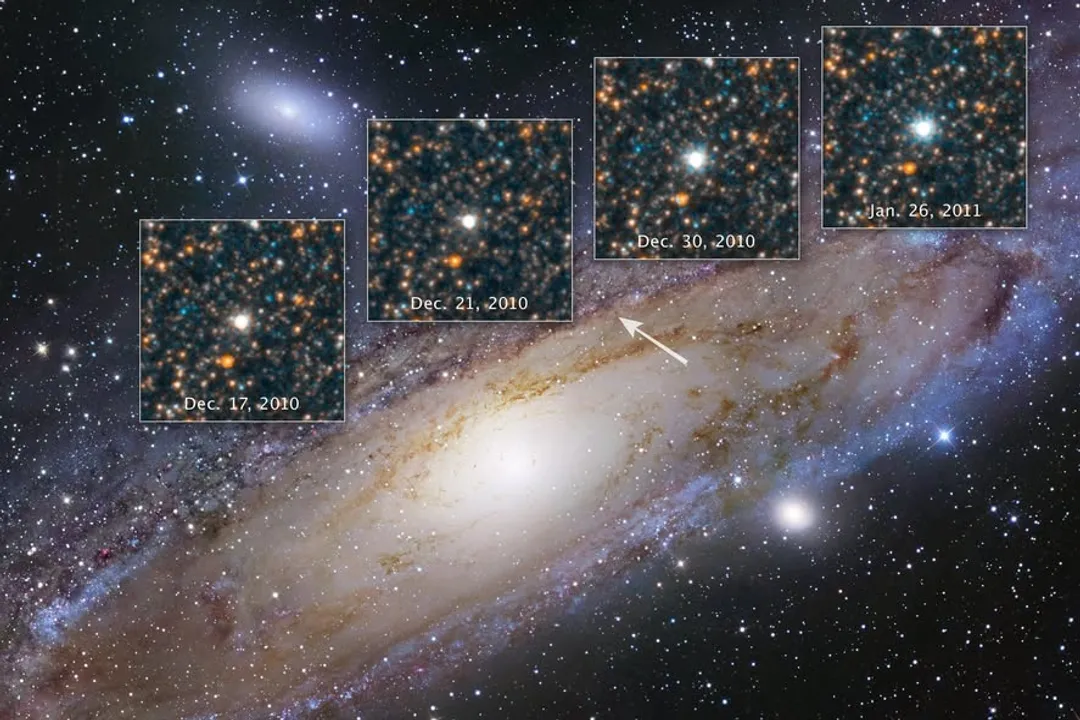
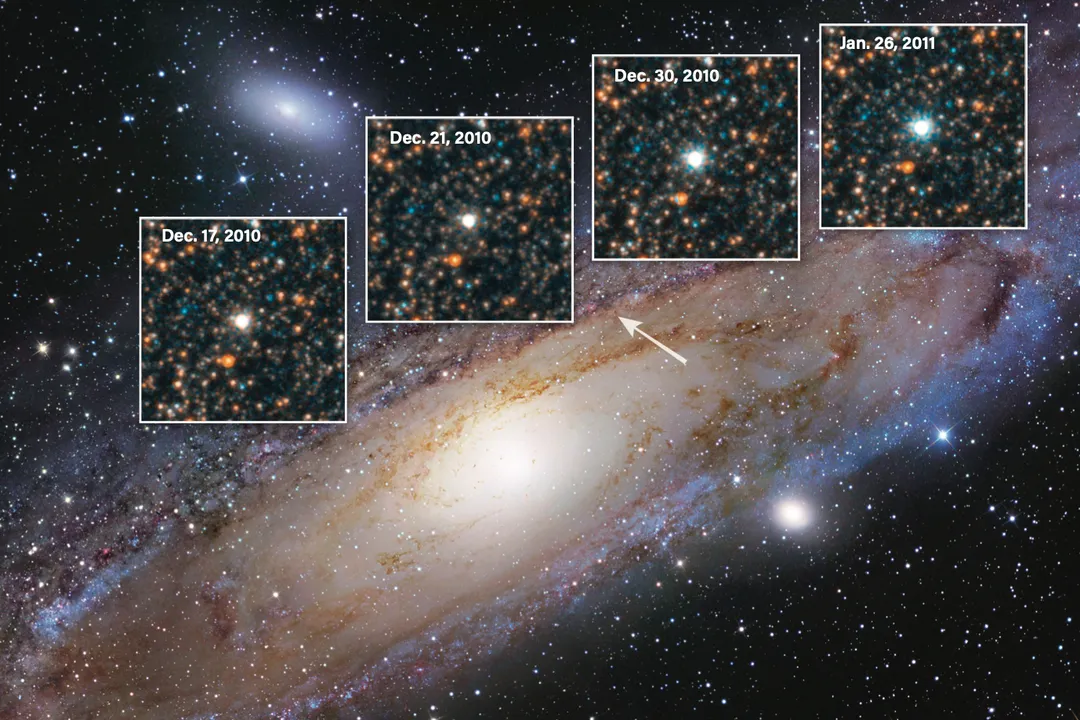
In 1923, while meticulously examining photographic plates of the Andromeda Nebula, Hubble identified one such star, later designated V1. Finding a variable star inside the supposed nebula was the smoking gun evidence he needed. The detection of a Cepheid confirmed that this object was not a uniform cloud of gas, but rather a collection of individual stars, just like the Milky Way.
# Leavitt's Law
Hubble's ability to proceed from identifying V1 to calculating a distance hinged entirely on the prior work of astronomer Henrietta Swan Leavitt. Leavitt had studied Cepheids in the Small Magellanic Cloud and established a profound cosmic relationship: the Period-Luminosity Relationship. This law states that the longer the time it takes for a Cepheid to complete one cycle of brightening and dimming (its period), the intrinsically brighter (more luminous) the star actually is.
Hubble took his observations of V1 and determined its period—how long it took to cycle from bright to dim and back again. Once the period was known, Leavitt's established relationship provided the star's absolute magnitude (its true brightness).
This method represents a crucial step on the cosmic distance ladder, bypassing geometric measurements entirely in favor of intrinsic stellar properties. While measuring the distance to the nearest stars relies on geometry (parallax), measuring objects as distant as Andromeda requires reliable standard candles like Cepheids, whose absolute brightness is tied directly to a measurable timing property.
# Distance Calculation
With two critical pieces of information—the star's absolute magnitude (its actual, intrinsic brightness based on its period) and its apparent magnitude (how bright it looked through the telescope)—Hubble could perform the final calculation. The inverse square law of light dictates that apparent brightness decreases with the square of the distance. By comparing how bright the star should be (absolute) to how bright it appeared (apparent), Hubble could solve for the intervening distance.
The calculation demonstrated that V1, and therefore the entire Andromeda Nebula, was impossibly far away if it resided within the Milky Way. Hubble calculated the distance to be approximately 900,000 light-years. In the context of the time, this was an enormous figure, dwarfing the known diameter of the Milky Way, which was then estimated to be about 300,000 light-years across, though later estimates adjusted this significantly downward.
The sheer magnitude of the calculated separation provided the first strong evidence that Andromeda was, in fact, an independent galaxy, existing entirely outside the confines of our own stellar system.
# Refinement and Legacy
Hubble's initial 1925 figure of 900,000 light-years was a monumental step, but it was based on the period-luminosity relationship as calibrated at that time. Subsequent discoveries revealed a subtle but significant issue with the initial calibration of Leavitt’s law that affected all extragalactic distance calculations derived from it. Astronomers later found that the Cepheids Hubble used were likely Type II Cepheids, which are inherently fainter than the Type I Cepheids used for the initial calibration.
This recalibration meant that Andromeda was actually further away than Hubble first calculated. While his initial measurement was revolutionary for proving Andromeda was external, the precise value has been revised over the decades. For instance, modern estimates place Andromeda closer to 2.5 million light-years away. This evolution in measurement highlights a key aspect of scientific progress: initial foundational discoveries provide the framework, which is then refined by subsequent, more accurate calibration data gathered using the same fundamental technique.
Hubble's technique fundamentally redefined humanity's place in the cosmos. It moved the Milky Way from being the entirety of creation to merely one among countless galaxies. The successful measurement of V1’s period and the subsequent application of Leavitt’s Law established the baseline for all future cosmological distance measurements, making the identification of a single, periodically varying star the single most important data point in confirming the existence of the modern universe, one populated by billions of galaxies.
Related Questions
#Citations
Astronomy Quiz 10 Flashcards - Quizlet
Hubble Determines the Distance to the Andromeda Nebula - EBSCO
How did Edwin Hubble prove Andromeda was a galaxy?
[FREE] How did Edwin Hubble measure the distance to the ... - Brainly
Cepheid Variable Star V1 in Andromeda Galaxy - NASA Science
A century ago, astronomer Edwin Hubble pointed a telescope at the ...
How did Hubble determine that the Cepheid was actually located ...
Solved How did Edwin Hubble measure the distance to the - Chegg
The universe: Historical discoveries from Edwin Hubble and others
How did Hubble determine the distance to the Andromeda Galaxy?