Which two discoveries are attributed to Edwin Hubble?
The very notion of the universe as we understand it today—a vast, boundless arena filled with countless other star systems—was not always the accepted view. For decades, the scientific consensus held that everything observable existed within the confines of our own Milky Way galaxy. To truly grasp the magnitude of Edwin Hubble’s impact, one must appreciate the smallness of the universe before his observations. He fundamentally rearranged our cosmic address, shifting humanity from the supposed center of everything to a mere speck within an unimaginably larger structure. This transformation rests primarily upon two monumental discoveries, both rooted in meticulous observation at the very edge of technical feasibility in the early 20th century.
# Stellar Pioneer
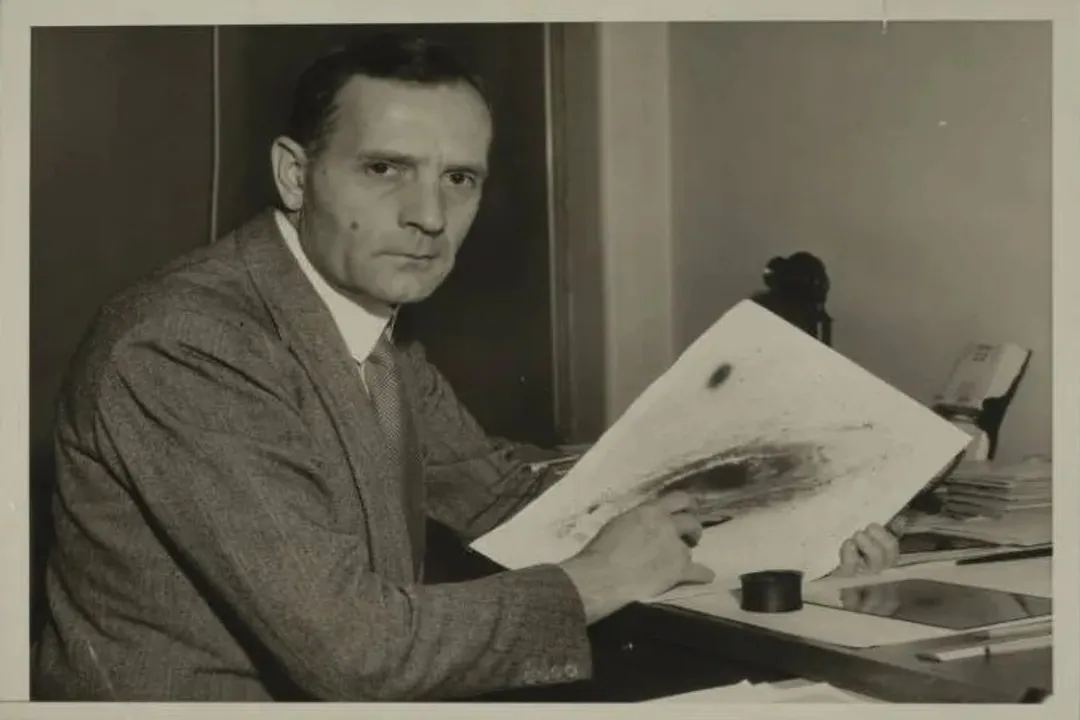
Edwin Powell Hubble, born in Missouri in 1889, initially pursued paths laid out by expectation, studying law at Oxford as a Rhodes Scholar after completing his undergraduate work in mathematics and astronomy at the University of Chicago. Yet, the call of the cosmos proved too strong to ignore. After his father’s passing, Hubble returned to his true passion, earning his Ph.D. in astronomy from the University of Chicago in 1914, with a dissertation focused on faint nebulae. His destiny became intertwined with the world’s most powerful instrument of the era: the 100-inch Hooker Telescope at the Mount Wilson Observatory in California, where he began his staff position in 1919. This massive instrument provided the necessary aperture to begin challenging the established boundaries of the cosmos.
# Island Universes
The first of Hubble’s groundbreaking achievements was settling the long-standing debate over the nature of the spiral nebulae—those faint, fuzzy, cloud-like patches seen in the night sky. Were they merely gas and dust clouds within our own Milky Way, or were they, as some speculated, entirely separate "island universes" of stars? The key to resolving this lay in measuring distance, a task that required a specific tool: the period-luminosity relationship for Cepheid variable stars, a relationship first discovered by Henrietta Swan Leavitt. These pulsating stars act as 'standard candles' because their cycle of brightening and dimming directly correlates with their true intrinsic brightness.
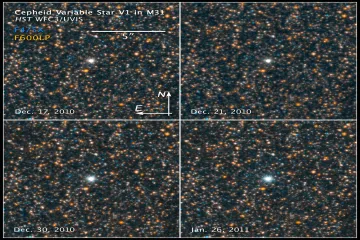
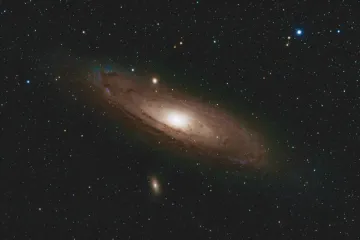
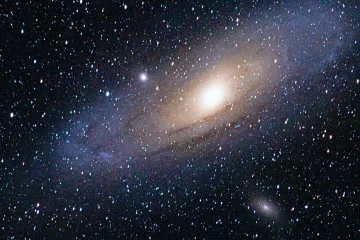
Hubble applied this method to the Andromeda Nebula (M31). In 1923, he successfully resolved individual stars within it, and crucially, he found a Cepheid variable star whose period allowed him to calculate its distance. His calculation placed the Andromeda Nebula far beyond the accepted edges of the Milky Way, proving it was an external galaxy in its own right. This finding, announced publicly in late 1924, effectively shattered the perception of the universe as being solely the Milky Way. He extended this technique to study other nebulae, concluding that millions of galaxies existed beyond our own system. This paradigm shift redefined astronomy, transforming the Milky Way from the universe into simply our galaxy within a multitude of others, a thing that could now be measured in scale.
It is worth noting that Hubble’s success was built upon foundational work done by others. While Leavitt provided the distance scale, it was the earlier spectral analysis by Vesto Slipher that hinted at the true nature of these distant objects, showing their light was strongly redshifted, suggesting rapid motion away from us. Hubble took these independent threads—Leavitt’s distances and Slipher’s velocities—and wove them together to construct a new, vastly larger cosmos. While this was a moment of profound scientific triumph, it also highlights a complexity in the history of science: the initial publication of Hubble's findings in a peer-reviewed journal was delayed until 1929, even though he had presented them earlier. The sheer weight of the evidence, however, soon won over the astronomical establishment, despite earlier opposition from figures like Harlow Shapley.
The ability to determine the distance to Andromeda, placing it nearly a million light-years away (though modern figures are closer to 2.5 million, reflecting later refinement in Cepheid calibration), was revolutionary. The ability to measure the size of the cosmos rather than merely speculate upon it marks a fundamental boundary in human scientific endeavor. Before Hubble, the largest measurable scale was the Milky Way; afterward, the observable universe grew exponentially, creating a new realm for exploration that demanded new theoretical underpinnings.
# Hubble Sequence
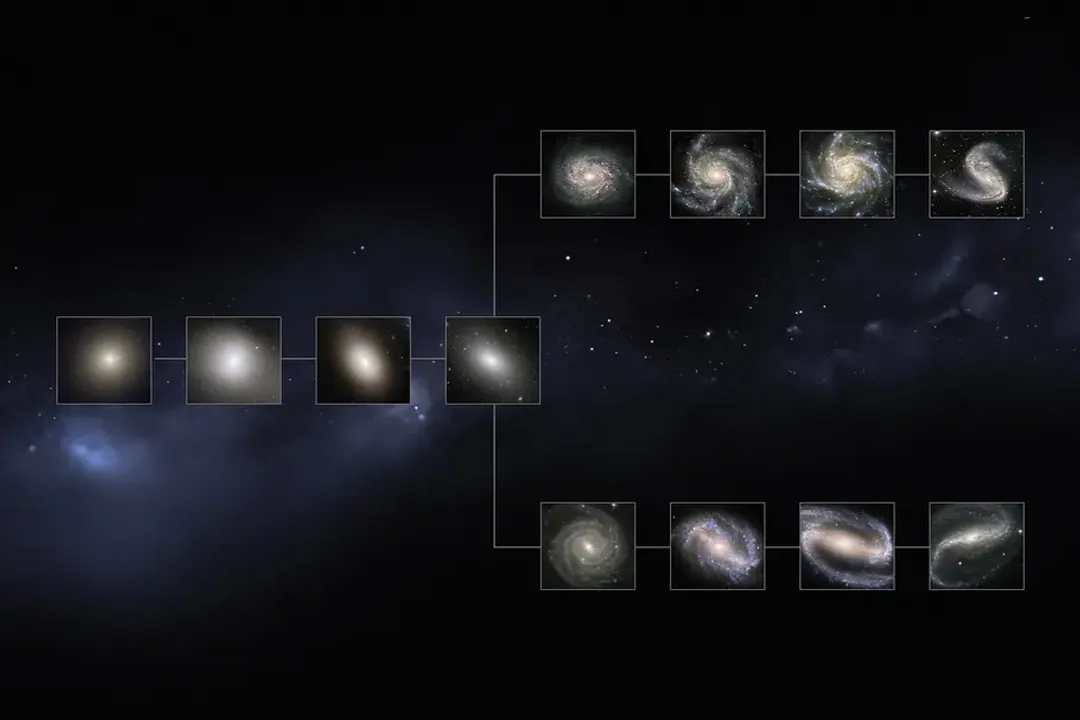
While establishing the existence of external galaxies was his most earth-shattering result, Hubble’s empirical drive led him to categorize what he found. By 1926, after observing numerous galaxies, he developed the Hubble Classification Scheme. This influential system organizes galaxies based on their visual appearance into primary categories: elliptical or spiral. This scheme, sometimes depicted as a tuning-fork diagram, further subdivides spirals based on the tightness of their arms ( to ) and includes barred spirals ( to ), lenticulars (), and irregulars (). Although Hubble initially suspected this visual sequence represented an evolutionary path for galaxies—that one type morphed into the next—the classification system itself proved foundational for understanding galactic structure and provided a necessary framework for his subsequent, even grander cosmological discovery. The sequence remains in use today, showing the enduring utility of his systematic observation.
# Expanding Universe
The second great discovery, which cemented Hubble’s celebrity and provided the observational basis for the Big Bang theory, was the realization that the universe is not static but expanding. This followed his work on extragalactic distances. In 1929, Hubble compiled his distance estimates for over two dozen galaxies with the radial velocity measurements (based on redshift) that Vesto Slipher had already obtained.
What he observed was a clear, roughly linear relationship: the farther away a galaxy was, the faster it appeared to be receding from us. This relationship is formally expressed as Hubble’s Law, , where is the recessional velocity, is the distance, and is the Hubble Constant—the proportionality factor. The implication was unavoidable: all galaxies are moving away from one another, meaning the universe must be actively expanding.
This discovery validated theoretical work, notably that proposed by Georges Lemaître two years earlier, which used Einstein’s equations of General Relativity to predict such a relationship. The expansion described by Hubble’s Law is the primary observational pillar supporting the Big Bang Theory, which posits that the universe originated from a much hotter, denser state.
# Interpreting the Shift
Hubble’s 1929 paper presented a constant of . While this number was significantly larger than modern figures (which hover in the range, depending on the measurement technique) due to earlier calibration errors, the fundamental principle—that velocity increases proportionally with distance—remained sound.
Interestingly, despite the observational evidence pointing toward an expanding universe, Hubble himself reportedly held reservations about the theoretical interpretation for some time. He sometimes referred to the recessional speeds as apparent velocities, leaving the interpretation to theorists. In fact, by 1941, he reported survey data that seemed to suggest the nebulae were not uniformly distributed, which he felt did not support the "explosion idea" of the Big Bang, even calculating a short age for the universe based on his early constant that would predate life on Earth.
This slight hesitation on the theoretical front provides an opportunity to reflect on Hubble’s core strength. He was, by his own admission and by the testimony of his peers, an observer, not a theorist. He famously stated, “The search will continue. Not until the empirical resources are exhausted, need we pass on to the dreamy realms of speculation.” This commitment to observation over pure theory, even when the observations pointed toward a radical conclusion like the Big Bang, speaks to a high degree of scientific integrity. While Lemaître provided the theoretical framework first, Hubble supplied the necessary, undeniable proof gathered through hard work at the telescope. He sought empirical evidence, and when he found it, he presented it, even if it contradicted the previously accepted static view of the cosmos that even Einstein had initially tried to enforce on his own theories.
The tension surrounding priority is also a significant historical note. While Hubble established the law observationally, Georges Lemaître published the mathematical correlation based on General Relativity earlier. Further complicating the credit landscape, Vesto Slipher provided the redshift data necessary for the distance-velocity relationship, and later criticisms noted that Hubble did not always explicitly credit Slipher’s contributions in his initial communications. The fact that Hubble pushed so hard for recognition, even campaigning for astronomy to be included in the Nobel Prize categories shortly before his death in 1953, suggests a deep understanding of the historical weight his empirical findings carried.
# Methodological Precision
To better appreciate the scale of his achievements, consider the tools available. Prior to using Cepheids, distance measurements were restricted by trigonometric parallax, effective only for the nearest stars—perhaps 60 measurable stars by the turn of the century. Hubble’s work, using Leavitt’s standard candles on the 100-inch telescope, extended the measurable scale out to millions of light-years, opening up the extragalactic realm.
When we look at the modern values for , we see the legacy of this ongoing measurement struggle. The Planck satellite data suggests a value around , while the SH0ES team suggests . This discrepancy, known as the Hubble Tension, is currently one of the most exciting areas in cosmology. It demonstrates that while Hubble established the relationship, pinning down the exact constant—which directly influences the calculated age and expansion rate of the universe—is a challenge so profound it may require entirely new physics to resolve. Hubble’s initial measurement, , highlights just how difficult the first step in this cosmic distance ladder truly was. The very existence of this current debate shows that Hubble’s Law remains the critical measure by which we test the universe’s fundamental behavior, much like Copernicus's model forced a re-centering of the solar system centuries earlier.
# Enduring Legacy
Edwin Hubble’s contributions are crystallized in two distinct, world-altering statements: The Milky Way is one of many galaxies, and the universe is expanding. His empirical rigor in establishing these facts, alongside his systematic classification of galactic morphology, provided the foundation for 20th-century cosmology. Though he did not live to see the Hubble Space Telescope launched in 1990—an instrument designed specifically to surpass the atmospheric limits he contended with at Mount Wilson—his name is permanently affixed to humanity’s continuing window into the cosmos. His legacy is not just the two answers he provided, but the new, immense questions he revealed.
Related Questions
#Citations
Edwin Hubble - Wikipedia
Edwin Hubble - NASA Science
Hubble finds proof that the universe is expanding - PBS
Who is the Man That Discovered the Universe?
Edwin Hubble | Biography, Discoveries & Accomplisments - Study.com