What will happen if two galaxies collide?
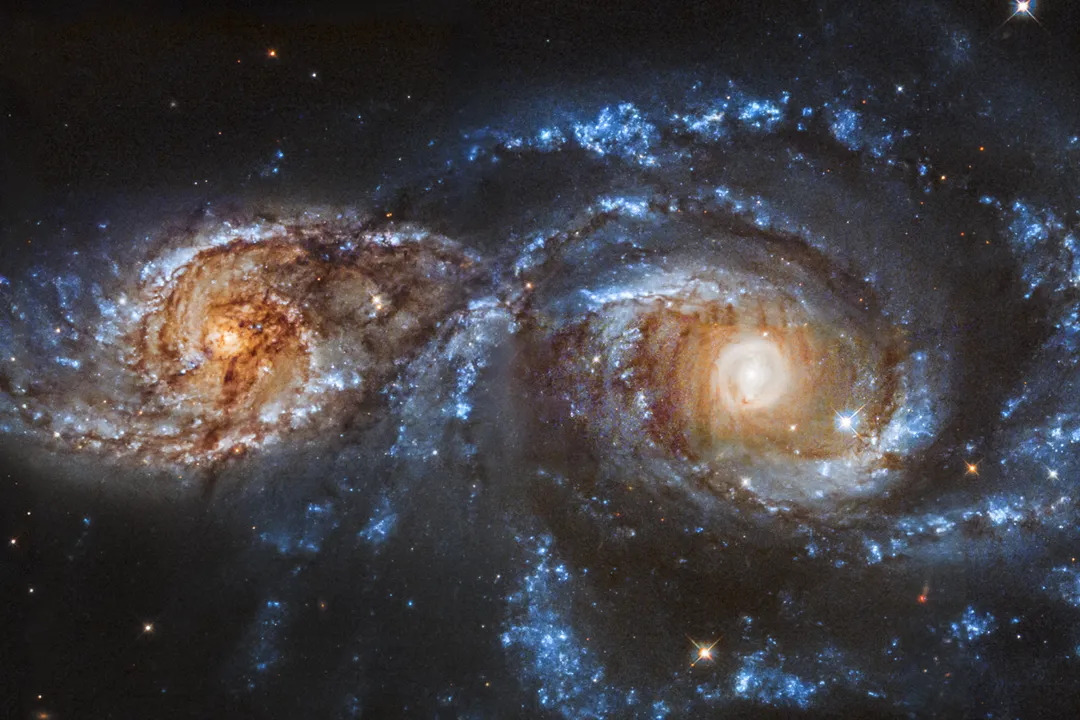
When two galaxies meet, the event is less of a violent crash and more of a slow, stately cosmic dance that spans hundreds of millions of years. Contrary to what dramatic science fiction might suggest, the overall outcome is not the complete annihilation of everything involved; stars almost always manage to pass right by each other unscathed. [3][10] The sheer emptiness of space means that even within the dense cores of galaxies, the distance between individual stars is immense—vast gulfs of vacuum separate these stellar islands. [3] Imagine if the Sun were the size of a grain of sand; the next nearest grain of sand (another star) would still be several miles away. [1] Given this incredible spacing, when the great clouds of stars that make up two galaxies begin to overlap, they mostly phase through one another like ghosts. [3]
# Galactic Scale
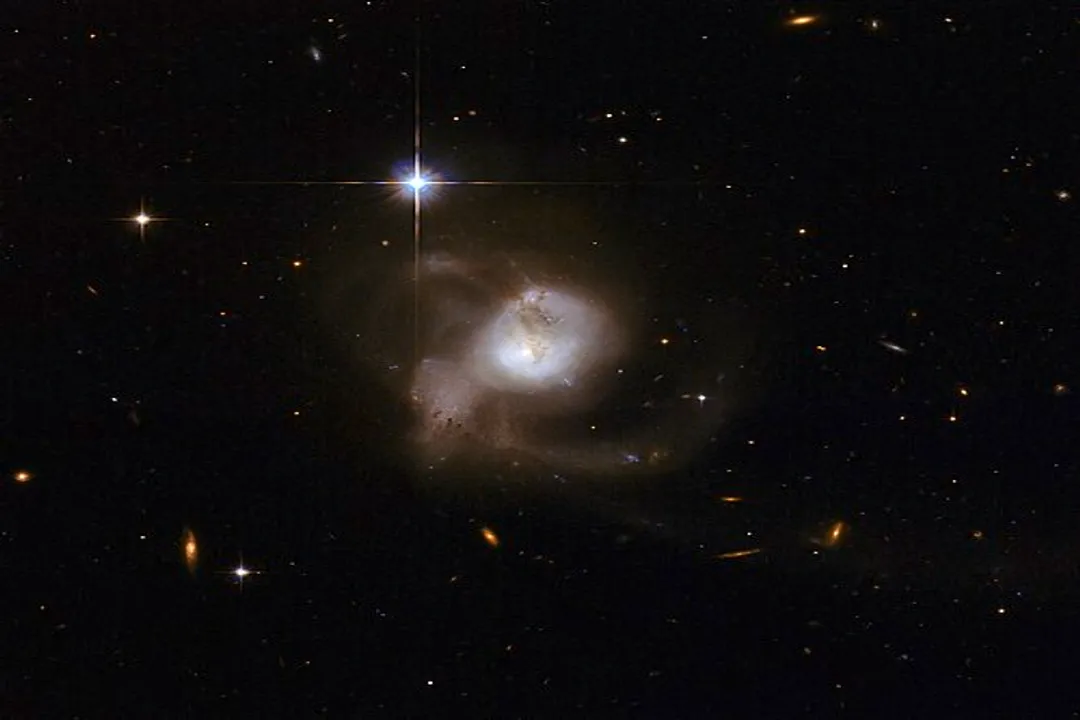
The drama of a galaxy collision, or galaxy merger, is not about instantaneous destruction but about a slow, inexorable gravitational rearrangement orchestrated over cosmic timescales. [2] Galaxies are colossal systems held together by gravity, containing billions of stars, vast clouds of gas and dust, and significant amounts of dark matter. [2] When two such titans approach, the first things to feel the effect are their outer edges, where the gravitational influence of the partner galaxy begins to tug and stretch the material. [2] This gravitational tug-of-war pulls out long streamers of stars and gas, known as tidal tails, which can stretch for hundreds of thousands of light-years across the void. [2] These tails are visible evidence of the ongoing interaction, a signature written in starlight detailing the history of the near-miss or full overlap. [2]
Consider the famous impending event: the collision between our own Milky Way and the much larger Andromeda galaxy. This event, which astronomers expect to begin in about 4.5 billion years, [9] is less of a direct head-on smash and more of a gravitational wrestling match. [9] The two galaxies will likely pass through each other, then slow down, and eventually merge into a single, much larger entity over several subsequent gravitational swings. [9] This process isn't quick; it can take hundreds of millions of years from initial close approach to final settlement into a new configuration. [2] If we could observe this over a human lifetime, it would appear utterly frozen in time, yet across eons, the shape of our night sky will be completely redrawn. [1]
# Star Safety
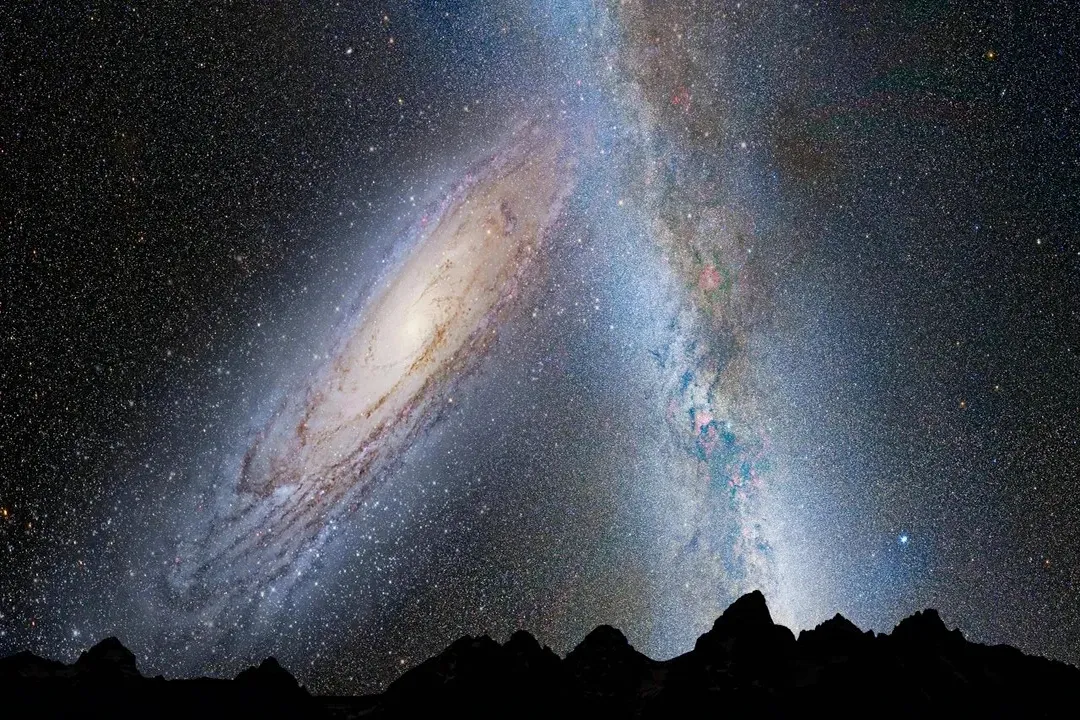
The primary source of public apprehension regarding galactic mergers is the fear that stars, planets, and life itself will be obliterated by direct stellar impacts. However, as the distances between stars are so vast, the probability of a direct collision is extremely low, even when the stellar populations of two galaxies interpenetrate. [3][6] The physical volume occupied by the stars is negligible compared to the volume of the space between them. [3] A star is far more likely to pass near a solar system unharmed than it is to actually strike a planet or another star. [6] For life on Earth, this means that even if the Sun were to be flung into a new orbit during the merger, the physical destruction from a direct stellar impact is virtually impossible to worry about. [6] Our Sun, and by extension Earth, would likely survive the Andromeda-Milky Way event without even noticing a close shave from another star. [9]
However, objects can still be lost or moved. While stars might not collide, the orbits of celestial bodies can be severely disrupted by the massive gravitational shifts caused by the merging dark matter halos and the collective gravity of the billions of stars. [6] Stars that were once safely orbiting the center of the Milky Way might find themselves flung into new, wildly different paths within the newly formed galaxy. [6]
# Gas Dynamics
While the stars largely ignore each other, the large, diffuse clouds of gas and dust that permeate the galactic disks are a different story entirely. [2] Gas clouds have a much larger physical cross-section than individual stars and are far more susceptible to interaction and compression. [2] When these gas clouds from the two galaxies collide, they slam into each other violently. [2] This collision compresses the gas significantly, raising its temperature and density. [2] This compression acts as a powerful trigger for star formation. [2]
Therefore, a galaxy merger often results in a period of intense starburst activity. [2] The resulting system, particularly in the early stages of the merger, can shine brilliantly due to the birth of countless new, massive, hot stars. [4] NASA's Hubble Space Telescope has observed many ongoing mergers, revealing these spectacular bursts of creation where the gas clouds are collapsing under the stress of the interaction. [4] This is a key distinction: the merger doesn't destroy matter; it recycles it into new stellar generations through gravitational compression. [4] The Hubble observations have shown that these interactions are complex, sometimes leading to unexpected morphologies and star formation patterns that defy simple models. [4]
To appreciate the sheer volume of material involved in these events, consider a comparison: if we think of the entire observable universe as a single 24-hour day, the entire process of two large galaxies like the Milky Way and Andromeda merging might take up the last minute of that day, culminating in a new structure—a process that feels instantaneous on the cosmic scale but spans billions of years locally. [1][2]
# Shaping the Future
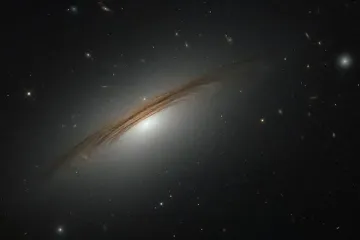
The final form a galaxy takes after a merger depends heavily on the initial participants. [2] When two galaxies of roughly equal mass collide, the process is often violent and leads to the creation of a large elliptical galaxy. [2] The merging process typically disrupts the delicate, spinning disk structures characteristic of spiral galaxies like our own. [2] The organized rotation is destroyed as the stars settle into more random, randomized orbits around the new, combined center of gravity. [2]
Conversely, if a large galaxy swallows a much smaller one—a process often termed a minor merger—the larger galaxy retains its general shape, perhaps with some added material and minor structural disturbances. [2] Our Milky Way itself has likely grown through many minor mergers over its lifetime, absorbing smaller satellite galaxies. [9] The Andromeda merger, however, is expected to be a major merger because the two involved galaxies are relatively similar in size. [9] The resulting galaxy, sometimes nicknamed "Milkomeda," is predicted to be a giant elliptical galaxy, quite different from the stately spiral we see today. [9]
# Surviving the Event
For any hypothetical life existing on a planet orbiting a star within one of the participating galaxies, the immediate threat is negligible, but the long-term fate of the solar system is uncertain. [6] In the Milky Way-Andromeda scenario, the primary danger comes not from star-on-star contact, but from the gravitational rearrangement. [9] Stars, like our Sun, might be flung outward into the vast halo surrounding the new galaxy, or they might migrate inward toward the denser, merged core. [6]
If the Sun were to end up near the core of the new elliptical galaxy, the environment would be far denser, increasing the chances of close encounters with other stars down the line. [6] However, even in this more centralized location, the process is slow, taking billions of years for the stellar orbits to fully settle into their final, randomized configuration. [6] Life, if it were to exist, would have an incredibly long window to adapt or, more likely, would have evolved countless times before the final structure stabilized. [1] The important takeaway for any hypothetical observer is that the collision itself does not involve a sudden wave of destructive energy or radiation that wipes out planets; the changes are gravitational and occur over timescales too vast for direct observation of the entire process. [3]
# Observing Interactions
Astronomers study these colossal events using powerful tools like the Hubble Space Telescope and newer instruments such as the James Webb Space Telescope. [4][8] These observatories capture images of galaxies in various stages of interaction, providing a "snapshot" gallery of the merger process across different time points. [4] By observing systems in different evolutionary stages, scientists can piece together the entire timeline, from the first tentative gravitational locking to the final, settled elliptical form. [2] The data gathered allow experts to model the distribution of mass, including the invisible dark matter, which dictates the gravitational dance. [2] The images often reveal complex streams of material, stellar nurseries blazing in new light, and the gradual blurring of distinct galactic shapes into a single, larger entity. [4][8] These observations confirm that galaxy mergers are fundamental to galaxy growth and evolution throughout the universe's history. [2]
#Videos
What Happens When Galaxies Collide? - YouTube
Related Questions
#Citations
ELI5: What happens when two galaxies collide? What ... - Reddit
Galaxy merger - Wikipedia
Does everything get smashed to bits when two galaxies collide?
What Happens When Galaxies Collide? Hubble Space Telescope ...
What Happens When Galaxies Collide? - YouTube
What kills us in the event of two galaxies combining?
If the two biggest galaxies we know of collide, what would happen?
what happens when two galaxies collide? - Facebook
The Andromeda and Milky Way collision, explained
What Happens When Two Galaxies Collide? - NPR