What would happen to Earth if two galaxies collide?
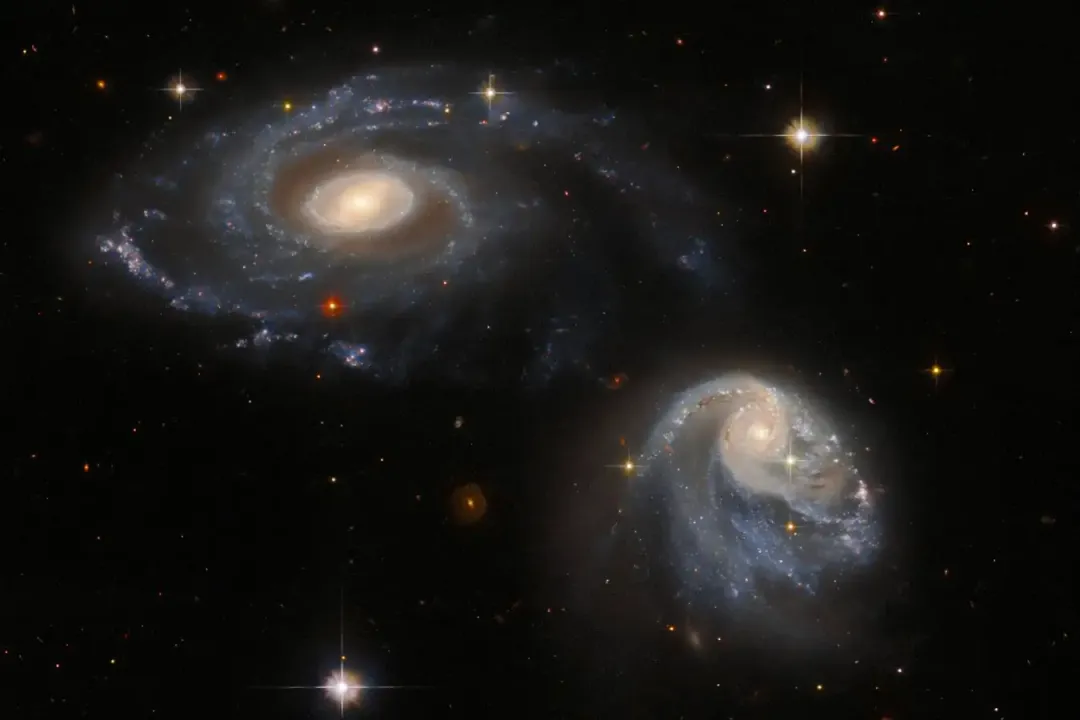
The cosmic ballet of galaxies is rarely a gentle dance; it is often a slow, inevitable merger dictated by gravity over timescales that dwarf human history. When two massive island universes, like our own Milky Way and our larger neighbor, the Andromeda galaxy (M31), begin their mutual passage, the resulting event is often sensationalized as a catastrophic, universe-ending smash-up. The reality, however, is far more nuanced, posing little direct threat to any individual star or planet, yet profoundly reshaping the stellar geography of our local group. [2][9]
The idea that a galactic collision means every star slams into another star is a common misconception, perhaps fueled by the dramatic visuals often associated with such events. [2] If you imagine a galaxy as a spinning pinwheel made of stars, gas, and dark matter, the spaces between those stars are immense. Stars are separated by light-years of near-perfect vacuum. Even when two galaxies collide, the gravitational forces are strong enough to distort the overall structure—pulling out long tidal tails of stars and gas—but the stars themselves are so sparse that direct hits are extraordinarily rare. [2] In the specific case of the Milky Way and Andromeda, which are about $2.5$ million light-years apart, the process will take billions of years before the first close passes occur. [5]
# Galactic Approach

The initial stage of a galactic merger involves the two primary components slowly closing the distance between them, driven by their mutual gravitational attraction. [1] For the Milky Way and Andromeda, the approaching speed is approximately $110$ kilometers per second ($68$ miles per second). [5] This speed might sound fast in human terms, but across the vast gulf of intergalactic space, it translates to an encounter still billions of years away, likely beginning around $4.5$ billion years from now. [5]
The first major observable event won't be a direct impact but a gravitational dance. As the galaxies draw nearer, their tidal forces—the differential pull of gravity across their respective diameters—will begin to distort their delicate spiral structures. [1] Imagine stretching a piece of taffy; the outer arms of both galaxies will start to be pulled out into long, spectacular streams of stars and gas that arc away from the main bodies. [2] Hubble Space Telescope observations of other colliding galaxies show these structures forming long "tidal tails," a hallmark of the initial interaction. [4] It is during this phase that the overall appearance of both galaxies changes dramatically, even if the individual stars within remain untouched. [1]
# Stellar Spacing
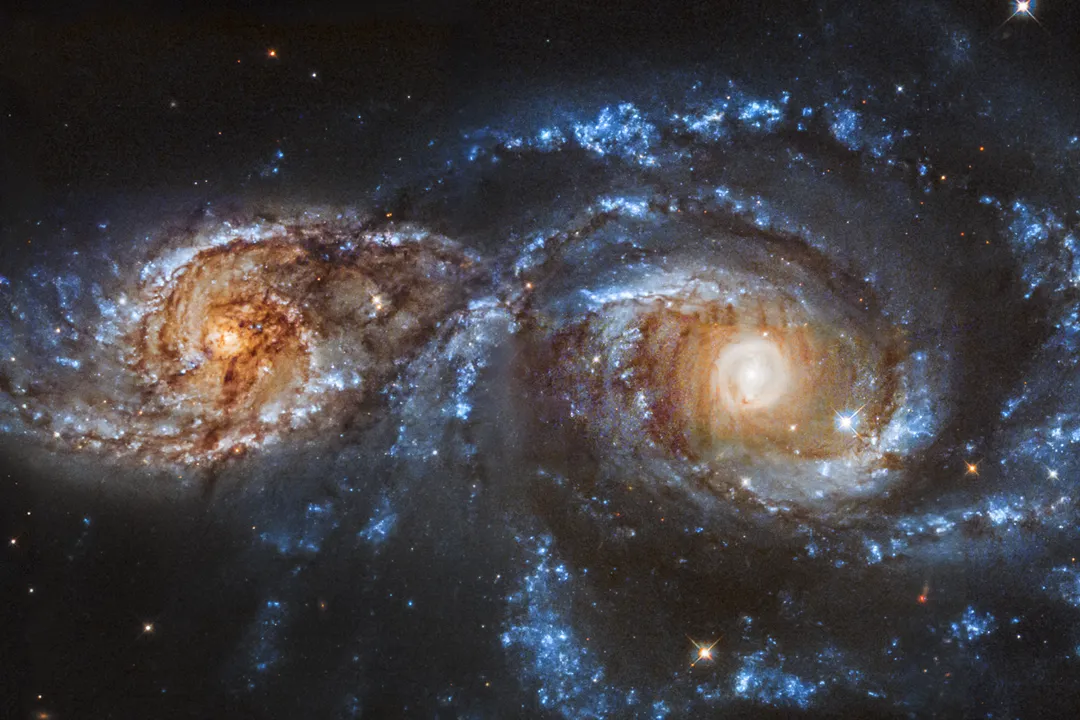
To truly appreciate the drama unfolding on a grand scale, one must grasp the scale of emptiness between stellar neighbors. The average distance between stars in our solar neighborhood is incredibly large compared to their physical size. [1] A typical star is less than a million miles across, yet it is separated from its nearest neighbor by trillions of miles of empty space. [1]
When two galaxies collide, the stars are not destroyed by physical impact because the space between them is so vast. [2] Think of it this way: if the Sun were the size of a grain of sand, the nearest grain of sand (another star) would be several miles away. [1] When the Milky Way and Andromeda merge, the effect is similar to two massive clouds of smoke passing through each other; the structure of the cloud changes, but the individual smoke particles rarely bump into each other. [2] Therefore, the overwhelming probability is that our Sun, Earth, and every planet in our solar system will emerge from the merger completely unscathed by a direct stellar collision. [3][9] Life, if it still exists on Earth, would not be immediately extinguished by a stellar impact. [8]
However, the gravitational influence cannot be ignored entirely. While direct physical collisions are highly improbable, the gravitational field of the incoming galaxy will certainly perturb the orbits of stars and gas clouds within the Milky Way. [3]
# Orbital Perturbations
While a star-on-star collision is unlikely, the orbital paths of stars are definitely subject to change during a galaxy merger. [3] If we consider the scale of the Milky Way (about $100,000$ light-years across) and Andromeda, the gravitational interactions between the stars of the two galaxies will definitely alter their long-term trajectories within the new combined system. [1]
For our solar system, this means that while we won't be hit by a rogue star, our position relative to the center of the new galaxy could be significantly altered. [5][8] Our current orbit around the Milky Way's supermassive black hole, Sagittarius A*, might be completely redefined. We could be flung much farther out toward the edges of the resulting structure, or perhaps sent spiraling much closer to the core of the newly formed galaxy. [5] An interesting comparison point is to consider the speed required for an escape: being ejected from the combined galaxy entirely would require a very specific, highly energetic interaction, which remains a low-probability event for a system located in the outer spiral arms of the Milky Way. [3]
The interstellar gas and dust, unlike the stars, interact much more frequently. These clouds of gas can collide and compress, which often triggers massive bursts of new star formation in what is sometimes called a "starburst" phase. [4] This rapid birth of new stars could temporarily increase the overall brightness of the resulting galaxy. [4] If our Sun were to survive the gravitational shift, it would find itself in a vastly different stellar neighborhood in a few billion years.
To better frame the orbital dynamics, we can look at the relative size difference. The Milky Way has about $200$ billion stars, while Andromeda is estimated to have about $1$ trillion stars. [6] This means the resulting galaxy, sometimes nicknamed "Milkomeda," will be dominated by the gravitational influence of the larger Andromeda component, effectively dictating the new orbital mechanics for all stars, including our Sun. [6]
# Visual Spectacle
For any observer on Earth, provided the Sun still exists in its habitable zone, the view of the collision would be unlike anything ever witnessed. Since the encounter unfolds over hundreds of millions of years, the change in the night sky would be gradual, not instantaneous. [8]
Initially, Andromeda, which is currently visible as a faint smudge in the Northern Hemisphere sky, would grow dramatically larger and brighter. [8] As the two galaxies begin their deep interpenetration, we would see streamers of stars from both systems weaving together. [4] The smooth, familiar spiral arms of the Milky Way would become distorted by the gravitational tides of Andromeda, and vice versa. [1] The result is often predicted to be an elliptical galaxy, as the highly ordered spiral structures are gravitationally scrambled during the chaotic merger process. [2][4]
If we imagine an observer on Earth, say $3$ billion years from now, the night sky would be dominated by this massive, disorganized celestial structure. [8] Instead of two distinct objects, the sky would be filled with a composite structure of light and dark clouds of dust, punctuated by intense regions of newborn, hot, blue stars lit up by the compressed gas clouds. [4] This spectacular visual change, however, is distinct from the physical danger: The light and heat from the stars in the merging galaxy would not pose a significant threat to Earth because the vast majority of the light-emitting stars would still be millions of light-years away from our solar system, even at the closest point of passage. [9] The change would be purely aesthetic and gravitational, not thermal or destructive to the planet itself.
# New Structure
Galactic collisions are less about destruction and more about rearrangement and eventual stabilization into a new configuration. [2] The final product of the Milky Way and Andromeda collision is expected to be a single, larger, and more massive elliptical galaxy. [5]
The process involves several close passes. The first sweep of Andromeda through the Milky Way will be followed by a receding phase, only for the two structures to be pulled back together for subsequent, closer passes. [5] It is during these later passages that the most significant gravitational mixing and disruption occur, thoroughly blending the stars of both original systems. [5] Gas clouds collide and collapse, leading to a major, but temporary, episode of star formation, after which the fuel for star birth is largely exhausted, and the new elliptical galaxy settles into a more quiescent state. [4]
This transition from two spirals to one giant ellipse is a common evolutionary path for large galaxies. Astronomers use observations from telescopes like Hubble to study this phenomenon in other galaxy pairs, confirming that gravitational chaos eventually yields a more compact, spheroidal system. [4] In this final, merged state, the location of our Sun—if it still exists—will be fixed within the gravitational well of the new Milkomeda, a giant resident of the Local Group. [5]
# Fate of Life
Considering the immense timescale—billions of years—the primary threats to life on Earth are far more immediate than a galactic merger. The Sun itself will evolve significantly over this period. [8] In about $1$ billion years, the Sun will become hot enough to cause a runaway greenhouse effect on Earth, boiling off the oceans and making the surface uninhabitable long before Andromeda arrives. [8]
Therefore, any discussion of survival during the galactic collision must operate under the assumption that humanity, or our descendants, have either become extinct or have developed the technology for interstellar or intergalactic travel to relocate the planet or its inhabitants. [8] If an advanced civilization were still present on Earth, or on a transplanted Earth, the galactic merger itself presents minimal direct hazard. [9] The key takeaways for survival relate to gravitational stability and solar evolution, not stellar impacts.
A helpful way to contextualize the timeline versus solar evolution is to compare the two events:
| Event | Approximate Time From Now | Primary Effect on Earth |
|---|---|---|
| Runaway Greenhouse Effect (Sun) | $1$ Billion Years | Surface uninhabitable due to heat [8] |
| First Galactic Pass (Milky Way/Andromeda) | $4.5$ Billion Years | Initial large-scale structural distortion [5] |
| Final Merger/Elliptical Formation | Billion Years | New, stable gravitational environment [5] |
This comparison reveals that the internal aging of our own star is the most certain, near-term existential threat, rendering the galactic collision a distant, academic concern for the biology of the planet in its current location. [8] Should an advanced species survive the Sun's evolution, the merger is simply a change in the surrounding cosmic scenery, not an immediate physical threat to the planet itself. [3][9] The gravitational perturbations, though real, are slow enough that complex orbital adjustments could theoretically be managed by a sufficiently advanced civilization, especially if they have mastered planetary or stellar system relocation over the eons.
#Videos
How Would We Survive If the Milky Way Collided with Andromeda?
Related Questions
#Citations
What would our experience be like on earth if the milky way ... - Reddit
Does everything get smashed to bits when two galaxies collide?
What kills us in the event of two galaxies combining?
What Happens When Galaxies Collide? Hubble Space Telescope ...
What will happen to the solar system when the Milky Way and ...
If the two biggest galaxies we know of collide, what would happen?
How Would We Survive If the Milky Way Collided with Andromeda?
What would happen to Earth if the Milky Way hit another galaxy?