What galaxy arm is Earth in?
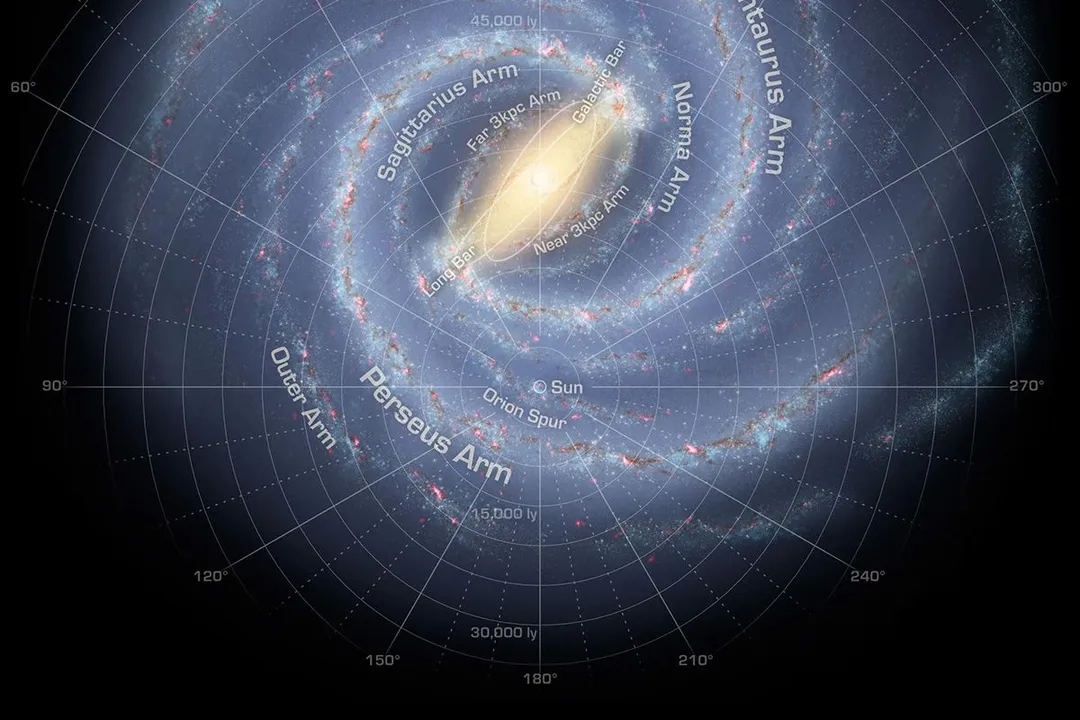
Our cosmic address places the Sun, and by extension, Earth, within a specific, smaller feature of our massive home galaxy, the Milky Way. [4][7] The Milky Way itself is classified as a barred spiral galaxy, a grand structure containing hundreds of billions of stars, gas, and dust, all orbiting a central black hole. [2] For decades, the simplest answer placed our solar system squarely within the Orion Arm, or sometimes called the Orion Spur. [1][7] However, as our understanding of the galaxy's architecture has improved, this location has become both more precise and slightly more nuanced, recognizing that we reside on the inner edge of this particular segment of stellar material. [4]
# Galactic Structure
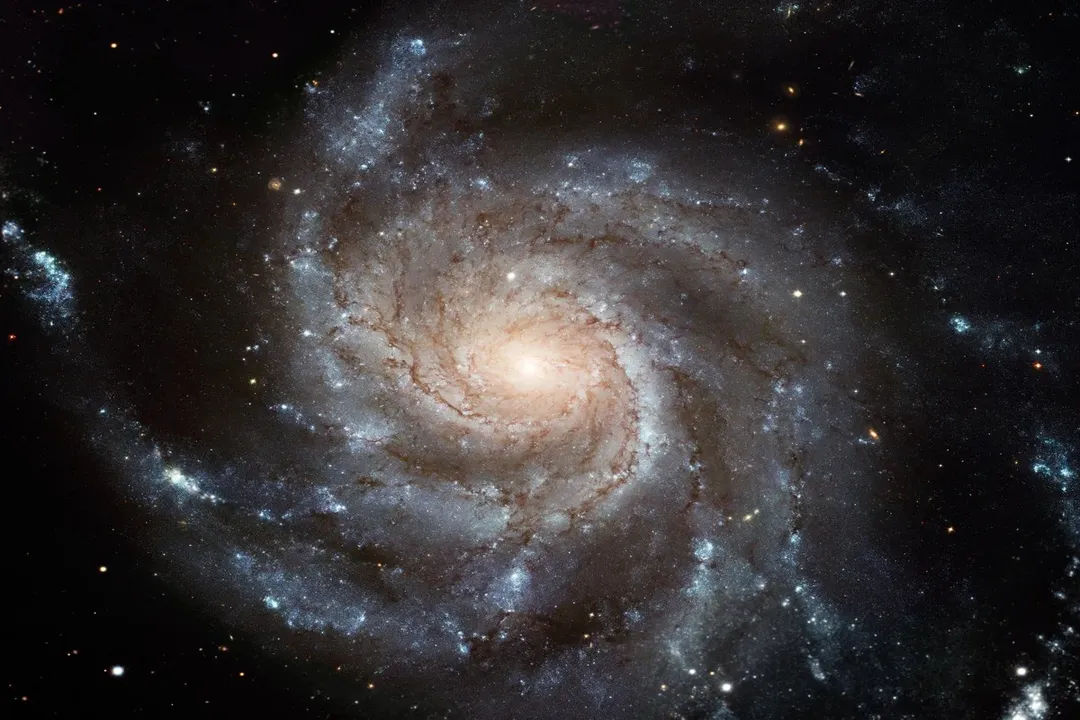
The Milky Way is immense, estimated to contain between 100 and 400 billion stars, and it spans roughly 100,000 light-years across. [2] From our vantage point, we cannot step outside to take a clear photograph of the entire disk, which makes mapping its spiral structure an ongoing challenge for astronomers. [4] The main structural components are the central bar, a dense bulge of older stars, and the vast, flattening disk where the spiral arms reside. [7] These arms are not solid structures like the spokes of a wheel; rather, they are transient, density-wave regions where star formation is triggered, meaning stars move in and out of them over galactic timescales. [4]
The major spiral arms are colossal features. Astronomers have generally identified four major arms: Scutum-Centaurus, Perseus, Norma, and Sagittarius. [1][4] These arms are significant, sweeping structures, each containing billions of stars and spanning tens of thousands of light-years. [1]
# Our Local Arm
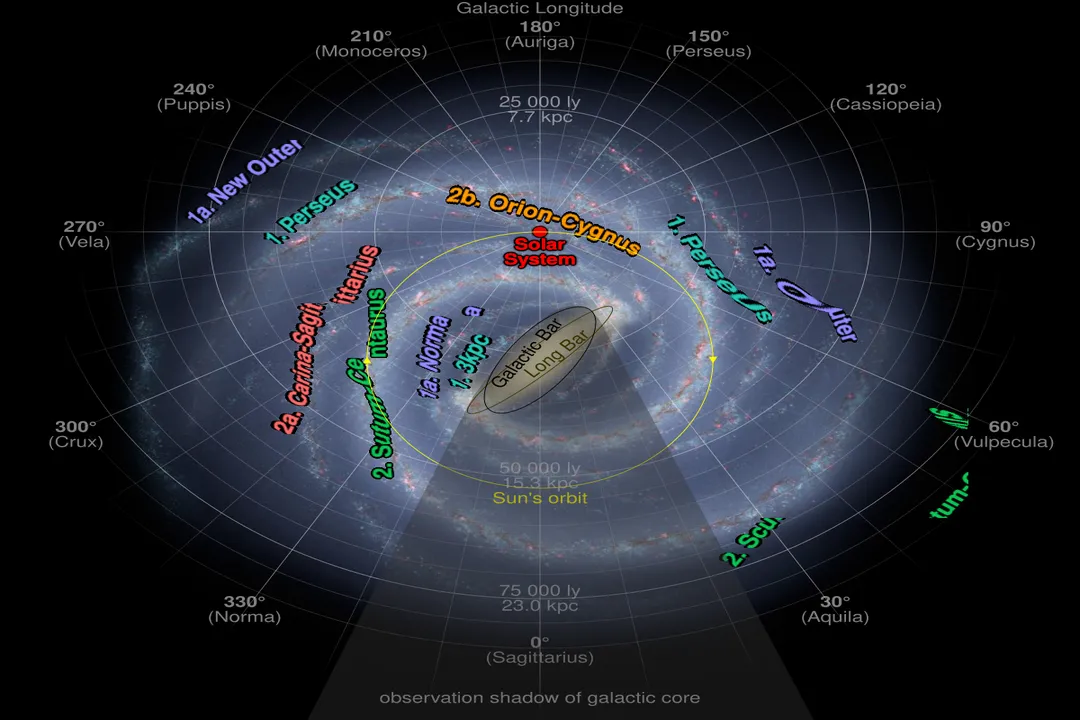
The designation of the Orion Arm is critical because it describes where our Sun, which is about 25,000 to 27,000 light-years from the galactic center, is situated relative to these behemoths. [1][7][4] The Orion Arm is considered a relatively minor feature, or perhaps a spur, nestled between two of the major arms: the Sagittarius Arm closer to the galactic core, and the Perseus Arm farther out. [1][4]
Specifically, our solar system is located about halfway between the Sagittarius Arm and the Perseus Arm. [7] Think of the major arms as interstate highways; the Orion Arm is more like a smaller, local road system branching off, connecting smaller towns (star clusters and nebulae) to the main thoroughfare. [4] The physical path we trace through the galaxy means we aren't deeply embedded in the dense star-forming regions of a main arm, which may explain why our immediate stellar neighborhood seems less crowded than other parts of the disk. [1] This positioning gives us a relatively clearer view outward into space compared to what we might see if we were deep within the Sagittarius Arm, for instance. [4]
The PNAS study analyzing the structure of the local interstellar medium provided further clarification, suggesting that the local structures that host our Sun might be better described as the Local Arm or the Local Spur. [9] This area is characterized by a distinct, albeit less defined, concentration of matter stretching across about 1,600 light-years, where our Sun resides about 100 light-years "above" the main galactic plane. [9] This emphasizes that while "Orion Arm" is a common and useful term for general reference, the precise local grouping of stars we are part of might be better termed the Local Arm, emphasizing its smaller scale relative to the Perseus and Sagittarius structures. [1][9]
If we try to map our place using a comparison, imagine a massive spiral hurricane seen from above. The major arms are the main, thick bands of wind and rain. Our location is akin to a smaller, secondary eddy or vortex spinning off the main circulation, still moving in the general pattern but distinct from the primary flow. [1]
| Feature | Approximate Distance from Galactic Center (Light-Years) | Relative Location to Sun |
|---|---|---|
| Galactic Center | 0 | Central core |
| Sagittarius Arm | ~26,000 | Interior/Closer to Center |
| Sun/Earth | ~27,000 | In the Local Spur/Orion Arm |
| Perseus Arm | ~52,000 | Exterior/Farther from Center |
| Milky Way Diameter | ~100,000 | Total Extent |
| [1][7] |
# Clarity and Cosmic Perspective

The relative sparseness of the Orion Arm, or our position within that spur, provides an interesting, though perhaps non-standard, perspective on our stellar environment. Some discussions online have pointed to the idea that our location is between major arms, suggesting a cleaner path for observation. [3] While the idea that we are strictly between the Sagittarius and Perseus arms is fundamentally correct, the term Orion Arm/Spur is the accepted identifier for the specific region within that gap that contains the Sun. [1][4] The distinction between a "spur" and a "minor arm" reflects ongoing scientific refinement rather than a complete contradiction of location. The key takeaway for any general enthusiast remains that we are not in a primary, massive spiral arm. [4]
This positioning has an observable effect. When looking towards the central bulge, through the Sagittarius Arm, the night sky is often more obscured by dust and gas clouds, leading to fewer visible stars and less distant visibility across the plane of the galaxy. [4] Conversely, looking outward, toward the Perseus Arm, we are looking through less dense stellar regions, which sometimes gives the illusion of a clearer, albeit darker, view in that direction, though the density of objects does eventually pick up again further out. [4]
It is also worth noting that terminology and classification can shift as new data is incorporated. For example, some older models may have placed the Sun closer to the Sagittarius Arm than newer models based on improved distance measurements suggest. [4] The PNAS research, utilizing detailed modeling, highlights the complex, three-dimensional nature of these structures, suggesting that a simple 2D label might always be an approximation. [9] The label "Orion Arm" likely persists due to historical precedent and its utility in describing this specific local neighborhood, even if "Local Spur" or "Local Arm" is technically more precise for the immediate vicinity. [1][9]
# Viewing the Galaxy
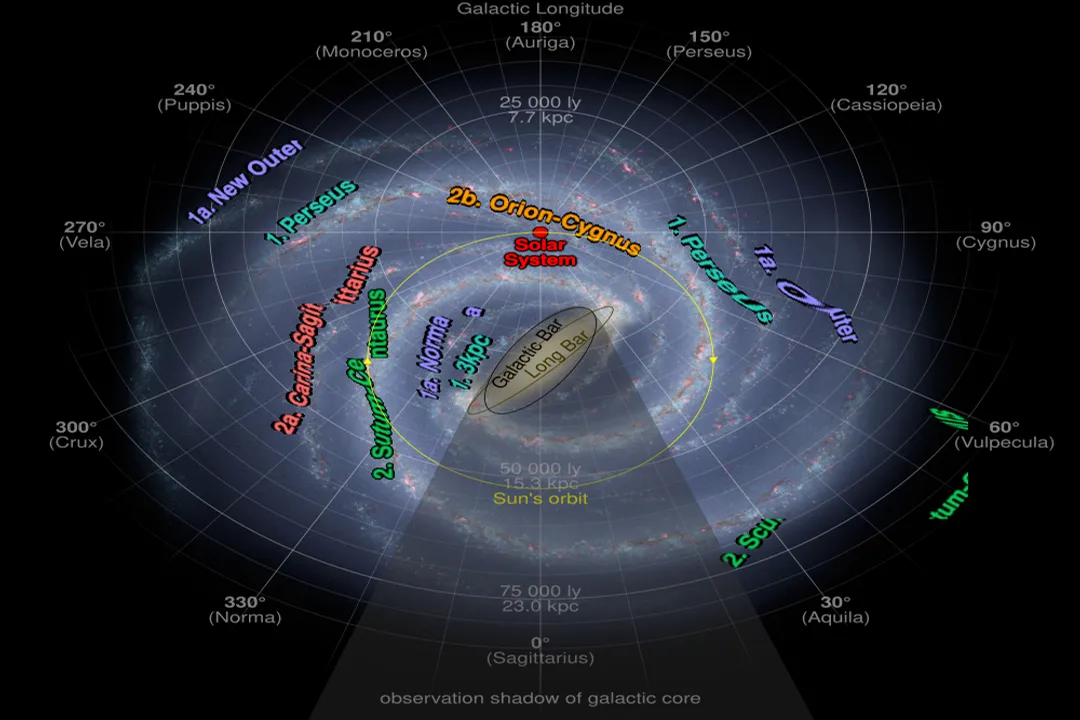
Our location dictates how we perceive our own galaxy. Since we are embedded within the disk, all the stars we see—the Milky Way band stretching across the night sky—are our neighbors within that disk. [7] We are looking sideways through the structure. [4] If Earth were located far above or below the disk, the Milky Way would appear as a thin, complete circle encircling the sky, much like how astronomers view the Andromeda Galaxy from our perspective. [2]
Because we are relatively close to the edge of the main star-forming zone, we have access to regions that are relatively quiet in terms of intense, destructive star formation events. This might be an evolutionary advantage, allowing stable planetary systems like our own to persist over billions of years without being frequently sterilized by nearby supernovae characteristic of the dense regions within major arms. [1][5] While the Orion Arm itself is still a region of active star formation, it is less intense than the core arms. [9] This relative tranquility is a tangible consequence of our mid-range position within the galactic structure.
One useful way to contextualize this location is to consider the time it takes for the Sun to complete an orbit around the galactic center, a period known as a cosmic year. Our Sun takes approximately 220 to 240 million years to complete one lap. [7] Given that the Sun is about 4.6 billion years old, it has completed perhaps twenty orbits of the galaxy. [7] This slow, massive revolution means that our solar system’s position relative to the overall structure of the galaxy is constantly changing over vast timescales, even if our position within the Orion Spur seems fixed across human history. [1] The "neighborhood" we inhabit today will be significantly different in terms of stellar neighbors a hundred million years from now, having drifted through different densities of matter. [4]
# Final Placement
To summarize the established view: Earth orbits the Sun, the Sun orbits the center of the Milky Way galaxy, and that orbit takes place within the Orion Arm (or Spur), a minor feature situated between the larger Sagittarius and Perseus spiral arms. [1][7] While research continues to refine the precise boundaries and naming conventions of these structures, especially concerning the immediate local environment, [9] the Orion Arm serves as the common, authoritative designation for our stellar address in the grand cosmic map. [4] This location ensures our solar system enjoys a view that is both expansive and relatively stable within the context of galactic dynamics. [4]
#Videos
Which Spiral Arm Of The Galaxy Is Ours? - YouTube
Related Questions
#Citations
Orion Arm - Wikipedia
Galaxy Basics - NASA Science
Earth is no longer between the Orion and Sagittarius arms ... - Reddit
Where are Earth and the Sun located in the Milky Way?
Which Spiral Arm Of The Galaxy Is Ours? - YouTube
Earth located in the Orion arm of the Milky Way - Facebook
Flexi answers - Where is the Earth in the Milky Way galaxy? - CK-12
Astronomers are redrawing our corner of the Milky Way - PNAS