What is the apparent path of the Sun along the celestial sphere or equivalently the plane determined by the Earth's orbit called?
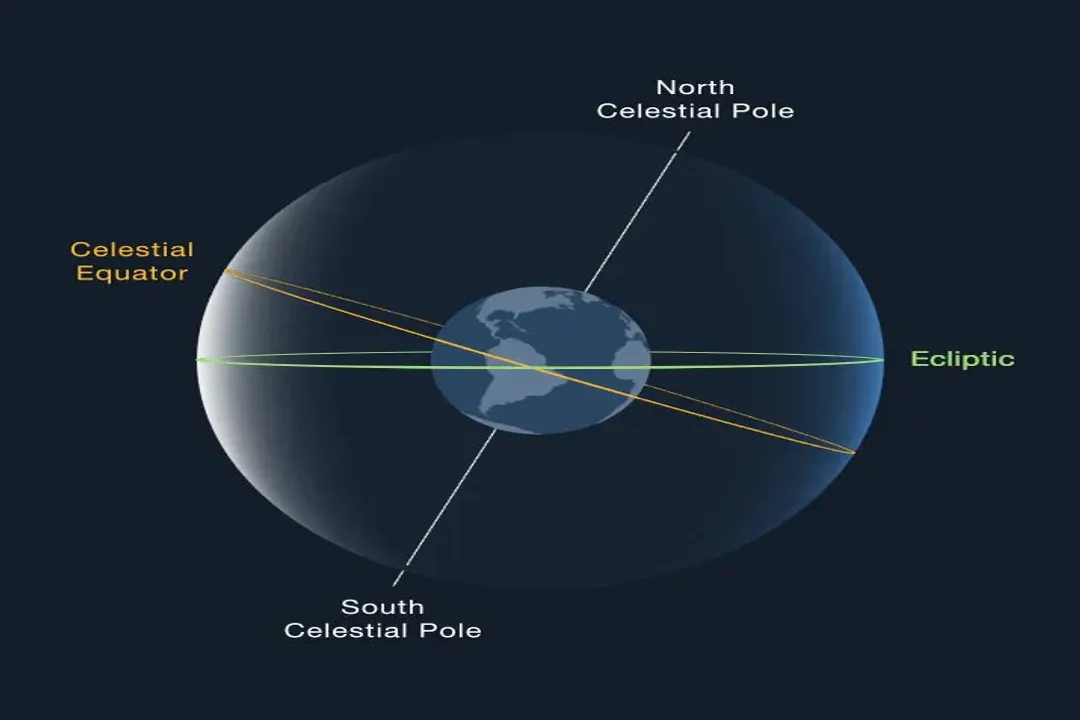
The apparent path traced by the Sun across the background stars over the course of a year, which also corresponds to the plane established by our planet's orbit around our star, is known by a specific astronomical term: the ecliptic. [4][6][7] This seemingly simple concept is fundamental to celestial navigation, timekeeping, and understanding why we experience seasons on Earth. It is not a physical line in space but rather a great circle drawn on the imaginary celestial sphere, a projection that helps us organize our view of the cosmos.
# Apparent Solar Track
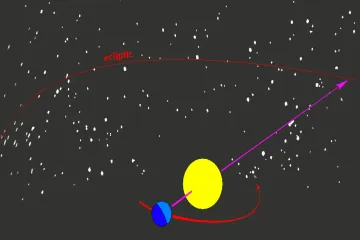
When we look up at the sky day after day, we notice the Sun rises, crosses the sky, and sets. While its daily path seems consistent in its east-to-west motion, its position relative to the fixed stars changes slowly over the months. [4] If you could perfectly blot out the Sun’s glare and track its position against the distant stellar backdrop, you would map out this circle known as the ecliptic. [6] As the Earth makes its journey around the Sun, the Sun appears to move eastward along this path at a rate of roughly per day, completing a full circuit in about $365.25$ days. [4]
This path is also the plane of our solar system, or more precisely, the plane defined by the Earth’s orbit around the Sun, projected outward onto the celestial sphere. [6][7] Because the other major planets in our solar system orbit the Sun in roughly the same planar region, they too are typically found near the ecliptic when viewed from our perspective. [6][7] The Moon, too, follows this general track, though its orbit is inclined slightly relative to the Earth’s orbital plane. [6]
# Orbital Projection
To grasp the true nature of the ecliptic, we must understand its geometric definition. It is the ecliptic plane that is the key—this plane is the mathematical plane in which the Earth revolves around the Sun. [7] When this plane intersects the celestial sphere, the resulting great circle is the ecliptic. This connection between an off-Earth event (Earth orbiting the Sun) and an apparent celestial event (the Sun’s path) is vital for positional astronomy. [4][7]
This plane is distinct from another crucial reference plane: the celestial equator. [5] The celestial equator is simply the projection of Earth’s own equator onto the sky, fixed relative to the Earth’s rotational axis. [5] Since the Earth’s spin axis is not perfectly perpendicular to its orbital plane, the ecliptic and the celestial equator are not the same line; they cross each other at two specific points. [4][7]
# Two Great Circles
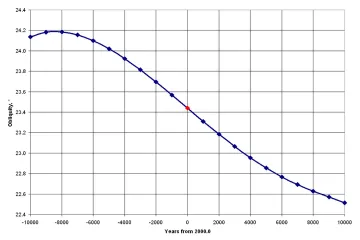
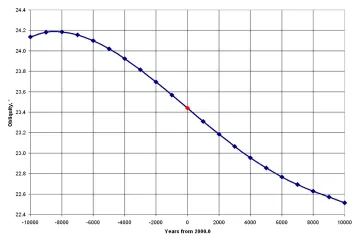
The difference in angle between these two great circles—the ecliptic and the celestial equator—is a direct result of how Earth is tilted on its axis. This tilt, the obliquity of the ecliptic, is currently about . [4][5] The two planes intersect where the Sun crosses the celestial equator, marking the equinoxes. [7]
When the Sun is on the celestial equator (at the equinoxes), any location on Earth experiences approximately $12$ hours of daylight and $12$ hours of night—the Sun rises due east and sets due west. [4] The Sun spends six months north of the celestial equator (gaining declination) and six months south of it (losing declination). [4][5]
The constellations that happen to lie along the ecliptic are collectively known as the Zodiac. [4][6] While the path of the Sun traces the ecliptic, the actual boundaries of the constellations that fall upon it can vary slightly over millennia due to a slow wobble in Earth’s axis called precession. [4] Historically, the vernal equinox—the point where the Sun crosses into the Northern Celestial Hemisphere—was located in the constellation Aries, leading to the naming convention "the first point of Aries," though today that point resides in Pisces. [7]
# Seasonal Markers
The tilt between the ecliptic and the celestial equator is the direct physical cause of the changing seasons as perceived by observers in the Northern and Southern Hemispheres. [4] As the Sun follows the ecliptic, its maximum distance (declination) north or south of the celestial equator dictates the severity of the seasons.
When the Sun reaches its maximum northward extent along the ecliptic (about north), it marks the summer solstice for the Northern Hemisphere. At this point, the Sun is highest in the sky at noon, and the day is at its longest duration. [4] Conversely, its lowest point to the south marks the winter solstice, resulting in the shortest day and the lowest noon altitude. [4] The fact that the planets and the Moon also appear near the ecliptic is why, if you track them over time, you can often see them moving through these same familiar Zodiac constellations. [6][7]
# Local Observation
The concept of the ecliptic is not just for theoretical charts; it directly dictates our everyday experience of daylight hours and temperature swings. Consider standing outside at noon on the day of the summer solstice compared to the day of the winter solstice, assuming you are not near the equator. The difference in the Sun's altitude above the horizon at noon is precisely twice the axial tilt, or roughly . [4] This significant shift—the difference between the Sun peaking high overhead in summer and skimming low across the southern sky in winter (for Northern Hemisphere observers)—is mapped out entirely by the Sun traversing the ecliptic plane relative to the fixed celestial equator. [4] If Earth’s orbit were perfectly aligned with its equator, the Sun would always trace the celestial equator, meaning noon solar elevation would remain constant year-round, and we would have no pronounced seasons based on solar angle.
# Annual Cycle
The precise tracking of the Sun along the ecliptic is crucial for defining the calendar year. There are two ways to measure the length of this solar "year." The sidereal year measures the time it takes for the Sun to return to the exact same position relative to the background stars (a true orbit). [4] This period is about $365.256$ mean solar days. [4] However, due to the slow axial precession of the Earth, the point where the ecliptic crosses the celestial equator (the vernal equinox) shifts westward slightly each year. [4]
The tropical year, which is the period that truly dictates our seasons, is defined as the time between successive crossings of the vernal equinox. [4] This period is slightly shorter than the sidereal year, lasting approximately $365.242$ mean solar days. [4] It is the tropical year that our Gregorian calendar is designed to approximate. The difference of about $20$ minutes between the two types of years means that without adjustments like the leap day, our calendar would drift relative to the actual astronomical events like the equinoxes and solstices. This constant, slow drift underscores why understanding the intersection points on the ecliptic is essential for maintaining a stable civil calendar aligned with seasonal reality. [4]
# Eclipse Key
The very name ecliptic hints at its most dramatic consequence: eclipses. [6] While the Moon orbits the Earth roughly every $29.5$ days, we do not see a solar or lunar eclipse every month. This is because the plane of the Moon’s orbit is inclined by about relative to the ecliptic plane. [6]
An eclipse requires near-perfect alignment. For a solar eclipse, the Moon must pass directly between the Earth and the Sun, meaning it must be at the new moon phase and crossing the ecliptic plane at that exact moment. [6] For a lunar eclipse, the Moon must pass through Earth’s shadow when it is directly opposite the Sun, meaning it must be at the full moon phase and crossing the ecliptic plane from the opposite side. [6] Because the Moon only crosses the ecliptic twice per orbit, eclipses are relatively rare events, occurring perhaps a couple of times a year at most, dictated by this alignment along the ecliptic line. [6]
#Videos
The Ecliptic: Crash Course Kids #37.2 - YouTube
Related Questions
#Citations
The Ecliptic: the Sun's Annual Path on the Celestial Sphere
The Ecliptic: Crash Course Kids #37.2 - YouTube
Ecliptic vs. Celestial Equator: Understanding Differences
The ecliptic is the path of the sun - EarthSky
Ecliptic – Knowledge and References - Taylor & Francis
Glossary term: Ecliptic - IAU Office of Astronomy for Education
Orbits and the Ecliptic Plane - HyperPhysics Concepts