How many of our Suns can fit in the biggest Sun?
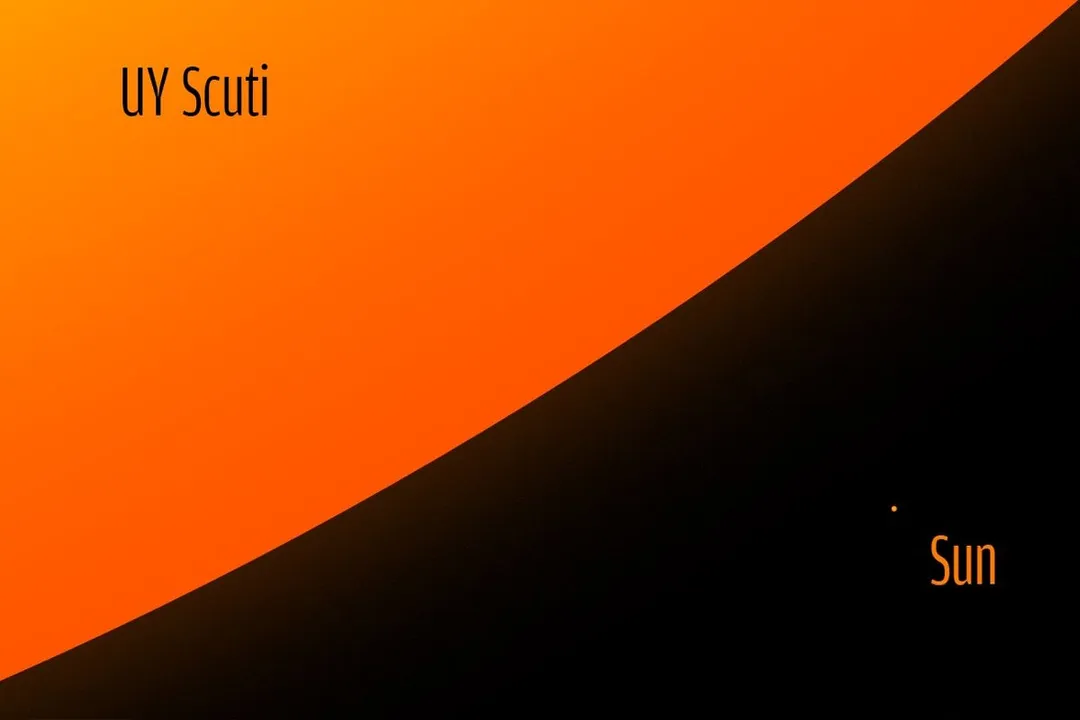
The sheer scale of space often defies simple visualization, and perhaps no comparison highlights this better than measuring our own star against the true behemoths of the cosmos. For us, the Sun is an undeniable giant; it comprises over 99.8% of the entire mass of our solar system. [6] It dictates our climate, our sense of time, and provides the energy for all life on Earth. Yet, compared to the largest stars known to exist, our Sun shrinks to a mere cosmic pebble. [2][9]
# Solar Baseline
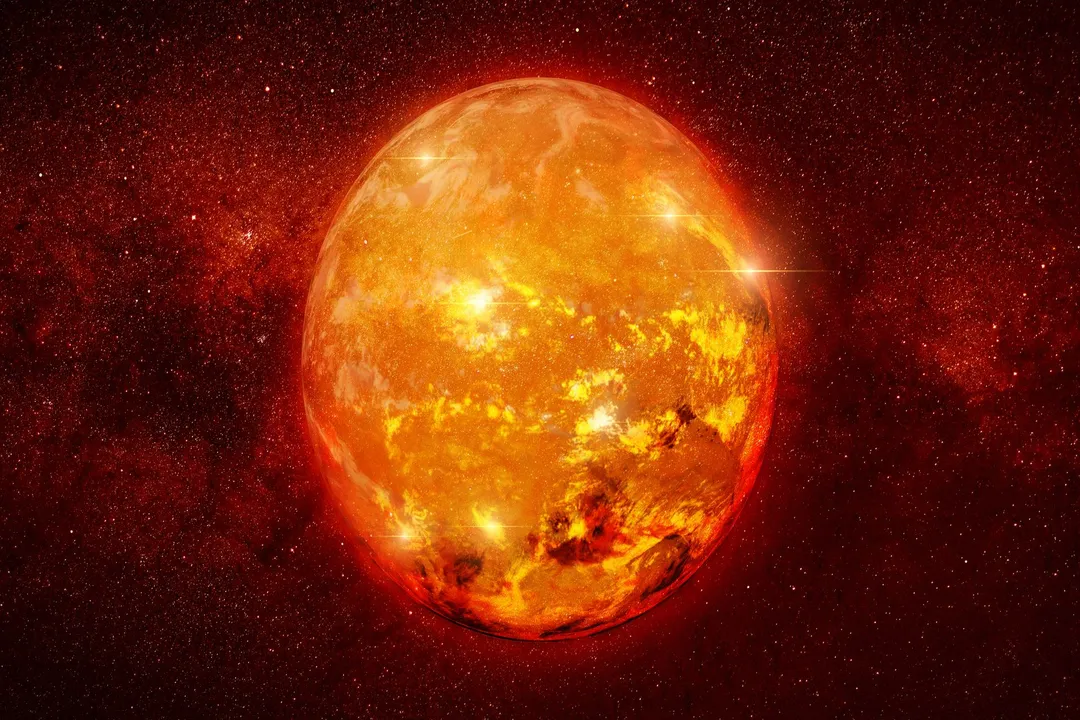
To grasp the true magnitude of a stellar giant, we first need a solid grasp of the scale we currently inhabit. Our Sun, a G-type main-sequence star, has a diameter of approximately 1.39 million kilometers. [6] This measure is the yardstick we use to gauge stellar size across the Milky Way. While this number is vast—it's large enough to fit over a million Earths inside it [6]—it sits squarely in the middle range of stellar classification. [3][9] It is a healthy, middle-aged star, not destined for dramatic, short-lived glory like the hypergiants.
# Stellar Giants
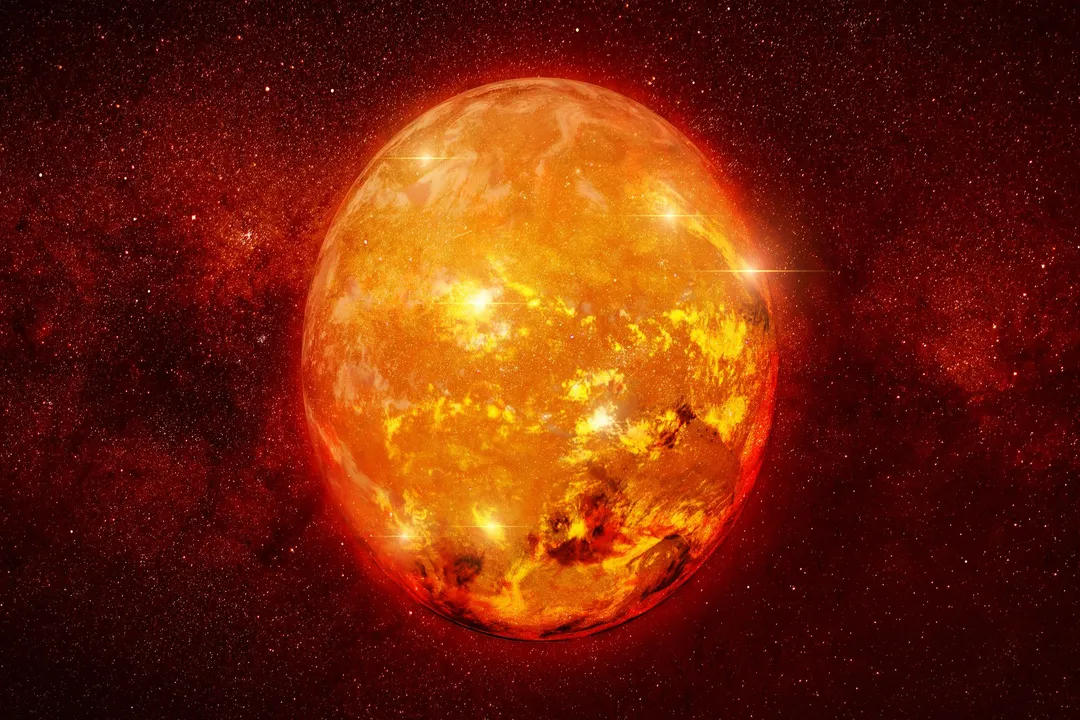
The universe plays host to stars that have exhausted their core hydrogen fuel and inflated into colossal red supergiants or hypergiants. [3] These stars are not necessarily the most massive in terms of sheer atomic content—that title often belongs to hotter, bluer stars—but they are the largest in terms of volume. [8]
One historical benchmark in this category, often cited for its enormous size, is VY Canis Majoris. [3] This star, located about 3,700 light-years away, is classified as a red hypergiant. [3] When astronomers calculate how many of our Suns could be placed side-by-side to span the diameter of VY Canis Majoris, the numbers become astronomical. [2]
More recently, the title of "biggest star" has been subject to change as measurement techniques improve. [8] However, the principle remains: these stars are orders of magnitude larger than the Sun. [8] For instance, if one of these known giants were placed at the center of our Solar System, its outer layers could easily swallow the orbits of Mercury, Venus, Earth, Mars, and even Jupiter. [3]
# Fitting Comparison
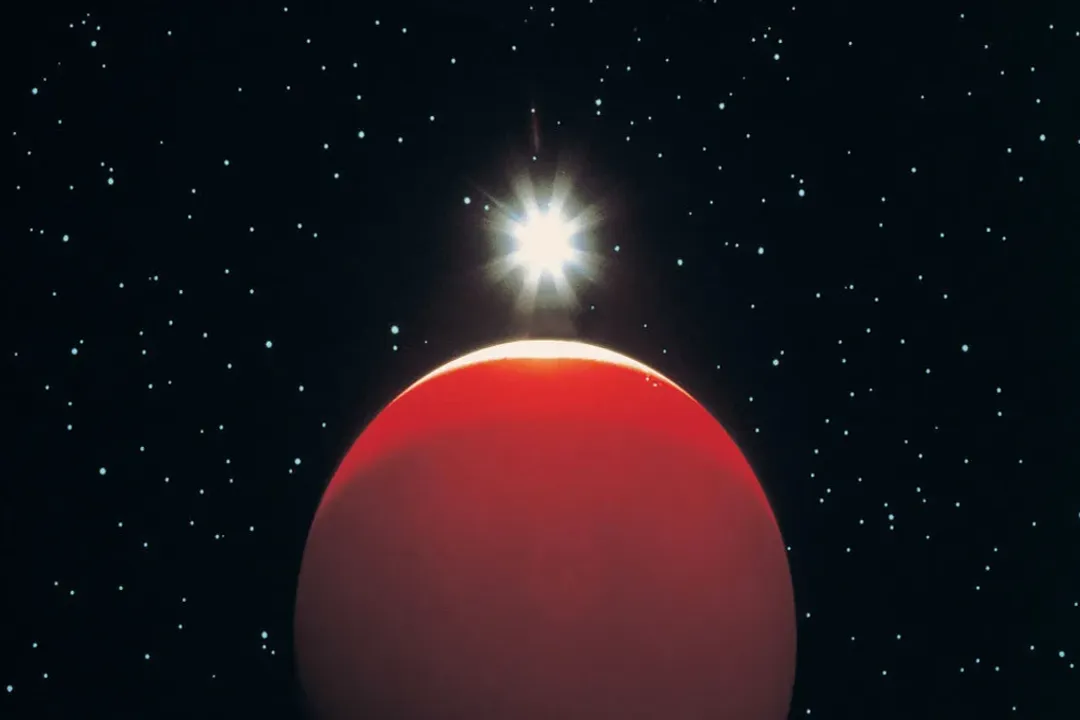
The crucial question of how many Suns fit inside the biggest star isn't a simple count across a diameter; it's a volumetric comparison. [6] Since volume scales with the cube of the radius or diameter, the resulting number is staggering.
If we take the diameter of a star like VY Canis Majoris, it is estimated to be about 1,400 times wider than our Sun. [3] This linear difference—the diameter ratio—is already immense. [2] However, to calculate how many Suns fit inside its volume, we must cube that factor: . This calculation yields a figure in the billions. [3]
While older data pointed to VY Canis Majoris, current surveys often point toward even larger contenders, sometimes citing stars whose measured radii suggest they are over 2,000 times that of the Sun. [8] If a star were indeed 2,000 times the Sun’s diameter, the volume calculation changes dramatically. Cubing the factor of 2,000 yields 8 billion. [2] Therefore, depending on which specific hypergiant holds the current record—which changes as instruments improve—the number of Suns that could be packed inside ranges into the billions. [8] One comparison suggests that stars like UY Scuti could contain the volume equivalent of roughly 5 billion of our Suns. [6] These comparisons often rely on inferred data and estimations, as precisely mapping the fuzzy, diffuse edges of these bloated stars presents significant observational challenges. [3][8]
# Volume Versus Mass
It is important to pause here and note a common point of confusion when discussing stellar size. Being the largest by volume does not automatically mean being the most massive star overall. [8] Mass, the actual amount of material, is what truly determines a star’s life cycle and ultimate fate. [3] Many of the largest, like the hypergiants, are extremely diffuse; their outer layers are so expanded that they are many times the radius of the Sun, but their overall mass might only be 20 to 40 times that of the Sun. [3] By contrast, a much smaller, denser star—perhaps only 50 or 60 times the Sun's diameter—could potentially have 150 or more times the Sun's mass because its material is packed much more tightly. [8] Our own Sun is relatively average in mass for a star, settling around one solar mass. [6]
# Conceptualizing the Void
To put this difference into a perspective that feels slightly more tangible, consider the sheer emptiness inherent in these structures. If our Sun were scaled down to the size of a standard basketball—say, 24 centimeters in diameter—the Earth would be smaller than a grain of sand orbiting it. [6] Now, imagine scaling the largest known star, like UY Scuti, up so that its surface reaches you. If Earth were the size of a pinhead, the Sun-basketball would be a small pebble, and the giant star would be a celestial structure so immense that its surface would be kilometers away from you, spanning entire cities. [6] The difference between the Sun and these giants is not merely additive; it is exponential, demonstrating how outliers in nature can drastically redefine our concepts of "large". [2]
# Stellar Longevity Insight
When observing a star like VY Canis Majoris expanding to such a size, we are witnessing a star near the end of its life. [3] These massive stars burn through their fuel at an incredible rate compared to our steady Sun. [3] Our Sun is expected to happily fuse hydrogen for about 10 billion years, and it is only halfway through that process. [6] A star large enough to contain billions of Suns lives fast and dies young, perhaps lasting only a few million years in its hypergiant phase before collapsing or exploding in a spectacular supernova. [3] This means that while our local star offers billions of years of stable energy, the biggest stars we observe are fundamentally showing us the brief, final moments of stellar giants before they vanish from the night sky forever. [2]
# Measuring the Unseen Boundary
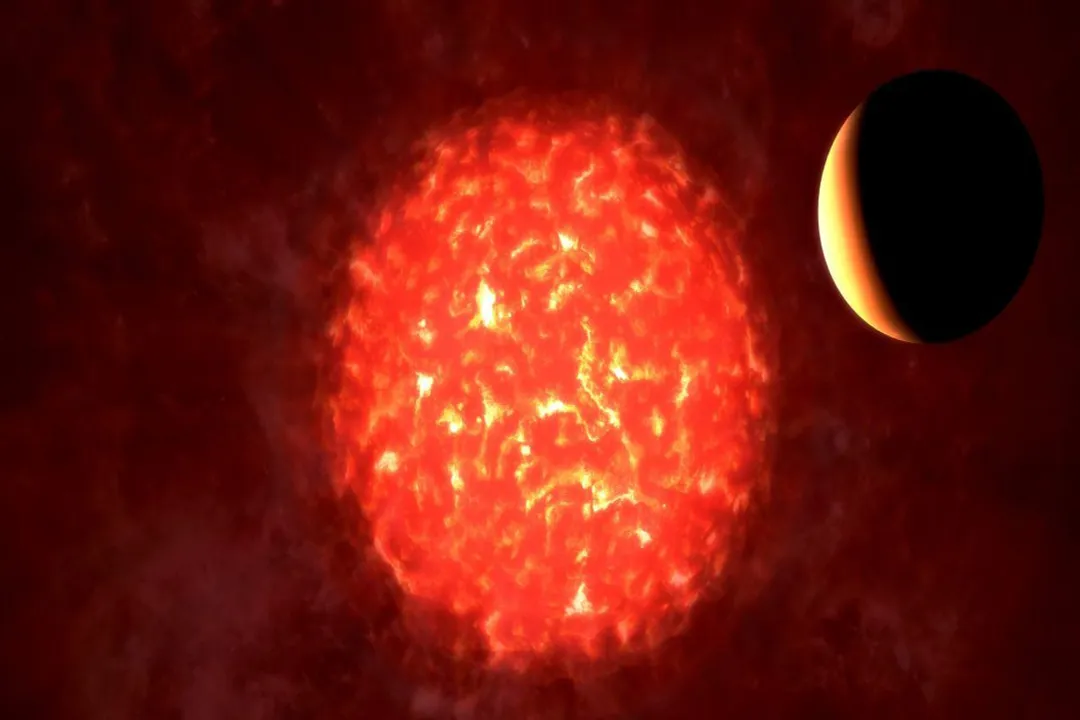
One fascinating aspect of finding the "biggest star" is the difficulty in measurement. [8] Stars are not perfectly defined spheres, especially when they are in their late, swollen phases. [3] Red supergiants are characterized by very low density in their outer layers, making it hard to determine exactly where the star ends and space begins. [3] Astronomers must rely on measuring the star’s total luminosity and assuming a standard surface temperature to work backward to an estimated radius. [8] This uncertainty is why the exact list of the top contenders often shifts—a slight adjustment in the assumed temperature or a more precise measurement of brightness can change a star’s calculated size by hundreds of solar radii. [8]
# Quick Size Check Table
To contrast the local view with the cosmic extreme, here is a simplified look at the scale difference based on common estimates for these stellar classes: [3][6]
| Star | Relative Diameter to Sun | Approximate Volume Capacity (Suns) |
|---|---|---|
| Our Sun | 1 | 1 |
| VY Canis Majoris | ||
| Current Record Holder (e.g., UY Scuti) | to $2,000$ |
This table illustrates that even within the category of "biggest stars," the variation is significant enough to change the number of Suns that would fit by several billion objects. [2][8] The next generation of telescopes, designed to overcome atmospheric distortion, may refine these boundaries further, perhaps revealing an even larger neighbor lurking just beyond our current detection threshold. [8]
Related Questions
#Citations
How Many Suns Can Fit? - YouTube
People don't realize how big stars can get. The sun is above ... - Reddit
VY Canis Majoris, one of the biggest stars in the Universe
Comparing Earth's Suns to the Largest Star: Stephenson 218 | TikTok
Stephenson 2-18 size compared to the sun - Facebook
Q: How many suns can fit into the biggest star?
Can 1 Earth's Suns Fit Inside the Largest Star in the Universe?
What is the biggest star in the universe? - Space
Is the Sun the biggest star? - Quora