What is the apparent great circle annual path of the Sun in the celestial sphere as seen from the Earth?

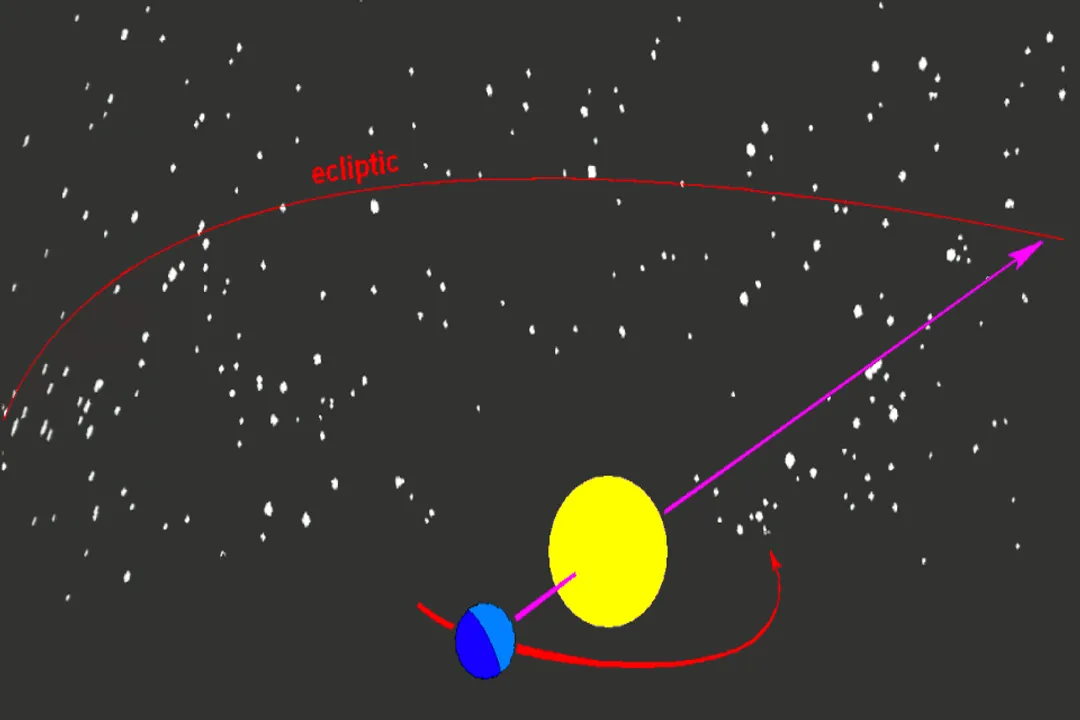
The line traced by the Sun across the backdrop of the distant stars over the span of one year defines a fundamental concept in observational astronomy: the ecliptic. This apparent track is not random; rather, it is a direct consequence of our planet's own movement. It is an imaginary great circle etched onto the celestial sphere, representing the precise geometric plane in which the Earth travels in its orbit around the Sun. [1][2][3]
# Celestial Path
From our perspective on Earth, the Sun seems to wander through the heavens over the course of twelve months. [2] This path is smooth, a continuous loop that the Sun completes once every solar year, taking just over $365$ days. [2] Because the Sun appears to trace this path, the ecliptic also inherently marks the plane of our solar system, as all the major bodies—planets and the Moon—orbit within or very close to this same plane. [1][4] This alignment is crucial; if the Moon’s orbit lay exactly in the plane of Earth’s orbit, we would experience a solar and a lunar eclipse every single month. [1] The fact that eclipses are relatively rare tells us the Moon’s orbital plane is tilted slightly away from the ecliptic—by about $5$ degrees, to be precise. [1]
The entire concept of the ecliptic was historically vital for ancient scientists who relied on it not only for astronomy but also for creating calendars and for astrological predictions. [1][3] It serves as the foundation for the ecliptic coordinate system, an essential tool for precisely locating objects in the sky relative to this main solar track. [1]
# Geometric Measure
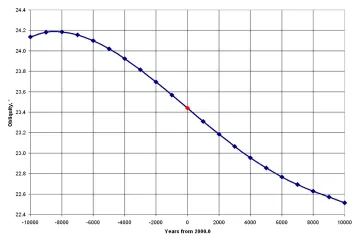
To fully appreciate the ecliptic, we must understand its relationship with another key celestial feature: the celestial equator. The celestial equator is the projection of Earth's geographic equator onto the sky, a reference plane directly tied to our planet’s rotation. [2] Because Earth spins on an axis that is tilted relative to its orbital plane, the ecliptic and the celestial equator are not aligned; they intersect at an angle of approximately . [2] This angle is famously known as the obliquity of the ecliptic, and it is the primary cause of our planet's seasons. [2]
Where the ecliptic and the celestial equator cross paths on the celestial sphere, we find the equinoxes. [2][4] These two intersection points are immensely important markers along the Sun's annual journey. The Sun crosses the equator going from south to north, marking the vernal equinox (or March equinox), which historically set the zero point ( longitude) for measuring positions along the ecliptic eastward. [2] The other crossing, when the Sun moves from north to south, marks the September equinox. [2]
The entire circle of the ecliptic is . As Earth moves in its orbit, the Sun appears to drift eastward against the background stars. [2] Since a year is slightly longer than $365$ days, the Sun advances, on average, a little less than one degree eastward every single day along this path. [2]
We can calculate this daily average motion to gain some appreciation for the subtlety of this celestial bookkeeping. With to cover in approximately $365.25$ days, the mean daily movement is degrees. [2] This number, just shy of one degree, is profoundly important. Consider that the visible disk of the Sun spans roughly half a degree () across the sky. [2] This means that each day, the Sun moves forward by an amount equivalent to about twice its own diameter against the fixed stars. [2] This small, consistent daily progression is what causes the length of our solar day—the time between one noon and the next—to be about four minutes longer than the sidereal day (the time it takes for the stars to return to the same position). [2] If the Earth did not orbit, our day would be the sidereal day, about $23$ hours and $56$ minutes long. [2]
# Seasonal Markers
The Sun’s position on the ecliptic dictates more than just the date; it defines the turning points of the year. These annual extremes occur when the Sun reaches its maximum angular distance north or south of the celestial equator. [2]
These four critical moments—the equinoxes and the solstices—correspond to precise longitudes along the ecliptic:
- March Equinox (): The Sun crosses the equator moving north. This marks the beginning of spring in the Northern Hemisphere. [2]
- June Solstice (): The Sun reaches its farthest northward point, resulting in the longest day in the Northern Hemisphere—the summer solstice. [2] At this point, the Sun is directly overhead at the Tropic of Cancer. [2]
- September Equinox (): The Sun crosses the equator moving south, marking the beginning of autumn in the Northern Hemisphere. [2]
- December Solstice (): The Sun reaches its farthest southward point, marking the shortest day in the Northern Hemisphere—the winter solstice. [2]
What's often overlooked is that the Sun’s speed along this path is not perfectly constant, even though the overall cycle takes a year. [2] Because Earth’s orbit is an ellipse, not a perfect circle, our orbital speed varies throughout the year, speeding up slightly as we approach perihelion (closest approach to the Sun) and slowing down near aphelion (farthest point). [2] This variation in orbital speed is a contributor to a phenomenon known as the equation of time, which describes the difference between apparent solar time (measured by the actual Sun) and mean solar time (based on the hypothetical uniform motion along the ecliptic). [2] For an observer tracking shadows, the Sun might appear to "hurry up" or "slow down" slightly compared to the steady tick of a modern clock, all due to this irregularity in the ecliptic path itself. [2]
# Zodiac Band

The ecliptic is inextricably linked to the concept of the Zodiac. [1][2] When ancient observers looked at the constellations the Sun appeared to pass through over the year, they cataloged them along this path. [1] The ecliptic forms the very centerline of the zodiacal band in the sky. [1]
Traditionally, the ecliptic is divided into twelve segments, known as the twelve signs of the zodiac, each corresponding roughly to the time the Sun spends passing through that region over a month. [1] While the names of the signs were historically drawn from the constellations in those regions, modern astronomical boundaries complicate this picture. [2]
While the Sun appears to pass through twelve constellations named in Western astrology (Aries, Taurus, Gemini, etc.), modern mapping, which adheres to established IAU boundaries, shows the Sun actually crosses thirteen constellations that lie along the ecliptic plane. [1] The thirteenth, often excluded from traditional astrology but recognized by astronomers, is Ophiuchus, the Serpent-Bearer, which the Sun passes between Scorpius and Sagittarius. [1] This discrepancy between the fixed astronomical reality of the ecliptic and the traditional $12$-sign system highlights a historical development where the signs (based on the equinox position at a specific ancient date) drifted out of alignment with the constellations due to the slow wobble of the Earth's axis known as precession. [1] For instance, the "First Point of Aries," which defines ecliptic longitude, is no longer in the constellation Aries due to this shift. [1]
# Practical Observation
While the ecliptic is an imaginary line, its projection across the sky is very real for observers, and the planets offer a convenient way to trace it. [4] Since the other major planets orbit in planes very close to Earth’s orbital plane, they too remain close to the ecliptic on the celestial sphere. [1][4] If you see a planet like Venus or Jupiter low on the horizon near sunset or sunrise, you are seeing it directly along the ecliptic line. [4] By noting where the planets appear relative to the constellations, one can effectively map out the zodiacal belt for themselves. [4]
For someone standing on Earth, the ecliptic’s apparent height above the horizon changes dramatically throughout the year, directly driving the character of the seasons. [2] The greater the angle between the ecliptic and the celestial equator during the summer months, the higher the Sun climbs at midday, leading to more direct, intense sunlight—the solstice. [2]
A handy way to gauge the Sun's current relationship to the celestial equator, and thus the seasonal intensity, is by observing its altitude at noon [Insight 1]. If you know your own latitude, you can estimate the Sun’s current declination—its angular distance north or south of the celestial equator—by measuring its maximum altitude at local solar noon. On the day of the June solstice (when the Sun is at its maximum northward declination, equal to the obliquity of ), the Sun will pass directly overhead (be at the zenith) for any observer standing on the Tropic of Cancer (latitude North). [2] For an observer at any latitude , the Sun's noon altitude on that day will be . Throughout the rest of the year, this relationship changes predictably based on the Sun's changing ecliptic longitude, moving toward the equator at the equinoxes when the noon altitude drops to (the altitude it would reach if the equator were always directly overhead). This simple geometric connection between latitude, time of year, and the noon Sun reveals the immediate, observable consequence of the ecliptic’s tilt.
# Stability and Change
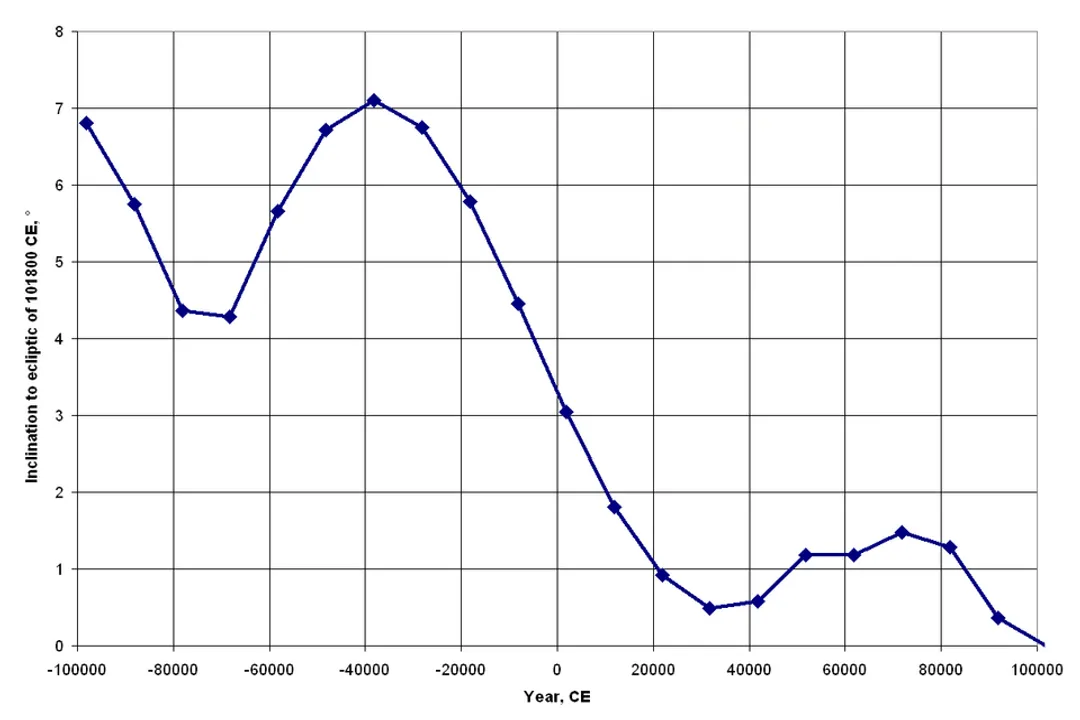
While the ecliptic serves as a reliable reference plane, it is not entirely static over vast stretches of time. The gravitational influence of the other planets causes minor shifts in Earth's orbit, leading to a slow change in the ecliptic’s orientation, known as planetary precession. [2] This contributes to a very gradual shift in the position of the equinoxes against the background stars over millennia. [2]
However, the ecliptic is generally considered a stable reference compared to the celestial equator, which appears to rotate around the poles of the ecliptic over a period of about $26,000$ years due to lunisolar precession (caused mainly by the gravitational effects of the Sun and Moon). [2] The actual movement of the ecliptic plane due to planetary perturbations is much smaller, about one-tenth the rate of the celestial equator's shifting position. [2]
For modern, high-precision work, astronomers must account for these tiny wobbles, including nutation (short-term periodic oscillations) when defining the true equinox for any given date, as opposed to the mean equinox which smooths out these perturbations. [2]
For the casual observer interested in the Sun's path, the fact that the ecliptic represents the projection of the Earth’s orbit provides an excellent mental anchor [Insight 2]. Since the Earth’s orbit is nearly flat (inclined only about from the Solar System's invariable plane, which is defined by the total angular momentum of all solar system bodies), the ecliptic is an excellent, convenient approximation for the overall flat geometry of the system. [2] To trace this path in the sky throughout the year, look for the point where the Sun is highest in the sky at noon—that point is defined by the solstice position on the ecliptic for that date. If you look due south (in the Northern Hemisphere) at noon on any day, the angle between the Sun and the horizon is directly related to how far the Sun has traveled from the celestial equator along the ecliptic. If the Sun is setting due west (around the equinoxes), you know its ecliptic longitude is near or , meaning it is crossing the celestial equator, and the Sun’s path for the observer is exactly bisected by the horizon.
Related Questions
#Citations
Ecliptic - Wikipedia
The ecliptic is the path of the sun - EarthSky
Glossary term: Ecliptic - IAU Office of Astronomy for Education
Ecliptic - Oxford Reference
Ecliptic - Space Wiki | Fandom