How do astronomers know the Sun rotates?
It might seem like a silly question, given that the Sun is a gigantic ball of plasma, but figuring out that it spins at all—and how it spins—was a genuine scientific puzzle that required careful observation over time. Unlike Earth, which has solid continents and oceans that make its rotation obvious, the Sun doesn't have fixed landmarks. Astronomers couldn't simply watch a mountain on the Sun's surface reappear in the same spot 24 hours later. Instead, the process relies on tracking temporary, yet reliably visible, features that dot its surface: sunspots. [6][9]
# Tracking Spots
The most straightforward method to determine the Sun's rotation involves observing these dark, cooler regions on the photosphere. [1][9] If an astronomer spots a distinct sunspot, they simply note its position relative to the Sun's edge. Then, they wait. Over the course of several days, that spot appears to drift across the visible disk of the Sun, disappearing behind the limb (edge) on the far side. When it eventually reappears days later, that reappearance confirms rotation. [5][6] If the Sun were a solid, fixed object, the spot would remain stationary relative to the background stars.
Early observers, such as Galileo Galilei in the early 17th century, were key in documenting this motion by systematically tracking sunspots. [1][9] This visual tracking provided the initial, undeniable proof that the Sun was not static in its rotation as seen from Earth, but that it was indeed turning on its axis. [5][9] This method essentially turns the sunspot into a temporary 'marker' on the Sun's surface that allows us to time its period of revolution. [3]
# Varying Speeds
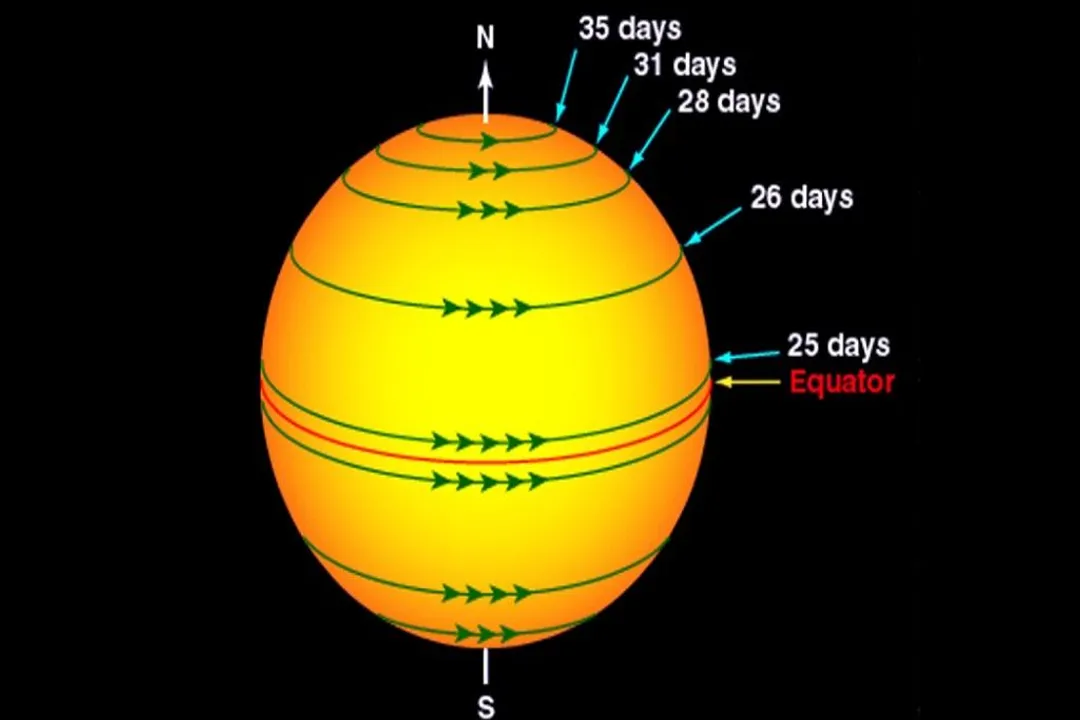
A fascinating discovery made through this tracking process is that the Sun does not rotate as a single, rigid body, like a compact marble. It exhibits differential rotation. [1][2] This means different parts of the Sun rotate at different rates depending on their latitude. [2]
For instance, the Sun's equator rotates significantly faster than its polar regions. [1][2] When measuring the time it takes for a feature near the equator to complete one rotation, astronomers calculate a period of roughly 25 days (the synodic period, which accounts for Earth's orbit). [1][9] However, if you track a feature closer to the Sun's poles—say, at a latitude of about 60 degrees—the rotation period stretches out to approximately 35 days. [1][2] This variation is due to the Sun being composed of plasma, which is fluid and does not possess the cohesive structure of a solid object like Earth. [2][3] This difference in rotational speed across latitudes is a fundamental characteristic of stars dominated by fluid dynamics. [1]
If you were tracking a sunspot for an entire rotation from an Earth-bound perspective, you would notice that the time for a spot near the equator to return to its starting longitude is shorter than for one near the poles. [9] This phenomenon is a direct consequence of the physics governing differentially rotating, differentially moving fluid bodies. [1]
# Rotational Periods
To be precise about the time it takes for the Sun to complete a full 360-degree spin, astronomers must distinguish between two types of measurement: the synodic period and the sidereal period. [1][9]
The synodic period is what observers on Earth actually measure. It's the time it takes for a feature to return to the same position as viewed from Earth. [1] Because the Earth is simultaneously orbiting the Sun in the same direction, the Sun appears to have rotated an extra bit before the spot is back in our line of sight. This measured period near the equator is about 27 days. [1][5][9]
The sidereal period is the true rotation period relative to the distant background stars. [1] For the Sun's equator, this true period is about 24.47 days. [1] The difference between the two values (e.g., 27 days vs. 24.5 days observed from Earth) highlights the need for careful calculation when studying solar mechanics. [1] Imagine trying to time a merry-go-round while you yourself are walking around its base; the time it takes for an object to return to the same spot relative to you will be longer than its true rotation time relative to a distant lamppost. [3]
# Calculating the Motion
While tracking sunspots is the classic and most intuitive way to see the rotation, modern astrophysics uses more advanced techniques, especially when dealing with areas where sunspots are absent or infrequent. One significant technique involves the Doppler shift. [1]
When light from a point on the Sun's eastern limb (the edge appearing to rotate toward us) is analyzed, its wavelength is slightly shifted toward the blue end of the spectrum. Conversely, light from the western limb (the edge rotating away from us) is shifted toward the red end. [1] By measuring this subtle frequency difference across the Sun's face, scientists can calculate the rotational velocity at various latitudes, even without relying on visible features like spots. [1] This Doppler measurement confirms the differential rotation observed via sunspots, providing a physically independent verification of the rotation rates. [1]
Here is a quick reference summarizing the general rotational periods observed:
| Latitude Zone | Approximate Synodic Period (Observed from Earth) | Approximate Sidereal Period (Relative to Stars) |
|---|---|---|
| Equator (0°) | ~27 days | ~24.5 days [1] |
| Mid-Latitudes (e.g., 30°) | ~28-30 days | Not explicitly stated, but longer than equator [1] |
| High Latitudes (~60°) | ~35 days | Longer than mid-latitudes [1][2] |
If you were to observe the Sun from a spacecraft positioned far outside Earth's orbital plane, you would see the Sun rotating, but the appearance of speed relative to your clock would be more consistent across the solar system because you wouldn't have the confounding factor of your own planet's orbital motion complicating the timing of features reappearing. [1]
# Interpreting Data
Understanding solar rotation isn't just an academic exercise in counting days; it's central to understanding solar activity, like magnetic fields and flares. Sunspots themselves are manifestations of intense magnetic fields emerging from the Sun's interior. [1] The way the Sun winds up its magnetic field—which is governed by this differential rotation—is what drives the solar cycle, the roughly 11-year period of changing activity. [1]
For an amateur astronomer observing through a small telescope with a proper solar filter, keeping a detailed log of sunspot passage is an excellent exercise in contributing to basic scientific understanding. A practical tip, rooted in experience, is to start tracking a spot immediately after it crosses the limb. Since the rotation is fastest at the equator, a spot near the center is moving across your field of view at its slowest apparent speed (tangential to your line of sight), making it easiest to measure its initial drift against the background 'fixed' solar granulation patterns before it moves too far toward the side limb, where the foreshortening makes judging its true path difficult.
Another key insight comes from considering the why behind the difference in rotation. The Sun's interior rotation might be different from its surface. While we track the surface well, models suggest the deep interior, particularly the tachocline layer near the radiative zone boundary, is where the differential rotation begins to transition into more solid-body behavior, acting as the engine that shears and twists the magnetic field lines. [1] While surface tracking gives us the visible result, the complexity beneath drives the entire solar engine.
# Observation Challenges
Even with clear skies and a good filter, observing the Sun presents unique difficulties that must be accounted for when measuring rotation. Earth's atmosphere causes constant seeing variations—tiny distortions that make the Sun's surface appear to shimmer and blur. [4] This makes precise tracking of any single feature across the center of the disk somewhat challenging, as the feature's apparent edges are never perfectly sharp. When we rely on visual observation, we are essentially drawing an average path, rather than measuring an exact coordinate at any given second. [4]
This is why dedicated space assets, like the Solar Dynamics Observatory (SDO), offer a crucial advantage: they observe from above the distorting atmosphere. [4] Space-based imaging allows for near-perfect resolution and constant monitoring, enabling extremely precise measurements of feature drift and Doppler shifts over long periods, vastly improving the accuracy over historical visual charting. [2] The consistency of space-based data is what allows astronomers to define the subtle differences between the rotational speeds at 10 degrees latitude versus 15 degrees latitude, details impossible to resolve through Earth-based visual tracking alone. [2] The knowledge that the Sun rotates is thus built on centuries of visual confirmation, but its precise details are refined by modern orbital technology.
Related Questions
#Citations
Solar rotation - Wikipedia
Solar Rotation Varies by Latitude - NASA
ELI5: How do we know when we complete a loop around the sun ...
Sun rotation explained with sunspots - Facebook
Sun Rotates in 27 Days: How Do They Know?
Does the sun rotate? Science of solar rotation - Space
How do astronomers know that planets orbit around the Sun? - Quora
Does the Sun rotate? - Astronomy Stack Exchange
Sun's Rotational Period